
The first thing Kyoto teaches you is that it rewards the early riser. Not in a generic motivational-poster way — in a very literal way. The Fushimi Inari gates at 5:30am are one of the most extraordinary things I’ve experienced in Japan. The same path at 11am on a Saturday in cherry blossom season looks like the entrance to a theme park. The city hasn’t changed; the crowd has.
Kyoto has been Japan’s cultural capital for more than a thousand years. It contains approximately 1,600 Buddhist temples, 400 Shinto shrines, and 17 UNESCO World Heritage sites — all within a mid-sized city that also has excellent ramen and a working geisha district. Managing all of that as a visitor is essentially a scheduling problem, and this guide is an attempt to solve it.
What’s in This Guide
- Why Kyoto in 2026
- The neighbourhoods that matter
- What to eat and drink
- Getting to Kyoto
- Where to stay
- Realistic budget breakdown
- Things nobody tells you
- More destination guides
- FAQ
Why Kyoto in 2026
Japan’s post-pandemic tourism rebound has been substantial. Kyoto specifically has had to grapple with overtourism in a way that few cities of its size have — the combination of an internationally famous bucket list and a compact geography means that certain sites (Arashiyama bamboo grove, Fushimi Inari, the geisha lanes of Gion) become genuinely dysfunctional during peak hours in peak season.
The city has responded: ticketing has been introduced at some sites, photography restrictions in Gion have become stricter (and are enforced), and there’s more genuine infrastructure for visitor management than existed five years ago. What this means practically is that Kyoto is still completely visitable — you just need to use the tools the city now provides, which mostly amount to going earlier and choosing less-obvious alternatives.
There is also no substitute for it. Nowhere else in Japan — nowhere else in Asia — has the same density of living cultural heritage. The temples are not museum pieces. They are active religious sites, most of them over a thousand years old, that have been maintained continuously and are still used for the purposes they were built for. That is rare in the world and Kyoto has it in extraordinary concentration.
The Neighbourhoods That Matter
Gion
The historic geisha district is Kyoto’s most photographed neighbourhood and also one of its most functional — the machiya (wooden townhouses) converted into restaurants, bars, and ochaya (geisha teahouses) line streets that are still navigated by maiko (apprentice geisha) on their way to evening engagements. Hanamikoji Street is the visual centrepiece: stone-paved, lantern-lit, lined with ochaya from one end to the other.
The best time to visit Gion is the late afternoon, between 4–7pm, when the maiko begin making their way between engagements. You may see one or several. The correct behaviour is to observe quietly from a respectful distance and not to pursue, block, or photograph without consent — a rule now posted on signs throughout the neighbourhood after years of harassment incidents. Pontocho Alley, one block west, runs parallel to the Kamo River and has some of the city’s best small-bar and kaiseki dining tucked into a narrow lane.
Higashiyama
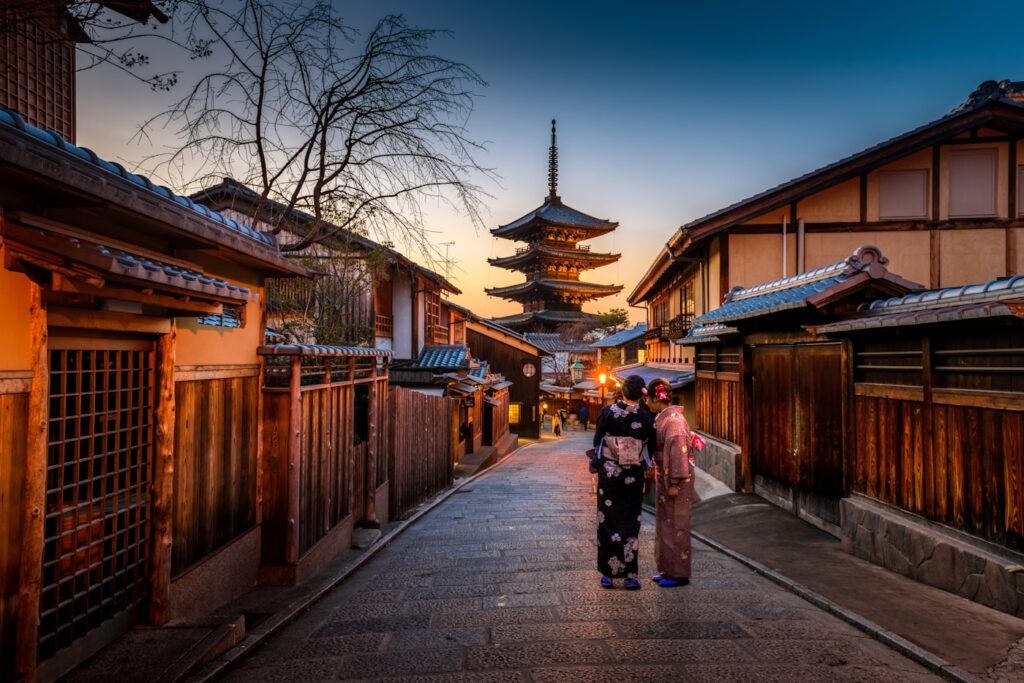
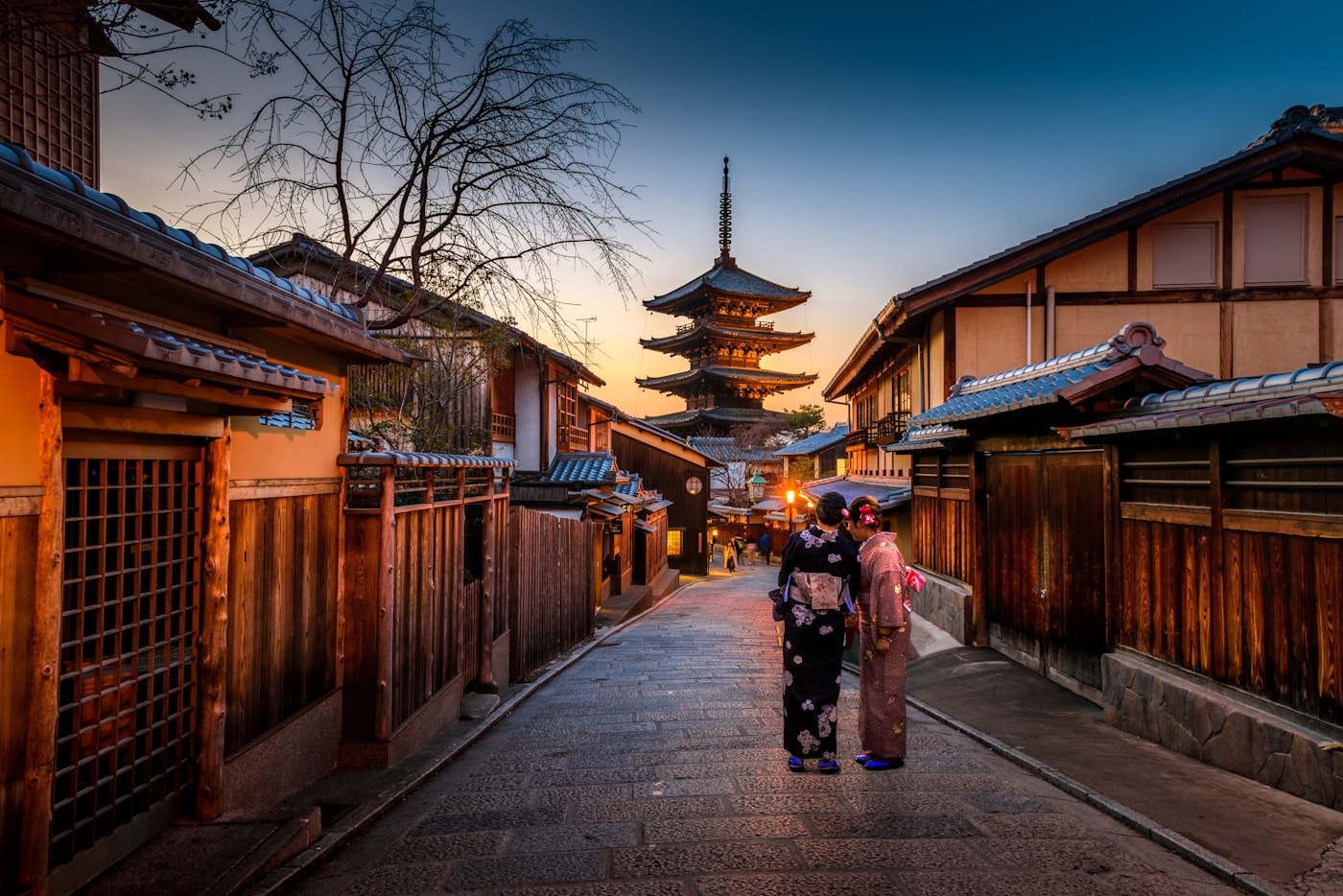
The hillside district east of the Kamo River contains some of Kyoto’s most atmospheric walking. The stone-paved lanes of Ninenzaka and Sannenzaka (literally “Two-Year Slope” and “Three-Year Slope” — falling on the former is considered two years bad luck, falling on the latter three) climb through preserved machiya to Kiyomizudera, the 8th-century temple built into the cliff face with its wooden stage projecting 13 metres over the hillside. The view from the stage over the forested hillside and the city beyond is one of the canonical images of Japan.
Walk Ninenzaka in the early morning before the shops open. The stone lanes with wooden buildings and the soft light through the cedar trees are extraordinary quiet. By 10am, it’s full.
Arashiyama
The bamboo grove at Arashiyama is justifiably one of Japan’s most famous sights — a dense stand of giant bamboo through which a narrow path runs, the light filtering green through the canopy, the sound of the wind moving through the stalks. It’s also genuinely thirty seconds long. The path is short. The surrounding area — Tenryuji temple (a UNESCO garden), the Togetsukyo bridge, the monkey park above the hill — is what makes the half-day trip worthwhile.
Arrive before 8am. After that, the bamboo path is so dense with visitors that you can’t hear the bamboo over the selfie sticks. Before 8am, it’s almost empty and close to the experience it was always supposed to be.
Fushimi
South of the city centre, the Fushimi Inari shrine complex is the one that the 10,000 orange torii gates belong to. The gates line a 4km trail up the forested mountain — sponsored by businesses and families over centuries, each bearing the donor’s name and the date. Walking the full trail (about 2–3 hours up and back) takes you away from the crowds entirely within about 30 minutes; the lower section near the main shrine is mobbed, the upper mountain is nearly empty. Fushimi also has the sake brewery district nearby — the water from Fushimi’s springs has been used to brew sake for 600 years and several breweries offer tastings.
What to Eat and Drink
Kyoto cuisine is among the most refined in Japan — and Japan already sets an extraordinary standard. A few things that are specifically worth going out of your way for:
- Kaiseki — the multi-course tasting menu of Japan, built around seasonal ingredients, impeccable presentation, and an unhurried pace. A proper kaiseki dinner at a traditional restaurant is one of the best meals you can eat anywhere in the world, and it requires booking weeks ahead during peak seasons. Budget 8,000–20,000 yen ($55–140) per person at a mid-range house; the upper end is higher. Nakamura (est. 1716) on Nishiki is one of the oldest. For a more accessible introduction, lunch kaiseki bento sets at many restaurants run 3,000–5,000 yen and require no advance booking.
- Tofu cuisine (Yudofu) — soft tofu simmered in a light dashi broth, eaten with a dipping sauce of soy, ginger, and spring onion. It sounds modest. The version made with Kyoto’s silken tofu — the water quality here produces something with a different texture entirely — is not modest at all. The temple districts of Nanzenji and Arashiyama are lined with tofu restaurants; Okutan Nanzenji has been serving it since 1635.
- Nishiki Market — the “Kitchen of Kyoto,” a covered market running five blocks through the city centre. 400 stalls, 400+ years of operation. The walk-and-eat options along the market include grilled skewers, freshly made tofu doughnuts, pickled vegetables of extraordinary variety, octopus balls, and sea urchin on a stick. Budget 1,000–2,000 yen for a proper walk-through lunch.
- Matcha — Uji, just south of Kyoto, is Japan’s most famous matcha-growing region and the quality of what’s available here far exceeds anything exported. Matcha soft serve, matcha parfait, matcha cake, ceremonial-grade whisked matcha. Tsujiri on Shijo has the best matcha soft serve queue in the city. A proper tea ceremony experience (around 2,000–3,000 yen, available at dozens of locations) is worth doing once.
- Sake in Fushimi — the breweries clustered in the Fushimi district offer tastings of their current bottles. Gekkeikan Okura Sake Museum has the most accessible tasting experience. A flight of four to five sakes runs about 400–600 yen. The difference between drinking sake in Fushimi and drinking sake elsewhere is the freshness — it’s brewed here, bottled here, and you’re tasting it at its source.
Getting to Kyoto
- Shinkansen from Tokyo: The Nozomi bullet train from Tokyo Station to Kyoto takes 2 hours 15 minutes and costs 13,320 yen (~$90) one way. The JR Pass (7-day ~50,000 yen, 14-day ~80,000 yen) covers all shinkansen journeys and is worth buying if you’re also visiting Osaka, Hiroshima, or Nara.
- From Kansai International Airport (KIX): The Haruka Limited Express train runs direct from KIX to Kyoto Station in 75 minutes, about 3,260 yen. Major international airlines fly into KIX from London, Paris, Dubai, Singapore, Seoul, Hong Kong, and most major Asian hubs.
- From Osaka: 15 minutes on the JR Shinkansen, or about 30 minutes on the Hankyu train line (much cheaper, no JR Pass required).
Within Kyoto: the bus network is extensive but confusing. The subway covers the north–south axis efficiently. A bicycle is the single best transport option for the central city — flat geography, good cycling infrastructure, rental shops everywhere for about 1,200 yen/day. An IC card (Suica or Icoca — load cash at any station) works on every bus, subway, train, and convenience store in the city.
Where to Stay
Central location matters more in Kyoto than in most cities — it’s a walking and cycling city and proximity to the main districts saves significant time. The Higashiyama and Gion areas put you closest to the most atmospheric streets.
- Budget (3,000–6,000 yen / $20–42): Hostel dorms and budget guesthouses throughout the centre. Piece Hostel Kyoto near Kawaramachi is a consistently good option with private rooms available.
- Mid-range (8,000–18,000 yen / $55–125): Business hotels and boutique guesthouses. The Daiwa Roynet Hotel Kyoto-Ekimae near the station is well-located and reliable. For more character, small machiya-style guesthouses in Higashiyama require advance booking but the setting is exceptional.
- Ryokan (12,000–40,000 yen+ / $85–280+): A traditional inn — tatami mats, futon bedding, yukata robes, kaiseki dinner, communal or private onsen. The ryokan experience is worth budgeting for at least one night. Tawaraya (est. 1709) is one of the world’s finest hotels; for a more accessible introduction, dozens of well-regarded mid-range ryokan exist in Higashiyama and Arashiyama.
Realistic Budget Breakdown
- Accommodation: 5,000–20,000 yen/night ($35–140)
- Nishiki market lunch (walk-and-eat): 1,000–2,000 yen
- Ramen dinner: 900–1,500 yen
- Kaiseki lunch set: 3,000–6,000 yen
- Temple entry (most sites): 500–1,000 yen each
- IC card transport (daily): 400–800 yen
- Total per day, mid-range: 15,000–25,000 yen ($100–175). Japan is more expensive than Southeast Asia but the quality ceiling is higher than almost anywhere else.
Things Nobody Tells You
- The best sites are best before 8am. This applies specifically to Fushimi Inari, Arashiyama bamboo grove, and Ninenzaka/Sannenzaka in Higashiyama. All three are extraordinary in the early morning and genuinely unpleasant at peak hours. Set an alarm and eat breakfast after.
- Cherry blossom and autumn leaf seasons require booking 6 months ahead. Late March to early April (cherry blossoms) and mid-November (maples turning red) are Kyoto’s most beautiful weeks and also its most crowded. Accommodation books out faster than anywhere else in Japan during these windows. If you’re aiming for either, confirm your accommodation before you buy flights.
- The Philosopher’s Path is underrated at the right hour. The 2km canal-side walking path from Ginkakuji (Silver Pavilion) to Nanzenji is a classic but genuinely beautiful walk — particularly in cherry blossom season and particularly in the early morning. The temples along the route (Nanzenji’s enormous san-mon gate, the aqueduct that runs through it) are quieter than the main tourist circuit and architecturally exceptional.
- Nara is 45 minutes away and completely worth a day. The ancient former capital has free-roaming deer (over 1,000 of them, considered sacred) and Todaiji — a wooden structure that is the largest wooden building in the world and contains a 15-metre bronze Buddha. The sheer scale of it, in person, resets your sense of what human construction can be. First train from Kyoto to Nara is about 45 minutes.
- Convenience stores are not a fallback — they’re part of the culture. 7-Eleven, Lawson, and FamilyMart in Japan are unlike convenience stores anywhere else in the world. Fresh onigiri (rice balls) made daily, excellent hot food, good coffee, ATMs that accept international cards (important — many Japanese ATMs don’t). A 7-Eleven onigiri and a can of cold matcha latte from a Lawson vending machine is a legitimate breakfast option and a fine one.
Get our next underrated destination in your inbox
One offbeat travel guide every Friday. Hidden cities, quieter coastlines, shoulder-season logistics. Free.
Experiences & Activities
Book Tours & Activities in Kyoto
Skip the planning stress. Browse hundreds of guided tours, skip-the-line tickets, day trips, and local experiences in Kyoto — all bookable online with free cancellation on most options.
Browse Kyoto Experiences →Frequently Asked Questions
How many days do you need in Kyoto?
Four days is the minimum to cover the main districts properly — Gion, Higashiyama, Arashiyama, and Fushimi Inari — while leaving enough time to eat well and not rush. Five to six days lets you add Nara as a day trip, spend a night in a ryokan, do the Philosopher’s Path at a human pace, and explore the northern Kinugasa neighbourhood (Kinkakuji, Ryoanji’s rock garden). Most first-time visitors to Kyoto wish they had more time.
What is the best time of year to visit Kyoto?
Cherry blossom season (late March to early April) and autumn colours (mid to late November) are the most beautiful times — and the most crowded and expensive. If you want the beauty without the extreme crowds, early April (after peak blossom) or late November (after peak colour) offer a compromise. October is warm, clear, and increasingly popular. January and February are cold (2–8°C) and very quiet — the temples in light snow are extraordinary and accommodation drops by 30–40%.
Is Kyoto or Tokyo better for a first visit to Japan?
They’re fundamentally different cities that serve different needs. Tokyo is one of the great modern megalopolises — food, culture, nightlife, scale. Kyoto is the preserved historical Japan — temples, gardens, geisha, crafts. Most visitors to Japan want both, which is easy: they’re 2h15m apart on the shinkansen. If you can only go to one, choose based on what you’re there for: urban energy and contemporary culture (Tokyo) or historical depth and natural beauty (Kyoto).
Do I need to book temples and sites in advance?
Most temples and shrines in Kyoto do not require advance booking — you pay entry on arrival. Exceptions exist: Ryoanji and Kinkakuji are timed-entry in peak season; a small number of private gardens and tea houses require advance reservations. For restaurants, kaiseki dining in peak seasons (cherry blossom, November) should be booked 4–8 weeks ahead. Ryokan accommodation in cherry blossom season often requires booking 3–6 months in advance.
Is the JR Pass worth it for a Kyoto trip?
The 7-day JR Pass (approximately 50,000 yen) makes financial sense if you’re travelling Tokyo–Kyoto–Osaka and making at least two shinkansen journeys. The Tokyo–Kyoto shinkansen alone costs 13,320 yen each way; two round trips cover the cost of a 7-day pass. If you’re only visiting Kyoto and the Kansai region (Osaka, Nara, Hiroshima), a regional Kansai pass may be more economical. Calculate your specific itinerary before buying.