
Marrakech has a reputation for being difficult. The touts follow you, the souks are deliberately confusing, and every third person who approaches you wants to show you a shortcut to somewhere you didn’t ask to go. None of this is a myth. All of it is also manageable. And once you get past it, you find yourself in one of the most genuinely extraordinary cities on earth — a place where the medieval and the modern don’t just coexist but actively argue with each other in real time.
The medina of Marrakech is a UNESCO World Heritage Site. It has been continuously inhabited for roughly a thousand years. The same streets that today carry motorcycle deliveries and tourist groups carried camel caravans and spice traders in the twelfth century. That continuity is real — not performed, not recreated for visitors. The city was doing this before tourism arrived and will be doing it long after. Your job as a traveller is to observe rather than extract, and to spend your money in places where it stays in the neighbourhood.
This guide is what I wish I’d had on my first visit. Which was, to be clear, a partial disaster. On my second visit I got it right.
What’s in This Guide
- Why Marrakech in 2026
- The medina and how to move through it
- Djemaa el-Fna and what actually happens there
- What to eat and drink
- Day trips worth doing
- Getting to Marrakech
- Where to stay
- Realistic budget breakdown
- Things nobody tells you
- FAQ
Why Marrakech in 2026
Morocco has been one of the fastest-growing travel destinations in North Africa for the past several years, and Marrakech remains the engine of that growth. American Express’s 2026 trending destinations list names Marrakech as one of the year’s top picks specifically because of its historic medina, palace culture, and the maze-like souk system that draws travellers who want immersion rather than a beach chair.
The practical case is also strong. Flights have expanded considerably from European hubs and now connect from several North American cities via Casablanca. A new tramway line opened in late 2024, making the journey from the airport to the medina edge considerably more reliable. The riad scene — boutique guesthouses built inside traditional courtyard houses — has matured to the point where you can find genuinely excellent accommodation at a wide range of budgets without booking a year in advance.
And there is a post-earthquake recovery element. The September 2023 earthquake, centred in the Atlas Mountains, caused significant damage to some villages and historic structures outside the city. Marrakech’s medina was less affected than many feared, though some restoration work continues. Visiting in 2026 directly supports the local economy during what remains an important recovery period.
The Medina: How to Move Through It
The medina is a walled city of roughly 70,000 people. It was not designed to be navigated by tourists. The streets have no logic that’s apparent from above, there are relatively few street signs, and the ones that exist are not always pointing where you think. This is not an accident — it’s the architecture of a defensive city designed to slow down invaders and keep commercial areas legible only to those who already knew them.
Accept that you will get lost. Plan for it. Build extra time into every morning. And then stop fighting it. Some of the best moments in Marrakech happen in dead ends and unmarked passages — a woman weaving textiles in a doorway, a tiny bakery with a clay oven, a fountain tiled in the twelfth century that people still stop at to splash water on their faces.
The Souks
The souk area north of Djemaa el-Fna is organised by trade, more or less. The Souk Semmarine is the main commercial artery — leather goods, ceramics, textiles, carpets. Break off left into Souk el-Attarin for spices and perfumes. Souk Haddadine for metalwork. Souk Chouari for woodcarving. These aren’t theme-park recreations. They are working markets where Moroccan traders do serious business, and tourist commerce runs alongside and sometimes through that.
The carpets, specifically, deserve a note. The carpet shops in the main souk are often run on a commission system — the person who led you there gets a cut, the price you see is not the price, and the ritual of mint tea is an extended sales technique. You can decline the tea, decline the pitch, and move on without being rude. You can also enjoy the tea, watch the carpets, and walk out. What you probably shouldn’t do is buy a carpet on your first day.
The Mellah (Jewish Quarter)
The Mellah sits in the southeast part of the medina, originally established as the Jewish quarter in the sixteenth century. It has a different texture from the main souk area — quieter, the architecture slightly different (the balconied houses are a giveaway), the pace slower. The covered Mellah market runs parallel to a long arched passage and sells food, fabric, and general goods to a largely local clientele. The Saadian Tombs, rediscovered in 1917 after being sealed for over two centuries, are a short walk away.
Gueliz (the New City)
Built by the French as the colonial administrative centre, Gueliz is Marrakech’s modern neighbourhood. Boulevard Mohammed V runs through it, lined with cafés, patisseries, boutiques, and restaurants catering to locals, expats, and in-the-know visitors. If you need a break from the medina’s intensity, Gueliz is where you go. The café culture here is excellent — third-wave coffee arrived several years ago and is now thoroughly embedded.
Djemaa el-Fna: What Actually Happens There
The square changes completely across the day. In the morning it’s relatively quiet — juice stalls, a few snake charmers setting up, some water sellers in their ceremonial red outfits. By mid-afternoon the entertainers have arrived: acrobats, musicians, storytellers who’ve been performing in the same place for generations, Gnawa musicians in blue robes with metal castanets. By evening it’s a full outdoor restaurant, a hundred food stalls offering harira, merguez, snails, sheep’s head for the adventurous, and fresh-squeezed orange juice for everyone. The smoke from the grills hangs over the square in a way that’s simultaneously atmospheric and intense.
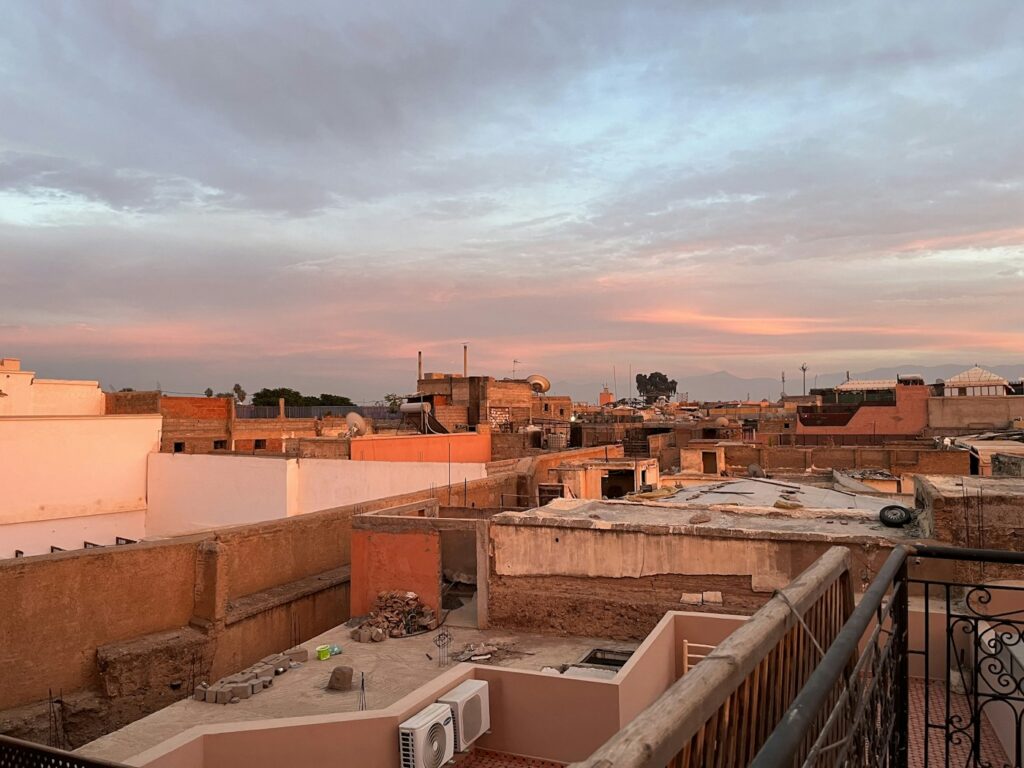
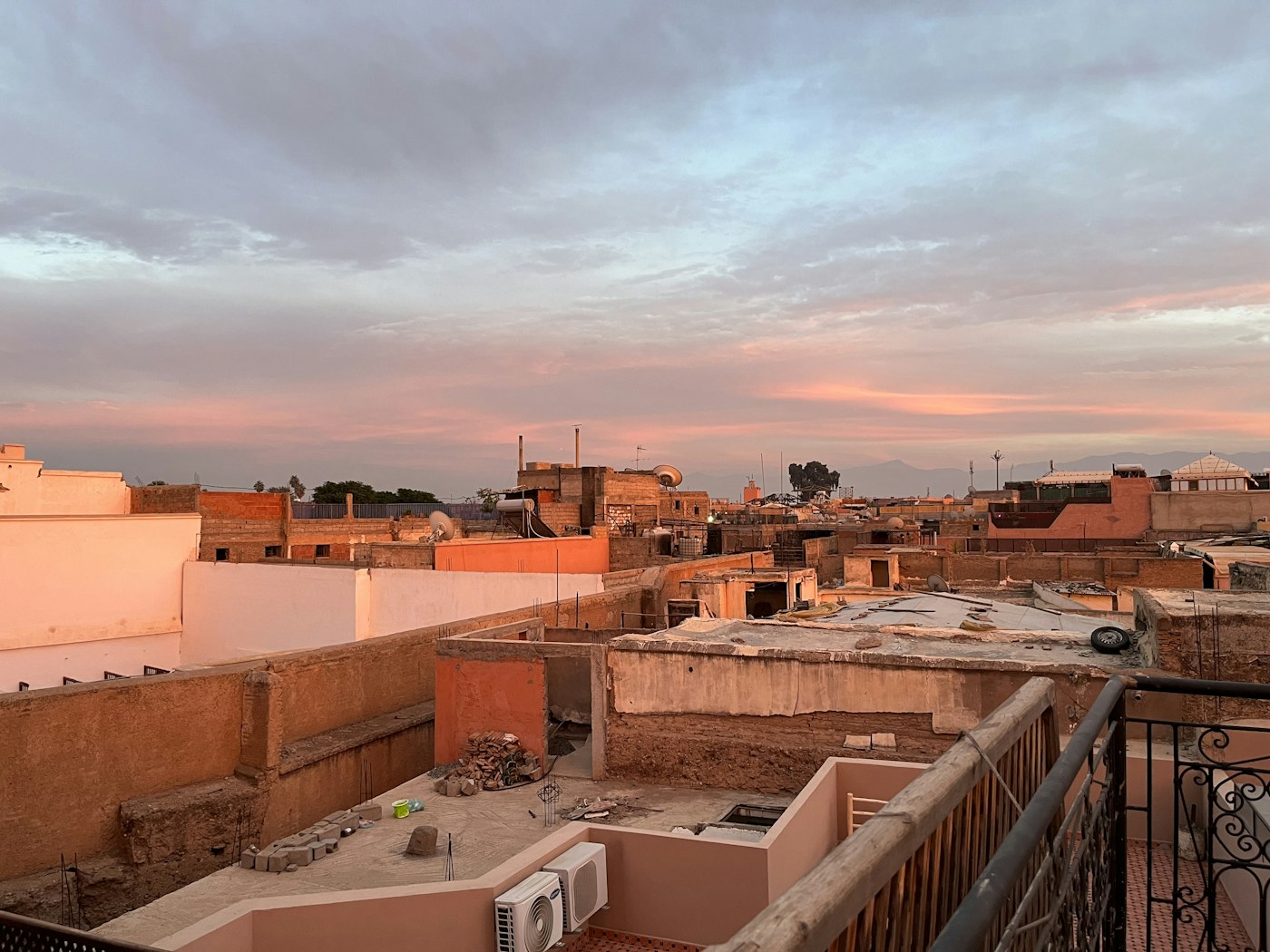
Vendors will ask for money if you photograph them. This is fair. If you point a camera at a snake charmer or a monkey handler (the latter an ethically questionable operation regardless of tips), pay what they ask. If you want to take a photo and not be asked for money, photograph the skyline from a rooftop terrace — several restaurants around the square offer elevated views in exchange for the price of a drink.
What to Eat and Drink
Moroccan food is slow food. Tagines cook for hours. Bastilla — the layered pastry pie of pigeon or chicken with almonds and spiced egg — takes most of a morning to prepare. Couscous is traditionally served on Fridays and takes the entire morning to steam properly. This is not a cuisine that can be rushed, and the best versions of all of it are found in small, non-tourist restaurants where the ingredients are local and the recipes are old.
For tagine, look for places in the medina’s residential areas rather than on the main tourist routes. The further you walk from Djemaa el-Fna, the better the prices and the more interesting the clientele. Order lamb with prunes and almonds (tagine mrouzia), or chicken with preserved lemon and olives — these are the benchmark dishes and every serious cook has a version of them.
Harira is the city’s soup — tomato and lentil based, thick and spiced, eaten with a date and a piece of chebakia (a honey-glazed sesame cookie). At 5–10 dirhams a bowl from a stall, it’s the best cheap meal in Marrakech. The juice stands on the square sell fresh-squeezed orange juice for 4 dirhams — this is the fixed price, negotiation is not expected.
Alcohol is available in Marrakech at licensed restaurants and some hotels, though not in the medina proper. Wine production in Morocco is actually quite good — the Meknes region produces bottles that hold up in comparison to mid-range southern French wine. Les Deux Tours, La Maison Arabe, and a handful of Gueliz restaurants have solid lists.
Day Trips Worth Doing
The Atlas Mountains
The High Atlas mountains are visible from Marrakech on a clear day, approximately 50km south. Imlil village is the standard base for trekking and the starting point for ascents of Jbel Toubkal (4,167m, the highest peak in North Africa). You don’t need to summit Toubkal — the valleys below it are spectacular enough, and day hikes through Berber villages are possible even without a guide. The drive through the Ourika Valley is itself worth doing.
Essaouira
The walled coastal city of Essaouira is a 2.5 hour drive west, on the Atlantic. The medina here is smaller and considerably less intense than Marrakech’s, the wind is constant (it’s a windsurfing destination), and the seafood is exceptional. The Gnawa music tradition is strong here — it originated partly in this city and the annual Gnawa Festival turns it into a major cultural event (usually June). Day trip or overnight; if you’ve been in Marrakech for four or more days, an Essaouira overnight is a very good reset.
Getting to Marrakech
Marrakech Menara Airport (RAK) connects directly to most major European cities, with Ryanair, easyJet, Air Arabia, and Royal Air Maroc all flying routes. From the US, the most common routing is through Casablanca’s Mohammed V Airport (CMN) — Royal Air Maroc flies direct from New York JFK and a handful of other North American cities. Casablanca to Marrakech is a 3-hour drive or a 4-hour train.
From the airport into the city, the new tram (Line 1) connects to the medina edge. Taxis are plentiful but negotiate the fare before you get in — the metered rate exists but is not universally applied. From the airport to the medina should cost 70–100 MAD fixed price; push back on anything significantly over that.
Where to Stay
Riads are the obvious choice and the right one. A riad is a traditional courtyard house — the rooms face inward onto a central courtyard rather than outward onto the street. The street-facing exterior is deliberately plain; step inside and you get tiled floors, carved plasterwork, a fountain, and sometimes a rooftop terrace. The combination of those details at the right price point is one of Marrakech’s genuine pleasures.
Budget riads in the medina start around 350–500 MAD per night (roughly $35–50 USD). Mid-range, expect 700–1,200 MAD. At the upper end, converted riads like Riad El Fenn or La Sultana offer hotel-level service in genuinely extraordinary spaces at 2,500–5,000 MAD per night. Book through the riad directly if possible — the commission structure for booking platforms reduces what goes to the owner.
If you want space, air conditioning that actually works, and a pool without the medina noise, the Palmeraie district (north of the medina) has a cluster of larger resort properties. The trade-off is that you’re 15–20 minutes from everything worth seeing.
Realistic Budget Breakdown
- Budget traveller (hostel dorm or basic riad, street food, walking): 500–700 MAD/day ($50–70 USD)
- Mid-range (private riad room, restaurant meals, occasional taxi): 1,200–1,800 MAD/day ($120–180 USD)
- Comfortable (boutique riad, good restaurants, guides, day trips): 2,500–4,000 MAD/day ($250–400 USD)
- Djemaa el-Fna orange juice: 4 MAD — non-negotiable
- Hammam (traditional bathhouse, local neighbourhood): 15–30 MAD
- Hammam (tourist-facing, with scrub service): 200–400 MAD
- Saadian Tombs entry: 70 MAD
- Bahia Palace entry: 70 MAD
Things Nobody Tells You
- The “false guide” is mostly extinct now. The notorious system of unofficial guides who would follow tourists and lead them to commission shops has been significantly curtailed. Persistent strangers offering to show you the way still exist, but the aggressive version that defined the 1990s and 2000s is much reduced.
- Dress modestly, especially in the medina. This is not a legal requirement for non-Muslims, but it is a mark of respect and will materially reduce the attention you attract. Covered shoulders and knees are the practical standard for both men and women.
- The city runs on Moroccan time. Lunch is at 1–2pm, dinner starts at 8pm at the earliest and often later. Restaurants that are empty at 7pm are often full by 9pm. Don’t arrive early and conclude the place is empty.
- Haggling has a floor. The starting price in souks is always inflated, but so is the tourist perception of how much you can reduce it. A realistic discount on initial pricing is 30–50%; getting something for 10% of the asking price just means you probably didn’t need to buy it in the first place.
- Friday is the day of rest. Many shops in the medina close for part or all of Friday afternoon. Plan accordingly.
- The Jardin Majorelle is crowded for a reason. It genuinely is one of the most beautiful gardens in North Africa — cobalt blue architecture, cacti the size of trees, Yves Saint Laurent’s tomb in a quiet corner. Go early (9am opening) and you’ll have it more or less to yourself for the first hour.
Experiences & Activities
Book Tours & Activities in Marrakech
Skip the planning stress. Browse guided medina walks, Atlas Mountain day trips, desert excursions, cooking classes, and hammam experiences in Marrakech — all bookable online with free cancellation on most options.
Browse Marrakech Experiences →New guides every few months — no noise, no spam.
Subscribe freeFrequently Asked Questions
Is Marrakech safe for solo travellers in 2026?
Yes. Marrakech is a safe city for solo travellers, including solo women, though some harassment (verbal, persistent attention from vendors) is common in tourist areas. The medina is generally safe to walk at night, though the darker lanes in non-tourist areas are better avoided after midnight. Travelling with a confident posture, avoiding eye contact with touts, and knowing where you’re going (or pretending to) significantly reduces unwanted attention.
What is the best time of year to visit Marrakech?
March through May and September through November are the best months — temperatures are comfortable (18–28°C), rain is possible but not disruptive, and the city isn’t in the grip of extreme heat. Summer (June–August) sees temperatures regularly above 40°C in the medina; manageable if you stay in the shade during midday but genuinely exhausting. December through February is mild but evenings can be cold in the unheated stone riads.
How many days do you need in Marrakech?
Three full days is the minimum to do the medina justice — one day for the main souk circuit, palaces, and Djemaa el-Fna; one day for the quieter medina areas (Mellah, Saadian Tombs, Bahia Palace); one day for Gueliz and the Jardin Majorelle. Five days allows you to add a day trip into the Atlas Mountains and a slower pace overall, which the city rewards.
Do I need to speak French or Arabic in Marrakech?
No. English is widely spoken in the tourist areas of the medina and by most riad staff. That said, learning a few words of Darija (Moroccan Arabic) — shukran (thank you), la shukran (no thank you), bslama (goodbye) — is genuinely appreciated and materially changes how people treat you. French is useful outside the tourist zone and in Gueliz.
Can you drink tap water in Marrakech?
Technically treated and safe by local standards, but most visitors stick to bottled water to avoid stomach adjustment issues. Large 5L bottles are available at any corner shop for 10–12 MAD. Avoid ice in drinks at street stalls unless you’re confident of the water source.