
Prague has a reputation problem that has nothing to do with the city. For roughly fifteen years, it was the European city where groups of young men flew on budget airlines, drank litre steins of beer at four euros each, and behaved with an enthusiasm that the local population found exhausting. The stag party era left a cultural residue on how people talk about Prague — a shorthand for cheap excess rather than for what the city actually is.
What the city actually is: one of the most architecturally complete historic centres in Europe, a UNESCO-listed Old Town that survived both World War II and the most aggressive phases of communist development with most of its medieval and Baroque fabric intact. Gothic churches, Renaissance arcades, Art Nouveau facades, and modernist apartment buildings sitting within a few hundred metres of each other, all of it overlooking the Vltava river and the hilltop castle complex that has been at the centre of Central European history for a millennium.
The Points Guy named Prague in its top 17 destinations for 2026, specifically calling out the city’s transformation from cheap tourist destination to genuine cultural capital, with major luxury hotel conversions, serious restaurants, and a 179% increase in flight searches compared to the previous year. This is a city rediscovering its own worth — and the timing for visitors is good, because the restaurants and hotels have improved faster than the crowds have arrived.
What’s in This Guide
- Why Prague in 2026
- Old Town and the Jewish Quarter
- Prague Castle and Malá Strana
- Vinohrady and Žižkov
- Food, beer, and the actual culture
- Day trips
- Getting to Prague
- Where to stay
- Realistic budget breakdown
- Things nobody tells you
- FAQ
Why Prague in 2026
Several forces are converging this year. The Czech Republic saw a 179% year-on-year jump in flight searches, making it one of the fastest-growing European destinations by booking interest. New hotel openings — Four Seasons expansions, Palace Prague, several independent boutique conversions — are bringing a level of accommodation quality that didn’t exist five years ago. And a new generation of Prague chefs, trained in Copenhagen, Paris, and Barcelona, have returned to the city and opened restaurants that are winning attention in serious food media for the first time.
There is also the simple fact of the exchange rate. The Czech koruna (CZK) has meant that Prague has remained significantly cheaper than Vienna, Munich, or Paris for comparable quality of experience, and the city’s investment in food and hospitality has been running ahead of the price increases. Right now is a particular window where the quality-to-price ratio is unusually good.
Old Town and the Jewish Quarter
The Old Town Square (Staroměstské náměstí) is the centrepiece — the astronomical clock (Orloj), the Church of Our Lady before Týn with its twin Gothic spires, the Baroque Church of St. Nicholas, and a ring of medieval buildings that have been standing in more or less this configuration for 700 years. The clock draws a crowd every hour when the apostles rotate through their display; the crowd disperses immediately afterward. If you want to stand in the square without people in every photograph, go at 7am.
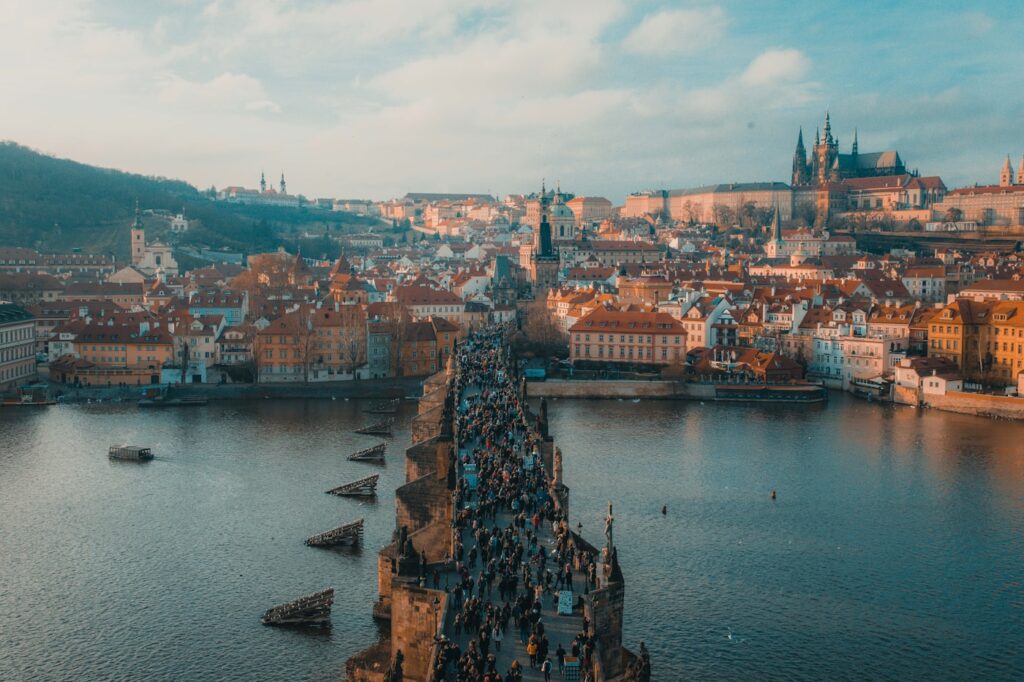
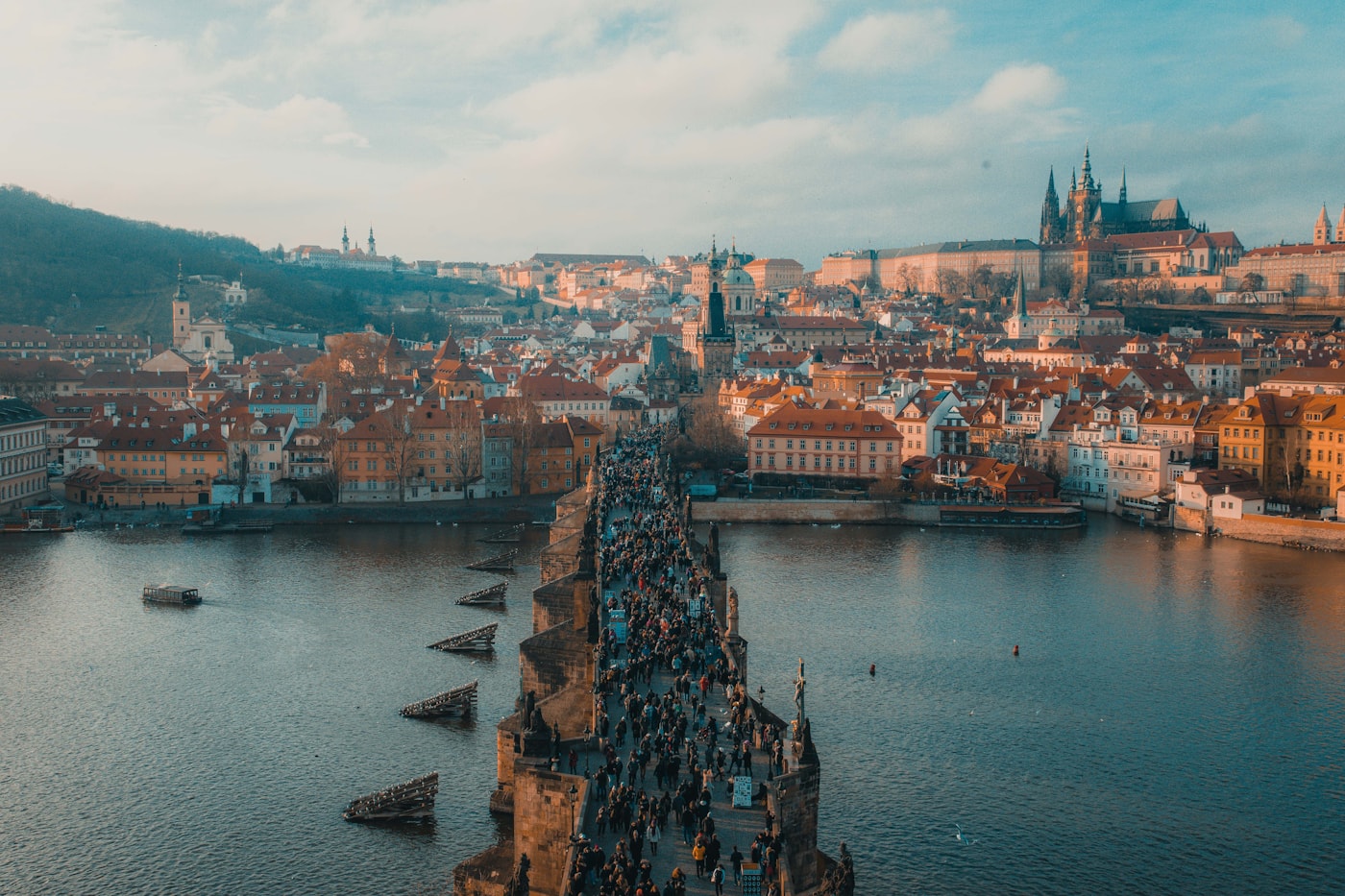
The Charles Bridge (Karlův most) is the city’s most photographed structure — a medieval stone bridge lined with 30 Baroque statues, stretching across the Vltava between Old Town and Malá Strana. It is genuinely beautiful. At 8am on a weekday morning, before the tour groups arrive, it’s one of the great urban experiences in Europe. At 2pm in July, it’s a slowly moving crowd with limited visibility between the statues.
Josefov, the former Jewish Quarter, contains six synagogues and the Old Jewish Cemetery — a burial ground used from the 15th century in which an estimated 100,000 people are buried in layers, the oldest graves visible at the surface. The history here is extraordinary and difficult in equal measure. A combined ticket to the Jewish Museum network of synagogues and the cemetery is €20 and worth every cent.
Prague Castle and Malá Strana
Prague Castle (Pražský hrad) is the largest ancient castle complex in the world by area — not a single building but a hilltop cluster of palaces, churches, gardens, and galleries that has been the seat of Czech power since the 9th century. The St. Vitus Cathedral inside the complex took nearly 600 years to build and contains the tombs of Bohemian kings and Holy Roman Emperors. The view from the castle’s south gardens over the city is the definitive panorama. Budget half a day.
Malá Strana (the Lesser Town) sits between the castle hill and the Charles Bridge — a neighbourhood of Baroque palaces, embassy residences, small museums, and garden restaurants that represents Prague’s most atmospheric residential area. The streets are quiet in the evenings, the architecture is immaculate, and several of the best restaurants in the city are tucked into courtyard spaces here. It’s the part of Prague that most closely resembles a movie set, and unlike some of the Old Town tourist infrastructure, the set is fully inhabited.
Vinohrady and Žižkov: Where Prague Actually Lives
Vinohrady is Prague’s version of Paris’s Marais — a late-19th-century residential neighbourhood of apartment buildings with grand facades, tree-lined streets, neighbourhood cafés, and a population that is a mix of young professionals, long-term residents, and international expats. The food scene here is where Prague’s restaurant renaissance is most visible: natural wine bars, third-wave coffee shops, small tasting-menu restaurants, and weekend brunch queues that would be familiar in any major European city.
Žižkov, adjacent to Vinohrady, is slightly rougher, slightly cheaper, and contains the Žižkov Television Tower — a brutalist structure that goes up 216 metres and has giant baby sculptures crawling up its exterior (an installation by sculptor David Černý). The tower’s observation deck has the best views in the city. Žižkov also has a higher density of pubs per capita than anywhere in Prague, mostly serving Pilsner Urquell and Kozel at prices that make you appreciate the koruna exchange rate.
Food, Beer, and the Actual Culture
Czech cuisine has been one of central Europe’s best-kept secrets, partly because its reputation rests on the tourist-facing version (pork knuckle, svíčková, goulash) that can feel heavy and museum-like. The better version — the one you find in neighbourhood restaurants and the new wave of modern Czech places — is excellent: game dishes, freshwater fish, root vegetables prepared with real technique, and a pastry tradition that goes far beyond the trdelník (chimney cake) that tourist vendors sell on every corner of the Old Town.
Svíčková (beef sirloin in cream sauce with bread dumplings and cranberry jam) is a benchmark dish and worth ordering once at a proper restaurant to understand what Czech cooking can do. Bramboráky (potato pancakes with garlic and marjoram) are the street snack. And the question of beer is basically settled: Czech lager is the finest in the world by the standards of the style, and drinking unfiltered Pilsner Urquell from a tank (tankové pivo) at a place that keeps it properly is an experience worth building a visit around.
For the new wave: Eska in Holešovice serves modern Czech food with fermented and foraged ingredients. Manifesto Market (a pop-up container market in Vinohrady and elsewhere) hosts some of the city’s most interesting food vendors. The Lokál chain of traditional pubs serves excellent Czech food at non-tourist prices — the Lokál Dlouhá in Old Town is specifically designed for locals and tourists who want to eat properly rather than as a performance.
Day Trips
Český Krumlov
A 3-hour bus or car journey south, Český Krumlov is a medieval town set in a bend of the Vltava — a UNESCO heritage site with a castle complex that rivals Prague’s in visual impact but a fraction of the crowds. It has been called one of the most beautiful towns in Europe and the description holds. Day trip or overnight; the town is quiet after the day visitors leave and several small hotels are excellent value.
Kutná Hora
A UNESCO-listed silver mining town an hour east of Prague by train, home to the Sedlec Ossuary — a small church whose interior is decorated with the bones of approximately 40,000 people, arranged into chandeliers, coats of arms, and architectural features. It is genuinely extraordinary and not at all what it sounds like. The Gothic Cathedral of Saint Barbara in the town centre is among the finest Gothic buildings in Central Europe. Half-day from Prague.
Getting to Prague
Václav Havel Airport Prague (PRG) connects to all major European cities, with Ryanair, Wizz Air, Czech Airlines, easyJet, and British Airways all operating routes. From the US, connections typically route through Frankfurt, Amsterdam, Paris, or London. The airport metro connection (metro line A to central Prague) takes 35 minutes. Taxis to the city centre run 500–700 CZK (€20–28); book in advance or use the official AAA Taxi rank to avoid overcharging.
Where to Stay
Malá Strana or the edge of Vinohrady for the best combination of atmosphere and access without the full tourist-zone pricing. Vinohrady itself for the food scene and a very walkable residential neighbourhood. The Old Town is convenient but expensive and loud on weekends. Žižkov for budget options in a genuinely local area a 10-minute tram ride from everything.
Budget (hostel, guesthouse): 600–1,200 CZK/night (€25–50). Mid-range boutique hotel: 2,500–5,000 CZK (€100–200). Luxury (Four Seasons, Mandarin Oriental, Aria Hotel): 8,000–20,000 CZK (€320–800). The luxury tier in Prague represents genuinely extraordinary value against equivalent European competition.
Realistic Budget Breakdown
- Budget traveller (hostel, pub meals, tram): 700–1,000 CZK/day (~€28–40)
- Mid-range (hotel, restaurant dinners, museum entry): 2,000–3,500 CZK/day (~€80–140)
- Comfortable (boutique hotel, tasting menus, day trip): 5,000–9,000 CZK/day (~€200–360)
- Half-litre of Czech beer in a pub: 35–55 CZK (€1.40–2.20)
- Svíčková dinner at a good restaurant: 280–420 CZK (€11–17)
- Prague Castle complex entry: 250–500 CZK depending on circuit
- Jewish Museum combined ticket: ~500 CZK (€20)
Things Nobody Tells You
- The Old Town is extremely small. The central historic area covers maybe 2 square kilometres. Most first-time visitors are surprised how quickly they’ve walked it. This is why 3 days in Prague works better as a base for exploring the city’s real neighbourhoods than as just a checklist of the major sights.
- Exchange your money carefully. Currency exchange kiosks in the Old Town offer extremely unfavourable rates and some use deceptive signage. Withdraw CZK directly from ATMs using a card with low foreign transaction fees, or use a Revolut/Wise card. Never change money at the airport kiosks.
- The trdelník is not traditional. The chimney cake sold on every Old Town corner is a recent invention marketed as traditional Czech street food. It’s fine, but don’t think you’re eating something historic.
- Autumn is the best season. September and October have mild weather, less crowding than summer, the city’s cultural season in full swing, and a wine festival (Vinobraní) in nearby wine country that’s worth the day trip.
- The metro is extremely good. Three lines cover the city efficiently. A 24-hour pass costs 120 CZK (€5). Trams cover the rest.
Experiences & Activities
Book Tours & Activities in Prague
Skip the planning stress. Browse guided Old Town walking tours, Prague Castle visits, river cruises, Czech beer and food experiences, and day trips to Český Krumlov and Kutná Hora — all bookable online with free cancellation on most options.
Browse Prague Experiences →New guides every few months — no noise, no spam.
Subscribe freeFrequently Asked Questions
Is Prague too touristy in 2026?
The Old Town and Charles Bridge area are heavily tourist-facing, especially in summer. But Prague’s real character lives in Vinohrady, Žižkov, Holešovice, and Smíchov — neighbourhoods that are 10–15 minutes by tram from the historic centre and largely undisturbed by the main tourist flow. Visiting in spring or autumn also significantly reduces the Old Town crowds.
Is Czech Republic part of the Schengen Area?
Yes, the Czech Republic is in the Schengen Area but does not use the euro — the currency is the Czech koruna (CZK). EU and Schengen passport holders can enter without a visa. US, UK, and most Western passport holders can enter without a visa for up to 90 days. The koruna gives Prague a price advantage over eurozone cities.
How many days should I spend in Prague?
Three days is the standard recommendation and it works for the main sights. Four to five days allows you to add a day trip to Kutná Hora or Český Krumlov, spend time in the residential neighbourhoods, and eat your way through the restaurant scene properly. More than five days requires specific interests (galleries, music venues, hiking in Bohemian Switzerland).
What is the best Czech beer to drink in Prague?
Pilsner Urquell (tankové — unfiltered from a tank) is the benchmark Czech lager experience. Kozel dark (černý) is a very good dark lager. Budvar (the original Czech Budweiser, unrelated to the American brand) is excellent on tap. Locally brewed craft beers have expanded significantly — Pivovar Majestic in Vinohrady and Matuška are worth seeking out for something outside the mainstream.
Is Prague safe for tourists?
Prague is very safe for tourists. The main risks are petty theft (pickpocketing in crowded areas like Charles Bridge and public transport), currency exchange fraud at tourist-area kiosks, and overcharging in tourist-facing restaurants that don’t display prices. Violent crime is rare. Use a money belt in crowds and check restaurant bills before paying.