
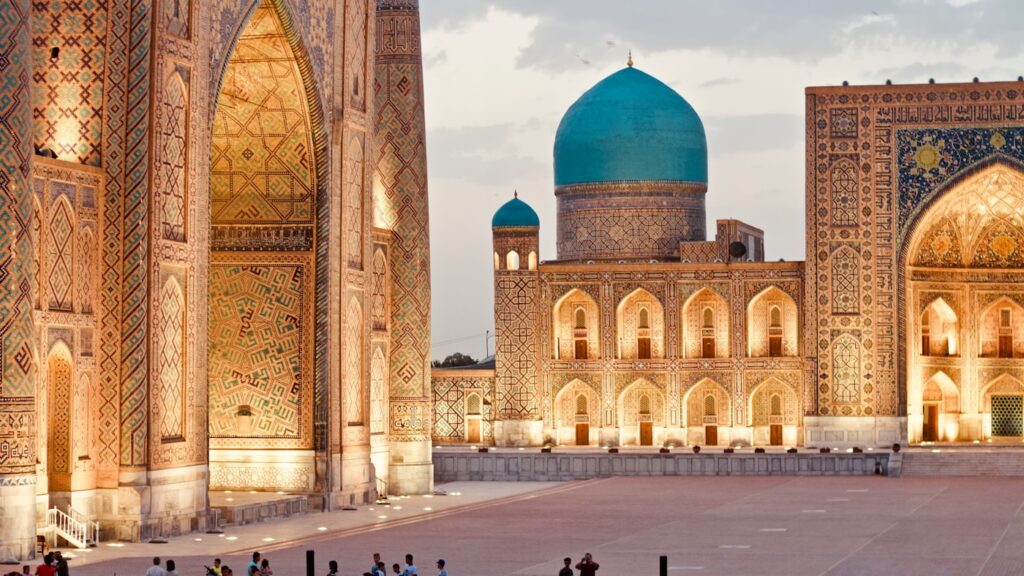
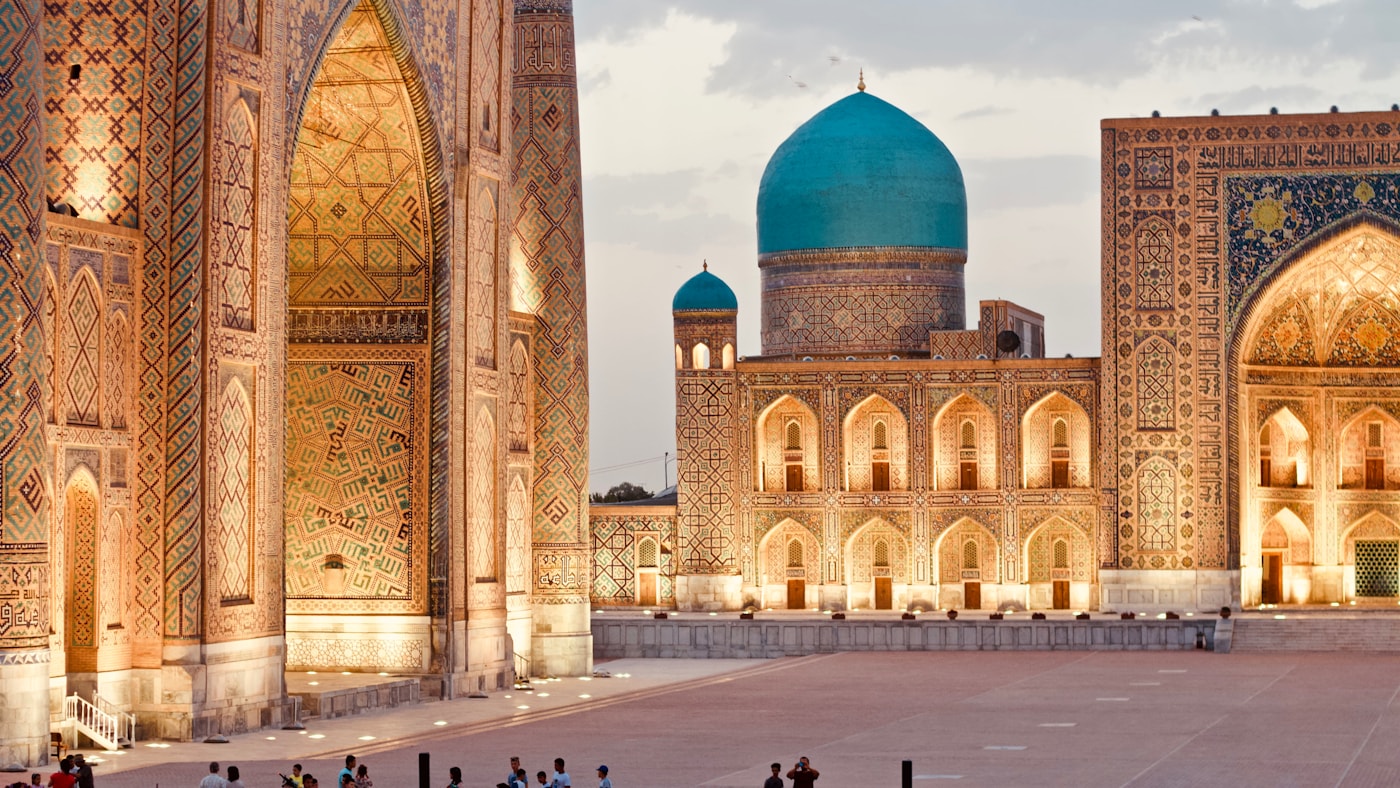
Most people have seen the Registan in photographs without knowing its name. Three 15th and 17th-century madrasas (Islamic schools) forming a perfect plaza of turquoise-tiled domes and minarets, the proportions so assured that the building complex looks designed — which it was, over two centuries and by some of the greatest architects of the Islamic world. The Registan is to Central Asian architecture what the Hagia Sophia is to Byzantine architecture or the Alhambra is to Moorish architecture: a building that exceeds what you prepared for.
Samarkand has been a major city for 2,750 years. It was the capital of Timur (Tamerlane) the Great’s empire in the 14th century, a hub of the Silk Road trading network that connected China with the Mediterranean for over a thousand years, and the site of scientific and scholarly achievement that pre-dated the European Renaissance by decades. Alexander the Great was so impressed that he reportedly said: “Everything I have heard about Samarkand is true, except that it is even more beautiful than I imagined.”
In 2026 it is finally accessible in a way it wasn’t for most of recent history. Uzbekistan introduced visa-free entry for US citizens in 2022 and has since expanded this to over 90 nationalities. A high-speed train connects Samarkand to Tashkent in under 2 hours and to Bukhara in 2 more. The tourism infrastructure — hotels, restaurants, guides — has improved significantly. The crowds have not yet arrived to the degree this city warrants. This is the window.
What’s in This Guide
- Why Samarkand in 2026
- The Registan
- The other monuments
- What to eat
- Combining with Bukhara and Tashkent
- Getting to Samarkand
- Where to stay
- Realistic budget breakdown
- Things nobody tells you
- FAQ
Why Samarkand in 2026
Both The Points Guy and National Geographic’s Best of the World 2026 list featured Uzbekistan specifically, with The Points Guy noting the visa-free access for US citizens as a game-changer and National Geographic highlighting Khiva’s high-speed rail connections. The JW Marriott Tashkent opened in 2025, signalling the international hotel chains’ confidence in the destination. Flight connections have expanded with FlyDubai, Turkish Airlines, and Uzbekistan Airways all adding capacity.
The context matters here. Central Asia has been one of the most difficult regions in the world to visit for decades — Soviet-era visa regimes, limited infrastructure, and a lack of tourist infrastructure that made independent travel genuinely challenging. Uzbekistan’s reform programme has changed this faster than most observers expected. The country is making a bet on cultural tourism, and the bet is supported by genuinely extraordinary raw material: three UNESCO World Heritage cities (Samarkand, Bukhara, Khiva) within a day’s travel of each other, each with monuments that belong on any list of world architecture.
The window of “accessible but not yet crowded” closes as more travellers discover this. If Central Asia is on your list at all, 2026 is the year to go.
The Registan
Arrive at the Registan for the first time and give yourself a few minutes to simply stand and look. The three madrasas — Ulugh Beg (built 1420), Sher-Dor (1636), and Tilya-Kori (1660) — frame a plaza that functions as both architectural composition and public space. The Ulugh Beg madrasa is the oldest and in some ways the most interesting: its tile mosaics include mathematical and astronomical motifs, reflecting its patron’s obsession with science (Ulugh Beg was one of the greatest astronomers of the medieval world and built an observatory a short distance away).
The Sher-Dor (meaning “lion-bearing”) madrasa has deer and sun-faced lions in its tympana — unusual figurative imagery on a religious building that has been much discussed by scholars. The Tilya-Kori (“gold-decorated”) madrasa contains a mosque whose interior is covered in 18-carat gold leaf in a style that makes Versailles seem restrained.
Entry to the Registan costs around 100,000 UZS (roughly $8 USD). Go first thing in the morning and in the evening. The light is different and the crowds are smaller. The sound-and-light show on summer evenings is tourist-facing but genuinely spectacular as a way to see the buildings lit at night.
The Other Monuments
Shah-i-Zinda
A necropolis of mausoleums built over six centuries along a processional alley, Shah-i-Zinda is the monument that affects visitors most deeply. The sheer concentration of 14th and 15th-century Timurid tilework — turquoise, cobalt, white, gold — in a confined space, the combination of spiritual significance and architectural achievement, and the fact that it is still an active pilgrimage site for Muslims make it something genuinely different from a typical tourist monument. Women should dress modestly (covered hair and shoulders); both sexes should enter respectfully as a place of religious observance.
Gur-e-Amir
The mausoleum of Timur (Tamerlane) himself — the conqueror who built an empire from Turkey to India and made Samarkand his capital. The exterior dome, in ribbed turquoise, is one of Central Asian architecture’s defining images. Inside, the simple dark-green jade tombstone marks what is reputedly the burial site of one of history’s most powerful and feared rulers. The mausoleum is small and intimate in a way that feels incongruous with its occupant’s scale. Worth visiting in the hour before the Registan visit so you understand the historical context of who commissioned it.
Ulugh Beg Observatory
A 15-minute taxi ride from the centre, the observatory site preserves the surviving arc of the enormous sextant that Ulugh Beg used to compile his catalogue of over 1,000 stars in the 15th century — a scientific achievement that was more accurate than European astronomy for a further hundred years. The museum is modest but the context is extraordinary: the grandson of Timur, ruler of a great empire, chose to spend his reign charting the heavens. He was assassinated at the instigation of his own son in 1449. History in Central Asia is rarely clean.
What to Eat
Uzbek food is the product of a culture that was simultaneously nomadic and urban, at the crossroads of trade routes from China, India, Persia, and the Mediterranean. The signature dish is plov (known as osh in Uzbek) — a rice dish cooked with lamb, onions, carrots, cumin, and various additions depending on the occasion and the cook. Samarkand plov specifically is known throughout Uzbekistan as different from Tashkent plov: the rice varieties, the spice ratios, the cooking technique. The plov served at the Siab Bazaar’s plov centre on Friday and Saturday mornings is made in enormous quantities for hundreds of diners and is one of the most communal food experiences in Central Asia.
Beyond plov: samsa (baked lamb pastries from clay ovens), lagman (hand-pulled noodles in lamb broth), shashlik (lamb or chicken skewers over charcoal), non (the Samarkand flatbread stamped with distinctive patterns, genuinely different from bread elsewhere). The local yogurt (qatiq) and cheese (suzma) are extraordinary and cheap. The bazaars sell dried fruits and nuts — almonds, apricots, mulberries, pomegranate seeds — that are among the finest in the world.
Tea culture is central. Green tea (koʻk choy) arrives before every meal and is refilled constantly. The traditional teahouses (choyxona) are social institutions — older men drinking tea, playing nard (backgammon), talking. Sitting in a choyxona for an hour is a more genuine experience of Uzbek culture than most museums offer.
Combining with Bukhara and Tashkent
The high-speed train network (Afrosiyob and Sharq express services) makes a Silk Road multi-city trip entirely manageable. The standard itinerary runs: fly into Tashkent (2 nights, excellent food scene, Soviet architecture, modern city), train to Samarkand (2–3 nights, UNESCO monuments), train to Bukhara (2 nights, remarkably preserved medieval Islamic urban fabric), optional train to Khiva (further 6 hours, but worth it for the completely intact walled city).
Bukhara deserves its own guide but the summary: it’s the most intact medieval Central Asian city, a cluster of mosques, madrasas, and caravanserais around the Lyabi-Hauz pool, with far less obvious tourist infrastructure than Samarkand, a more complicated relationship between the preserved monuments and the living city, and plov that many Uzbeks consider even better than Samarkand’s.
Getting to Samarkand
Fly to Tashkent (TAS) — the national hub with connections from Istanbul (Turkish Airlines), Dubai (FlyDubai, Emirates), Moscow, and several European cities. From Tashkent, the Afrosiyob high-speed train reaches Samarkand in 2 hours 10 minutes for roughly 90,000–150,000 UZS ($7–12 USD). Samarkand International Airport (SKD) has some direct regional flights but Tashkent is the primary gateway. From the US, typical routing is through Istanbul or Dubai; total journey around 16–20 hours.
Where to Stay
The hotel infrastructure has improved dramatically in the last five years. The JW Marriott Samarkand opened in 2022 — genuinely good by international standards, positioned near the monuments. Independent boutique hotels and guesthouses in restored traditional houses (similar in concept to riads) are excellent options: clean, atmospheric, breakfast included, and staffed by people who know the city. Budget guesthouses near the Registan start around 200,000–350,000 UZS ($16–28 USD) per night. Mid-range hotels run 600,000–1,500,000 UZS ($50–120).
Realistic Budget Breakdown
- Budget traveller (guesthouse, bazaar meals, walking): 300,000–500,000 UZS/day (~$25–40 USD)
- Mid-range (hotel, restaurant meals, guided tours): 700,000–1,200,000 UZS/day (~$55–95 USD)
- Comfortable (good hotel, full monument circuit, day trips): 1,500,000–2,500,000 UZS/day (~$120–200 USD)
- Registan entry: ~100,000 UZS ($8)
- Shah-i-Zinda entry: ~50,000 UZS ($4)
- Bowl of plov at bazaar: 25,000–40,000 UZS ($2–3)
- High-speed train Tashkent–Samarkand: 90,000–150,000 UZS ($7–12)
Things Nobody Tells You
- The monuments have been heavily restored. The Registan you see today is a 20th-century Soviet restoration of a partially ruined original. The tiles are largely reproduction, the proportions occasionally adjusted. Whether this matters is your call — the original design is faithfully represented and the scale is authentic — but it’s worth knowing.
- Bring US dollars or euros in cash. While card payments are increasingly possible at hotels, the most practical approach is to carry dollars or euros and exchange at the airport or banks in the city. The exchange rate has been stable. ATMs exist but are not universally reliable for foreign cards.
- The Siab Bazaar is the real thing. Samarkand’s main market is one of Central Asia’s great bazaars — spices piled in cones, dried fruit in 20 varieties, fresh vegetables, butchers, bread ovens. Shop there, eat there, and spend a morning there rather than at souvenir stalls near the monuments.
- Photography inside monuments requires separate tickets. The standard entry ticket doesn’t cover photography at many sites. Ask about photo permits at the ticket office — usually 20,000–50,000 UZS extra.
- Spring (April–May) is the best season. The climate is continental — cold winters, scorching summers (40°C in July), mild and beautiful spring and autumn. April is particularly good: the tulips bloom, the air is clear, and the tourist numbers haven’t hit their peak.
Experiences & Activities
Book Tours & Activities in Uzbekistan
Skip the planning stress. Browse guided Registan and Silk Road tours, multi-city Uzbekistan itineraries, plov cooking classes, and day trips to Bukhara and Khiva — all bookable online with free cancellation on most options.
Browse Uzbekistan Experiences →New guides every few months — no noise, no spam.
Subscribe freeFrequently Asked Questions
Do Americans need a visa for Uzbekistan in 2026?
No — US citizens can enter Uzbekistan visa-free for up to 90 days. The same applies to citizens of the EU, UK, Canada, Australia, and over 90 other countries. Check the official Uzbekistan e-visa portal for the most current list of eligible nationalities.
Is Uzbekistan safe to travel?
Yes. Uzbekistan is one of the safest countries in Central Asia for visitors. Violent crime against tourists is extremely rare. Petty theft is uncommon by regional standards. The main practical cautions are food hygiene (stick to cooked food from busy restaurants and bazaars) and the need to carry cash. Political demonstrations and border regions require standard caution.
How many days should I spend in Samarkand?
Two full days is the minimum for the main monuments. Three days allows a slower pace, a morning at the Siab Bazaar, the Ulugh Beg Observatory, and an evening sound-and-light show at the Registan. Most Silk Road itineraries allocate 2 nights in Samarkand as part of a Tashkent–Samarkand–Bukhara circuit.
What language is spoken in Samarkand?
Uzbek is the official language. Russian is widely spoken as a second language, particularly by older generations and in business contexts. English is spoken by hotel staff, many guides, and younger Uzbeks in the tourism industry, but is not universally understood outside those contexts. Learning a few Uzbek phrases (rahmat — thank you, assalomu alaykum — hello) is appreciated.
What is the currency in Uzbekistan and how do I pay?
The Uzbek Som (UZS). Bring US dollars or euros to exchange — they’re accepted at official exchange points at airports, banks, and hotels. The exchange rate has been relatively stable. Cards are increasingly accepted at hotels and some restaurants in major cities but not universally. ATMs exist in Samarkand but not all accept foreign cards; withdraw sufficient cash on arrival in Tashkent before travelling to smaller cities.