
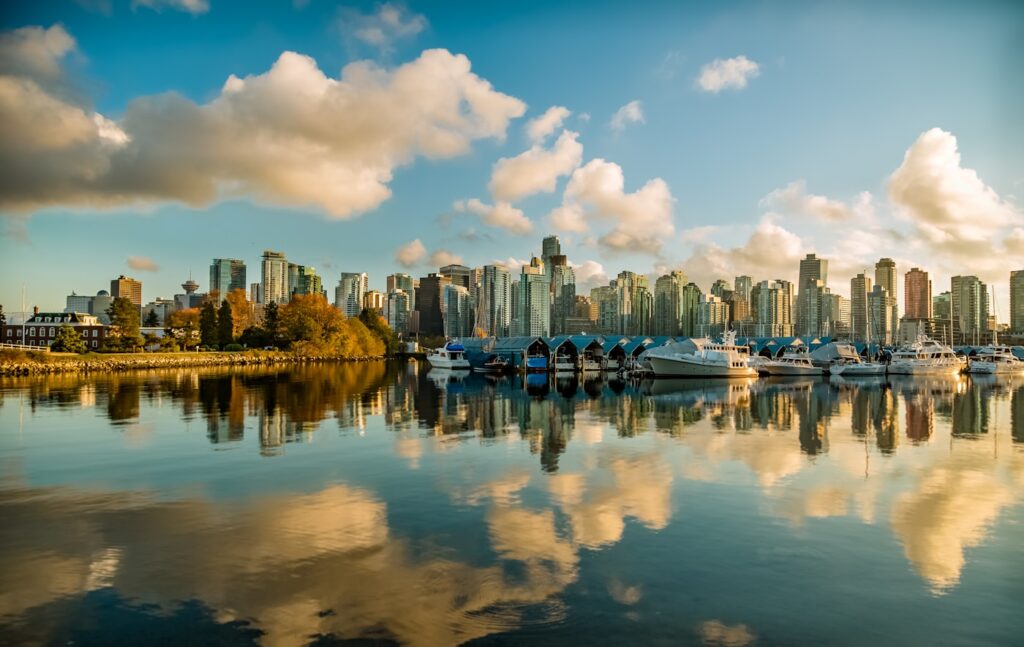
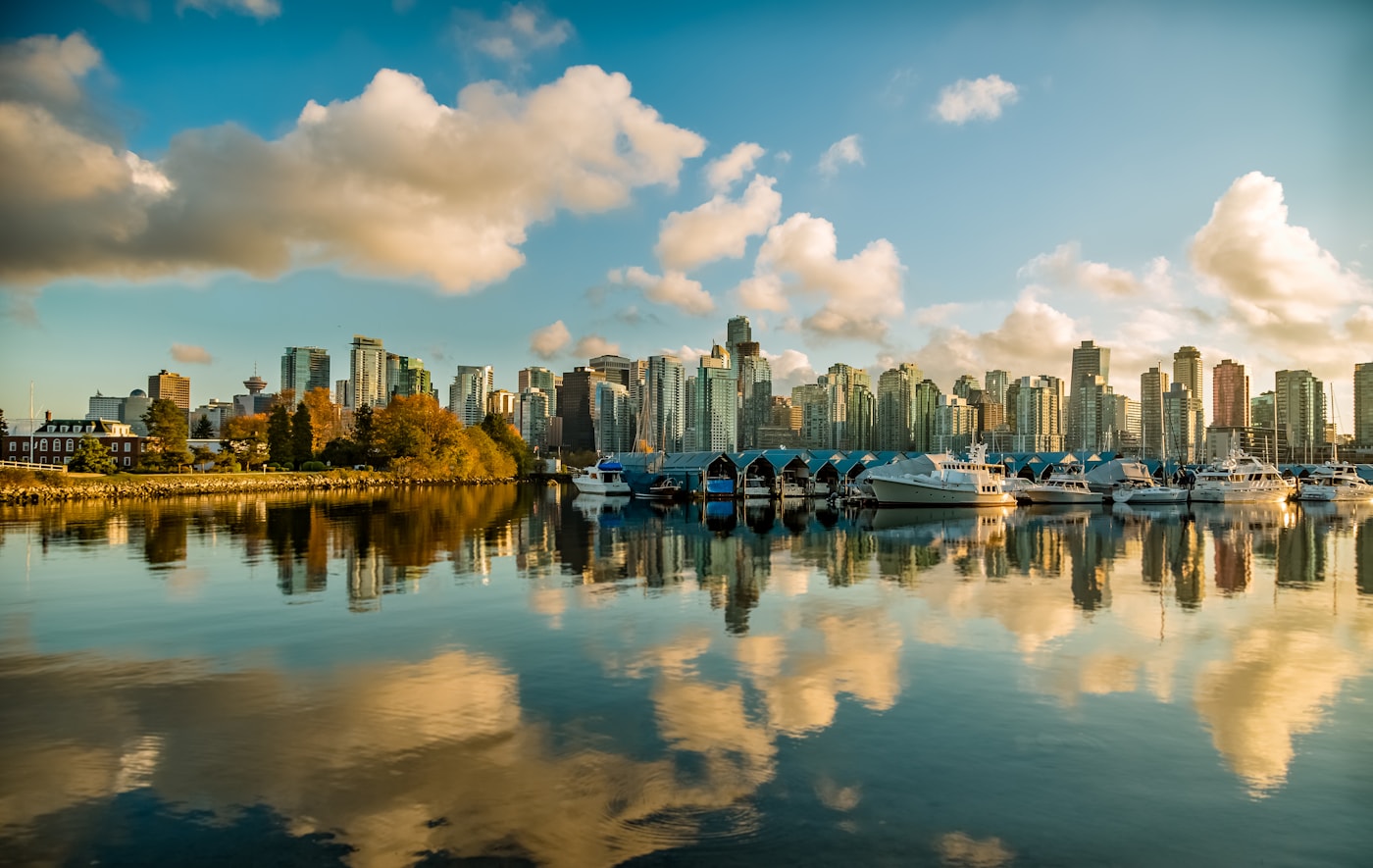
The thing about Vancouver is the scale. You’re walking through a modern glass-and-steel downtown, ducking into a ramen shop on Robson Street, and you look up — and there, filling the entire northern horizon, are the North Shore mountains, snow-capped in winter, green in summer, close enough to feel like a backdrop painted by someone with an unrealistic sense of proportion. It takes a couple of days before you stop being startled by them.
This is the defining feature of Vancouver: the collision of city and wilderness at a scale that shouldn’t work but does. Stanley Park — a 400-hectare old-growth forest — is a 15-minute walk from the downtown financial district. The Sea-to-Sky Highway runs from suburban traffic to alpine scenery in under an hour. Grouse Mountain, where locals go skiing after work, is visible from most of the city. And everywhere, the ocean: English Bay, False Creek, Burrard Inlet, and beyond them the Strait of Georgia and Vancouver Island.
The city itself is young by global standards — the downtown core was largely built in the last 40 years — and it shows in the architecture (glass towers, not heritage stone) and the culture (multicultural, progressive, tech-forward). The population is about 2.5 million in the metro area, roughly 45% of whom are visible minorities. The Asian influence is particularly strong: Richmond, a suburb built on the Fraser River delta, has one of the largest Chinese populations in North America, and the food that comes out of this community is staggering.
What’s in This Guide
- Why Vancouver in 2026
- The neighbourhoods
- Food: the real story
- Outdoor Vancouver
- Day trips
- Indigenous culture
- Getting around
- Realistic budget
- What nobody tells you
- FAQ
Why Vancouver in 2026
Vancouver has always been a beautiful city, but 2026 brings some specific draws. The Broadway Subway extension — connecting downtown to the University of British Columbia — has transformed access to the city’s west side. The Indigenous art and cultural scene has grown substantially, with new galleries and cultural spaces opening along the waterfront. The food scene continues its quiet ascent, with several new restaurants earning international attention. And the outdoor infrastructure keeps improving — new trails, expanded bike networks, and improved ferry connections to the Gulf Islands and Sunshine Coast make it easier than ever to combine city and nature in a single trip.
The Neighbourhoods
Gastown — The oldest neighbourhood, centred on a cobblestoned strip with the steam clock that tourists photograph and locals walk past. Behind the tourist layer: good coffee shops, cocktail bars, and independent boutiques in heritage brick buildings. Also the gateway to the Downtown Eastside, one of Canada’s most visible areas of poverty and addiction — the contrast is stark and real.
Chinatown — One of the oldest in North America, now in a state of flux between heritage preservation and new development. The Dr. Sun Yat-Sen Classical Chinese Garden is a genuine oasis. The night market (summer weekends) and the old-school dim sum restaurants are the highlights.
Granville Island — A former industrial site under the Granville Bridge, now home to a public market (the best in the city for seafood, produce, and prepared food), artisan studios, a brewing cluster, and a performing arts scene. Go hungry.
Kitsilano — The beachside neighbourhood south of downtown. Kits Beach, outdoor pool, yoga studios, organic grocery shops — the Vancouver lifestyle in concentrated form. Good restaurants along West 4th Avenue and Broadway.
Main Street / Mount Pleasant — The creative district. Breweries, independent restaurants, vintage shops, and a more diverse, less polished energy than the west side. This is where the interesting food happens.
Food: The Real Story
Vancouver’s food scene doesn’t get the hype of New York or London, which is both its tragedy and its charm. The sushi is extraordinary — the proximity to Pacific fishing grounds and the large Japanese community combine to produce sushi that rivals Tokyo’s mid-range restaurants at a fraction of the price. Tojo’s, widely credited with inventing the California roll, is the iconic name; Miku for contemporary Japanese; and countless neighbourhood spots where an omakase runs CAD $60–80 and leaves you questioning why you ever eat sushi anywhere else.
The Chinese food is the other revelation. Richmond, accessible by the Canada Line SkyTrain in 20 minutes, has the best Chinese food in North America — a claim that would start fights in San Francisco but holds up under scrutiny. Cantonese seafood restaurants, Sichuan hotpot, Shanghainese soup dumplings, Hong Kong-style BBQ — the range and quality reflect decades of immigration from Hong Kong and mainland China. Dim sum at Dynasty Seafood or Chef Tony’s is a weekend institution.
Beyond Asian cuisines: the Pacific Northwest seafood (spot prawns in season, wild salmon, halibut, Dungeness crab) is exceptional. The craft brewery scene is mature — over 30 breweries in the city, with a cluster on East Vancouver’s “Brewery Creek.” And the farm-to-table movement here is genuine, not a marketing exercise — the Fraser Valley provides produce, Pemberton grows potatoes, and the Gulf Islands contribute artisan cheese and charcuterie.
Outdoor Vancouver
Stanley Park — 400 hectares of old-growth cedar and Douglas fir, ringed by a 10km seawall that’s perfect for walking, running, or cycling. Inside: Beaver Lake, totem poles at Brockton Point, Third Beach for sunset watching. It’s the equivalent of Central Park, except it’s an actual forest.
Grouse Mountain — The locals’ mountain, accessible by bus from downtown. In winter: skiing and snowshoeing. In summer: the Grouse Grind — a 2.9km trail that gains 850m of elevation and functions as the city’s outdoor gym. The gondola up (and a beer at the summit lodge) is the alternative for those who value their knees.
Lynn Canyon — A suspension bridge (free, unlike the nearby Capilano Bridge which charges CAD $65) over a forested canyon, with swimming holes in summer and trails through old-growth forest. 30 minutes from downtown by bus.
Kayaking — Deep Cove, a small inlet on the North Shore, is the classic launch point. Paddle through sheltered waters with mountain views and the occasional seal. Rentals from CAD $40 for two hours. English Bay and False Creek offer urban kayaking with skyline views.
Day Trips
Whistler — The ski resort that hosted the 2010 Winter Olympics, 2 hours north on the Sea-to-Sky Highway (one of Canada’s most scenic drives). In summer: mountain biking, hiking, zip-lining, and the Peak 2 Peak Gondola between Whistler and Blackcomb mountains. In winter: 200+ runs across two mountains with reliable snow. Day-trippable but better with an overnight.
Victoria and Vancouver Island — The BC Ferries crossing (1.5 hours from Tsawwassen) is a scenic journey through the Gulf Islands. Victoria, the provincial capital, has a walkable old town, the Royal BC Museum, afternoon tea at the Empress Hotel, and whale-watching tours that regularly spot orcas. Tofino, on the island’s wild west coast, is a 4.5-hour drive from Victoria — worth it for the surf, the old-growth rainforests, and some of the most dramatic Pacific coastline in North America.
Bowen Island — A 20-minute ferry from Horseshoe Bay, this small Gulf Island has hiking trails, a village with cafés, and a slower pace. Excellent for a half-day escape. No car needed.
Indigenous Culture
Vancouver sits on the unceded territories of the Musqueam, Squamish, and Tsleil-Waututh Nations — a fact that’s increasingly visible and meaningfully engaged with across the city. The Museum of Anthropology at UBC, designed by Arthur Erickson, houses one of the world’s finest collections of Pacific Northwest Indigenous art, including monumental totem poles and Bill Reid’s iconic sculpture “The Raven and the First Men.” The Audain Art Museum in Whistler has an outstanding collection of BC First Nations masks and carvings.
On the ground, Indigenous-led cultural experiences have expanded: guided walking tours of Stanley Park’s totem poles with Talaysay Tours, Indigenous food experiences at Salmon n’ Bannock (Vancouver’s only Indigenous-owned restaurant), and the annual Gathering Festival at the Museum of Anthropology. The Squamish Lil’wat Cultural Centre in Whistler offers an immersive introduction to the two Nations whose traditional territories meet there.
Getting Around
Vancouver is one of the easiest Canadian cities to navigate without a car. The SkyTrain (automated light metro) connects the airport, downtown, Richmond, Burnaby, and New Westminster. The new Broadway extension reaches UBC. Buses cover the rest. The SeaBus — a commuter ferry — crosses Burrard Inlet to North Vancouver in 12 minutes. A day pass (Compass Card) costs CAD $11. The city’s cycling infrastructure is excellent — separated bike lanes connect most neighbourhoods, and the seawall is a dedicated cycling route. Mobi bike-share has stations across the city from $2.50/trip.
Realistic Budget
- Budget (hostel, food courts, SkyTrain): CAD $80–120/day (~$58–87 USD)
- Mid-range (hotel, restaurants, SkyTrain + occasional taxi): CAD $200–350/day (~$145–255 USD)
- Comfortable (boutique hotel, fine dining, car rental for day trips): CAD $400–600/day (~$290–435 USD)
- Sushi omakase (neighbourhood spot): CAD $60–80
- Dim sum for two (Richmond): CAD $40–60
- Grouse Grind (hike up, gondola down): CAD $20
- Kayak rental (Deep Cove, 2 hours): CAD $40–55
- BC Ferries to Victoria (foot passenger, return): CAD $36
What Nobody Tells You
- It rains less than you think — just at the wrong time. Vancouver gets most of its rain from November to March. Summer (June–September) is genuinely dry and sunny, with long days and comfortable temperatures. The rain reputation is a winter phenomenon.
- Richmond is not optional. If you’re a food person and you skip Richmond, you’ve missed the best eating in the city. Take the Canada Line to Aberdeen or Lansdowne station. The food courts in the malls (Aberdeen Centre, Parker Place) alone are worth the trip.
- The Downtown Eastside is real. The area around East Hastings Street between Gastown and Chinatown has visible homelessness, drug use, and poverty. It’s not dangerous to walk through but it can be confronting. It’s also the result of decades of policy failure. Walking past quickly and pretending it doesn’t exist is the wrong response — but so is avoiding the surrounding neighbourhoods, which include some of the city’s best food and culture.
- Whistler is better in summer. Controversial opinion, but the mountain biking, hiking, and sheer beauty of the alpine in summer are at least as impressive as the skiing. And it’s cheaper, less crowded, and the Sea-to-Sky Highway is a better drive without snow.
- Bring layers, always. Even in summer, the temperature can swing 10°C between sun and shade, sea level and mountain. A light jacket and a layer for the evenings are essential year-round.
Experiences & Activities
Book Tours & Activities in Vancouver
Browse Capilano suspension bridge visits, whale watching tours, Granville Island food walks, and Sea-to-Sky day trips — all bookable online with free cancellation on most options.
Browse Vancouver Experiences →New guides every few months — no noise, no spam.
Subscribe freeFrequently Asked Questions
What is the best time to visit Vancouver?
June through September for dry, sunny weather and outdoor activities. December through March for skiing. Avoid November — it’s the rainiest month and the mountains aren’t fully open yet.
How many days do I need in Vancouver?
Four to five days for the city and North Shore. A week if you add Whistler or Victoria. Two weeks for a broader BC trip including Tofino and the Gulf Islands.
Do I need a car in Vancouver?
Not for the city — SkyTrain, buses, and cycling cover it well. For day trips to Whistler, the Sea-to-Sky Highway, or the ferry terminals, a rental car is helpful. Most car-share services also operate in Vancouver.
Is Vancouver expensive?
Accommodation is pricey — comparable to San Francisco or Sydney. Food is more reasonable, especially Asian cuisines. Activities like hiking and beach-going are free. Budget travellers can manage on CAD $80–120/day with hostels and food courts.