
Last updated September 12, 2026 · Editorial policy
- Spring (March–May): sakura maths and the Golden Week trap
- June to mid-July: tsuyu, and the Hokkaido loophole
- High summer (mid-July–August): heat as a safety issue, plus Obon
- Typhoon season (August–October): count versus consequence
- Autumn (September–November): the smarter peak
- Winter (December–February): the cheapest Japan, and the snowiest
- Month by month at a glance
- The worst times, honestly
The short answer: late March to mid-April for cherry blossoms and late October through November for autumn colour are Japan’s two headline windows, and both now carry the year’s steepest hotel rates and its densest crowds. If value matters more than petals, January and February are the cheapest months nationwide, with savings of 20–50% against the spring and autumn peaks. The core trade-off is structural: Japan took a record 42.68 million foreign visitors in 2025 and JTB projects 41.4 million for 2026, so the better a month looks on paper, the more of those arrivals you share it with.
Spring (March–May): sakura maths and the Golden Week trap
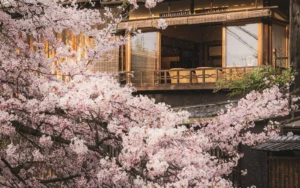
Cherry blossom timing is more predictable than its reputation suggests. In 2026 Tokyo’s first blooms opened on March 19 and hit full bloom March 28; Kyoto ran March 23 to full bloom March 30, and Osaka March 26 to April 3. For 2027, the central cities (Tokyo, Kyoto, Osaka) are expected to bloom roughly March 28 to April 5. Two planning rules follow. First, full bloom in any single city lasts only about a week, so a ten-day itinerary should not bet everything on one town. Second, the blossom front moves south to north between March and May, which means a trip that starts in Kansai and finishes in Tohoku can catch the wave twice.
The cost of that window is real and rising: Tokyo’s average hotel rate hit ¥33,168 in mid-2026, up 12.8% year on year, and April–May rates specifically climbed 14–17%. Then comes the trap at the end of the season. Golden Week 2026 ran Wednesday April 29 to Wednesday May 6 (May 6 was a substitute holiday because Constitution Day fell on a Sunday); Golden Week 2027 runs Thursday April 29 to Wednesday May 5, with April 30 a normal working day. During this stretch trains, buses and domestic flights are routinely fully booked, and Golden Week 2026 hotel rates rose about 20% year on year in Kyoto and 17% in Tokyo. In 2027, outbound domestic travel peaks around May 1 and the return crush lands May 4–5. The smart play is either to finish your trip before April 28 or to arrive mid-May, when the country exhales and prices drop into a genuine shoulder season.
June to mid-July: tsuyu, and the Hokkaido loophole
Japan’s rainy season (tsuyu) is a front, not a monsoon, and it arrives on a schedule. In 2026 it began in Okinawa on May 4 (six days earlier than average) and Amami around May 3; southern Kyushu followed around June 1 and Tokyo/Kanto around June 7. It then ended in the same south-to-north order: Okinawa June 29, Amami July 1, the Kinki/Chugoku/northern Kyushu belt July 8, Shikoku July 12, southern Kyushu July 13, and Tokyo (Kanto-Koshin) declared out on July 20, close to its July 19 average. On most of Honshu the season means persistent drizzle and heavy humidity rather than all-day downpours — the front stalls over the archipelago where cold northerly and warm southerly air masses collide. The Japan Meteorological Agency’s 2026 outlook called for an average-length or slightly shorter season, with average-or-above rainfall from southern Kyushu up through northern Tohoku.
The loophole is Hokkaido, the only region with no meaningful tsuyu: the rain front weakens before reaching the island, so Sapporo stays comparatively dry and low-humidity through June and July while the rest of the country is wet. This is also when Furano’s lavender fields perform — blooming late June to early August, with the best window roughly July 10–25 before harvesting starts in August. Early June is additionally one of the year’s secondary low-price windows, so a rainy-season trip built around Hokkaido is both drier and cheaper than the calendar suggests.
High summer (mid-July–August): heat as a safety issue, plus Obon
Modern Japanese summers are not merely sticky; they are dangerously hot. Summer 2025 was Japan’s hottest since records began in 1898, running 2.36°C above the 1991–2020 normal and setting a new national record of 41.8°C. Tokyo logged 23 days at or above 35°C that year, including a record ten consecutive days, and more than 100,000 people nationwide were hospitalised for heatstroke between May and early October 2025. The pattern held into 2026: in July, more than 10,000 people were rushed to hospital for heatstroke in a single week. Plan sightseeing for mornings, and treat midday temple circuits in Kyoto as a genuine health risk, not a comfort issue.
Summer still earns its place for specific reasons. Gion Matsuri fills all of July in Kyoto, with the grand Yamaboko Junko float parades on July 17 (9:00) and July 24 (9:30) and pedestrianised yoiyama festival evenings July 14–16 and July 21–23. Mount Fuji’s 2026 climbing season runs July 1 to September 10 on the Yoshida Trail (Fujinomiya and Gotemba opened July 10), now with a ¥4,000 per-person fee and advance online permit on all trails, a 4,000-hiker daily cap on Yoshida, and gates closed 2pm–3am to anyone without a hut booking — the era of spontaneous overnight “bullet climbing” is over.
Then there is Obon. In 2026 the holiday proper is August 13–16, but the travel rush spans August 8–16, and every Nozomi shinkansen runs reserved-seats-only August 7–16 with no unreserved cars; reserved seats go on sale at 10am exactly one month before each travel date, and they sell out weeks ahead. Hotels and ryokan in Kyoto, Hokkaido and Okinawa are often booked months in advance of that week. Note the regional quirk: Tokyo, Yokohama and parts of northern Japan observe Obon on July 13–16, and Okinawa follows the lunar calendar (around August 25–27 in 2026). If August is your only option, Hokkaido is the escape hatch: Sapporo averages around 25°C in August against Tokyo highs near 32°C.
Typhoon season (August–October): count versus consequence
Typhoon season runs roughly May to October and peaks August through October, when Japan is affected by about 2–3 typhoons per month — roughly 70% of the annual total. The nuance most guides miss: August produces the most storms by count (an average of 5.7 forming), but September’s storms are more likely to track toward the main islands and historically cause the most damage. Exposure is heavily regional. Okinawa sees an average of 7.7 typhoon approaches per year, peaking at 2.2 in August, 1.9 in September and 1.5 in July — though most are near-misses rather than direct hits — with Kyushu next in line before systems reach Honshu. Practical translation: book refundable rooms in this window, build one flex day into island itineraries, and note that Okinawa’s typhoon risk collapses around mid-October while its sea temperature holds at 25–27°C.
Autumn (September–November): the smarter peak
September is Hokkaido’s moment. Daisetsuzan’s high-altitude foliage starts colouring around September 15 — the earliest autumn in Japan — while Sapporo still enjoys 22–25°C days early in the month, all while Honshu remains hot. One 2026-specific warning: Silver Week gives Japan a rare continuous five-day national holiday September 19–23 (Respect for the Aged Day and the Autumn Equinox sandwiching a bridge holiday) — only the third such alignment ever, after 2009 and 2015 — so plan around heavy domestic travel in that slot. Outside it, September is one of the year’s secondary low-price windows.
Autumn foliage (koyo) runs north to south, the mirror image of sakura: Hokkaido peaks late September into October, Tohoku mid-October, Kanto and Chubu late October to mid-November, Kyoto typically November 10–30, and Kyushu holds colour into early-to-mid December. Two caveats for planners. Warm autumns in 2024 and 2025 pushed peaks one to two weeks later than those traditional windows, especially in Kyoto, so recent-year planning needs flexibility toward late November or even early December there. And year-specific koyo forecasts from tenki.jp, Walkerplus and WeatherNews are only published from September onward, so anything booked earlier is riding climatology, not a forecast. One quieter footnote: October is actually Tokyo’s wettest month (~235 mm), and it overlaps the tail of typhoon season — pack accordingly.
Winter (December–February): the cheapest Japan, and the snowiest
Pacific-side winters are dry and sunny — Tokyo sees January highs around 10°C and December is its driest month at roughly 58 mm (February ties it at ~57 mm) — which makes December through February far better city-sightseeing weather than its reputation. January and February have the lowest hotel prices nationwide (ski resorts excepted), with February usually the cheapest month overall for flights plus hotels and typical savings of 20–50% against the blossom and foliage peaks.
The one hard exclusion zone is New Year. From about December 29–30 to January 3–4, most non-essential businesses close — small shops, restaurants, many museums and galleries, some castles and gardens — with January 1 the most widespread closure day. Shrines and temples stay open but draw hours-long hatsumode queues, and shinkansen crowding peaks December 29–31 outbound and January 2–4 on the return.
For snow, the calendar is generous. Niseko averages roughly 12–15+ metres of snowfall a season, with 3–4 metres in January alone; January and February deliver the most consistent light, dry powder off cold Siberian winds. Sapporo itself averages around −3°C in January with heavy snow (daytime highs hover near 0°C), and February — ~92 mm of precipitation, nearly all snow (its truly driest months are April–May at ~55 mm) — hosts the Sapporo Snow Festival, scheduled February 4–11 in 2027 across three sites (Odori Park’s 1.5 km main stretch, Susukino and Tsu Dome), with large snow sculptures up to about 25 m wide and 15 m high. At the other end of the country, Naha averages 17.5°C in January — Okinawa is never cold — though its swim season doesn’t properly start until late April, and even then April water of 22–24°C argues for a wetsuit; May through October the sea exceeds 25°C.
Month by month at a glance
| Month | Weather (Tokyo unless noted) | Rain / storm risk | Crowds & prices | Verdict |
|---|---|---|---|---|
| Jan | Highs ~10°C, dry and sunny; Sapporo ~−3°C with heavy snow | Low on the Pacific side | Cheapest tier once New Year ends Jan 3–4 | Value + world-class powder |
| Feb | Cold, dry; Sapporo’s ~92 mm month, nearly all snow | Low | Usually the cheapest month overall | Best budget window; Snow Festival Feb 4–11 (2027) |
| Mar | Warming; Tokyo sakura opened Mar 19, full Mar 30 in 2026 | Low–moderate | Rates climb steeply into bloom | Book far ahead or miss out |
| Apr | Mild; full bloom fades within about a week | Moderate | ADR up 14–17% YoY; Golden Week starts Apr 29 | First half excellent, then flee the holiday |
| May | Warm and clear after Golden Week ends (May 6 in 2026) | Okinawa tsuyu began May 4 in 2026 | Post-holiday lull on the mainland | Underrated mid–late May shoulder |
| Jun | Tsuyu in Tokyo from ~Jun 7 (2026): drizzle, humidity | High; Naha’s wettest month (~284 mm) | Early June is a cheap window | Go to Hokkaido — it has no tsuyu |
| Jul | Tsuyu ends Jul 8–19 south to north, then serious heat | Typhoons building (1.5 Okinawa approaches on average) | Gion Matsuri packs Kyoto all month | Furano lavender Jul 10–25; hydrate |
| Aug | Highs ~32°C; 2025 was the hottest summer since 1898 | Peak storm count (5.7 forming on average) | Obon rush Aug 8–16; booked months out | Worst Honshu month; Hokkaido ~25°C is the refuge |
| Sep | Slowly cooling; Sapporo 22–25°C early month | Most damaging typhoon tracks of the year | Silver Week Sep 19–23 (2026); cheap otherwise | Superb in Hokkaido; a gamble on the islands |
| Oct | Pleasant, but Tokyo’s wettest month (~235 mm) | Typhoon risk fades mid-month | Shoulder pricing before foliage peak | Strong all-rounder; colour arrives in the north |
| Nov | Crisp and drying; Kyoto foliage Nov 10–30, lately later | Low; one of Naha’s drier months (~119 mm; January, ~102 mm, is driest) | Kyoto foliage peak prices rival sakura | The second-best window of the year |
| Dec | Dry, sunny; Tokyo’s driest month (~58 mm) | Low | Quiet until the New Year shutdown from ~Dec 29 | Sleeper pick for the first three weeks |
The worst times, honestly
Three windows genuinely work against you. Mid-August combines everything at once: record-tier heat, the year’s highest typhoon count, and the Obon crush of August 8–16 with all-reserved Nozomi trains and rooms gone months earlier. Golden Week (April 29–May 6 in 2026) is only a problem if you arrive unbooked — with everything reserved far ahead it is survivable, but with trains and flights routinely sold out and hotel rates up another 17–20% year on year, it is the most expensive way to see Japan. And December 29 to January 3 quietly breaks itineraries because the country’s restaurants, shops and many museums simply close, whatever your hotel confirmation says. Honourable mention: June on Okinawa, which stacks the island’s wettest month onto the tail of its rainy season — the same yen buys a drier beach in late October.
One final 2026 planning note on cost: the nationwide Japan Rail Pass runs ¥50,000 for seven days ordinary class (¥70,000 Green Car, children 6–11 half price), and the 7-day ordinary price rises to ¥53,000 through overseas sales channels from October 1, 2026 — if a pass fits your route, buying before that date saves real money.
Climate data source: monthly temperature and rainfall figures on this page come from Open-Meteo’s Historical Weather API, which serves the ECMWF ERA5 reanalysis (Copernicus Climate Change Service). Five-year averages, 2019–2023. See our data methodology.
Japan weather & climate by month
Best months to visit: April, May, June, July, September, October. Japan’s warmest month is August (avg 32°C / 90°F), the coolest is January (low -0°C / 32°F). The wettest is October (235 mm) and the driest is February.
| Month | Avg high | Avg low | Rainfall | Rainy days |
|---|---|---|---|---|
| January | 9°C / 48°F | -0°C / 32°F | 60 mm | 5 |
| February | 11°C / 51°F | 1°C / 34°F | 57 mm | 5 |
| March | 15°C / 60°F | 6°C / 42°F | 116 mm | 9 |
| April | 18°C / 65°F | 9°C / 48°F | 134 mm | 10 |
| May | 23°C / 73°F | 14°C / 58°F | 140 mm | 10 |
| June | 26°C / 79°F | 19°C / 65°F | 168 mm | 12 |
| July | 30°C / 85°F | 23°C / 73°F | 156 mm | 11 |
| August | 32°C / 90°F | 24°C / 76°F | 155 mm | 8 |
| September | 28°C / 82°F | 21°C / 70°F | 225 mm | 11 |
| October | 22°C / 71°F | 14°C / 57°F | 235 mm | 11 |
| November | 18°C / 64°F | 8°C / 47°F | 96 mm | 7 |
| December | 12°C / 53°F | 2°C / 36°F | 58 mm | 5 |
Climate source: Open-Meteo / WMO climate normals (WMO 1991–2020, or ERA5 2019–2023 where unavailable). Compare destinations in the Best Time to Visit Index.
You Might Also Love


Written by
Founder of Packzup. Independent travel writer covering offbeat destinations across six continents since 2018. Every guide is independently researched and self-funded — no press trips, never sponsored.
