
Last updated August 24, 2026 · Editorial policy
- When to come
- The honest geography
- The temples, ranked by morning
- The food, by tier
- The neighbourhood worth a slow afternoon
- Where to stay
- Day trips, briefly
- What will surprise you
- What will disappoint you if you let it
- Practical, briefly
- A final thought
- Seasonal questions
- Kyoto like a local: temples, the seasons & the plan
- Kyoto Travel Guide FAQ
- More from Packzup
- More Travel Guides You'll Love
- Frequently Asked Questions
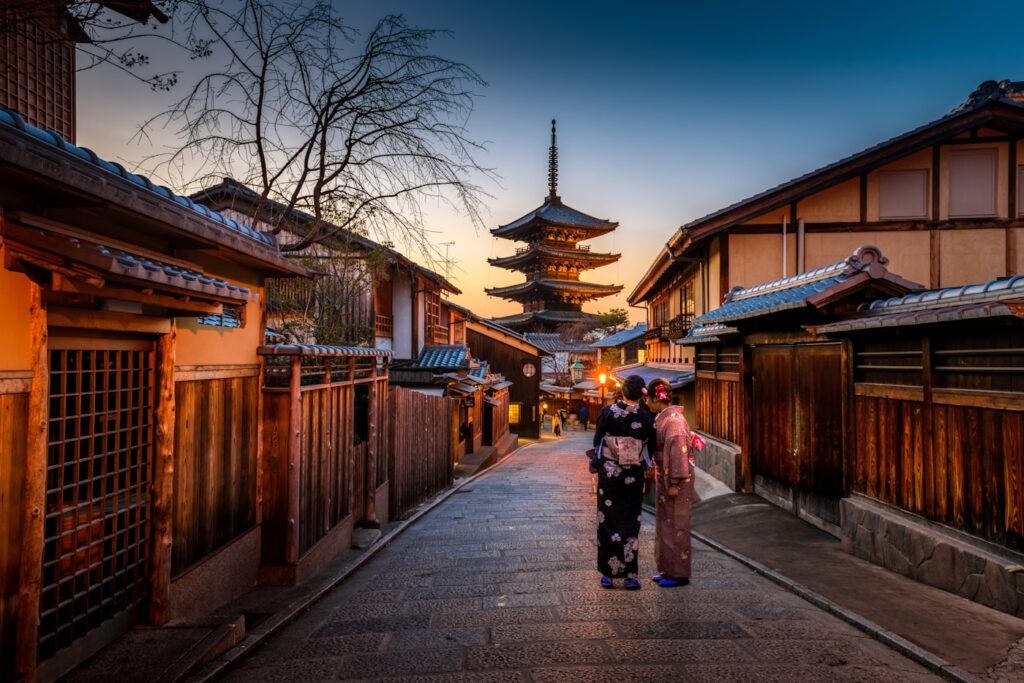
Kyoto, you should know going in, is now in a difficult relationship with its own beauty. The city receives more visitors than it has the streets to absorb, and the most photographed corners, Fushimi Inari at midday, the bamboo grove at Arashiyama on a Saturday, the Gion lanes after dark — have become harder to experience than to photograph. The city has begun to push back. Geisha-district photography has been formally restricted on some streets since. The taxis decline certain pickups. The famous restaurants have a quiet refusal policy. None of this is hostile; it is, in a very Japanese way, a request that the visitor adjust their pace. The visitor who adjusts is rewarded with a city that, in its proper rhythm, has almost no equal anywhere in the world.
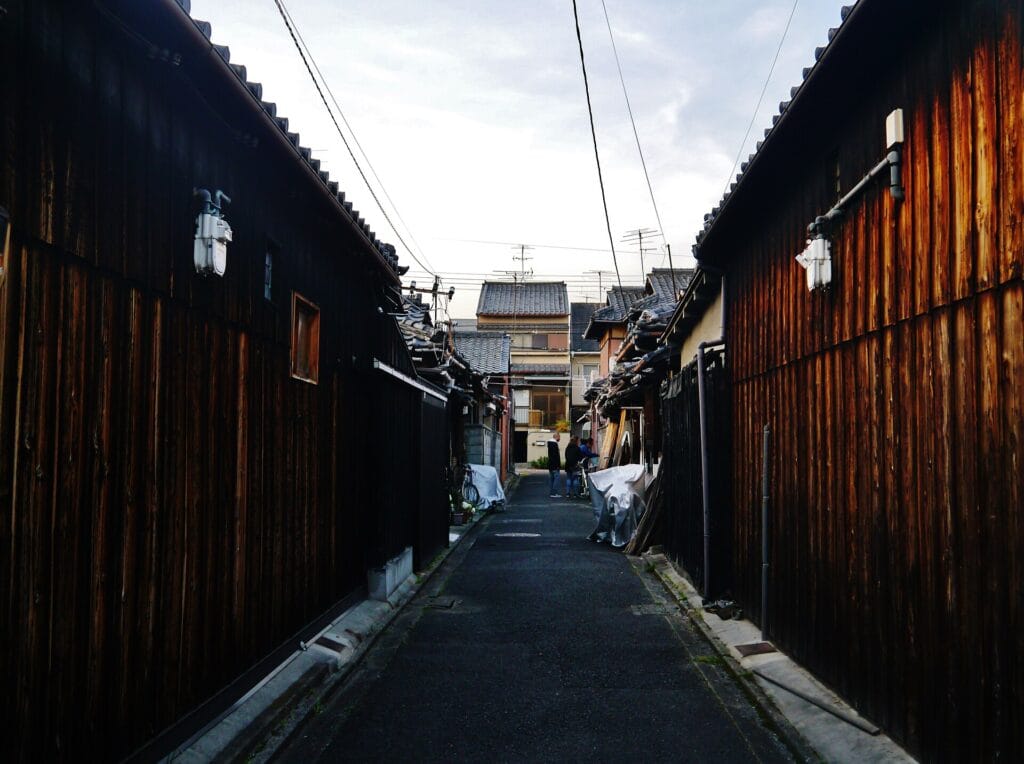
I want to be useful in this guide rather than romantic. The temple count in Kyoto is around two thousand, which is more than any traveller can usefully visit. The honest move is to choose five or six well, see them at the right hours, and leave time for the parts of the city that are not temples, the kissaten coffee houses still serving a single blend on porcelain at three in the afternoon, the neighbourhood izakayas where the menu is hand-written and no one expects English, the small textile shops that have been in the same family since the eighteenth century. The temples are the famous Kyoto. The texture is the real one.
Planning around the season?
See Kyoto in November for month-specific timing, pricing, and crowd realities.
| Best month to visit | October — 21.9°C, 9 wet days |
|---|---|
| Warmest month | August, 32°C average high |
| Wettest month | July, 19 wet days |
| Plugs & power | Type A,B · 100 V · 50/60 Hz |
| Driving side | Left |
Climate: normals (WMO 1991–2020, or ERA5 2019–2023 where unavailable) via Open-Meteo. Open data.
When to come
Five windows are worth knowing.
Cherry blossom: sakura. Runs late March through the first week of April. As good as the photographs suggest, and as crowded. Hotel prices double. The reservations for famous restaurants vanish a quarter ahead. If you come for sakura, accept the trade-off and stay seven nights minimum so you have several mornings to chase the bloom in less-photographed places, the Philosopher’s Path before seven in the morning, the canals around Okazaki at dawn, the small temple grounds in the northwest that no one walks to.
Autumn colours, kōyō — peak from the third week of November into the first week of December. This is the season I’d recommend to a first-time visitor. The colour is softer than New England’s; the moss gardens (Saihō-ji, Gio-ji) hold the orange and yellow against the green in a way that feels distinctly Kyoto. Crowds are real but a third less than sakura.
The underrated window is the second half of January into February. Cold, sometimes snow, the city at its quietest in the year. The famous temples have meaningful air around them again. The kaiseki season menus reach their proper winter form: sea bream, monkfish, root vegetables, an entirely different palate from spring’s. Hotel prices are at their annual low.
Summer (June to early September) is humid, hot, and the temples lose most of their visual relief in the haze. Avoid if your dates are flexible. The exception is the Gion Matsuri festival in July, the city’s great event, which is worth a trip in itself if your interests run that way.
Golden Week (late April / early May) and Obon (mid-August) are Japanese domestic-travel surges. Foreigners feel the price spike and the crowding. Plan around them.
The honest geography
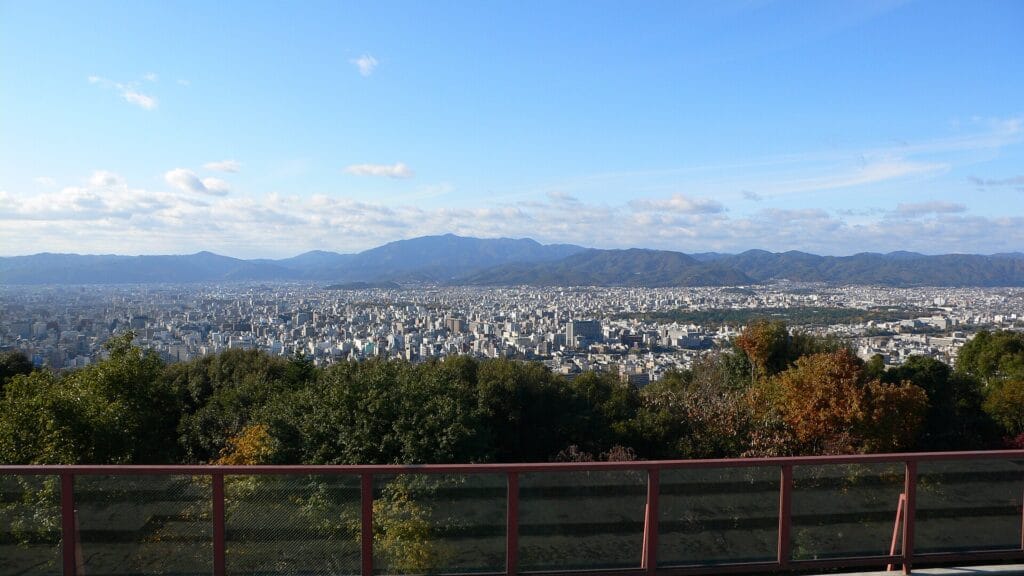
Kyoto is shaped like a north-south rectangle, three kilometres east-west and seven north-south, with the famous neighbourhoods spread along the eastern and western edges and the centre containing the train station, the modern shopping, and most of the hotels.
Higashiyama, on the eastern side, is the postcard Kyoto. Kiyomizu-dera, Yasaka Shrine, the lanes of Sannenzaka and Ninenzaka, the Gion entertainment district, the Philosopher’s Path running north along a canal. This is where most visitors spend most of their time, and where most of the famous photographs were taken. Walk it in the very early morning. By ten it is overwhelmed.
Arashiyama, on the western edge, has the bamboo grove, the Tenryū-ji temple, the small island of Nakanoshima in the river, and the Saga-Toriimoto quarter further up. Half a day. Go early.
The north, the Kitayama and Daitoku-ji and Kinkaku-ji neighbourhoods, is quieter and home to the Zen temple complexes that reward a longer visit. Daitoku-ji is a network of about twenty sub-temples; only four or five are open to the public, and the moss gardens at the smaller ones are the underrated Kyoto experience.
The centre — Karasuma, Shijō, the Nishiki Market: is for shopping, eating, and the everyday rhythms of the city. Stay here if you want to be most convenient for getting everywhere; stay east or northeast if you want the morning walk through quiet streets to a temple before the visitors arrive.
The temples, ranked by morning
The single most useful piece of advice for Kyoto is to do one temple a day, properly, in the first two hours after opening. The famous temples are essentially unrecognisable at midday. They are extraordinary at seven.
The famous temples are essentially unrecognisable at midday. They are extraordinary at seven.
Fushimi Inari (the orange torii gates) opens at six in the morning. The first kilometre of the climb is the photographed part; the trail continues uphill for another hour to the summit, and almost no one walks it. Go at sunrise. Drop out at the second viewpoint if the heat is bad.
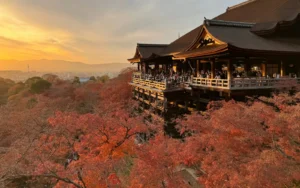
Kiyomizu-dera opens at six. By eight it is full. By nine it is unmanageable. Go at opening, drink the spring water (the three streams have three distinct meanings. Pick one rather than all three, which is considered impolite), and walk down Sannenzaka before the shops open.
Ginkaku-ji (the Silver Pavilion) is small and serene and best at opening. Combine with the start of the Philosopher’s Path in the same morning. Tofuku-ji has the great autumn maple view, and is one of the few places worth doing in the late afternoon for the slant light.
Ryōan-ji has the famous rock garden. It is small. You sit on the wooden viewing platform. You stay twenty minutes. Pick a morning when you can sit through the silence; pick a different day if you can’t.
Saihō-ji (the moss temple) requires an advance written application by mail and a three-thousand-yen entry that includes a copying-of-sutras meditation before you are allowed into the garden. Worth the effort. The garden is, properly seen, one of the great achievements of any kind of design.
Skip, on a first visit — Kinkaku-ji (the Golden Pavilion) unless you arrive at opening and can leave within forty minutes. The pavilion is a photograph, the gardens around it are touristed, and the time is better spent at the smaller temples nearby.
The food, by tier
Kyoto’s food culture is older and more codified than Tokyo’s. There are three tiers worth understanding.
The kaiseki dinner at a ryotei. This is the famous Kyoto multi-course dinner: eight to twelve courses, seasonal vegetables, fish from the Sea of Japan, a careful procession from sashimi through grilled fish through a rice course. The genuine ryotei (Kikunoi, Hyotei, Kitcho Arashiyama) are €200 to €500 a head, book three months ahead, and deliver an experience that is half theatre and half cuisine. Do this once if your trip allows it. Do not do it on your first night, because you have not yet calibrated to the city.
The kaiseki lunch, which is the same cuisine at lunch and at a third of the price. Most ryotei serve a meaningful lunch tier (Hyotei’s lunch is famously beautiful for ¥7,000–9,000). This is the right way to experience kaiseki on a first trip.
The everyday Kyoto food, which is its own genre. Ohan, the home-style obanzai cuisine. Small plates of vegetables and fish, served as a teishoku set at lunch, is what locals eat. Menami in the centre, or any small obanzai counter in a working neighbourhood, is the right call. Add to this: the ramen at Inoichi or Honke Daiichi-Asahi for the local Kyoto take (lighter than Tokyo’s), the udon at Omen near Ginkaku-ji, the tofu cuisine (yudofu) at Tousuiro by the canal — Kyoto’s tofu is genuinely better than anywhere else, a holdover from the temple-vegetarian tradition.
And the matcha. The serious tea houses (Ippodo near Karasuma, En in Gion) will prepare a bowl of matcha for you in proper form for under ¥1,500, with a wagashi sweet. Do this once. The tourist version with the rolling green-tea ice cream is a different product.
The neighbourhood worth a slow afternoon
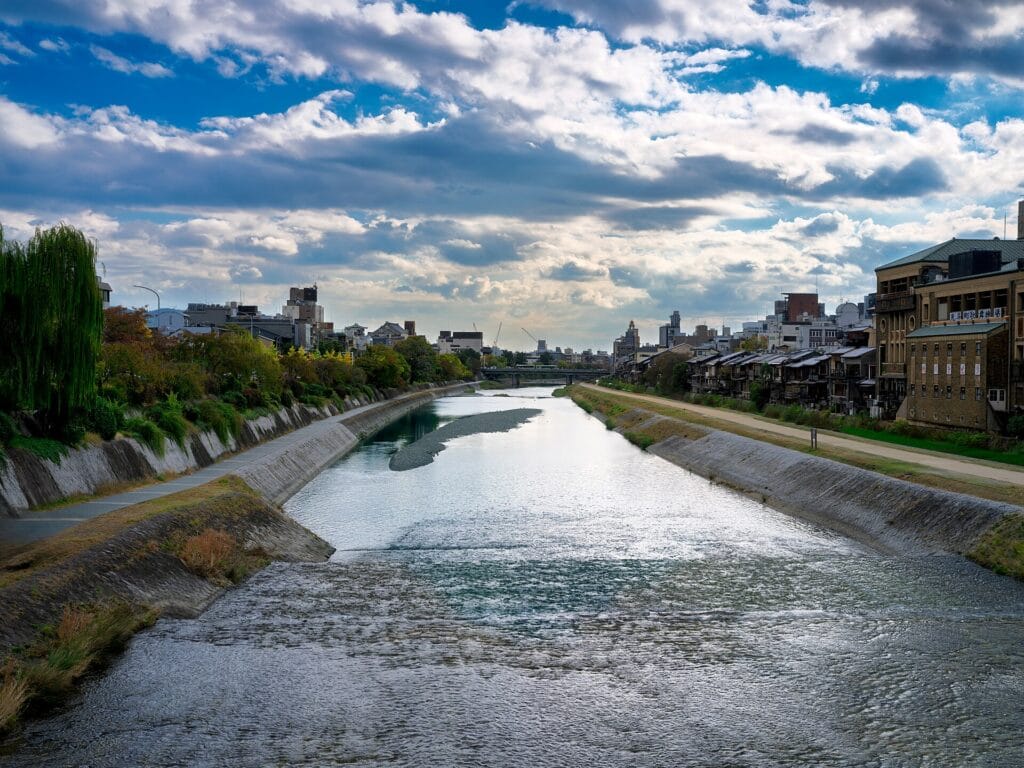
Kamogawa. The river that runs north-south through the centre, and the part of Kyoto where the city seems to remember it has a body. In late spring through autumn, the eastern bank south of Sanjō Bridge fills with people sitting on the grass at sunset: students, salarymen with cans of beer, dating couples placed at almost perfectly equal intervals along the embankment (a habit so consistent it has been studied), families on small picnic mats. Grey herons stand in the shallows below them and do not move for an hour at a time. The river itself shifts audibly through the season; by August the shallow rapids near Demachiyanagi can be heard from a hundred metres back. The wooden platforms (yuka) extend from the western-bank restaurants from May through September, a yuka dinner is one of the city’s quieter summer pleasures, and the food is, in honest cases, a touch less interesting than the air over the water.
Sit on the river for a long evening. Do not photograph it. This is the Kyoto worth remembering.
Where to stay
The Park Hyatt Kyoto, opened 2019 on a hillside above Higashiyama, is the contemporary luxury benchmark. Design-careful, with views over the city and walking access to Kiyomizu-dera. The Aman Kyoto, in the northern hills behind Kinkaku-ji, is the secluded forest-temple Aman experience and a different sort of trip entirely. The Hoshinoya Kyoto, on the Hozu-gawa river accessible only by boat, is the ryokan-luxury option for travellers wanting a quieter base outside the city.
For a more honest mid-range, the small ryokan still operate at scale in Kyoto, Tawaraya is the famous traditional ryokan (eleven generations), Hiiragiya next door is the smaller counterpart, both run between ¥50,000 and ¥120,000 a night. The contemporary independent hotels — Mume, The Thousand Kyoto, Node Hotel, Maana Kyoto: are the design choices in the same range as Tokyo’s boutique tier.
Below that, the machiya rentals (restored wooden townhouses) are the underrated option, a whole house, sleeping four or six, often with a small private garden, in a quiet residential neighbourhood, at a price below the comparable hotel. The licensed operators (Iori, Yadoya, Mr. & Mrs. Smith) are the safe versions.
Day trips, briefly
Nara. Ninety minutes by train, the older capital, Tōdai-ji and its great Buddha, the deer in the park. A half-day is enough; the city itself does not reward longer.
Ohara, a small mountain village forty minutes north of Kyoto, with the Sanzen-in temple and a slower pace. Underrated. The best autumn-leaf afternoon I have had in Kansai was here, with eight other people on the temple grounds.
Uji, between Kyoto and Nara, the tea country, the Byōdō-in temple (the building on the ten-yen coin), and the small tea shops along the river. Half a day.
Skip, the bus-tour Hiroshima day trip, which is too far for the time. Go to Hiroshima as a separate two-night stay.
What will surprise you
The quiet. Tokyo at ground level is quieter than expected; Kyoto, outside the famous corridors, is quieter still. The walking distances, which are larger than the map suggests. The bus system, which is the actual transport of the city, the subway covers only the centre. The cold of December nights. The seriousness with which the kaiseki seasons are observed — what you eat in November is not what you eat in May, and the changeover is not flexible. The kindness in the small ryokan, which is a different register of service from the contemporary hotel.
What will disappoint you if you let it
The crowding at the famous places at midday. The Gion-photography problems, real and growing. The fact that many of the small restaurants do not accept walk-in foreigners, not from hostility but from a quiet system of regular customers and limited seats; the workaround is to have your hotel call ahead or use the OMAKASE booking app for the higher tier. The cost, which is now closer to Tokyo’s than it used to be, particularly for accommodation.
Practical, briefly
Kyoto Station is the hub for trains; the Shinkansen from Tokyo is two hours and a third (book a Hikari, not a Nozomi, if you have a JR Pass). The local subway has only two lines and the buses do almost all the heavy lifting: get an IC card (Icoca or Suica) at the station on arrival. Taxis are reasonable but the older drivers may decline destinations they don’t know in English; show the address in Japanese characters on your phone. Most signs in central Kyoto are bilingual; smaller temples and restaurants are not. Cash is more useful here than in Tokyo. Tipping is genuinely refused.
A final thought
The visitor who comes to Kyoto in a hurry leaves disappointed. The famous places, in a hurry, are crowds. The temples, in a hurry, are buildings you photograph. The kaiseki, in a hurry, is an expensive meal you do not understand. The same city, given the seven mornings it asks for, becomes one of the most quietly extraordinary places anyone can travel to, a place where the seasons are observed in detail you have never seen taken seriously, where the craft tradition is genuinely alive in the studios you walk past, where the gardens are designed to be read slowly and rewarded for it. Plan for the long stay. Plan for the early mornings. Walk back over the Kamogawa at six in the evening, with the lights of the wooden river houses coming on across the water, and let the city show you what it has been keeping for the patient visitor.
<!–Planning around the season?
–> <!–See Kyoto in November for month-specific timing, pricing, and crowds.
–> <!–Seasonal questions
When is the best month to visit Kyoto?
Late November for momiji (peak around the 20-25th, year-dependent), or early April for sakura. October is the value pick: 15-22 C, hotel pricing 25-30% below peak, the first ginkgo trees turning yellow. Avoid August: 34 C with 80% humidity is the wrong way to walk Kiyomizu-dera.
Is Kyoto better in spring or autumn?
Autumn, more reliable. Cherry blossom peak is a plus/minus-five-day window that can wreck a fixed itinerary; momiji is a plus/minus-ten-day window that is easier to hit. Autumn temples (Tofuku-ji, Eikan-do, Kifune Shrine) look better with red maples than they do with pink blossoms.
How early should I book Kyoto for momiji season?
Six months. By May, the well-located ryokan and machiya rentals for the late-November peak are gone. Add flights to the equation: KIX direct from major US/EU cities books out earliest. If you are flexible, target Nov 23-30; if not, target Nov 18-22 and pay 30% more.
Kyoto like a local: temples, the seasons & the plan
The must-dos
The thousand vermilion torii of Fushimi Inari (go at sunrise), the Arashiyama bamboo grove (also early), the Golden Pavilion Kinkaku-ji, and the lantern-lit lanes of Higashiyama and Gion at dusk.
Eat refined
Kyoto specializes in kaiseki (multi-course art), temple tofu (yudofu), obanzai home cooking, and matcha everything. Graze through Nishiki Market (“Kyoto’s Kitchen”).
Timing matters
Cherry blossom (early April) and autumn leaves (mid-late November) are magical but crowded. Start temple visits at opening to beat crowds and heat.
Day trip & logistics
Nara (bowing deer, Great Buddha) is a half-day. Buses get packed — consider a bike for the flatter center. Three days covers the highlights plus Nara.
Kyoto Travel Guide FAQ
How many days do you need in Kyoto?
Three — the headline temples, the bamboo grove, Gion, and a Nara day trip.
When is the best time for Kyoto?
Cherry blossom (early April) and autumn leaves (late November) — beautiful but crowded.
More from Packzup
Frequently Asked Questions
Is Kyoto worth visiting?
Yes. Kyoto rewards travelers who are willing to look beyond the surface. From local food to cultural sites, there is plenty to discover for every type of traveler.
How many days should I spend in Kyoto?
Plan for at least 3-4 days to cover the main highlights. A week allows for day trips and a more relaxed pace that lets you experience the destination more deeply.
What is the best way to get to Kyoto?
Options typically include flights to the nearest international airport, followed by local transport. Check for direct flight routes from your departure city for the most convenient travel.
Do I need travel insurance for Kyoto?
Travel insurance is strongly recommended for any international trip. It covers medical emergencies, trip cancellations, and lost luggage — risks that are expensive to handle out of pocket.
More guides: Kyoto vs Osaka
Best time to visit Kyoto (real climate data)
Best months: May, June, July, September, October.
Kyoto’s warmest month is August (avg 32°C / 90°F), the coolest is January (low -1°C / 31°F). The wettest is July (224 mm) and the driest is January.
Source: Open-Meteo / WMO climate normals (WMO 1991–2020, or ERA5 2019–2023 where unavailable). See the full month-by-month weather →
You Might Also Love

Written by
Founder of Packzup. Independent travel writer covering offbeat destinations across six continents since 2018. Every guide is independently researched and self-funded — no press trips, never sponsored.
Before you go: see whether they speak English in Kyoto and what to wear, check the tap water, sort your mobile data, and find out if it is a cash or card destination, and brush up on local etiquette.
