
Last updated September 1, 2026 · Editorial policy
Jericoacoara isn’t on any highway. The village sits behind a wall of sand dunes in northeast Brazil, and that’s exactly why it stayed magical while the rest of the Ceará coast got developed. No paved road reaches the town center. No regular cars drive its streets. The last stretch is sand, crossed in an open-air 4×4 truck the locals call a jardineira.
Need accommodation? Read our full guide: Best Pousadas in Jericoacoara, every budget from R$80 dorms to boutique pools.
If you’re planning a trip, here are the six attractions actually worth your time, plus the hard-won practical tips nobody mentions in the guidebooks. This guide is based on current-season pricing, recent trip reports, and input from operators working inside Jericoacoara National Park.
Ready to book your Jeri trip?
Dune-buggy tours, kitesurfing lessons, and sunset photography packages all run by licensed operators inside the national park.
More: When to visit Brazil · Brazil travel guide
What You’ll Find in This Guide
- Duna do Pôr do Sol, the legendary sunset dune
- Pedra Furada, the stone arch you’ve seen on every postcard
- Lagoa do Paraíso, the freshwater hammock lagoon
- Árvore da Preguiça, sunset at the “lazy tree”
- Kitesurfing the main beach — even if you’ve never tried
- Sunset capoeira on the beach
- How to get to Jericoacoara from Fortaleza
- Where to stay
- Practical tips nobody tells you
- FAQ
1. Duna do Pôr do Sol: The Legendary Sunset Dune
Every single evening, the entire village walks, or jogs, depending on how late they left: to a single massive sand dune on the western edge of town. At the top, hundreds of people gather in silence to watch the sun drop into the Atlantic Ocean. When the final sliver disappears, the crowd applauds. It sounds corny until you’re there. Then it isn’t.
When to arrive: 45 minutes before sunset. You want time to climb (it’s steeper than it looks), settle in, and claim a spot with a clear western sightline.
What to bring: A sarong or light blanket to sit on (the sand holds heat), water, and a small flashlight for the walk down in the dark.
Planning note: Skip the caipirinha vendors at the base. Prices are triple what you’ll pay in town. Drink before, or walk 5 minutes to the main square after.
2. Pedra Furada: The Stone Arch
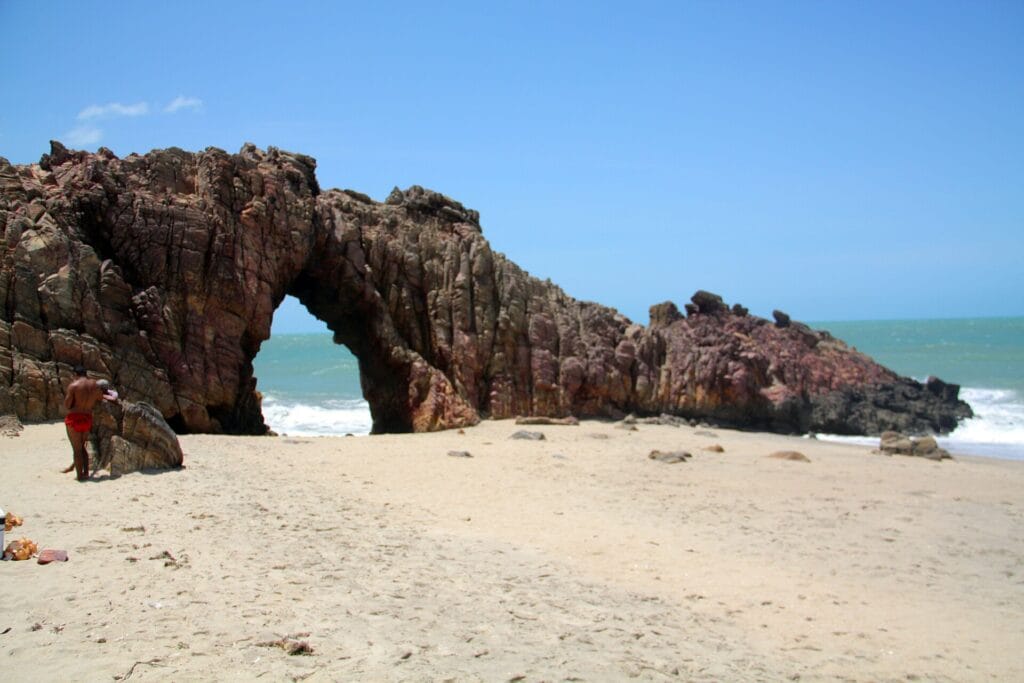
Pedra Furada is the natural rock arch carved into a cliff on the eastern coastline. It’s the image on half the postcards sold in the village and genuinely deserves the hype, but only if you time it right.
Access window: You can only reach the arch on foot at low tide, via a 45-minute walk along the beach from town. Check the tide chart posted on the chalkboard outside most pousada reception desks. Miss the window and you’re stuck climbing a slippery cliff path.
Best season: July through December, when the angle of sunrise puts the sun directly through the arch hole. Photographers: arrive 30 minutes before sunrise.
Alternative: If the tide doesn’t cooperate, take a buggy tour that includes Pedra Furada as one stop on the eastern route. Tours run around R$ 180–250 per person and cover 4–5 attractions in half a day. Book a Jericoacoara buggy tour.
3. Lagoa do Paraíso: The Hammock Lagoon
About 25 minutes outside Jericoacoara by buggy, Lagoa do Paraíso is exactly what it sounds like: a freshwater lagoon so shallow you can walk a hundred meters from shore, with wooden hammocks strung in the water and beach bars serving grilled fish and cold Skol. Spend the entire afternoon here. Nobody rushes.
Getting there: Every buggy tour from Jeri includes Lagoa do Paraíso and nearby Lagoa Azul. Don’t try to DIY with a rental car, you’ll get stuck in sand.
Hammock rental: Most bars let you use their-water hammocks free if you order food and drinks. Kaite, Rancho do Peixe, and Alchymist are the three most established spots.
What to pack: Reef-safe sunscreen (the sun reflects off the white sand — you will burn), a waterproof phone pouch, and cash. Card readers are unreliable this far from the village.
4. Árvore da Preguiça: The “Lazy Tree”
A single windswept tree leans over the sand on the western beach, roots exposed, branches stripped to an almost abstract shape by decades of coastal wind. Locals call it Árvore da Preguiça (“the lazy tree”) because of how it appears to be lying down. It’s a 10-minute walk from the main square and it’s where the best sunset photos happen: silhouetted tree, pink sky, kitesurfer in the distance.
Photography tip: Get here 90 minutes before sunset, shoot the “golden hour” through the branches, then walk 5 minutes north to Duna do Pôr do Sol to catch the actual sunset. Two different looks, one walk.
5. Kitesurfing the Main Beach: Even if You’ve Never Tried
Jericoacoara is on every serious kitesurfer’s bucket list for one reason: the wind blows steady at 18–25 knots from July through December with an almost clockwork-like reliability. If you’ve ever been curious about the sport, this is the place to learn.
Beginner lessons: A 3-hour intro lesson runs R$ 450–600. Rancho do Peixe, Club Ventos, and Jericoacoara Kite School are the three reputable operators. All provide gear. No swimming skill required for the first lesson. You’ll be on the beach learning kite control.
To get riding independently: Budget 8–12 hours of lessons over 3–4 days. Most visitors don’t have time for this; a single taster lesson is still worth every real.
Not into kitesurfing? Just go sit on the main beach at 3 PM and watch 60+ kites in the sky simultaneously. It’s a spectacle in itself.
6. Sunset Capoeira on the Beach
Most evenings around sunset, a local capoeira group forms a roda (circle) on the sand near the main square. Drums, berimbau, clapping, two players at a time, and anyone can watch. It’s not a performance, it’s a regular community practice that happens to be spectacular.
You won’t find this listed on any official tour operator page. Ask your pousada owner in the morning if a roda is happening tonight. In peak season (July, December, and Carnaval week) it runs almost daily.
How to Get to Jericoacoara From Fortaleza
Whatever transport you pick, your last leg will always be a jardineira, the open-air 4×4 that crosses 22 km of dunes between Jijoca de Jericoacoara (the gateway town) and the village itself. There is no paved road into Jeri. Plan for this.
- Private transfer: 4.5 hours door-to-door. R$ 1,200–1,800 per vehicle (up to 4 people). Best for groups.
- Shared van: 6 hours. R$ 180–250 per person. Best balance of cost and convenience for solo travelers and couples.
- Public bus (Fretcar) + jardineira: 6.5–7 hours. R$ 120–160 per person total. Cheapest option; overnight bus saves a hotel night.
- Fly into JJD (Jericoacoara Airport): 1 hour from Fortaleza. R$ 900–2,500 one-way depending on season. Fastest but expensive.
We’ve written a full breakdown of every route with current pricing here: our full Fortaleza-to-Jericoacoara transfer guide.
Where to Stay in Jericoacoara
Jericoacoara has accommodation for every budget, from R$ 90/night hostel dorms to R$ 2,500/night luxury pousadas with private pools. Three things to know before you book
- Stay inside the village. It’s small enough to walk end-to-end in 10 minutes. Any pousada more than a 15-minute walk from the main square means you’ll need a buggy for every meal.
- Book 2–3 months ahead for peak season. July, December, and Carnaval sell out completely.
- Check reviews for A/C and wind. Jeri is hot and windy. The combination of those two words matters for sleep quality.
Popular options: Pousada Tirol (mid-range, great location), Vila Kalango (upscale, beachfront), Essenza Hotel (boutique luxury). Compare current Jericoacoara hotel prices.
Practical Tips Nobody Tells You
- Bring cash from Fortaleza. The one ATM in Jeri is unreliable, especially on weekends. Expect to pay in cash at smaller restaurants and all beach bars.
- Cell signal is patchy. Vivo and Claro work best. Download offline Google Maps before you leave Fortaleza.
- The last jardineira out of Jeri leaves around 5 PM. Miss it and you’re staying another night.
- No street signs, no addresses. Pousadas are found by rua names and landmarks. Ask your driver to walk you to reception.
- Mosquitos at dusk. Bring repellent, especially if you’re near the lagoons in the evening.
- Tip your jardineira driver. R$ 5–10 per person is standard; they often double as luggage porters.
Get our next underrated destination in your inbox
Every Friday we send one offbeat travel guide — hidden beaches, quieter ski country, shoulder-season logistics. Free. Unsubscribe anytime.
What to Pack for Jericoacoara
Jeri’s combination of sand streets, strong wind, and remote location rewards specific gear. Half these items cost under $25 and save buying overpriced equivalents once you arrive.
- Reef-Safe Mineral Sunscreen (SPF 50): The sun in Ceara is intense year-round. Reef-safe is required in Brazilian national parks. Buy before you go; sunscreen is expensive and limited in the village.
- Dry Bag (20L, waterproof): The jardineira crossing is open-air. In rainy season (Feb-May) everything gets wet. Non-negotiable for protecting electronics.
- Quick-Dry Travel Towel (microfiber): Dries in under an hour. Saves buying an expensive resort towel or carrying a heavy regular one.
- Rash Guard / UPF 50 Shirt: Kitesurfing lessons and beach days back-to-back will burn you without sleeve coverage.
- Water Shoes: Lagoon floors have shells and small rocks. Water shoes make the hammock-lagoon days comfortable.
- Portable Phone Charger (10,000 mAh): Power flickers in the village and accommodations. A charger covers you for a day of photos and navigation.
- Universal Power Adapter (Brazil, Type N): Brazil uses an uncommon plug type. A universal adapter with Type N support handles every outlet you will encounter.
Disclosure: Packzup is a participant in the Amazon Services LLC Associates Program. We earn a small commission on qualifying purchases at no cost to you.
Frequently Asked Questions
Is Jericoacoara worth visiting?
Yes. Despite growing popularity, the national-park designation around the village strictly limits development, so the experience remains authentic. Peak season crowds concentrate in July and December: travel in May, June, or late August for smaller crowds and the same wind and weather.
How many days do you need in Jericoacoara?
Minimum 3 nights. Day 1 is usually a travel day. Day 2 for the western beach, Duna do Pôr do Sol, and the main village. Day 3 for the eastern beach buggy tour (Pedra Furada, lagoons). Add a fourth day if you want to kitesurf or fully relax.
Is Jericoacoara safe?
Yes. It’s one of the safest destinations in northeast Brazil. The village is small, tourism-dependent, and heavily patrolled. Standard precautions apply: don’t leave valuables on the beach unattended, use pousada safes, and stick to lit areas after midnight.
What’s the best time of year to visit Jericoacoara?
July to December for kitesurfing wind and dry weather. February to May for lower prices and greener landscapes, with occasional rain. Avoid Carnaval week unless crowds are part of what you’re looking for.
Can I visit Jericoacoara as a day trip from Fortaleza?
Technically yes with a private transfer, but it’s brutal: 9+ hours of driving for roughly 3 hours in the village. Don’t do it. Stay at least 2 nights.
Do I need a 4×4 to visit Jericoacoara?
No. You won’t drive your own vehicle into the village even if you have one. The final 22 km is sand, crossed only by licensed jardineira operators. All transfers from Fortaleza include the jardineira leg.
Last updated: April.
Related Jericoacoara Guides
- How to Get to Jericoacoara From Fortaleza, every transfer option compared
- Jericoacoara vs Canoa Quebrada, which Ceará beach town fits your trip
FAQ
How do you get to Jericoacoara? Fly to Jericoacoara airport (JJD) or Fortaleza, then a 4×4 transfer across the dunes — the final stretch has no paved road, and that is the point.
Best time to visit Jeri? July–December for wind sports; December–February for calmer beach days; sunsets deliver year-round.
Is Jericoacoara expensive? Mid-range for Brazil — pousadas from R$300; buggy tours are the main splurge. See where to stay.
FAQ
How do you get to Jericoacoara? Fly to Jericoacoara airport (JJD) or Fortaleza, then 4×4 transfer across the dunes: the final stretch has no paved road – that is the point.
When is the best time to visit Jeri? July-December for wind sports: December-February for calmer beach days: sunsets deliver year-round.
Is Jericoacoara expensive? Mid-range for Brazil: pousadas from R$200: buggy tours are the main splurge.
You Might Also Love


Written by
John Morrison is the founder and lead travel writer at Packzup. Over the past decade he has explored destinations across Africa, the Americas, Asia, Europe, the Middle East, and Oceania — always self-funded, never on a press trip.
