
- The Jordan Pass math (this actually changes the trip)
- When to come, honestly
- Amman: enough for one day, maybe two
- Petra: how many days, and which gate?
- Petra by Night: is it worth $40?
- Wadi Rum: which camp class
- Aqaba: the Red Sea decision
- What 5 days really costs
- Related guides
- Frequently asked
- Plan Your Jordan Trip
- More Travel Guides You'll Love
- Frequently Asked Questions
Jordan packs three of the Middle East’s most spectacular sights, Petra, Wadi Rum, and the Dead Sea — into a country small enough to drive from Amman to Aqaba in five hours. The standard route runs Amman → Dead Sea → Petra → Wadi Rum → Aqaba over 5–7 days, and the entire trip can be done by rental car or by hiring a driver. The Jordan Pass changes the cost math significantly for most travellers. This guide covers the pass break-even calculation, the Petra-by-night verdict, which Wadi Rum camp class matters, and what 5 days actually costs.
Quick stats
- When to come: March: May, September. November
- Best month: April (warm, post-rains, before summer heat)
- How long: 5 days minimum, 7 days ideal
- Daily budget: USD 100–180 mid-range
- Jordan Pass: JOD 70–80 (Petra 1–3 days + visa + 40 attractions)
- Petra ticket alone: JOD 50 for 1 day, JOD 55 for 2 days
The Jordan Pass math (this actually changes the trip)
The Jordan Pass bundles the entry visa, Petra entrance, and access to 40+ attractions into a single ticket. Three tiers, varying only by Petra-day count:
- Jordan Wanderer: 1 day at Petra. JOD 70 (USD 99).
- Jordan Explorer: 2 days at Petra. JOD 75 (USD 106).
- Jordan Expert: 3 days at Petra. JOD 80 (USD 113).
Critical condition: the bundled visa is only included if you stay 3 nights or more in Jordan. Shorter trips need to buy a visa separately (JOD 40 / USD 56 on arrival) and the pass becomes less compelling.
Break-even calculation
If you’re staying 3+ nights and visiting Petra, the Jordan Pass nearly always pays back:
- Visa standalone: JOD 40
- Petra 1-day: JOD 50
- Subtotal: JOD 90
- Jordan Wanderer: JOD 70
- Savings: JOD 20 (USD 28) before you visit any other attraction
Add Wadi Rum (JOD 5), Jerash (JOD 10), and any others, the pass saves USD 50–80 typically. Buy the Expert tier (JOD 80) if you’ll spend 2+ days at Petra, which most travellers should.
Buy at jordanpass.jo before arrival. Print the QR code; show it at the visa counter.
When to come, honestly
Jordan has two clear shoulder windows:
- March–May: Spring. Wildflowers in March. Atlas-mountain green visible from the King’s Highway. Temperatures 18–28°C. The window most photographers prefer.
- September–November: Autumn. Slightly cooler, the desert nights are crisp (sweater required in Wadi Rum), still excellent.
Summer (June–August): Petra hits 38–42°C with no shade in most of the ruins. The Monastery climb (900+ steps) becomes physically dangerous. Wadi Rum desert temperatures touch 45°C by 11am. Most experienced travellers avoid summer entirely.
Winter (December–February): Cold in Amman (5–12°C, occasional snow). Petra can be misty and atmospheric. Wadi Rum nights drop to 0°C. The off-season has lower prices and far fewer crowds but requires winter clothing: not the obvious choice.
Ramadan awareness: Ramadan dates shift each year. During the holy month, daytime food service slows in conservative areas, museum hours change, and tourist sites operate on reduced schedules. Tourism continues normally and travellers are not expected to fast, but check the calendar.
Amman: enough for one day, maybe two
Amman is a modern Arab capital built across seven hills, with a small but worthwhile downtown core. The standard 1-day visit:
- Citadel (Jebel al-Qal’a): Roman ruins on the hilltop, the Temple of Hercules, the Umayyad Palace, and the panoramic view over downtown. JOD 3 (or covered by Jordan Pass).
- Roman Theatre: 2nd-century 6,000-seat amphitheatre at the foot of the citadel hill.
- Rainbow Street: The walkable cafe-and-shop strip; the closest Amman gets to a “tourist neighbourhood.”
- Hashem Restaurant downtown for hummus and falafel. Cheap, busy, locally beloved.
Day-trips from Amman
Jerash (45 km north): one of the best-preserved Roman cities in the Middle East. Worth a half-day. JOD 10.
Wadi Mujib (canyon trekking, March–October only): the Siq trail involves wading and swimming through a slot canyon. JOD 21. Wet but spectacular.
Madaba + Mount Nebo: the Byzantine mosaic map of the Holy Land, and the view Moses had of the Promised Land. Half-day on the way south.
For a tight 5-day Jordan trip, skip Amman after the first day. For 7 days, include Jerash and Madaba.
Petra: how many days, and which gate?
Petra deserves at least 2 days and rewards 3. The site is much larger than first-time visitors expect, the famous Treasury is only the entrance; the full ruins extend across several kilometres of valleys, with the Monastery requiring a 45-minute uphill climb from the main route.
1-day vs 2-day Petra
- 1 day: Enter through the Siq, see the Treasury, walk down to the Street of Facades, climb to the High Place of Sacrifice or the Monastery (pick one). 6–8 hours of walking. Misses half the site.
- 2 days: Day 1 the main route + Monastery climb. Day 2 the High Place of Sacrifice + the back route from Little Petra. Far more complete.
- 3 days: Adds the Royal Tombs in detail, the Wadi Farasa trail, and the Petra by Night experience.
The back-route from Little Petra (Beidha)
Most visitors enter Petra through the main gate via the Siq. A more interesting alternative on Day 2: hire a local Bedouin guide (USD 30–50) for the back route from Little Petra (Beidha): a 3-hour hike that drops you into Petra near the Monastery, reversing the typical route and avoiding the morning Treasury crowd.
The Monastery climb
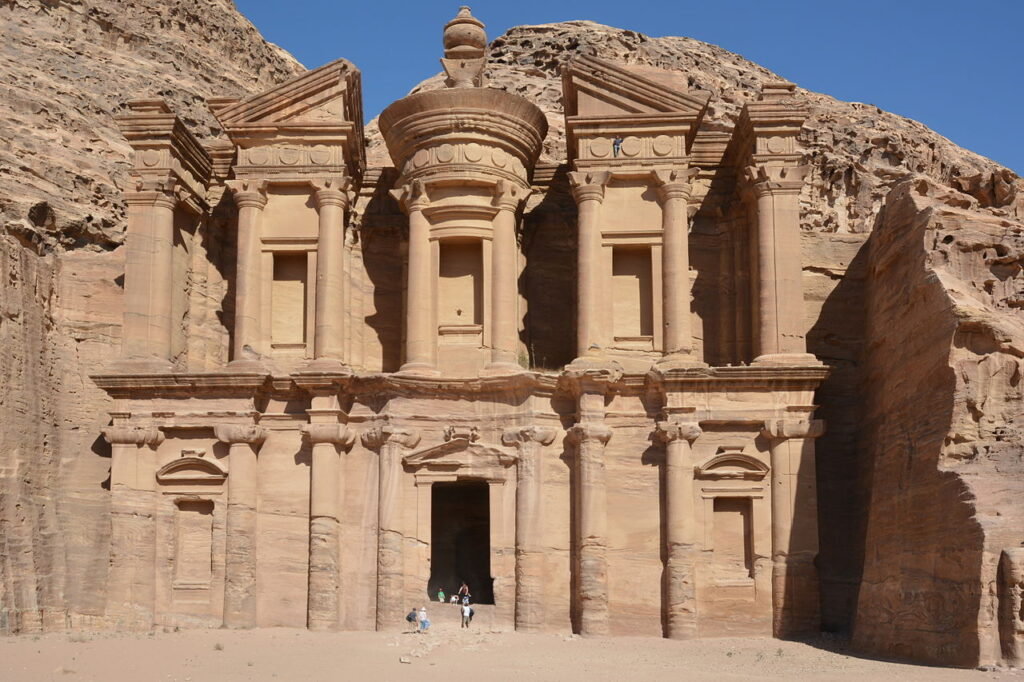
The Monastery (Al-Deir) is at the top of 900+ rock-carved steps. The climb takes 45–60 minutes uphill in heat. Locals offer donkey rides for JOD 15–25. The summit view, with the carved Monastery facade emerging from the rock, is the trip’s other defining moment after the Treasury reveal. Allow 3 hours round trip from the bottom of the steps.
Petra by Night: is it worth $40?
Petra by Night operates Monday, Wednesday, and Thursday evenings (8:30–10:30pm). The Siq and the Treasury plaza are lit by 1,500 candles in paper bags. A Bedouin musician plays oud. The experience takes 2 hours including the 30-minute Siq walk in each direction.
The honest verdict
Petra by Night is heavily romanticised on travel social media. The reality:
- The candle-lit Siq walk is genuinely beautiful.
- The Treasury at the end is impressive but cameras struggle, the lighting is too low for handheld phones.
- The Bedouin music is short (~10 minutes) and feels rushed.
- The crowd is large (200–400 people most nights).
If you have 3 days at Petra and the JOD 17 (USD 24) extra is comfortable, do it once. If you have 2 days or budget is tight, skip in favour of an extra hike during daytime.
Wadi Rum: which camp class
Wadi Rum is the desert valley south of Petra. Lawrence of Arabia lived here. The Martian was filmed here. The landscape is huge red-sandstone mountains rising from orange sand. You sleep in a Bedouin camp, you ride 4WD jeeps through the valleys during the day, you stargaze at night.
Camp tiers
- Traditional Bedouin camp: Tents in shared bathrooms. USD 30–50/person/night with meals. The authentic experience, goat-hair tents, communal dinner around fire.
- Mid-range tented camp: Permanent canvas tents with private bathrooms, beds, modest comfort. USD 60–100/person/night.
- “Martian Dome” or luxury bubble camps: Transparent geodesic domes for stargazing from bed. USD 150–300/person/night.
The right choice depends on how much “desert sleep” you actually want to commit to. The traditional camps are the better cultural experience, the luxury bubbles are a different category of trip. Most travellers find the mid-range camps the right balance.
4WD jeep tour vs camel
The standard half-day jeep tour (4–6 hours, included in most camp packages or USD 50–80 standalone) covers Lawrence’s Spring, Khazali Canyon (the petroglyphs), the rock bridges, and several dunes. The full-day option adds Burdah Rock and the Mushroom Rock. A 2-hour camel ride supplement (USD 15–25) is worth it for the photographs but redundant for actual sightseeing.
Aqaba: the Red Sea decision
Aqaba is Jordan’s only coastline, 27 km on the Red Sea, with the Israeli, Egyptian, and Saudi borders all visible from the beach. Most Jordan trips end here, either to fly out (AQJ airport) or to cross into a neighbouring country.
What’s actually here
- Red Sea snorkelling/diving: Good coral reefs but less spectacular than Egypt’s Sharm el-Sheikh side. Day-trip snorkel boats USD 25–40.
- South Beach area: The hotel zone. Beaches are decent but the city beach near downtown is unremarkable.
- Tala Bay: The upscale resort enclave 15 km south of the city.
The honest assessment: 1–2 nights in Aqaba is enough for most Jordan trips. The Red Sea reefs are better in Egypt or the Sinai. Aqaba’s role is mostly as a wind-down before flying out or crossing.
Border crossings
- Aqaba to Eilat (Israel): The Yitzhak Rabin / Wadi Araba border. 15 minutes by taxi from Aqaba downtown. Open daily except Yom Kippur. USD 11 exit fee.
- Aqaba to Taba (Egypt): Ferry from Aqaba port to Nuweiba (3 hours, USD 90+). Less common for tourists.
What 5 days really costs
Per person, mid-range,:
- Jordan Pass: USD 99–113.
- Hotels: USD 60–120/night for 4-star, USD 30–60/night for 3-star.
- Wadi Rum camp: USD 50–100 including meals + jeep tour.
- Rental car (4–5 days): USD 35–55/day for a small economy.
- Food: USD 25–40/day per person.
- Driver alternative (private driver-with-car for 5 days): USD 400–700 total.
Total per person, 5 days: USD 800–1,400 excluding flights. The single biggest variable is whether you self-drive (cheaper but more logistics) or hire a driver (more expensive but eliminates a major stressor).
Related guides
Frequently asked
Is the Jordan Pass worth it?
Yes, for almost any traveller staying 3+ nights in Jordan and visiting Petra. The pass bundles the visa, Petra entry, and 40+ attractions for JOD 70–80 (USD 99–113), saving USD 50+ versus buying each separately. Buy at jordanpass.jo before arrival.
How many days do you need in Petra?
2 days is the realistic minimum to cover both the main route (Treasury, Street of Facades, Monastery) and the secondary trails (High Place of Sacrifice, back route from Little Petra). 3 days adds depth and includes Petra by Night. 1 day catches only the headlines.
Is Petra by Night worth doing?
Selectively. The candle-lit Siq walk is genuinely beautiful, but the 2-hour experience is short and the Treasury lighting is too low for handheld photographs. Worth the JOD 17 if you have 3 days at Petra and the extra budget; skip if doing only 2 days.
Is Wadi Rum safe?
Yes, one of the safest desert tourism destinations globally. Bedouin camps are well-established, jeep tours are routine, and Jordanian security is strong throughout the area. Standard precautions apply (water, sun protection, warm layers for desert nights).
What is the best month to visit Jordan?
April or October. Both offer warm but tolerable temperatures (18–28°C), low rain, and ideal Petra-hiking conditions. Avoid June–August (extreme heat makes the Petra Monastery climb dangerous) and verify Ramadan dates if visiting in spring.
Can you visit Jordan from Israel?
Yes — three land borders connect Jordan and Israel: King Hussein/Allenby (Amman to Jerusalem area), Sheikh Hussein/Beit She’an (north), and Wadi Araba/Yitzhak Rabin (Aqaba to Eilat). The Aqaba crossing is the fastest, takes 15 minutes by taxi, and is open daily.
Plan Your Jordan Trip
Frequently Asked Questions
Is Jordan worth visiting?
Yes. Jordan rewards travelers who are willing to look beyond the surface. From local food to cultural sites, there is plenty to discover for every type of traveler.
How many days should I spend in Jordan?
Plan for at least 3-4 days to cover the main highlights. A week allows for day trips and a more relaxed pace that lets you experience the destination more deeply.
What is the best way to get to Jordan?
Options typically include flights to the nearest international airport, followed by local transport. Check for direct flight routes from your departure city for the most convenient travel.
Do I need travel insurance for Jordan?
Travel insurance is strongly recommended for any international trip. It covers medical emergencies, trip cancellations, and lost luggage ??? risks that are expensive to handle out of pocket.
You Might Also Love

Written by
Founder of Packzup. Independent travel writer covering offbeat destinations across six continents since 2018. Every guide is first-hand and self-funded — no press trips, never sponsored.