
Last updated September 16, 2026 · Editorial policy
- The four-base trip: Ljubljana, Bled, Bohinj, Soča
- Ljubljana: small, walkable, two days max
- Lake Bled, honestly
- Bohinj is the better lake
- The Soča Valley and Vršič Pass drive
- Triglav National Park: the hut system
- Slovenia in 7 days: a workable itinerary
- What 7 days really costs
- Related guides
- Frequently asked
- Plan Your Slovenia Trip
- More Travel Guides You'll Love
- Frequently Asked Questions
Slovenia is small, 20,000 square kilometres, two million people, less than four hours’ drive from end to end, but covers more landscape variety than countries five times its size. Mediterranean coast, Julian Alps, karst caves, Pannonian plains, and a capital city of 280,000 with a castle on a hill. This guide covers a seven-day loop through the four bases that matter (Ljubljana, Bled, Bohinj, Soča Valley), the Bled-vs-Bohinj question, and what makes Slovenia worth the trip.
Quick stats
- When to come: May: September; July is the peak
- Best month: June or September (warm, less crowded than July–August)
- How long: 7 days for the standard loop
- Daily budget: EUR 70–110 mid-range
- Ljubljana ↔ Bled bus: About 1.25 hours, EUR 6.30
- Best app: Arriva (buses), Slovenian Railways (trains)
| Best month to visit | June — 26.1°C, 11 wet days |
|---|---|
| Warmest month | July, 27.9°C average high |
| Wettest month | May, 17 wet days |
| Plugs & power | Type C,F · 230 V · 50 Hz |
| Driving side | Right |
Climate: normals (WMO 1991–2020, or ERA5 2019–2023 where unavailable) via Open-Meteo. Open data.
The four-base trip: Ljubljana, Bled, Bohinj, Soča
The Slovenia trip most worth doing splits seven days roughly as: 2 nights Ljubljana, 1 night Bled, 1 night Bohinj, 2 nights Soča Valley (Kobarid or Bovec base), 1 night to flex. This rotation covers Slovenia’s three landscape types (capital, Alpine lakes, river-canyon valley) without doubling back.
The alternative — basing entirely in Ljubljana and day-tripping: works but compresses the experience. Bled, Bohinj, and the Soča Valley are each 1–2.5 hours from Ljubljana by car or bus; doing them as long day trips means you see the destinations in their busiest hours and miss morning and evening light.
If you only have 5 days: skip the Soča Valley. If you only have 3 days: Ljubljana + Bled + Bohinj as day trips.
Ljubljana: small, walkable, two days max
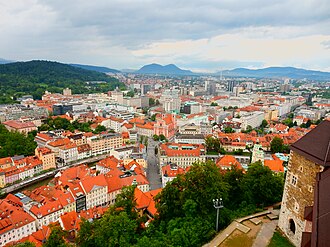
Slovenia’s capital has 280,000 people, a fortress-castle on a hill above the centre, three pedestrianised bridges by architect Jože Plečnik, and a riverside that fills with cafes from late spring to early autumn. It is one of Europe’s most walkable capitals, the historic core can be covered in a single afternoon.
The essentials
- Ljubljana Castle: reached by funicular (EUR 6 round trip) or 20-minute walk up. The view over old town and the Kamnik Alps is the main draw. Entry to the castle EUR 13.
- Triple Bridge and Dragon Bridge: both Plečnik designs; the dragon is Ljubljana’s heraldic animal.
- Central Market on Vodnik Square. Open Mon–Sat. Saturday’s Open Kitchen (Odprta Kuhna) in summer is the city’s best casual food experience.
- Metelkova: former military barracks turned alternative-arts complex. Bars come alive after 10pm.
Two days covers Ljubljana comfortably. The Tivoli Park walk and the Cobblers’ Bridge area are the two extensions if you have a third day.
Lake Bled, honestly
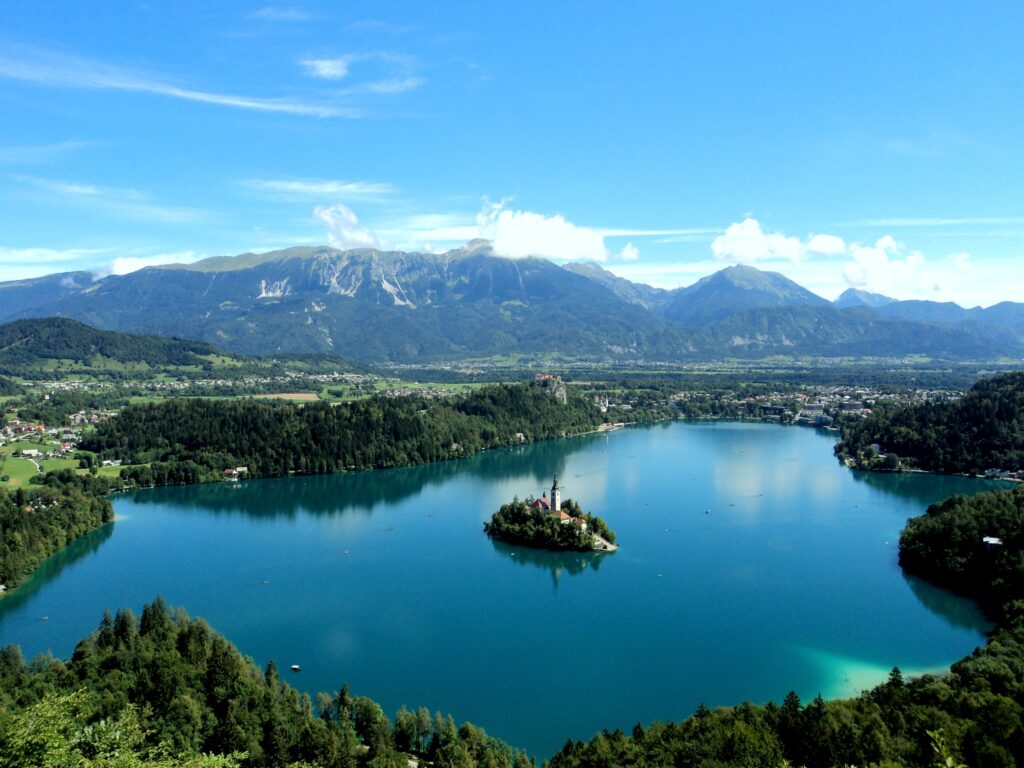
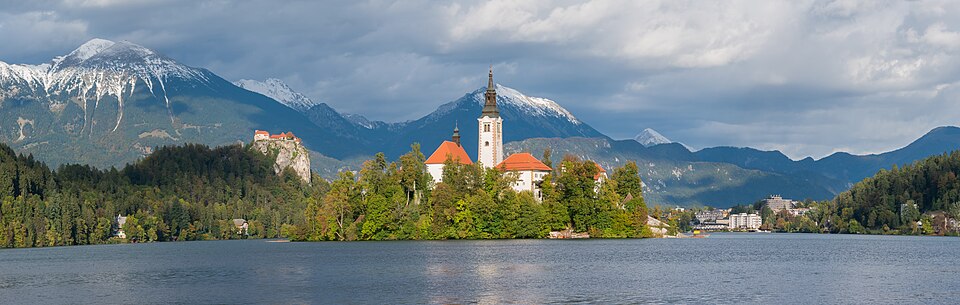
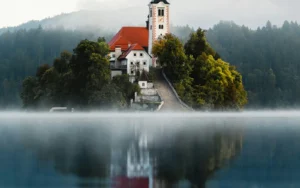
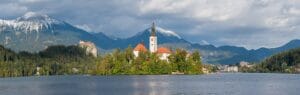
Bled is the most photographed location in Slovenia. The lake measures 2.1 km long by 1.4 km wide, with an island in the middle holding a 17th-century church, and a medieval castle perched on a 130-metre cliff above. It photographs spectacularly. In person, it is also smaller than the photographs suggest, you can walk around the entire lake in roughly two hours.
What’s worth doing
- Walking the lake perimeter: 6 km flat path. Best at sunrise or after 6pm when day-trippers leave.
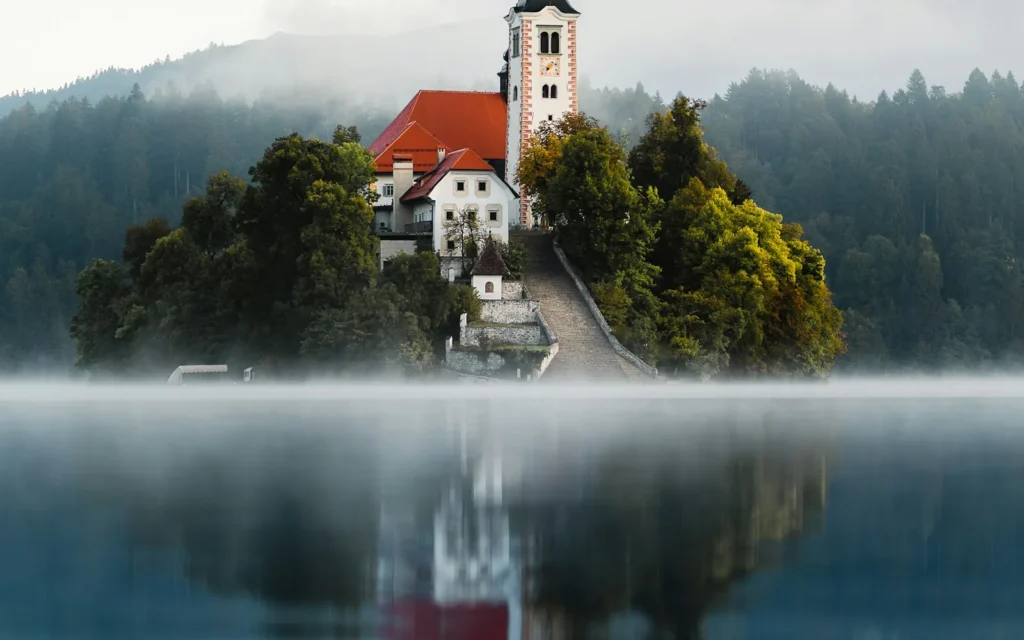
- Pletna boat to the island: traditional flat-bottomed rowboat (the rowing technique is local-protected). EUR 18 round trip. The church on the island has the famous “wish bell” you ring three times.
- Bled Castle: entry EUR 15. The terrace view is the only real reason; the museum is modest.
- Kremšnita (Bled cream cake), the official Bled dessert, made at the Park Hotel café since 1953. Try once.
Where Bled doesn’t deliver
The lake town itself is a tourism economy — restaurants are pricey, atmosphere is built for visitors, and crowds in July–August can make the lakeside path uncomfortable. One night is sufficient. Some travellers prefer to stay in Bohinj and day-trip to Bled.
Bohinj is the better lake
Lake Bohinj sits 30 minutes’ drive south-west of Bled, larger (4.2 km long), surrounded by Triglav National Park, and dramatically less crowded. The water is swimmable in summer (Bled discourages swimming because of the boat traffic; Bohinj welcomes it). The hiking around Bohinj: including the cable car up Mount Vogel for the lake panorama. Gives more landscape per hour than anywhere near Bled.
The case for Bohinj over Bled, point by point
- Same Julian-Alps backdrop, more dramatic from lake level.
- Roughly 70% fewer tourists.
- Swimmable lake with several free beach areas.
- Direct access to the Triglav National Park trail system.
- Bohinj cable car to Mount Vogel (EUR 25 round trip) gives a 1,500m view of the entire lake.
- Accommodation runs 30–40% cheaper than Bled.
The contrarian Slovenia trip stays 2 nights in Bohinj and day-trips to Bled for the postcard, rather than vice versa.
The Soča Valley and Vršič Pass drive
The Soča (pronounced “SO-cha”) river runs from the Julian Alps to the Adriatic, but the upper stretch between Kranjska Gora and the town of Bovec is the country’s most spectacular landscape and a different Slovenia from the eastern lakes.
The Vršič Pass drive
The 50-hairpin road over Vršič Pass (1611m) was built by Russian POWs in WWI. It connects Kranjska Gora to the Soča Valley. The drive itself is the attraction, pull-offs at every viewpoint, the Russian Chapel a third of the way up, the Mojstrana valley view from the summit. Closed October–May due to snow. Allow 2–3 hours one way with stops.
What to do in the valley
Kobarid (Caporetto in Italian) is the WWI history town, the Kobarid Museum is rated one of Europe’s best war museums. Bovec is the adventure-sports base (rafting, ziplining, kayaking on the emerald-green Soča). The Velika Korita Soče gorge is the swimming hole worth the detour.
One specific attraction: the Kozjak Waterfall: a 15-metre fall inside a basalt cave, accessed by a 20-minute walk from a free trailhead near Kobarid. One of Slovenia’s most photographed natural sites.
Triglav National Park: the hut system
Triglav (2864m) is Slovenia’s highest peak and a national symbol — it appears on the flag. Climbing it is a multi-day endeavour, not a casual hike. The standard ascent involves overnighting at one of several mountain huts (planinski domovi), an exposed via-ferrata section near the summit, and a total round-trip of 15–20 hours of effort.
For most visitors, Triglav itself is too ambitious. The realistic Triglav-National-Park hikes are
- The 7 Lakes Valley loop (Dolina Triglavskih jezer): 6–8 hour day hike from above Bohinj.
- Mount Vogel via cable car (very accessible: cable car does the elevation gain).
- Vintgar Gorge boardwalk: 1.6 km flat boardwalk along a river canyon near Bled (EUR 10 entry).
If you want the Triglav summit: book a hut at pzs.si 2+ months ahead, train cardiovascularly, hire a guide for the via-ferrata section.
Slovenia in 7 days: a workable itinerary
One shape that has worked for many travellers
- Day 1: Arrive Ljubljana airport (LJU), check in, evening walk along Ljubljanica river.
- Day 2: Ljubljana proper. Castle, market, Metelkova at night.
- Day 3: Bus or drive to Bled. Lake perimeter walk, island boat, kremšnita.
- Day 4: Bled to Bohinj. Cable car up Mount Vogel. Swim or rest by Bohinj lake.
- Day 5: Drive over Vršič Pass to Soča Valley. Settle in Kobarid or Bovec.
- Day 6: Soča Valley day, Kobarid Museum + Kozjak Waterfall + Velika Korita.
- Day 7: Drive back to Ljubljana, fly out.
Direction note: this counter-clockwise loop minimises backtracking. The Vršič Pass is one-way only in the sense that you drive it once.
What 7 days really costs
Mid-range, two people,
- Accommodation: EUR 80–130/night for hotels; EUR 60–100/night for apartments. Ljubljana is the most expensive, Soča Valley the cheapest.
- Rental car: EUR 35–55/day for a small car. Essential for the Soča Valley; optional for Ljubljana-Bled-Bohinj (buses cover this triangle adequately).
- Food: EUR 25–40/day per person for mid-range. Slovenian wine (Refošk, Rebula) is good and reasonably priced.
- Activities: Castle entries EUR 13–15 each, Pletna boat EUR 18, cable cars EUR 25.
- Fuel and tolls: EUR 70–120 for the week. The Slovenian motorway vignette is included in most rental cars; verify when picking up.
Total for two, 7 days: EUR 1,400–2,200 excluding flights.
Related guides
Frequently asked
Is Slovenia worth visiting?
Yes, particularly for travellers who want Alpine landscapes, lakes, and Mediterranean architecture in a compact, easily-driven country. Slovenia delivers more landscape variety per kilometre than nearly any European destination and remains less crowded than neighbouring Croatia or Austria.
How many days do you need in Slovenia?
7 days for the standard loop covering Ljubljana, Bled/Bohinj, and the Soča Valley. 5 days if you skip the Soča Valley. 10 days if you add the Karst region (Postojna or Škocjan caves) and the short coastal strip (Piran).
Is Lake Bled overrated?
Partly. The view is genuinely spectacular and the photographs do not lie. But the lake is smaller than expected (2 hours to walk around), the town caters heavily to tourism, and crowds in July–August are significant. One night is enough; many travellers prefer Bohinj as a primary base.
Bled or Bohinj: which one?
Bohinj for a base (quieter, swimmable, direct Triglav access, 30% cheaper). Bled for a day trip (the famous photograph, the cream cake, the island church). Doing both is the right answer if you have 2–3 days in the area.
Do you need a rental car in Slovenia?
Essential for the Soča Valley and recommended for flexible Triglav National Park hiking. Optional for the Ljubljana-Bled-Bohinj triangle — intercity buses (Arriva) cover this route adequately. Pick up the car at the start of the Soča leg if you want to save cost.
What is the best time to visit Slovenia?
June or September. Both deliver warm weather, long days, swimmable lakes, and the Vršič Pass open, but with 30–50% less tourism than July–August. Avoid Vršič from October to May, the pass closes.
Plan Your Slovenia Trip
Frequently Asked Questions
Is Slovenia worth visiting?
Yes. Slovenia rewards travelers who are willing to look beyond the surface. From local food to cultural sites, there is plenty to discover for every type of traveler.
How many days should I spend in Slovenia?
Plan for at least 3-4 days to cover the main highlights. A week allows for day trips and a more relaxed pace that lets you experience the destination more deeply.
What is the best way to get to Slovenia?
Options typically include flights to the nearest international airport, followed by local transport. Check for direct flight routes from your departure city for the most convenient travel.
Do I need travel insurance for Slovenia?
Travel insurance is strongly recommended for any international trip. It covers medical emergencies, trip cancellations, and lost luggage — risks that are expensive to handle out of pocket.
Torn between destinations? See our honest comparisons: Slovenia vs Croatia, Dolomites vs Slovenia.
Plan the practical side: Slovenia Visa Guide.
Best time to visit Slovenia (real climate data)
Best months: May, June, July, August, September.
Slovenia’s warmest month is July (avg 28°C / 82°F), the coolest is January (low -3°C / 26°F). The wettest is September (160 mm) and the driest is January.
Source: Open-Meteo / WMO climate normals (WMO 1991–2020, or ERA5 2019–2023 where unavailable). See the full month-by-month weather →
You Might Also Love

Written by
Founder of Packzup. Independent travel writer covering offbeat destinations across six continents since 2018. Every guide is independently researched and self-funded — no press trips, never sponsored.
Before you go: see whether they speak English in Slovenia and what to wear, check the tap water, sort your mobile data, and find out if it is a cash or card destination, and brush up on local etiquette.
