
Last updated September 17, 2026 · Editorial policy
- Post-crisis Sri Lanka: what’s actually different
- The two-week loop
- The Kandy-to-Ella train
- Tuk-tuk driver for two weeks, or train-hopping?
- Sigiriya: rock fortress or Pidurangala for the photo?
- Yala vs Wilpattu for safari
- Galle, Mirissa, and the south coast
- What 2 weeks really costs
- Safety
- Related guides
- Frequently asked
- Plan Your Sri Lanka Trip
- More Travel Guides You’ll Love
- Frequently Asked Questions
- Compare Sri Lanka with other destinations
Sri Lanka packs nine UNESCO sites, eight national parks, a thousand kilometres of coastline, and a hill country of tea plantations into an island the size of Ireland. The post-economic crisis affected pricing and infrastructure differently than the headlines suggest; by, fuel queues are gone, ETA visas are fully online, and the tourism economy has rebuilt to roughly 75% of pre-crisis levels. This guide covers a 14-day counter-clockwise loop from Negombo through Sigiriya, Kandy, Ella, Yala, Galle, and Mirissa, with honest assessments of the famous Kandy-to-Ella train, the tuk-tuk-driver-for-hire economics, and what’s actually changed.
Quick stats
- When to come: December, March (south/west coast); May — September (east coast)
- Best month: February (post-rains, peak-but-not-overcrowded, whale season)
- How long: 14 days for the standard loop
- Daily budget: USD 50–90 mid-range
- ETA visa cost: USD 50 for most nationalities, valid 30 days
- Ella train booking window: 30 days ahead via 12Go or station counter
| Best month to visit | February — 31°C, 11 wet days |
|---|---|
| Warmest month | February, 31°C average high |
| Wettest month | October, 30 wet days |
| Plugs & power | Type D,G,M · 230 V · 50 Hz |
| Driving side | Left |
Climate: normals (WMO 1991–2020, or ERA5 2019–2023 where unavailable) via Open-Meteo. Open data.
Post-crisis Sri Lanka: what’s actually different
The economic crisis triggered fuel shortages, currency controls, and a tourism collapse. By, most of the visible impacts have resolved
- Fuel is widely available again; queues ended in mid-2023.
- The Sri Lankan rupee has stabilised around LKR 320 to the USD (it was LKR 360 at peak).
- Tourism infrastructure: hotels, tour operators, drivers, has rebuilt to about 75% of 2019 capacity. Smaller B&Bs that closed during the crisis are gradually reopening.
- ATM access works reliably in cities; smaller towns can still be cash-light, so carry rupees.
- ETA visa is now fully online via eta.gov.lk: USD 50 for most nationalities, valid 30 days, processed in 24–48 hours.
What’s slightly different: fuel prices are higher than pre-crisis, which has pushed up taxi and tuk-tuk costs by roughly 30%. Some smaller hotels closed permanently: book mid-range accommodations a bit earlier than you would have in 2019. Power outages, common during the worst of the crisis, are now rare.
The two-week loop
The standard Sri Lanka itinerary runs counter-clockwise from Colombo airport (CMB) and hits the cultural triangle, the hill country, the southern coast, and back. The exact shape
Negombo (1 night): arrival recovery near the airport. Better than spending the first night in Colombo if you’re tired.
Sigiriya / Dambulla (2 nights): the cultural triangle. Sigiriya rock fortress, Dambulla cave temples, optional Polonnaruwa.
Kandy (1 night): Temple of the Tooth, transit point to the hill country.
Nuwara Eliya or Haputale (2 nights): tea country. Optional, but worth it if you take the train through here.
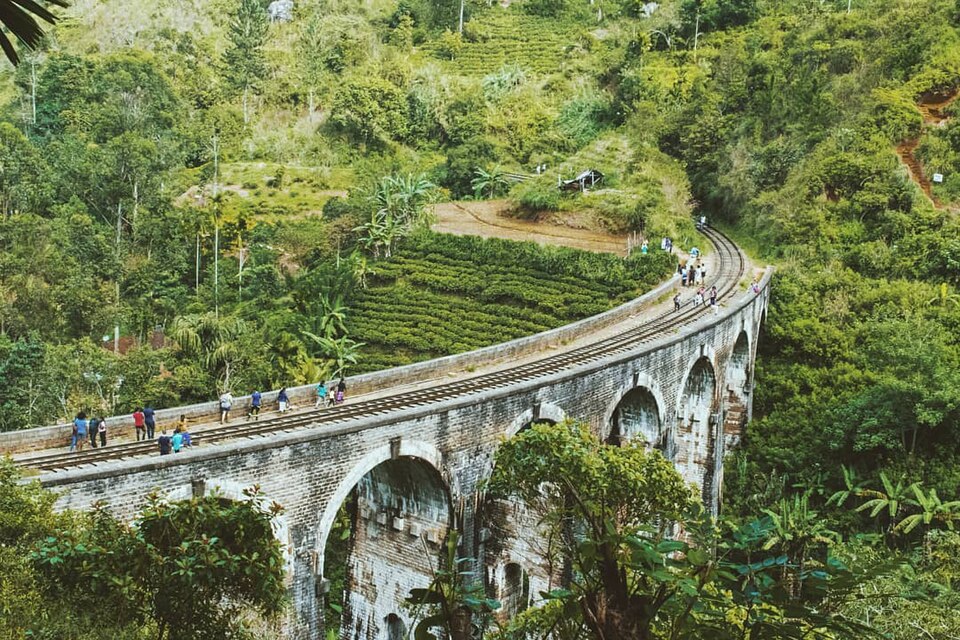
Ella (2 nights): the famous train arrives here. Little Adam’s Peak, Nine Arches Bridge, hill-country chill.
Yala or Udawalawe (1 night): safari. Leopards at Yala, elephants at Udawalawe.
Galle (2 nights): Dutch fort city. The Old Town walk, the rampart at sunset.
Mirissa / Weligama (2 nights): beach end-cap. Whale watching from Mirissa Nov–Apr.
Colombo (1 night): final night, return flight.
Why counter-clockwise? The west-to-east weather window matters less than the logistics: you start with the most physically active section (climbing Sigiriya) when freshly arrived and end with beaches when you need recovery. Reverse if your priorities differ.
The Kandy-to-Ella train
The seven-hour train ride from Kandy through the hill country to Ella is one of the world’s famous rail journeys. Locals stand in the open doorways. The track passes tea plantations, waterfalls, and the famous Nine Arches Bridge. Most travellers consider it the trip’s highlight.
Which class
- 1st class observation: Air-conditioned, reserved seats, rear-facing viewing windows. The most comfortable. LKR 5,000+ (book ahead).
- 2nd class reserved: The sweet spot. Windows open, fans, reserved seats. LKR 2,500–3,500.
- 3rd class: Unreserved bench seating. The cheapest (LKR 600) and the most authentic, but you may not get a seat and may stand for hours.
The contrarian recommendation: 2nd class reserved. Windows open for photographs, seats secured for the long ride, fans rather than aircon (you want to feel the air at this altitude).
Which side
Travelling from Kandy to Ella, sit on the right side for the better views (tea plantations, valleys). Reverse direction (Ella to Kandy) means left side. The window-views switch around Hatton.
Booking
Reserved seats open 30 days in advance. Book via 12Go Asia (foreign credit cards work) or at any major station in person (cheaper, requires queueing). Train numbers 1015 / 1016 are the main daily services.
Tuk-tuk driver for two weeks, or train-hopping?
There are two ways to do Sri Lanka: hire a driver-and-vehicle for the full trip, or combine trains, buses, and short taxi hops for each segment.

Driver-for-hire economics
A driver with an air-conditioned car or van for 14 days typically costs USD 50–75/day all-in (including the driver’s accommodation in separate quarters at your hotels). Total: USD 700–1,050 for two weeks. Tuk-tuk drivers for full multi-day hires run slightly cheaper but with the tuk-tuk experience (open-air, slower, no AC).
Train-and-bus economics
Public transport across all segments runs roughly USD 150–250 for two weeks. You save USD 500–800 but trade time and flexibility — tighter daily schedules, more luggage handling, less ad-hoc detour capacity.
The right choice depends on group size and pace
For one or two travellers wanting an active itinerary with daily flexibility, a driver pays back the cost in time saved. For solo budget travellers or backpackers, public transport remains workable and offers more local interaction. For three or more, a driver is almost always the better economic choice.
Reputable driver platforms include Ceylon Roots, Sri Lanka Drivers via Tripadvisor with vetted reviews, and direct booking through your first hotel.
Sigiriya: rock fortress or Pidurangala for the photo?
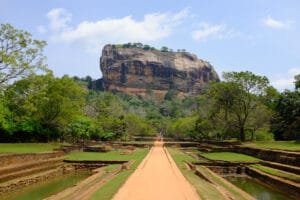
Sigiriya is the 5th-century rock-fortress citadel rising 200 metres from the plain, with a Lion Gate halfway up and the ruins of a royal palace at the summit. It is also one of Sri Lanka’s most touristed sites and the entry fee (USD 35 for foreigners) has crept up sharply.
The contrarian move: climb Pidurangala Rock instead. Pidurangala is the smaller rock immediately north of Sigiriya. The view from its summit is Sigiriya in profile, the photograph nearly every Sigiriya visitor wants but can’t take from atop Sigiriya itself. Entry to Pidurangala: LKR 1,000 (USD 3). The climb is shorter (45 minutes) but rougher: some scrambling.
The right answer depends on what you want
- Climb Sigiriya if you want to walk the citadel, see the Mirror Wall, and visit the famous frescoes, the historical experience.
- Climb Pidurangala if you want the famous photograph of Sigiriya, the visual experience at one-tenth the price.
- Do both on consecutive mornings: Sigiriya at dawn (6am opening, the only way to beat the crowd), Pidurangala the next dawn from the opposite side.
Yala vs Wilpattu for safari
Sri Lanka’s most-visited national park is Yala, in the south-east. It is famous for having one of the world’s highest leopard densities. It is also famous for being overcrowded. Dozens of safari jeeps cluster around any leopard sighting, which damages both the experience and the wildlife.
The alternative is Wilpattu National Park in the north-west: bigger (the largest in Sri Lanka), with comparable leopard populations, and roughly one-fifth the visitor traffic. Leopard sightings at Wilpattu still happen and feel less like a tour-bus zoo.
Decision points
- If you’re routing through the south (Galle, Mirissa) anyway, Yala is on the way. Go in the afternoon (less crowded than morning) and Block 5 (less popular than Block 1).
- If you have time for a detour or are starting from Colombo, Wilpattu is the better wildlife experience.
- For elephants specifically, neither, go to Udawalawe National Park, which has guaranteed elephant sightings.
Safari costs: USD 60–100 per person for a half-day group jeep. Private full-day jeeps run USD 120–200 per vehicle.
Galle, Mirissa, and the south coast
The southern coast is where most 14-day Sri Lanka trips end. The two main bases
Galle
Galle Fort, a 16th-century Portuguese / Dutch fortified town — is one of South Asia’s best-preserved colonial old quarters and a UNESCO World Heritage site. The 3 km rampart walk at sunset is the classic experience. Boutique hotels inside the fort run USD 100–300/night; restaurants and cafes in the fort are pricier than outside.
2 nights is the right Galle stay, one day for the fort, one for day trips (Hikkaduwa snorkelling, Koggala stilt fishermen, or the Galle Cricket Stadium during a match).
Mirissa & Weligama
The two beach towns 35 km east of Galle. Mirissa is the more developed of the two: crescent-shaped beach, the Coconut Tree Hill viewpoint, and the November–April whale-watching season. Weligama is the surf-beginner beach: gentle waves and surf schools every 50 metres along the seafront.
The whale watching from Mirissa (USD 25–50, departures 6am) targets blue whales and sperm whales. Quality varies sharply by operator. Raja and the Whales and Mirissa Water Sports are the two operators with consistently good reviews; some operators chase whales aggressively in ways that violate ethical standards.
What 2 weeks really costs
For two travellers, 14 days
- Backpacker: USD 1,800–2,400 total. Hostels, public transport, street food, no driver, one or two paid attractions per day.
- Mid-range: USD 2,800–4,200 total. Mid-range B&Bs (USD 50–90/night), driver-with-car for transport, restaurant meals, all major attractions.
- Comfortable: USD 4,500–7,000 total. Boutique hotels (USD 120–200/night), private driver, fine dining where available, premium safaris.
The two biggest surprises for first-time visitors
- The USD 50 ETA visa per person.
- The Sigiriya entry fee (USD 35), high relative to most other Sri Lankan attractions.
Travel insurance with medical evacuation is strongly recommended. Rural medical facilities are limited, and evacuation to Bangkok or Singapore can run USD 50,000+.
Safety
Sri Lanka is generally safe for tourists. The political unrest has settled. The 2019 Easter bombings remain a memory but security at major sites is now standard.
Practical concerns
- Petty scams: Common around major tourist sites. Tuk-tuk overcharging, gem-shop “free tours,” temple “donation” pressure. Agree on prices in advance and use metered tuk-tuks (PickMe app) where available.
- Driving: Roads are chaotic and Sri Lankan driving is aggressive. Self-driving as a foreigner is not recommended, hire a driver.
- Sun and heat: The hill country can be cool (Nuwara Eliya overnight: 8–15°C), but coastal areas are 28–33°C with 75%+ humidity. Heat exhaustion at Sigiriya midday is a real risk.
- Female travellers: Reports of harassment, particularly on public buses, are not uncommon. Most female travellers report Sri Lanka as easier than India but still requiring standard precautions. Solo female travel is doable; many travel in groups for the most crowded segments.
Related guides
Frequently asked
Is Sri Lanka safe to travel to?
Yes, generally. The economic crisis and 2019 Easter bombings have both stabilised. Standard precautions apply — petty scams near tourist sites, traffic chaos, and heat. Female travellers report the country as safer than India but still requiring caution on public buses.
How many days do you need in Sri Lanka?
14 days for the standard loop covering the cultural triangle, hill country, safari, and south coast. 10 days if you skip the safari or compress the hill country. Less than 7 days means choosing between the cultural triangle and the beach: you can’t reasonably do both.
What is the cheapest month to visit Sri Lanka?
May or September during the inter-monsoon shoulder weeks. Hotels run 30–40% below December–February peak season. Weather is mixed. Expect afternoon rain on the south coast in May, but mornings are usually clear. The east coast (Trincomalee, Arugam Bay) is in its prime June–September.
How much does a 2-week Sri Lanka trip cost?
Mid-range, two travellers: USD 2,800–4,200 excluding flights. This covers comfortable B&Bs, a driver-with-car for transport, restaurant meals, and all major attractions including Sigiriya, the Kandy-to-Ella train, and one safari. Backpacker travel runs USD 1,800–2,400 for the same period.
Do you need a visa for Sri Lanka?
Yes. Most nationalities need an Electronic Travel Authorization (ETA), valid 30 days, which has been free since 25 May 2026 for 40 nationalities, including the US, UK, Canada and Australia. Apply online at eta.gov.lk at least 48 hours before travel. The previous on-arrival system has been phased out. Processing typically takes 24–48 hours.
Is Sri Lanka worth visiting after the economic crisis?
Yes. Tourism is back to roughly 75% of pre-crisis capacity, fuel is widely available, and the rupee has stabilised. The country is currently in a sweet spot: infrastructure works, prices are reasonable, and tourist numbers have not yet returned to pre-2019 peaks.
Plan Your Sri Lanka Trip
Frequently Asked Questions
Is Sri Lanka worth visiting?
Yes. Sri Lanka rewards travelers who are willing to look beyond the surface. From local food to cultural sites, there is plenty to discover for every type of traveler.
How many days should I spend in Sri Lanka?
Plan for at least 3-4 days to cover the main highlights. A week allows for day trips and a more relaxed pace that lets you experience the destination more deeply.
What is the best way to get to Sri Lanka?
Options typically include flights to the nearest international airport, followed by local transport. Check for direct flight routes from your departure city for the most convenient travel.
Do I need travel insurance for Sri Lanka?
Travel insurance is strongly recommended for any international trip. It covers medical emergencies, trip cancellations, and lost luggage — risks that are expensive to handle out of pocket.
Compare Sri Lanka with other destinations
Still deciding where to go? See how Sri Lanka stacks up head-to-head:
What it actually costs: Sri Lanka Trip Cost
Plan the practical side: IS Sri Lanka Safe to Visit.
Still deciding on Sri Lanka?
How far does your money go? Read our Global Travel Affordability Report 2026 — 200 countries ranked by cost, with the cheapest regions and countries to travel.
Best time to visit Sri Lanka (real climate data)
Best months: July, August, December.
Sri Lanka’s warmest month is February (avg 31°C / 88°F), the coolest is January (low 23°C / 73°F). The wettest is October (359 mm) and the driest is February.
Source: Open-Meteo / WMO climate normals (WMO 1991–2020, or ERA5 2019–2023 where unavailable). See the full month-by-month weather →
You Might Also Love

Written by
Founder of Packzup. Independent travel writer covering offbeat destinations across six continents since 2018. Every guide is independently researched and self-funded — no press trips, never sponsored.
Before you go: see whether they speak English in Sri Lanka and what to wear, check the tap water, sort your mobile data, and find out if it is a cash or card destination, and brush up on local etiquette.
Still deciding? Read our honest take: Is Sri Lanka worth visiting? The honest verdict
