
Last updated August 27, 2026 · Editorial policy
- Albania vs Croatia: the key numbers (2026)
- Albania vs Croatia at a glance
- At a glance
- What Albania actually delivers
- What Croatia actually delivers
- Cost comparison
- Old-town comparison
- Island access
- When to visit each
- Related guides
- Albania or Croatia: which is better?
- Frequently asked
- Plan Your Albania Trip
- Frequently Asked Questions
- Which is better for your trip, Albania or Croatia?
Albania vs Croatia, in one line: Not a toss-up on money: Albania runs roughly half Croatia's daily cost. Tipping, plugs (identical C/F 230V) and tourist tax are broadly similar, so the real split is character. Pick Albania for a raw, emerging, budget coast plus mountains; pick Croatia for polished infrastructure and island-hopping. Shoulder season, May-June or September, suits both best.
When to go: Albania vs Croatia
Measured, not guessed — five years of climate normals (WMO 1991–2020, or ERA5 2019–2023 where unavailable). Months are ranked by how close the average high sits to 25°C, penalised by wet days.
Albania
- Best month
- September
- Then expect
- 27.3°C · 7 wet days
- Next best
- June, October
- Wettest month
- January (13 wet days)
Croatia
- Best month
- June
- Then expect
- 28°C · 5 wet days
- Next best
- September, July
- Wettest month
- November (15 wet days)
- Different windows — Albania peaks in September, Croatia in June. If your dates are fixed, that is the deciding factor.
- Croatia is the drier bet at its peak — 5 wet days vs 7.
- Biggest split is November — Albania is 1.1°C warmer that month.
Source: climate normals (WMO 1991–2020, or ERA5 2019–2023 where unavailable) via Open-Meteo, CC BY 4.0 — Packzup Travel Climate Dataset (open data).
Albania vs Croatia: the key numbers (2026)
| Albania | Croatia | |
|---|---|---|
| Mid-range daily cost | USD 40-90/day; budget-friendly | USD 120-200/day; moderate |
| Tourist tax (2026) | EUR 1-3 per person/night; coastal cities higher | EUR 1-2.65 per person/night; higher in peak season |
| Tipping | 5-10%, cash in Lek; optional | About 10%; optional/appreciated |
| Plug / voltage | Type C/F, 230V | Type C/F, 230V (identical – one adapter covers both) |
| Best months | May-Jun or Sep | May-Jun or Sep |
Figures from Packzup’s Travel Cost Index, Tourist Tax Index, Tipping Guide and Power Plug Index — updated 2026.
Albania and Croatia share an Adriatic coastline and increasingly share travelers. Croatia is established, Dubrovnik, Split, Hvar, all the islands, the price points that have caught up to Italy. Albania is the trending alternative — same sea, similar coast, 40–60% lower prices, dramatically fewer crowds. This comparison covers what each delivers (after Croatia’s tourism explosion and Albania’s rapid catch-up), where prices have actually landed, food scenes, and which to pick based on what you want from an Adriatic trip.
Quick verdict
- Pick Albania if: You want a more affordable, less crowded coast plus mountain access (Theth).
- Pick Croatia if: You want established infrastructure, island-hopping ferries, and don’t mind crowds + prices.
- Both: Possible: Sarandë (Albania) to Corfu (Greece, technically) to Dubrovnik trip works.
- Best months: May–June or September (peak shoulder, avoid August)
Albania vs Croatia at a glance
| Albania | Croatia | |
|---|---|---|
| Best for | Value, emerging beaches | Polished islands, Dubrovnik |
| Vibe | Raw, up-and-coming | Established, busy in summer |
| Daily budget (mid-range) | €40–70 | €80–120 |
| Best time | May–Jun, Sep | May–Jun, Sep |
| Don’t miss | The Riviera, Berat, Tirana | Dubrovnik, Hvar, Plitvice |
| The catch | Rougher infrastructure | Pricey & crowded in peak |
At a glance
| Category | Albania | Croatia |
|---|---|---|
| Coastline length | 362 km | 1,777 km (more variety) |
| Population | 2.8 million | 3.9 million |
| Mid-range hotel (peak) | €60–110/night | €140–280/night |
| Restaurant lunch | €8–18 | €18–35 |
| Best beach | Ksamil, Dhërmi, Himarë | Hvar, Brač (Zlatni Rat), Korčula |
| Best old town | Berat (Ottoman white houses) | Dubrovnik (UNESCO walled city) |
| Island-hopping | Limited (mainly ferry to Corfu) | Excellent (dozens of populated islands) |
| Mountain access | Albanian Alps (Theth + Valbona) | Plitvice Lakes National Park |
| Tourism growth (26) | Fastest in Europe (+200% post-pandemic) | Stable, already saturated |
What Albania actually delivers
Albania has gone from “the empty corner of the Balkans” to one of Europe’s fastest-growing destinations over five years. The Albanian Riviera (Sarandë → Himarë → Vlora) gives you Mediterranean beach landscape at 40–60% of Croatian prices. The country also has mountains, the Albanian Alps in the north (Theth + Valbona + Lake Komani) offer multi-day hut-to-hut hiking that Croatia doesn’t have.
The defining experiences: Albanian Riviera (Ksamil’s Greek-style islets, Himarë’s quieter beaches, the Llogara Pass drive), Tirana (the colorful capital with its Bunk’Art communist-era museums and lively Blokku district), the Theth-Valbona hike (17 km mountain crossing with hut nights), and the Sarandë → Corfu ferry day-trip (25 minutes by fast ferry, a unique Albania bonus).
The honest current state: prices in tourist areas (Ksamil specifically) have risen 30–40% since, but interior and shoulder-season pricing remain genuinely cheap. The infrastructure is still catching up. Roads have improved dramatically (the highway to Pristina opened), but service standards are less polished than Croatia.
See the full Albania travel guide for the 10-day Riviera + Alps loop.
What Croatia actually delivers
Croatia has 1,777 km of Adriatic coastline plus over 1,200 islands, of which 47 are populated. The country’s tourism infrastructure is among Europe’s most developed: ferry network connecting islands, English widely spoken, Schengen membership (since January) means no border checks from EU, and standardized service quality.
The defining experiences: Dubrovnik’s walled Old Town (UNESCO since 1979, the most-photographed Adriatic city), Split’s Diocletian Palace (a working town built inside a Roman emperor’s palace), island-hopping (Hvar for nightlife, Brač for Zlatni Rat beach, Korčula for the contemplative version of Dubrovnik), and Plitvice Lakes National Park (the 16 turquoise lakes with waterfalls cascading between them).
The honest current state: Croatia has been victim of its own tourism success since 2015 (Game of Thrones effect on Dubrovnik). Peak-season Dubrovnik in July–August is genuinely uncomfortable, cruise-ship offloading + restaurant pricing + Walls walk crowds. Hvar and Split similarly saturate. The shoulder seasons (May–June, September) are dramatically better.
Cost comparison
Side-by-side daily budget for a mid-range traveler
- Albania (Sarandë/Himarë in shoulder season): hotel €70/night, restaurant lunch €10, dinner €18, activities €20 = ~€118/day per person.
- Croatia (Dubrovnik/Split in shoulder season): hotel €180/night, restaurant lunch €22, dinner €38, activities €40 = ~€280/day per person.
Peak season (July–August) widens the gap further. Albania’s Ksamil hotels in August run €120–180/night (up 60% from May); Dubrovnik’s run €300–500/night (up 70%).
For ~10 days on the coast, Albania saves ~€1,500 per person vs Croatia at equivalent comfort levels.
Old-town comparison
Both countries have UNESCO-listed walled old towns. The honest assessment
Dubrovnik (Croatia) is more impressive at first encounter, the limestone walls, the orange-tile roofs, the Stradun marble street. But the city in summer is essentially a tourist installation; locals have left the Old Town in dropping numbers since 2015. Walking the walls (KN 250 / €33) is mandatory once. Game of Thrones tours dominate the souvenir economy.
Berat (Albania) is smaller, older, and still inhabited by locals. The white Ottoman houses stacked up two mountainsides (“the town of a thousand windows”) create a different visual than Dubrovnik’s stone-and-tile palette. Tourism is increasing but the town remains overwhelmingly residential. Entry is free; the castle €5.
For first-time visitors, Dubrovnik delivers the more recognized photograph. For travelers seeking living-city authenticity, Berat delivers more.
Island access
Croatia decisively wins on island variety. The ferry network (Jadrolinija, Kapetan Luka, TP Line) connects 47 inhabited islands with multiple daily services in peak season. Hvar for upscale nightlife and the cliff-perched town, Brač for the photogenic Zlatni Rat beach, Korčula for Dubrovnik-without-the-crowds, Vis for the more remote experience, Mljet for the national park island.
Albania has very limited island access. The main option is the fast ferry from Sarandë to Corfu (Greece): 25 minutes, €25–30 each way. This makes a great half-day or overnight extension but isn’t an Albanian-island experience per se.
If island-hopping is core to your trip vision, Croatia wins decisively. If it’s not, this advantage doesn’t apply.
When to visit each
Both countries share Mediterranean climate with hot summers and mild winters.
- May–June (shoulder, recommended): warm enough to swim (sea 18–22°C), 30% lower hotel rates than peak, modest crowds. Best month for both.
- July–August (peak): hot (30–35°C), sea peaks at 25°C, prices at maximum, Dubrovnik and Ksamil specifically uncomfortable.
- September (shoulder): warm sea (23–25°C), Italian holidaymakers leave, prices drop 20%. Many consider it the best month.
- October–April (off-season): many seasonal restaurants and boat services close; not recommended for beach-focused trips. Croatia’s old towns remain visitable; Albania’s mountains close to multi-day trekkers.
Related guides
Albania or Croatia: which is better?
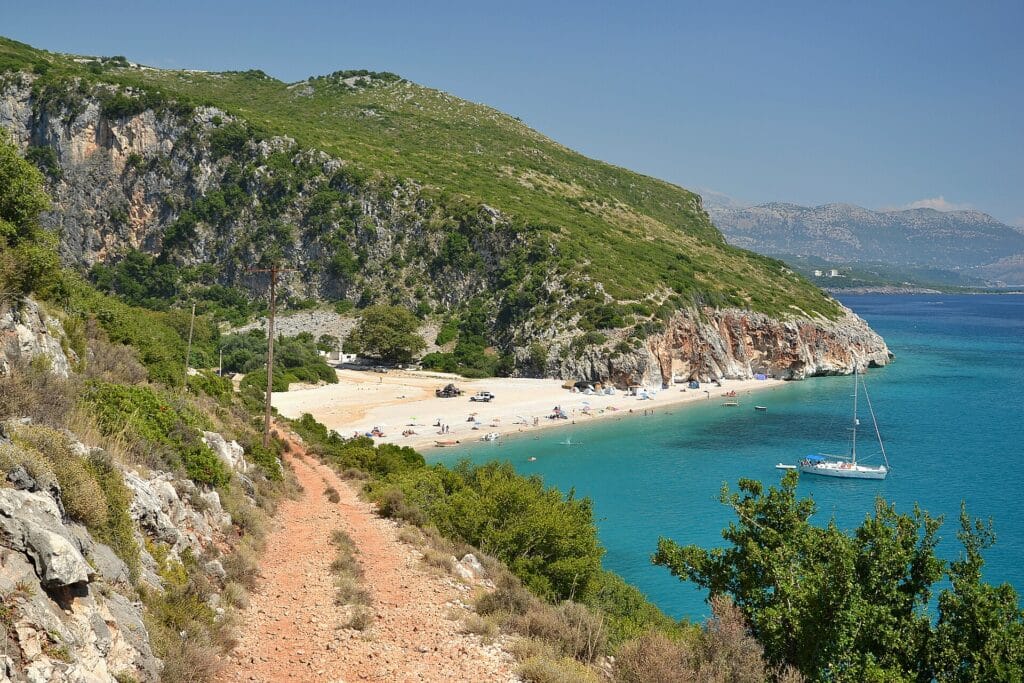
The deciding factor is whether island-hopping by scheduled ferry is the point of your trip. Choose Croatia if it is: Jadrolinija and the catamarans link Hvar, Korcula, Vis and dozens more islands on fixed timetables, something Albania’s coast simply cannot match. Choose Albania if the swimming matters more than the boats and the bill matters most of all. The water at Ksamil, Gjipe and Drymades is every bit as clear, and the crowds are a fraction of Croatia’s. Dubrovnik draws around 1.5 million visitors against 40,000 residents, so a midweek Ksamil feels like a quiet Tuesday on Hvar.
The money gap is the loudest argument. A dinner for two with wine runs about 40 to 70 euros at a serious Albanian Riviera taverna, versus 100 to 180 in Dubrovnik’s old town. Over ten days a couple typically spends 1,500 to 2,000 euros in Albania against 3,500 to 5,000 in peak-summer Croatia. One logistics warning: there is no direct ferry between the two, so combining them means routing through Italy (Durres to Bari, then Bari to Dubrovnik) or a long drive via Montenegro.
Frequently asked
Is Albania cheaper than Croatia?
Yes — meaningfully. Mid-range Albania runs €60–110/night for hotels vs €140–280 in Croatia. Total daily budget runs ~€118 in Albania vs ~€280 in Croatia for equivalent comfort. Albania saves ~€1,500 per person on a 10-day coast trip.
Is Albania safer than Croatia?
Both are safe for tourists. Croatia has the more developed tourism infrastructure (English, signage, ATMs everywhere). Albania has had improving but less polished infrastructure. Violent crime against tourists is rare in both. Driving in Albania is more chaotic than Croatia.
Albania or Croatia for first-time Balkans?
Croatia if you want easy, infrastructure-heavy, English-friendly. Albania if you want better value, fewer crowds, and don’t mind less-polished service. For 7-day first-time trips, Croatia is the safer pick. For repeat Adriatic travelers or budget-focused trips, Albania is the upgrade.
Can you combine Albania and Croatia?
Yes: they share a border (Montenegro between them on the coast). The classic combined trip: Croatia (Dubrovnik) → Montenegro (Kotor) → Albania (Theth + Sarandë). Total ~12 days. Or do Albania’s Riviera → ferry to Corfu → into Greek mainland.
When is the best month for both?
May–June or September. Both countries are too hot and crowded in July–August (peak prices, peak crowds, peak heat). Shoulder months deliver warm sea, lower prices, and manageable crowds. May for both is excellent.
Are beaches better in Albania or Croatia?
Different. Croatia’s beaches are mostly pebble + clear water (Zlatni Rat on Brač is the famous shot). Albania’s are a mix of pebble (Riviera) and white sand (Ksamil). Albanian Riviera water clarity rivals Croatia’s, and the beaches are less crowded. For pure beach quality, Albania edges Croatia.
Plan Your Albania Trip
Frequently Asked Questions
Which destination is better for first-time visitors?
Both have strengths for first-timers. Consider your priorities — food, culture, nature, nightlife — and match them to each destination’s strengths as outlined in the comparison above.
Which destination is cheaper?
Costs vary by season and travel style. Check the budget comparison section above for specific price differences in accommodation, food, and activities.
Can I visit both destinations in one trip?
Depending on proximity and your available time, combining both is often possible. Check transport options and allow enough days to avoid rushing through either one.
Which is better for your trip, Albania or Croatia?
For families
Verdict: Croatia. The ferry network (Jadrolinija and Kapetan Luka run multiple daily services in peak season) makes car-free island days from Split straightforward, English is widely spoken, and service quality is standardized – all of which matters with kids in tow. Zlatni Rat on Brac and the boardwalk trails at Plitvice Lakes are dependable crowd-pleasers across ages.
For couples & honeymoons
Verdict: Croatia for the classic island honeymoon, Albania for a quieter one. Sunset drinks above the harbor in Hvar town and a night on Korcula deliver the postcard version. If August crowds and Dubrovnik old-town prices put you off, Himare and the quieter coves at Gjipe and Drymades give you the same turquoise water with far fewer people.
For budget travelers
Verdict: Albania, and it is not close. Mid-range daily budgets run roughly 50-80 euros against Croatia’s 100-140, and a 10-day coastal trip can come in 500 euros or more per person cheaper at equivalent comfort. A taverna dinner for two on the Albanian Riviera typically costs around half its Dubrovnik old-town equivalent.
For hikers & nature lovers
Verdict: Albania. The Theth-Valbona crossing in the Albanian Alps, reached via the Lake Komani ferry, is a real multi-day mountain trip you can pair with the coast over the Llogara Pass. Croatia’s Plitvice Lakes are spectacular but essentially a one-day visit; Albania rewards boots for a full week.
Planning the trip? Go deeper with best time to visit Croatia.
You Might Also Love


Written by
Founder of Packzup. Independent travel writer covering offbeat destinations across six continents since 2018. Every guide is independently researched and self-funded — no press trips, never sponsored.
