Last updated August 31, 2026 · Editorial policy
- Vietnam vs Thailand at a glance
- At a glance
- What Vietnam actually delivers
- What Thailand actually delivers
- If you have to pick one
- Food culture compared
- Beach quality compared
- When to visit each
- Related guides
- The Verdict: Adventure Country vs Beach Country
- Frequently asked
- Plan Your Vietnam Trip
- Frequently Asked Questions
Vietnam and Thailand are Southeast Asia’s two anchor destinations and the most common decision-point for first-time SE Asia trips. Thailand has been the established choice for 30 years, easier visas, more developed tourism infrastructure, beaches dialed in. Vietnam has been catching up rapidly, with the new 90-day e-visa (introduced August) making longer trips realistic. This comparison covers food, beaches, prices, visa rules, and which country fits which traveler.
Quick verdict
- Pick Vietnam if: You want street food culture, north-to-south country variety, lower prices, and longer stays.
- Pick Thailand if: You want established island beaches, polished tourism infrastructure, and first-time SE Asia ease.
- Both: Possible on 3+ week SE Asia trips. Adjacent countries, easy flights.
- Best months: November–March for both (dry season in both)
When to go: Vietnam vs Thailand
Measured, not guessed — five years of climate normals (WMO 1991–2020, or ERA5 2019–2023 where unavailable). Months are ranked by how close the average high sits to 25°C, penalised by wet days.
Vietnam
- Best month
- December
- Then expect
- 21.5°C · 5 wet days
- Next best
- November, February
- Wettest month
- August (25 wet days)
Thailand
- Best month
- December
- Then expect
- 31°C · 4 wet days
- Next best
- January, February
- Wettest month
- August (28 wet days)
- Same window — both Vietnam and Thailand are at their best in December.
- Thailand is the drier bet at its peak — 4 wet days vs 5.
- Biggest split is January — Thailand is 10.4°C warmer that month.
Source: climate normals (WMO 1991–2020, or ERA5 2019–2023 where unavailable) via Open-Meteo, CC BY 4.0 — Packzup Travel Climate Dataset (open data).
Vietnam vs Thailand at a glance
| Vietnam | Thailand | |
|---|---|---|
| Best for | Culture, food, value, history | Beaches, ease, infrastructure |
| Vibe | Bustling, varied | Lively, developed |
| Daily budget (budget) | $30–60 | $30–70 |
| Best time | Oct–Apr (north) | Nov–Mar |
| Don’t miss | Halong Bay, Hoi An, Sapa | Bangkok, the islands, Chiang Mai |
| The catch | Long distances; traffic | Touristy hotspots |
At a glance
| Category | Vietnam | Thailand |
|---|---|---|
| Population | 98 million | 70 million |
| Best feature | Street food + Hà Giang loop + spine variety (Hanoi to HCMC) | Islands (Phi Phi, Koh Tao, Krabi) + Bangkok food + temple density |
| Visa for most Westerners | 90-day e-visa, $25 | 30 days visa-free, then extension or visa run |
| Days needed | 14+ | 10+ |
| Mid-range daily budget | $35–60 | $50–80 |
| Beach quality | Mui Ne, Phu Quoc, Da Nang (decent) | Phi Phi, Koh Tao, Krabi, Koh Lanta (world-class) |
| Trekking quality | Sapa rice terraces, Hà Giang motorbike loop | Pai mountains, Doi Inthanon, Khao Sok |
| Capital pace | Hanoi (intense, atmospheric) | Bangkok (large, organized chaos) |
| English level | Improving but limited outside tourist zones | Better in tourist zones, similarly limited rural |
What Vietnam actually delivers
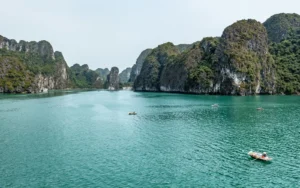
Vietnam stretches 1,650 km from the karst limestone of Hà Giang (near the Chinese border) to the Mekong Delta in the south. The country’s signature is the north-to-south spine trip: most travelers spend 2–3 weeks covering Hanoi → Sapa or Hà Giang → Hội An → Ho Chi Minh City. The 90-day e-visa introduced August makes 3-4 week trips realistic.
The defining experiences: Hanoi’s Old Quarter (36 streets each historically named for a trade), the Hà Giang loop (350-km motorbike circuit through karst valleys, now widely done as 3-day “easy rider” tours with a local guide on the bike), Hội An’s ancient town (UNESCO, lantern-lit nights), the Reunification Express train for the spectacular Hai Van Pass leg, and street food culture: the world’s most affordable serious cuisine.
Vietnam’s beaches (Mui Ne, Da Nang, Phu Quoc) are decent but not the country’s strongest card. The food, landscape variety, and price point are what make Vietnam.
See the full Vietnam travel guide for the spine itinerary + e-visa logistics.
What Thailand actually delivers
Thailand has been Southeast Asia’s tourism powerhouse since the 1980s. The infrastructure is the most developed in the region — English signage everywhere in tourist zones, ATMs in every town, ferry networks connecting islands, and a smile-friendly service culture that’s a real differentiator.
The defining experiences: Bangkok’s street food + temple complex + nightlife (Wat Pho, Wat Arun, Khao San Road, Sukhumvit), island-hopping in the south (Phi Phi, Koh Lanta, Krabi cliffs, Koh Tao for diving, Koh Phangan for full-moon parties), Chiang Mai’s old city + Northern Thailand (mountain temples, elephant sanctuaries, Pai), and Sukhothai/Ayutthaya ruins for the historical bonus.
Thailand’s beaches are world-class: among the best accessible-by-budget beaches on the planet. The visa-free 30-day entry for most Westerners makes shorter trips genuinely easy. The food, while pricier than Vietnam’s, is more standardized in quality.
See the existing Bangkok travel guide + Chiang Mai travel guide for north and central Thailand coverage.
If you have to pick one
For first-time SE Asia travelers with 2 weeks, pick Thailand. Reasons
- Easier visa (30-day visa-free vs Vietnam’s 90-day e-visa requiring online application).
- Better English infrastructure means less navigation friction.
- Beaches are the top draw and a 2-week trip can deliver the full Bangkok + 1–2 islands experience.
- Smile-friendly service culture is meaningfully easier than Vietnam’s more transactional vibe.
For travelers wanting maximum variety in one country, longer immersive trips (3+ weeks), or specifically seeking food culture over beaches, pick Vietnam. The 90-day e-visa makes longer trips possible. The spine-trip arc (Hanoi → Hội An → HCMC) gives more landscape variety than any single Thailand region.
Food culture compared
Vietnamese food: phở (the country’s signature noodle soup, regional variations between Hanoi’s clear broth and Saigon’s herb-loaded version), bánh mì (the French-Vietnamese sandwich, peak versions at Bánh Mì Phượng in Hội An or Bánh Mì 25 in Hanoi), bún chả (the grilled-pork noodle dish), cao lầu (Hội An’s unique pork-and-noodle), egg coffee (cà phê trứng), Vietnamese drip coffee. Eating well costs $1–3 per dish from street stalls; $5–10 in mid-range restaurants. The street food culture is arguably the world’s most affordable serious cuisine.
Thai food: pad thai (the famous noodle dish, often touristified. Try real versions at Khao San Road or smaller side-street vendors), tom yum (hot and sour soup), green curry, papaya salad (som tam), boat noodles, mango sticky rice. Eating well costs $1.50–4 per dish from street stalls; $8–15 in mid-range restaurants. Thai food is more polarizing, spicier, sweeter, more chili-forward.
For pure cost-to-quality ratio, Vietnam wins. For depth of recognized international cuisine, Thailand has the edge. Both are extraordinary food destinations.
Beach quality compared
Thailand wins decisively on beaches. Phi Phi, Koh Tao, Krabi’s cliffs (Railay), Koh Lipe’s clear water, Koh Lanta’s chill atmosphere, these are top beach destinations with developed (sometimes over-developed) infrastructure. The diving (Similan Islands, Koh Tao for certification) is among Southeast Asia’s best.
Vietnam’s beaches: Mui Ne (kitesurfing), Phu Quoc (more developed, often compared to Phuket but quieter), Nha Trang (decent but heavily Russian-tourist-coded), Da Nang (urban beach city). All workable, none world-class.
For beach-focused trips, Thailand. For trips where beach is one component among many (food, history, mountains), Vietnam’s beaches are sufficient.
When to visit each
Vietnam’s weather is regionally complex due to the long north-south geography
- North (Hanoi, Sapa, Hà Giang): October–December dry and cool (best). January–March cold and misty. June–August hot and rainy.
- Centre (Hội An, Hue): February–April best. October–December stormy.
- South (HCMC, Mekong): December–April dry season (best). May–November wet but warm.
Thailand’s weather is simpler
- November–March: cool, dry, peak tourist season. Best overall.
- April–May: hot (35–40°C). Songkran festival in April.
- June–October: monsoon. Variable — some weeks dry, some wet.
For a trip: November–February is the safest window for both. The classic combined trip is November Vietnam → February Thailand.
Related guides
The Verdict: Adventure Country vs Beach Country
The single deciding factor is what you actually want to do all day. Choose Vietnam if you want to be active: ride the Ha Giang Loop past the China border, kayak the limestone karsts of Ninh Binh, or book one of just 1,000 yearly permits to camp inside Son Doong, the world’s largest cave, in Phong Nha. Choose Thailand if you want a boat to drop you on a white-sand beach and a cold drink waiting. Railay and the Phi Phi Islands are reached by longtail in minutes, and the snorkel and dive scene around Krabi is booked in an afternoon with zero planning.
Three concrete gaps decide it. First, the visa: Vietnam’s 90-day e-visa costs about $25, while Thailand simply stamps 30 days free on arrival, so true long-haul travelers lean Vietnam. Second, getting between them is no quick hop. The countries share no land border, so overland means a 20 to 24-hour bus through Vientiane in Laos plus a night train; most people just fly Bangkok to Hanoi in under 2 hours from roughly $100. Third, Thailand’s tour infrastructure is years ahead, so first-timers who hate logistics save real stress there.
Frequently asked
Vietnam or Thailand for first-time SE Asia?
Thailand for first-time SE Asia travelers. Easier visa-free entry (30 days), better English infrastructure, top beaches accessible without complex logistics. Vietnam is the upgrade for repeat visitors or longer-stay travelers wanting more variety and lower prices.
Is Vietnam cheaper than Thailand?
Yes, by 25–35%. Mid-range daily budget runs $35–60 in Vietnam vs $50–80 in Thailand. Street food is similarly cheap in both ($1–3/dish), but accommodation, transport, and mid-range restaurants are notably cheaper in Vietnam.
Which has better food?
Subjective but both are world-class. Vietnam wins on price (more food for less money), street food culture (denser), and regional variety. Thailand wins on international recognition of dishes and broader sophistication at the higher end. Most repeat travelers in both find Vietnamese food slightly more interesting day-to-day.
Can I combine Vietnam and Thailand?
Yes: they’re adjacent and well-connected by flight. Bangkok to Hanoi or HCMC takes 2 hours. A 3-week combined trip works: 14 days Vietnam (north-to-south spine) + 7 days Thailand (Bangkok + 1 island). Reverse direction also works.
Is Thailand safer than Vietnam?
Both are safe for tourists. Standard precautions apply (scam awareness around tourist zones, agree on tuk-tuk prices, avoid tap water). Solo female travelers report similar experiences in both. Thailand has more tourist-targeting scams in beach areas; Vietnam has more tourist-targeting scams in Hanoi’s Old Quarter.
When is the best month for both?
November–February for both. Vietnam’s north is in its prime (cool, dry), Vietnam’s south is in dry season, and Thailand is in its peak cool-dry window. Avoid April–October if planning to combine.
Plan Your Vietnam Trip
Frequently Asked Questions
Which destination is better for first-time visitors?
Both have strengths for first-timers. Consider your priorities — food, culture, nature, nightlife — and match them to each destination’s strengths as outlined in the comparison above.
Which destination is cheaper?
Costs vary by season and travel style. Check the budget comparison section above for specific price differences in accommodation, food, and activities.
Can I visit both destinations in one trip?
Depending on proximity and your available time, combining both is often possible. Check transport options and allow enough days to avoid rushing through either one.
Planning the trip? Go deeper with our Thailand Travel guide.
You Might Also Love


Written by
Founder of Packzup. Independent travel writer covering offbeat destinations across six continents since 2018. Every guide is independently researched and self-funded — no press trips, never sponsored.