
Portugal packs a remarkable amount into a small, affordable country: a capital built on seven hills, a second city floating on port wine, one of Europe’s best beach coasts, and a subtropical Atlantic island — all with some of Western Europe’s lowest prices and over 300 days of sun a year in the south. This guide covers where to go, when, how much it costs, and how to move around, based on how travelers actually plan a Portugal trip.
Portugal at a glance
| Destination | Best for | When to go | Days to spend |
|---|---|---|---|
| Lisbon | Hills, trams, food, day trips to Sintra | Apr–Jun, Sep–Oct | 3–4 |
| Porto | Port wine, riverfront, walkable old town | May–Jun, Sep | 2–3 |
| The Algarve | Beaches, cliffs, warm sea | Jun–Sep (beach), May/Oct (quiet) | 3–5 |
| Madeira | Hiking, mild year-round climate | Any month (mildest Apr–Oct) | 4–6 |
Lisbon: the capital of light
Lisbon is where most trips start. The city drapes over seven hills above the Tagus, so expect steep cobbled lanes, viewpoints (miradouros) at every turn, and the rattling yellow Tram 28 that loops the historic core. Spend time in Alfama, the old Moorish quarter where fado drifts from tiny tavernas, and Belem, home to the Jeronimos Monastery and the original custard tarts (pasteis de nata) at Pasteis de Belem. The Time Out Market is an easy first-night dinner, and Sintra — a fairytale hill town of palaces — is a classic half-to-full-day trip 40 minutes away.
Porto: port wine and the Douro
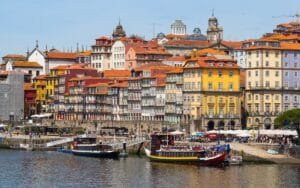
Smaller and more compact than Lisbon, Porto is many travelers’ favourite. The tiled churches, the Ribeira waterfront, and the Luis I bridge over the Douro define the postcard; across the river in Vila Nova de Gaia, the port wine cellars offer tastings that explain why the city exists. Porto is very walkable, rewards slow mornings in cafes, and is the gateway to the Douro Valley, one of the world’s oldest demarcated wine regions and a spectacular day trip by train or boat.
The Algarve: Portugal’s beach coast
The southern coast is what fills summer flights. Golden cliffs, hidden coves and warm, calm water stretch from Lagos to the Spanish border, with Faro as the transport hub. Lagos and the dramatic Ponta da Piedade sea stacks are the scenic highlight; the western Costa Vicentina is wilder and better for surf. July and August are hot, busy and pricier; May, June and October give you the same beaches with fewer crowds and better value.
Madeira and the islands
Madeira, an Atlantic island closer to Africa than to mainland Portugal, is a year-round destination built for hikers. Its famous levada trails follow old irrigation channels through laurel forest and along cliff edges, and Funchal makes a comfortable base. The Azores — nine volcanic islands further out — are the choice for whale watching, crater lakes and hot springs. Both are their own trips rather than easy add-ons to the mainland.
Best time to visit Portugal
Spring (April–June) and autumn (September–October) are the sweet spot almost everywhere: warm days, comfortable sightseeing, lower prices and thinner crowds. Summer (July–August) is peak for the Algarve’s beaches but hot inland and at its most expensive. Winter is mild and quiet — Lisbon and the south stay pleasant and cheap, while the north (Porto, Douro) is greener but wetter. Madeira is mild in every season.
How much does a trip to Portugal cost?
Portugal is one of the more affordable countries in Western Europe. As a rough guide, budget travelers can manage on a modest daily figure using hostels, pastelarias and public transport; a comfortable mid-range trip (a nicely located hotel, restaurant meals, the odd tour) sits in a moderate daily range; and the Algarve in peak summer costs noticeably more than the same trip in shoulder season. The biggest single lever on your budget is timing — travelling in May, June, September or October rather than mid-summer saves meaningfully on both flights and hotels. For a full itemised breakdown, see our Portugal cost pages.
Getting around
You don’t need a car for a city-focused trip: fast, cheap trains link Lisbon and Porto in around three hours, and both cities have metro, trams and buses. A rental car earns its keep for the Algarve, the Douro Valley and the interior, where public transport thins out. Domestic flights connect the mainland to Madeira and the Azores. English is widely spoken in tourist areas, the currency is the euro, and Portugal is part of the Schengen area.
Frequently asked questions
Is Portugal expensive to visit?
No — Portugal is among the most affordable countries in Western Europe. Food, transport and accommodation cost noticeably less than in France, Italy or Spain’s big cities, especially outside peak summer and away from the Algarve coast.
What is the best time to visit Portugal?
Spring (April–June) and autumn (September–October) are ideal: warm, affordable and uncrowded. Choose July–August only if beach time in the Algarve is the priority, and expect higher prices and bigger crowds.
How many days do you need in Portugal?
Seven to ten days suits a good first trip: 3–4 days in Lisbon (with a Sintra day trip), 2–3 in Porto, and the rest for the Algarve or the Douro. Madeira or the Azores deserve their own 4–6 day trip.
Lisbon or Porto — which is better?
Both, if you can. Lisbon is bigger, grander and better for day trips; Porto is smaller, more walkable and the home of port wine. Most travelers who visit both end up slightly preferring Porto’s compact charm.
Do you need a car in Portugal?
Not for Lisbon and Porto — the train between them is fast and cheap and both cities are walkable. A car is worth it for the Algarve, the Douro Valley and rural areas where buses are infrequent.
Is Portugal safe for tourists?
Yes. Portugal consistently ranks among the safest countries in the world, with very low violent crime. The main risk is pickpocketing on busy Lisbon trams and in tourist crowds — ordinary precautions are enough.
Popular guides: Porto vs Barcelona
Best time to visit Portugal (real climate data)
Best months: March, April, May, June, July, August, September, October, November.
Portugal’s warmest month is July (avg 28°C / 83°F), the coolest is January (low 8°C / 47°F). The wettest is December (117 mm) and the driest is July.
Source: Open-Meteo ERA5 climate normals (2019–2023). See the full month-by-month weather →
You Might Also Love


Before you go: see whether they speak English in Portugal and what to wear, check the tap water, sort your mobile data, and find out if it is a cash or card destination, and brush up on local etiquette.
