Frequently asked questions
Sri Lanka at a glance: best around Dec–Feb (23–30°C days, rainy season) · Plugs D,G,M (230 V) · drives left · ERA5 climate data
More: When to visit Sri Lanka · Sri Lanka travel guide
More: When to visit Sri Lanka · Sri Lanka travel guide
Sri Lanka travel FAQ: everything first-time visitors ask
Sri Lanka delivers South Asia at compact scale - tea country, ancient ruins, beaches, and wildlife in one accessible island. Here are 10 practical, current answers to traveler questions.
Is Sri Lanka safe for travelers?
Sri Lanka is broadly safe for travelers. The 2019 Easter bombings increased tourist awareness, but security has returned to normal. Main concerns: economic crisis caused fuel/food shortages but conditions have largely stabilized; pickpocketing in Colombo/Kandy crowds; tuktuk fare scams; ocean rip currents at south coast beaches. Solo female travelers may face attention but rarely physical issues.
How much does a trip to Sri Lanka cost?
Sri Lanka is exceptional value, especially post-2022. Budget travelers manage on $25-40/day. Mid-range travelers $70-120/day with charming guesthouses, train journeys, and Yala safari. Luxury travelers $300+/day at Cape Weligama, Heritance Tea Factory, or Anantara Tangalle.
What's the best time to visit Sri Lanka?
Sri Lanka has two monsoons hitting opposite coasts - so there's always a dry side. Southwest coast (Galle, Mirissa, Colombo) is dry December-March. Northeast coast (Trincomalee, Pasikuda) is dry May-September. Cultural triangle and hill country (Kandy, Ella) is best January-April and July-September.
How many days do I need in Sri Lanka?
Ten to fourteen days for a complete Sri Lanka circuit - 2 days Colombo/Negombo, 3 days cultural triangle (Sigiriya, Polonnaruwa), 3 days hill country (Kandy, Ella, train rides), 3-4 days southern beaches (Mirissa, Galle), 1-2 days Yala safari. Two weeks is generous; ten days is tight but workable.
Do I need a visa to visit Sri Lanka?
Most travelers need an ETA (Electronic Travel Authorization) via eta.gov.lk - $50 for 30 days, apply 1-2 weeks ahead. Some nationalities can buy on arrival. Confirm at the official ETA site before booking.
Can you drink the tap water in Sri Lanka?
No - tap water in Sri Lanka is not safe for travelers. Stick to bottled water (50-100 LKR / $0.15-0.30). Ice in upscale restaurants is usually safe. Brushing teeth with tap water is fine if you don't swallow it.
What language is spoken in Sri Lanka?
Sinhala is the majority language; Tamil is spoken in the north and east. English is widely spoken in tourism, hotels, and among educated Sri Lankans. Locals often speak excellent English.
What's the food culture like in Sri Lanka?
Sri Lankan food is one of South Asia's most distinctive - rice and curry (always plural), kottu (chopped roti stir-fry), hoppers (bowl-shaped pancakes), string hoppers, fresh coconut. Heat is real - 'mild' for locals is hot for Westerners. Don't miss: rice and curry at a homestay, kottu late at night, and Ceylon tea.
Is Sri Lanka good for first-time travelers?
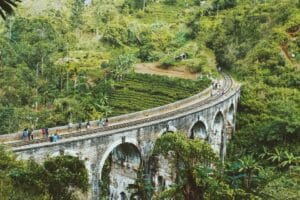
Sri Lanka is genuinely beginner-friendly South Asia - smaller scale than India, English-friendly, manageable logistics. The Sri Lankan railway journey through hill country is one of the world's iconic train rides. Tourism infrastructure has recovered well post-2022.
What should I avoid doing in Sri Lanka?
Don't disrespect Buddhist sites - cover shoulders and knees, remove shoes, never turn your back on a Buddha statue. Don't take photos with your back to a Buddha. Don't drink and swim. Don't ride elephants at tourist 'orphanages' (many are exploitative). Don't accept LKR cash that looks worn - some smaller bills aren't accepted.
What it actually costs: Sri Lanka Trip Cost