
Last updated September 11, 2026 · Editorial policy
- 3-Day Buenos Aires Itinerary: A Day-by-Day Travel Plan
- Buenos Aires Itinerary at a Glance
- Day-by-Day Itinerary
- Where to Stay in Buenos Aires
- Budget Breakdown (3 Days)
- What to Pack
- Tips for a 3-Day Buenos Aires Trip
- Routing Mistakes That Waste Half a Buenos Aires Day
- Frequently Asked Questions
- Related Buenos Aires Travel Guides
3-Day Buenos Aires Itinerary: A Day-by-Day Travel Plan
Quick answer: This 3-day Buenos Aires itinerary covers the must-see highlights without rushing, with detailed day-by-day plans, restaurant recommendations, and budget guidance.
Best for: night owls and food lovers who want steak, tango, and cafe culture at a walkable pace, with late dinners and one neighborhood per day.
Planning a 3-day trip to Buenos Aires? This itinerary is built from a first-time-visitor perspective: hit the icons, eat the best food, and finish with one or two memorable experiences locals would recommend. Each day mixes a major sight, food stops, and downtime — no death marches, no missing highlights.
Buenos Aires Itinerary at a Glance
| Day | Focus |
|---|---|
| Day 1 | Downtown & Recoleta |
| Day 2 | San Telmo to La Boca |
| Day 3 | Palermo’s Green Belt |
Day-by-Day Itinerary
Day 1 — Downtown & Recoleta
Start in the Plaza de Mayo, where the pink Casa Rosada and the Catedral Metropolitana anchor the city’s political heart, then walk north up the pedestrianized Calle Florida toward the leafy Recoleta barrio. Reserve a morning guided tour of the opulent Teatro Colón in advance (roughly 46 USD per person for the hour-long visit) — slots sell out days ahead. In the afternoon, wander the labyrinth of ornate mausoleums at the Cementerio de la Recoleta, resting place of Eva Perón; foreign-visitor entry runs about 15 USD, card only. Cabs and the Subte (Line D to Callao) are cheap with a SUBE card, roughly 1 USD a ride. Planning note: skip the tourist steakhouses on Florida and book a table at a Recoleta parrilla for a proper bife de chorizo, ideally after 9pm when locals actually dine.
Day 2 — San Telmo to La Boca
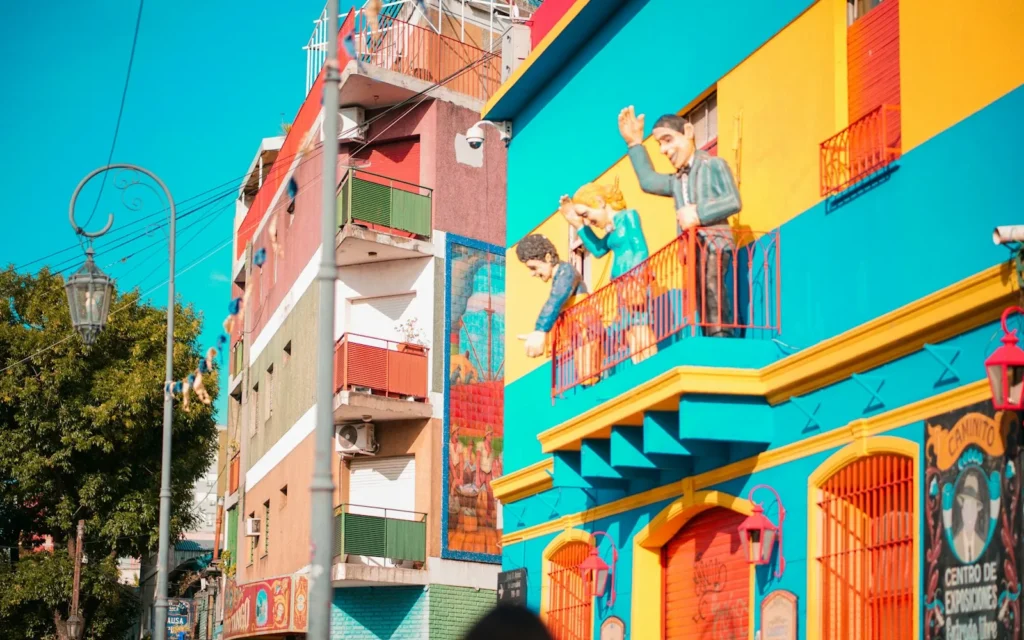
Sunday is the day for the sprawling Feria de San Telmo, when Defensa Street closes to traffic from Plaza Dorrego down toward Parque Lezama, filling with antiques, crafts and impromptu tango from about 10am to 5pm. Browse the covered Mercado de San Telmo for empanadas and a choripan (expect roughly 3–6 USD for a hearty street snack). Early afternoon, take a short taxi or the 29 bus south to La Boca and the brightly painted Caminito, snapping the corrugated-tin conventillos and the nearby La Bombonera stadium of Boca Juniors. Planning note: La Boca is best enjoyed by daylight and in the busy few blocks around Caminito — wander far and it gets rough, so return by cab before dusk. If your visit doesn’t land on a Sunday, San Telmo’s cobbled streets and cafes still reward a slow morning stroll.
Day 3 — Palermo’s Green Belt
Devote your last day to Palermo, the city’s largest and most fashionable barrio. Begin among the rose gardens and lakes of the Bosques de Palermo (Parque Tres de Febrero), then visit the MALBA, whose collection of Latin American art includes works by Frida Kahlo and Xul Solar; general admission runs roughly 10–15 USD. Spend the afternoon in Palermo Soho, browsing independent boutiques and design shops around Plaza Serrano, then linger over Argentina’s excellent coffee scene. As evening falls, settle into one of the buzzy corners of Palermo Hollywood for dinner and a glass of Mendoza Malbec (a good bottle often about 12–20 USD in a restaurant). Planning note: pay for meals and taxis in cash where you can and ask about the informal “blue” exchange rate — it stretches your dollars far further than card payments. A taxi from downtown is roughly 5–8 USD.
Where to Stay in Buenos Aires
Choose a central neighborhood within walking distance of major sights — you’ll save hours of commute time over 3 days. Book 6-12 weeks ahead for best rates.
Budget Breakdown (3 Days)
Argentina is rated Budget-friendly in our Travel Cost Index 2026. Figures are country-level daily ranges per person and exclude international flights.
| Travel style | Per day | Total 3 days |
|---|---|---|
| Budget | $12-25 | $36-75 |
| Mid-range | $45-90 | $135-270 |
| Luxury | $180-350 | $540-1,050 |
Source: Packzup Travel Cost Index 2026 — country-level averages; city and peak-season prices run higher. Excludes international flights.
What to Pack
- Clothing: Seasons run opposite the northern hemisphere – summer (Dec–Feb) is hot and humid, winter (Jun–Aug) needs a warm jacket. Pack sturdy shoes for San Telmo’s cobblestones, plus one smarter outfit for a late dinner or tango show.
- Tech: Argentina uses Type I and C plugs at 220V; load Cabify or Uber for taxis and the BA Como Llego app for subte and bus routing.
- Documents: Many nationalities, including US, UK, EU and Canadian visitors, currently enter Argentina visa-free for short stays – check current rules for your nationality and keep your passport valid well beyond the trip. Carry it if you add the Colonia ferry, which crosses into Uruguay.
- Money: Argentina’s peso is volatile – foreign cards now often get a favorable tourist exchange rate, but the San Telmo feria, taxis and small parrillas still tend to prefer cash. Tipping around 10% at restaurants, ideally in cash, is customary.
- Day bag: Tap water is safe, so carry a refillable bottle; add a light rain layer and keep your phone zipped away on crowded subte rides.
Tips for a 3-Day Buenos Aires Trip
- Book Teatro Colon ahead: guided tours and performances sell out days in advance, and popular tango dinner shows fill up on weekends, so reserve 3-5 days out.
- Build in buffer time: The calendar sets the day order here – San Telmo’s feria runs only on Sundays, MALBA closes Tuesdays, and Teatro Colón tour slots sell out days ahead – and with local dinners starting after 9pm, mornings tend to run slow.
- Eat where portenos eat: hit a neighborhood parrilla in Palermo or Chacarita after 9pm, and grab choripan or empanadas at Mercado de San Telmo for lunch.
- Travel insurance: $40-100 for 3 days. Covers medical, theft, cancellations.
- Get connected: Load an Airalo or Holafly eSIM before landing, roughly 10-15 USD for a week of data; buying a Claro or Personal SIM locally requires your passport.
Routing Mistakes That Waste Half a Buenos Aires Day
The fastest way to lose hours here is treating the city as one walkable blob. It is not. Anchor your days by neighbourhood cluster instead. Recoleta and Palermo sit next to each other, so a single day can run Recoleta Cemetery (open daily) into MALBA, then on to the Jardin Japones, the Rosedal and Bosques de Palermo, all reachable along Avenida Figueroa Alcorta without a taxi between them. Two timing traps catch first-timers on this leg: MALBA closes on Tuesdays, and the Feria de San Telmo street market only runs on Sundays, when Defensa Street shuts to traffic for roughly 13 blocks around Plaza Dorrego. Slot San Telmo into a Sunday if you can.
Pair San Telmo with La Boca on the same outing since they adjoin to the north, but treat La Boca as a daytime stop only and stay inside the tourist triangle around Caminito, the Riachuelo waterfront and Magallanes; do not wander out and do not linger after dark.
- Skip cramming both Tigre and Colonia into three days. Tigre alone is about an hour each way on the Mitre line from Retiro, and Colonia means a ferry from the Puerto Madero terminal into Uruguay, so each eats a full day. Pick one, or neither.
Frequently Asked Questions
Is 3 days enough for Buenos Aires?
For first-time visitors, 3 days in Buenos Aires covers the main highlights without rushing. If you want to add day trips, slower pace, or hidden gems, plan 2-3 more days. 3 days is the minimum to feel you’ve truly seen Buenos Aires — anything less is a sampler.
How much will a 3-day Buenos Aires trip cost?
Using the Budget Breakdown table above, drawn from our Travel Cost Index 2026: Budget $12-25/day ($36-75 for 3 days), Mid-range $45-90/day ($135-270 for 3 days), Luxury $180-350/day ($540-1,050 for 3 days). Country-level averages, excluding international flights.
What’s the best time to do a 3-day Buenos Aires itinerary?
Shoulder seasons (just before/after peak) offer the best balance of weather, crowds, and price for Buenos Aires. Check the destination’s specific best-time guide for exact months. Avoid major local holidays which spike prices and crowd attractions.
How do I get around Buenos Aires?
Get a SUBE card from a subte station or kiosko; it covers the subte, colectivo buses, and commuter trains, and fares are very cheap. The subte is fastest for the center, while colectivos run 24 hours citywide. Uber, Cabify, and DiDi all work well and are inexpensive for cross-town hops. Use the BA Como Llego app for door-to-door routing.
What should I pack for 3 days in Buenos Aires?
Remember the seasons are reversed: summer (December-February) is hot and humid, winter (June-August) is mild but damp, so pack layers either way. Bring comfortable shoes for San Telmo’s cobblestones and long Palermo walks. Portenos dress sharp in dark, smart-casual clothes, so leave the loud resort wear at home.
Should I book hotels or use Airbnb in Buenos Aires?
For 3-day trips, hotels are usually better: easier check-in, daily housekeeping, no laundry expectations, included breakfast often. Airbnb/apartments make sense for stays of 5+ nights, families, or kitchen-focused travelers. Book central locations to save commute time.
Related Buenos Aires Travel Guides
- Best Things to Do in Buenos Aires
- Where to Stay in Buenos Aires
- Best Food in Buenos Aires
- Best Time to Visit Buenos Aires
- Buenos Aires Trip Cost Breakdown
Best time to visit Buenos Aires (real climate data)
Best months: January, February, March, April, October, November, December.
Buenos Aires’s warmest month is January (avg 28°C / 83°F), the coolest is July (low 8°C / 46°F). The wettest is March (140 mm) and the driest is August.
Source: Open-Meteo / WMO climate normals (WMO 1991–2020, or ERA5 2019–2023 where unavailable).
You Might Also Love



Written by
John Morrison is the founder and lead travel writer at Packzup. Over the past decade he has explored destinations across Africa, the Americas, Asia, Europe, the Middle East, and Oceania — always self-funded, never on a press trip.
Trip prep: before you travel, plan what to wear, check the tap water, sort your mobile data, and see if it is a cash or card country, and skim local etiquette.
