Quick Answer
The best photo spots in Seoul are Bukchon Hanok Village, Gyeongbokgung Palace, N Seoul Tower from Namsan, Cheonggyecheon Stream and Dongdaemun Design Plaza. Several are residential neighbourhoods with quiet hours and photography restrictions — check the signs.
Seoul rewards photographers who move between its registers — Joseon-era palaces, hillside hanok lanes, and some of the most ambitious contemporary architecture in Asia, often within a few stops of each other.
10 Best Photo Spots in Seoul
1. Bukchon Hanok Village
Traditional tiled roofs stacked up the hillside with the modern city behind. Residents live here — signage asks for quiet, and photography is restricted in some lanes.
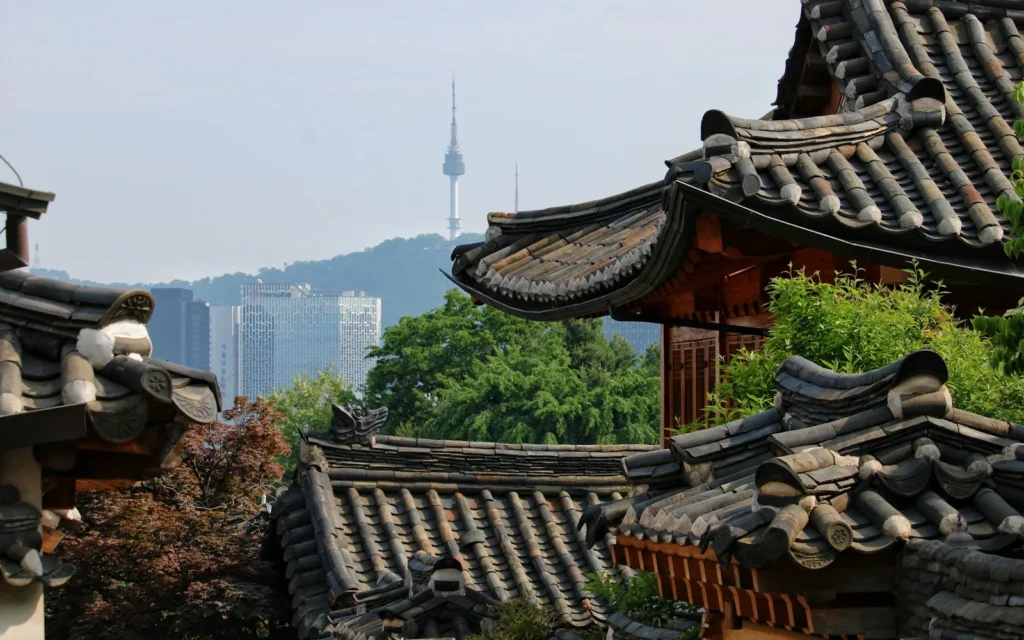
This is a lived-in residential neighbourhood rather than an open-air museum, and that is the constraint that matters: photography hours are posted and enforced, residents have complained for years about noise and intrusion, and some alleys are closed entirely. Shoot the rooflines and the sloping lanes rather than doorways, go early, and keep quiet. The classic view is looking downhill towards the modern city with tiled roofs in the foreground.
2. Gyeongbokgung Palace
The main throne hall reflected in the courtyard, with Bugaksan mountain behind. Free entry if you wear hanbok, which most visitors rent nearby.
Entry is free if you arrive wearing hanbok, which is why the rental shops cluster around the gates – and it is also why the courtyards fill with colour in every photograph. The changing of the guard runs on a fixed schedule at Gwanghwamun several times a day. Gyeonghoeru pavilion over its pond is the classic composition, and the palace closes on Tuesdays. Behind it, Bukaksan gives the elevated view down the palace axis.
3. N Seoul Tower from Namsan
The whole city at dusk from the mountain, reached by cable car or a steep wooded path.
The tower sits on Namsan at around 240 metres above the city, and the better photograph is usually of the tower from the mountain paths rather than the view from the top. Access is by cable car, bus or a walk up through Namsan Park. Sunset and the hour after are when the city lights come up against a still-blue sky. The padlock fences at the base are the other well-known subject.
4. Ihwa Mural Village
Painted stairways and murals on the slopes of Naksan — again residential, so keep noise down.
Ihwa was painted as a public art regeneration project in 2006, and its history is a useful caution: some residents later removed or painted over murals in protest at the volume of visitors, which is why a few of the best-known works no longer exist. It is a steep hillside residential area. Go quietly and early, expect stairs, and combine it with the Naksan city wall path immediately above.
5. Cheonggyecheon Stream
A restored stream running below street level through downtown, best after dark when the bridges are lit.
The stream was covered by an elevated highway from the 1970s and restored as an open watercourse in 2005 – it is one of the most-cited urban regeneration projects in the world, and knowing that changes how you read it. It runs about eleven kilometres below street level through the centre, so it is quiet and cool. It is lit at night and hosts the lantern festival in autumn. Long exposures work well from the stepping stones.
6. Dongdaemun Design Plaza
Zaha Hadid’s aluminium-clad curves, dramatic at night and almost abstract in close-up.
Zaha Hadid’s DDP opened in 2014 and is a study in curved aluminium panels with no straight lines – it photographs best in raking light early or late, when the surface reads as ridges rather than as a flat mass. The LED rose field installation appears seasonally. The building sits over the excavated remains of the Seoul city wall, which are displayed beside it. Interiors are open late, which suits night photography.
7. Banpo Bridge Rainbow Fountain
Water jets lit in colour along the Han River on summer evenings, shot from the park below.
The Moonlight Rainbow Fountain runs along nearly 600 metres of the bridge and is usually described as the longest bridge fountain in the world. Shows run on a schedule several times a day in the warmer months, typically April to October, and are suspended in winter and in high wind – check the day’s schedule rather than turning up. Shoot from the Banpo Hangang Park bank; the evening shows are lit.
8. Seoul City Wall at Naksan
The old fortress wall climbing the ridge, with the city spread out on both sides — the best sunset walk in the city.
The Naksan section is the most accessible stretch of the eighteen-kilometre Joseon-era wall and gives the best combination of historic stone in the foreground and the modern skyline behind. It is a gentle climb and is lit at night. The wall has been partially reconstructed, which is visible where old and new stonework meet – that seam is itself worth photographing. Naksan Park connects directly to Ihwa village below.
9. Gwangjang Market
Dense, steamy and full of movement — the best place in Seoul for food and people photography.
Gwangjang opened in 1905 and its food alley is the subject – stone-ground mung bean pancakes cooking at the stall, mayak gimbap, and the stallholders themselves, who are used to cameras but should still be asked. It is dense, low-lit and steamy, so a fast lens matters more than reach. Evening is busiest and most atmospheric. Seating is stools at the counter and sharing tables with strangers is normal.
10. Seonyudo Park
A former water treatment plant on a Han River island, reclaimed by plants — industrial concrete and greenery together.
Seonyudo is a former water treatment plant on an island in the Han, converted into a park in 2002 with the industrial structures left in place and planted – concrete tanks became gardens and the filtration basins became ponds. That makes it a genuinely different subject from anything else on this list, and it is almost always quiet. The pedestrian bridge from Yanghwa gives the approach shot, and autumn colour here is excellent.
Etiquette and timing
Bukchon and Ihwa are people’s homes, not sets. Both have had serious problems with visitor noise; Bukchon posts quiet hours and restricts photography in parts, enforced by wardens, and residents in Ihwa once painted over murals in protest. Keep your voice down, do not photograph into windows or doorways, and visit early.
Wearing hanbok gets you free entry to the main palaces, which is why the rental shops cluster around Gyeongbokgung — it is also the single best way to get a striking palace photograph. Autumn foliage peaks in late October and early November; cherry blossom around early April. Drone use requires permission in most of central Seoul and is prohibited near the presidential area and the river’s military zones.
Frequently Asked Questions
Where is the best view of Seoul?
Namsan for the classic skyline, or the Seoul City Wall at Naksan for the best sunset walk.
Can you photograph freely in Bukchon Hanok Village?
No — it is residential, with posted quiet hours and restrictions in some lanes. Go early and keep noise down.
Is hanbok rental worth it?
Yes — it gives free palace entry and makes for far better photographs.
Related Articles
Gear that earns its place: best travel cameras for beginners.