Things They Don't Tell You About Vietnam
Vietnam is becoming a more popular destination. Most travel content doesn't prepare you for what it actually feels like. Here's what's missing.
More: When to visit Vietnam · Vietnam travel guide
Vietnam is having a moment. The food. The cost. The landscapes. Travel content makes it look like Thailand-but-cheaper.
I've spent four weeks total across two visits. Some of the marketed experience is true. Some of it is not. Here's what guidebooks don't mention.
The traffic is a religion
You've seen photos of Vietnamese street traffic. Photos don't capture it.
Imagine 200 motorbikes per minute streaming through an intersection where there's no traffic light, no stop sign, no traffic cop. Each motorbike carries 1-4 people. Some have entire families. Some have ladders strapped sideways. Some have live chickens in baskets. None of them stop.
To cross the street, you walk into the traffic. You walk steadily. You don't stop. You don't run. The motorbikes flow around you. The first time you do this, you're certain you'll die. By the third day, you're crossing eight-lane roads without looking.
This is one of the most-Vietnamese experiences and nothing prepares you for it.
The food is real but the variety is regional
Travel content shows you pho, banh mi, and bun cha and implies these are the foods of "Vietnam."
The reality: pho is from Hanoi. Banh mi is from Saigon. Bun cha is northern. Mi quang is from Hoi An. Cao lau is from Hoi An specifically and is technically not available anywhere else (the water has to come from a specific well).
If you only spend time in tourist zones, you'll eat the same 5-6 dishes everywhere. The real Vietnamese food experience requires moving through the country and seeing how each region cooks.
The currency math is exhausting
Vietnamese dong (VND) has so many zeros that mental math is constant.
$1 ≈ 24,000 VND. Your hotel costs 1,200,000 VND per night ($50). Your dinner costs 250,000 VND ($10). Your taxi to the airport is 350,000 VND ($14).
The first few days you're constantly doing currency conversions. By day 5 you've internalized it but your brain still does the calculation. By the end of the trip you're tired of it.
This is a small thing but unique to Vietnam (no other major destination has currency with this many zeros).
Bargaining is expected but exhausting
Thailand has fixed prices for most things outside markets. Vietnam negotiates almost everything.
Hotel rates are negotiable (especially direct, especially monthly). Taxi rates negotiated before you enter the car. Market prices negotiable. Tuk-tuk fares negotiable. Cyclo rides negotiable. Tour prices negotiable.
Locals will start prices at 2-3x what they expect you to pay. You're expected to push back. This isn't aggressive — it's how commerce works.
By the end of three weeks of negotiating everything, you'll be tired. The constant low-level haggling is mentally exhausting in a way that fixed-price economies aren't.
The visa situation is annoying
Vietnam used to have visa-on-arrival options for many nationalities. They've changed it. You now apply for an e-Visa online before traveling.
The e-Visa application takes 3-5 business days (sometimes longer). It costs $25 for 30-day visa, $50 for 90-day. The system is functional but buggy. Some applications get stuck and require follow-up.
Plan to apply 2-3 weeks before your trip. Print the confirmation. Bring it on the plane (you'll be asked to show it before boarding).
The North-South divide is real
North Vietnam (Hanoi, Sapa, Ha Long Bay) and South Vietnam (Ho Chi Minh City, Mekong Delta, Phu Quoc) are culturally different.
The accents are different (Northern accent is more clipped; Southern is more melodic). The food is different (Northern food is more subtle; Southern is sweeter). The pace is different (Hanoi is older, slower; HCMC is newer, faster). The historical legacy is different (the divisions from the Vietnam War still resonate in subtle ways).
Tourism content often treats Vietnam as one country. Vietnamese people experience it as two cultures. For a 2-week trip, focus on either the north or the south. For 3+ weeks, do both.
Ha Long Bay is overrated
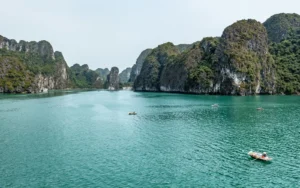
Yes, the limestone karsts are beautiful. Yes, the photos look stunning.
The reality: Ha Long Bay is now packed with hundreds of identical "luxury cruise" boats. The water is polluted in places. The "experience" is a heavily-orchestrated 2-day cruise with mediocre buffet food and Karaoke evenings.
Better alternative: Lan Ha Bay (just south of Ha Long, less developed) or Bai Tu Long Bay (north of Ha Long, even less developed). Same scenery, fewer crowds.
Or skip the cruise entirely and visit Cat Ba Island independently. Same area, different perspective, much more authentic.
Hoi An is gorgeous but small
Travel content makes Hoi An look like a major destination. It's a small town. Old town is walkable in 90 minutes. You can see the major sites in 1 day.
What it offers for longer stays: beach access, custom tailoring (made-to-measure clothing for very low prices), lantern atmosphere at night, cooking classes.
2-3 days is the right time in Hoi An for most travelers. 5+ days only if you're tailoring an entire wardrobe.
The motorbike risk is real
Travel blogs make Vietnamese motorbike rentals sound exotic and adventurous. The hospitals in Saigon and Hanoi treat 500-1000 motorbike-injured tourists per month.
Don't rent a motorbike unless: you have actual motorcycle experience, you have an international motorcycle license (your travel insurance probably requires it), and you understand the traffic culture (you don't).
Use Grab. Use taxis. Use buses. Save the motorbike romance for somewhere else.
Banking is harder than expected
Vietnamese ATMs have low withdrawal limits (typically 2-5 million VND per transaction, about $80-200). Fees are 30,000-50,000 VND per withdrawal.
Many places don't accept foreign cards (some restaurants, most markets, motorbike taxis, smaller shops). Cash is dominant.
Bring USD in $50 and $100 bills. Exchange at gold shops or jewelry stores (not banks — banks have worse rates). Carry small bills for tipping and small purchases.
The overall experience is great if you adjust expectations
Vietnam is wonderful but it requires more adaptation than a typical Western tourist destination. The traffic, the negotiation, the currency, the visa, the regional variation, the language barrier — all of these compound.
The reward is one of the most-fascinating, vibrant, food-rich destinations in Southeast Asia.
For first-time Asia travelers: do Thailand first, then Vietnam. Thailand is easier. You'll appreciate Vietnam more after Thailand has prepared you.
For experienced Asia travelers: Vietnam offers more cultural depth than Thailand. It just demands more from you to access it.
And one more thing nobody tells you: nearly every overcharging set-up in Vietnam depends on you not knowing the normal price, or being under time pressure. Our guide to scams and overcharging in Vietnam works through the recognisable patterns — and, just as usefully, what is not a scam but ordinary local pricing.