
Last updated August 27, 2026 · Editorial policy
- Budapest vs Vienna at a glance
- Cost
- Sights & culture
- Vibe
- Who should choose which
- The verdict: which one wins your trip?
- Budapest vs Vienna FAQ
- Getting between them — and getting around once you’re there
- The signature ritual: thermal baths vs. grand coffee houses
- What to actually eat and drink — named places, real prices
Quick answer: Choose Budapest for value, thermal baths and edgy energy; choose Vienna for imperial elegance, music and polish. Budapest is gritty-cool; Vienna is refined.
When to go: Budapest vs Vienna
Measured, not guessed — five years of ERA5 reanalysis (2019–2023). Months are ranked by how close the average high sits to 25°C, penalised by wet days.
Budapest
- Best month
- September
- Then expect
- 23°C · 8 wet days
- Next best
- June, August
- Wettest month
- May (13 wet days)
Vienna
- Best month
- July
- Then expect
- 27.3°C · 9 wet days
- Next best
- August, June
- Wettest month
- May (14 wet days)
- Different windows — Budapest peaks in September, Vienna in July. If your dates are fixed, that is the deciding factor.
- Budapest is the drier bet at its peak — 8 wet days vs 9.
- Biggest split is August — Budapest is 2°C warmer that month.
Source: ERA5 reanalysis (2019–2023) via Open-Meteo, CC BY 4.0 — Packzup Travel Climate Dataset (open data).
Budapest vs Vienna at a glance
| Budapest | Vienna | |
|---|---|---|
| Best for | Value, thermal baths, ruin-bar nightlife | Imperial palaces, classical music, coffee houses |
| Vibe | Gritty, youthful, edgy | Polished, elegant, orderly |
| Daily budget (mid-range) | €60–90 | €120–160 |
| Best time | Apr–Jun, Sep–Oct (baths shine in winter) | Apr–Jun, Sep–Oct |
| Don’t miss | Széchenyi Baths, Parliament, ruin bars | Schönbrunn, Hofburg, a live concert |
| The catch | Some rough edges, tourist-area scams | Pricey; can feel formal and quiet |
Cost
Budapest is significantly cheaper — Vienna is a polished Western capital with prices to match, while Budapest offers grand sights for far less.
Sights & culture
Vienna: imperial palaces (Schonbrunn, Hofburg), coffee houses, Mozart and world-class museums. Budapest: Parliament, Buda Castle and the thermal baths.
Vibe
Vienna is elegant, orderly and classical; Budapest is younger, edgier and famous for ruin bars and nightlife.
Who should choose which
Imperial grandeur, music and refinement: Vienna. Value, baths and energy: Budapest. They’re under 3 hours apart by train — easy to combine.
The verdict: which one wins your trip?
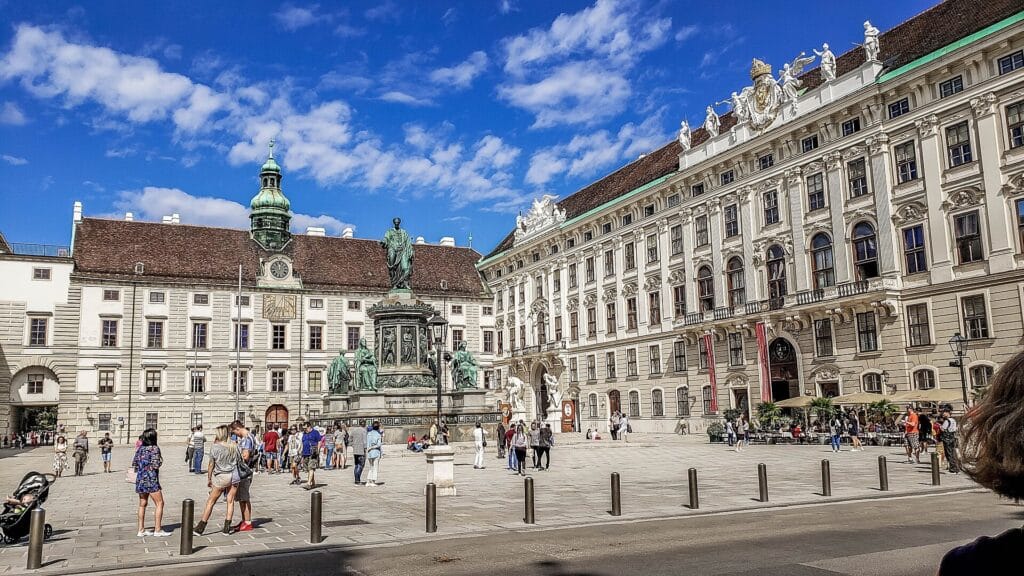
Choose Budapest if your ideal afternoon is soaking in the outdoor pools at Széchenyi then drinking in a Jewish-quarter ruin bar like Szimpla Kert. Choose Vienna if you’d rather tour Schönbrunn, sit two hours over a melange in a grand coffee house, and catch a concert without anyone rushing you. The deciding factor is your budget, plain and simple. Vienna costs roughly double per day, and that gap colors everything you do there.
The numbers that settle it:
- Daily spend. A mid-range day runs about €60–90 in Budapest versus €120–160 in Vienna. Same trip, nearly twice the bill.
- The bath thing is real. Széchenyi weekend entry is around €34, and there’s nothing equivalent in Vienna — it’s the single experience you can’t replicate across the border.
- Drinks. A beer in a central Budapest pub is roughly €3–5; Vienna’s coffee-house and bar prices sit well above that.
They’re a 2h37 Railjet apart, from €19 second class, so pairing them is the smart move. My call: give Budapest the extra night. It’s livelier, far cheaper, and the baths alone justify the stay — Vienna is the polished day-and-a-half on the way through.
Budapest vs Vienna FAQ
Which is cheaper?
Budapest, clearly.
Which is more elegant?
Vienna — imperial and refined.
Can I visit both?
Yes — a 2.5-hour train links them.
Getting between them — and getting around once you’re there
Here’s the best thing about choosing between these two: you don’t really have to. They sit just 244 km apart, and the ÖBB Railjet links them roughly hourly with 12 to 16 departures a day. The fast services run city-center to city-center (Budapest-Keleti to Wien Hauptbahnhof) in about 2 hours 20 minutes, and if you book a Sparschiene saver fare in advance you can land a second-class seat from around €20, with first class around €30. Trains have free WiFi, a dining car, and quiet zones — it’s a genuinely pleasant ride along the Danube, not a chore. I’d build a trip that does both rather than agonize over one.
Within each city the math is different. Vienna’s U-Bahn is slick and expensive: a 24-hour ticket is €10.20 (paper fare, as of January 2026; €9.70 if you buy it digitally). Budapest is the budget winner — a 24-hour BKK travelcard is 2,750 HUF (~€7), and single rides run 530 HUF.
- From Vienna Airport: the dedicated CAT express train is €14.90 one-way (€24.90 return) to Wien Mitte in 16 minutes.
- From Budapest Airport: the direct 100E bus is 2,500 HUF (~€7) straight to Deák Ferenc tér — far cheaper than Vienna’s airport link.
The signature ritual: thermal baths vs. grand coffee houses
This is where the two cities split hardest, and it’s the single best reason to visit each. Budapest is a spa town built on 120-plus thermal springs. The headline act is Széchenyi Baths in City Park — that neo-Baroque yellow palace with the steaming outdoor pools where locals play chess in the water. In 2026 it’s open 7am–8pm weekdays, 8am–8pm weekends, with day tickets around 13,200 HUF on weekdays / 14,800 HUF on weekends (~€34–38). One important heads-up: the minimum age for the thermal pools is now 14, and the historic Gellért Baths are closed for renovation until 2028 — so don’t plan around them, no matter what older guides say.
Vienna’s equivalent ritual is the Kaffeehaus, a UNESCO-listed institution where lingering for two hours over one coffee is the entire point. The classic trio is Café Central (the marble-columned former haunt of Trotsky and Freud), Demel, and Café Sacher, home of the Original Sacher-Torte at €7.90 a slice at the table. Budget the same money — roughly €30 — but in Vienna it buys an afternoon of coffee and cake; in Budapest it buys a half-day of soaking.
What to actually eat and drink — named places, real prices
Both cities reward you for skipping the tourist traps, but the food cultures point in opposite directions. Budapest is hearty, paprika-forward, and cheap. Real beef gulyás runs about 3,200 HUF (~€8) at a solid spot like Hungarikum Bisztró, and lángos — that deep-fried flatbread piled with sour cream and cheese — is around 1,200 HUF (~€3) from a market stall. Skip the famously gorgeous New York Café for a meal (a latte and pastry there pushes €25) and just pay for one coffee to gawk at the ceiling. The nightlife move is the ruin bars in the old Jewish Quarter: Szimpla Kert on Kazinczy utca, in its current home since 2004, has no cover charge and runs a farmers’ market on Sundays (9am–2pm).
Vienna is the pricier, more refined plate. The national dish is the Wiener Schnitzel — go to Figlmüller (serving it since 1905), where the plate-sized pork version runs about €21.90. Round it out at the Naschmarkt, the sprawling open-air food market, for cheese, olives, and Sachertorte to go. Rule of thumb: a satisfying Budapest meal-and-drink lands near €15; in Vienna, plan on €25–30.
Planning the trip? Go deeper with 3 Day Budapest Itinerary and things to do in Vienna.
You Might Also Love





Written by
John Morrison is the founder and lead travel writer at Packzup. Over the past decade he has explored destinations across Africa, the Americas, Asia, Europe, the Middle East, and Oceania — always self-funded, never on a press trip.
