3-day itinerary
More: When to visit Paris · Paris travel guide
Paris in 3 days: the perfect weekend itinerary
Paris in 3 days is intense but worth it. This route covers the iconic monuments, two major museums, the Left Bank's literary cafes, Montmartre's hilltop village, and the Marais's design district.
Day 1: Louvre, Notre Dame, the Marais
Morning
Louvre at opening (9am, pre-book to skip queues). Allow 3 hours - hit Mona Lisa, Venus de Milo, Egyptian wing, Napoleon III apartments.
Afternoon
Walk through the Tuileries Garden, across Pont Neuf to Ile de la Cite. Notre Dame (reopened Dec; free entry) + Sainte-Chapelle (16 EUR for EEA nationals and residents, 22 EUR for everyone else; the stained glass is the highlight).
Evening
Walk through the Marais for design-shop browsing and falafel queues on Rue des Rosiers. Dinner at Breizh Cafe (best crepes in Paris) or Chez Janou (classic bistro).
If you have an extra hour
Pere Lachaise Cemetery in the late afternoon if you have energy - Jim Morrison, Edith Piaf, Oscar Wilde.
Day 2: Eiffel Tower, Orsay, Saint-Germain
Morning
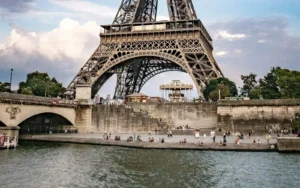
Champ de Mars early for Eiffel Tower photos. Climb the tower (36.70 EUR to the summit by lift, 23.50 EUR to the second floor) or just see it from Trocadero across the river.
Afternoon
Musee d'Orsay (16 EUR, closed Monday) for the world's best Impressionist collection. Allow 2.5-3 hours. Lunch at the Orsay rooftop cafe.
Evening
Walk across the river into Saint-Germain. Cafe time at Les Deux Magots or Cafe de Flore. Dinner at Bouillon Pigalle or a classic Saint-Germain bistro.
If you have an extra hour
Late-evening Eiffel Tower with hourly sparkle show (after 8pm Apr-Aug, 7pm Sep-Mar).
Day 3: Montmartre, Versailles, or Marche aux Puces
Morning
Choice: Montmartre + Sacre-Coeur (climb up at 7am for crowd-free; village atmosphere by 10am) OR Versailles day-trip (30 min by RER C; closed Monday).
Afternoon
Montmartre option - walk down through Place du Tertre (artists' square), Espace Dali, Moulin Rouge. Versailles option - palace tour (full day commitment).
Evening
Wine bar dinner in the 11th arrondissement (Septime, Le Servan, or Le Verre Vole). End at a riverside walk along the Seine.
If you have an extra hour
Marche aux Puces de Saint-Ouen (Saturday-Monday) is the alternative Sunday-morning move.
How France's 2026 two-tier admission prices change your budget
The biggest change to the cost of these three days is not inflation. From January 2026 several sites here charge two adult prices depending on where you live. The Louvre's official site lists EUR 22 for citizens and residents of the European Economic Area and EUR 32 for everyone else. The Centre des monuments nationaux applied the same split from 12 January 2026: Sainte-Chapelle is EUR 16 for EEA nationals and residents, EUR 22 otherwise, and the twin Sainte-Chapelle plus Conciergerie ticket is EUR 23 or EUR 30.
So two non-EEA visitors doing the Louvre and Sainte-Chapelle on Day 1 pay about EUR 32 more than two visitors from Dublin. Budget by residency, and carry proof: the CMN wording covers nationals of an EEA country or people resident there over four months, so a passport or ID card gets the lower price and a booking confirmation will not. Under-18s and under-26 EEA citizens enter the Louvre free.
Choosing your Eiffel Tower ascent
There are four adult tickets. The official site lists lift to the second floor at EUR 23.50, lift to the summit at EUR 36.70, stairs to the second floor at EUR 14.80, and stairs plus summit lift at EUR 28.00. The summit cannot be reached on foot.
- Stairs to the second floor suits anyone reasonably mobile who mainly wants the view. Cheapest, and usually the shortest queue.
- Stairs plus summit lift saves close to nine euros for identical top-floor access.
- Lift to the summit is for tight schedules, young children, or reduced mobility.
Two things go wrong. The summit closes more often than people expect: the official site warns that summit access may be restricted during severe weather or peak periods, usually wind, so buy that ticket only if you can absorb being turned back at the second floor. And hours are set per date, not by a seasonal timetable, so the official calendar is the only reliable source. One early-September date showed 09:30 to 23:00, last ascents 22:45.
The sparkle has no fixed clock either. Officially it runs five minutes at the start of every hour once the golden lighting comes on at nightfall, so the first show drifts later through spring and earlier through autumn. The official site puts the last sparkle at midnight, or 01:00 in summer. Work backwards from sunset on your date.
Is the Paris Museum Pass worth it over only three days?
Treat any pass price you read elsewhere as unreliable. It is sold in two, four and six-day versions from parismuseumpass.fr, and the figures published by third parties disagree with each other. Check the official site the week you buy and compare it against the per-site prices in the table below.
The mechanics matter more than the number, and they are not what most guides say. The official site calculates validity by the hour from your first visit: 48, 96 or 144 consecutive hours. A two-day pass first used at 16:00 therefore runs until 16:00 two days later, not to closing time the next day. It still has to cover adjacent days, and in the plan above your museum-heavy days are not adjacent: the Louvre is Day 1, Versailles is Day 3. Reorder so the Louvre and Sainte-Chapelle fall the day before Versailles.
The pass is not a queue-skip by itself. The Louvre asks all visitors, free-entry ones included, to book a time slot, and Versailles requires every visitor to book a Palace slot. Arriving with a pass and no slot is the commonest way this goes wrong. Skip the pass if you are under 18, or under 26 and an EEA resident: those sites are already free for you.
At a glance
| Site | Adult, EEA | Adult, non-EEA | Notes |
|---|---|---|---|
| Louvre | EUR 22 | EUR 32 | Closed Tuesday; late to 21:00 Wed and Fri |
| Sainte-Chapelle | EUR 16 | EUR 22 | Timed entry; rates from 12 Jan 2026 |
| Sainte-Chapelle + Conciergerie | EUR 23 | EUR 30 | Twin ticket |
| Pantheon | EUR 13 / EUR 16 | Low / high season, high from 1 Apr | |
| Arc de Triomphe | EUR 16 / EUR 22 | Same calendar | |
| Eiffel Tower, 2nd floor by lift | EUR 23.50 | Pass not valid here | |
| Eiffel Tower, summit by lift | EUR 36.70 | Wind can shut the summit | |
| Eiffel Tower, 2nd floor by stairs | EUR 14.80 | Cheapest ascent | |
| Versailles Passport | EUR 35 | Slot compulsory; closed Monday; last Palace entry 16:45 | |
Frequently asked questions
Which Versailles station should I use?
Three serve the town, with different walks. The Palace's own site gives about 10 minutes from Versailles Chateau Rive Gauche on RER C, 18 minutes from Versailles Chantiers (SNCF from Gare Montparnasse) and 17 minutes from Versailles Rive Droite (SNCF from Gare Saint-Lazare). Rive Gauche is the shortest walk, but from a Montparnasse base the mainline train often wins door to door.
What does a metro ticket cost now?
Fares rose on 1 January 2026. The French government's public information service lists a single metro, train and RER ticket at EUR 2.55, a bus or tram ticket at EUR 2.05, and the airport ticket at EUR 14. Load a Navigo Easy card rather than buying singles.
Is Monday a bad day for this itinerary?
Yes. The Musee d'Orsay and Versailles both close on Monday, while the Louvre closes on Tuesday. A Monday pushes you towards Montmartre, the Marais, Sainte-Chapelle and Pere Lachaise. If your three days span Monday and Tuesday, put the Louvre on the Monday, Orsay on the Wednesday, and drop Versailles.