
Last updated September 8, 2026 · Editorial policy
Quick answer: A classic 10-day rail route across Germany — Frankfurt and the Rhine Gorge, medieval Rothenburg on the Romantic Road, Munich with a Neuschwanstein day trip, then a high-speed ICE north to Berlin. Best months: May-September (warmest, longest days, beer gardens open). December for Christmas markets. Avoid November (gloomy + cold without Christmas markets). Total cost: US$1800-2800 mid-range / US$6000+ luxury per person. Excludes international flights.
Ten days covers Germany’s classic four — 3 nights Berlin, 1 night Dresden or Nuremberg, 2 nights Romantic Road (Rothenburg + Bavarian villages), 3 nights Munich + Neuschwanstein Castle. Uses high-speed ICE trains. Built across 2 personal Germany trips.
Day-by-day breakdown
Day 1 — Frankfurt: Arrival & Altstadt
Fly into Frankfurt Airport, Germany’s busiest gateway, and ride the S-Bahn (S8 or S9, about €5.65 / roughly $6.10, 12 minutes) straight to the Hauptbahnhof. Drop bags, then walk into the Altstadt, the reconstructed old town rebuilt after WWII. Start at Römerberg, the postcard square framed by the gabled Römer town hall, then step into the vast red-sandstone Frankfurt Cathedral (Kaiserdom) where Holy Roman Emperors were once crowned; entry is free, tower climb about €3 (roughly $3.25). As evening falls, cross the pedestrian Eiserner Steg footbridge over the Main for skyline views. Planning note: skip the tourist cafes and head to Sachsenhausen across the river, the traditional quarter where apple-wine taverns serve tart Ebbelwoi in ribbed Gerippte glasses (about €2 / roughly $2.15 a glass) alongside green sauce and schnitzel.
Day 2 — Frankfurt Museums & Skyline
Devote your morning to the Museumsufer, the museum embankment lining the Main’s south bank. The Städel Museum is the highlight, holding 700 years of European art from Dürer to Monet; admission runs about €16 (roughly $17) and it’s quietest right at the 10am opening. For a lighter option, the Museum für Kommunikation nearby is playful and hands-on. Grab lunch at the Kleinmarkthalle, an indoor market where the upstairs wine bar and sausage counters draw locals; a hot Handkäs mit Musik or bratwurst runs a few euros. In the afternoon ride the elevator up the Main Tower (about €9 / roughly $9.75), the only skyscraper in the banking district with a public rooftop platform, for 200-metre views over “Mainhattan.” Tip: buy the timed slot online in summer to skip the queue. Dinner back in the buzzing Bahnhofsviertel.
Day 3 — Rhine Gorge by Boat
Take an early regional train from Frankfurt toward Bingen or Bacharach (about 55–70 minutes, roughly €15–20 / about $16–22), gateway to the Rhine Gorge, a UNESCO World Heritage stretch dense with hilltop castles. Board a KD Rhine cruise between Bacharach and St. Goar; the fare runs roughly €20–30 (about $22–33) and boats leave Bacharach around 10:20, 12:20 and 14:20. Glide past the toll castle Pfalzgrafenstein mid-river and the legendary Lorelei rock, where sirens supposedly lured sailors to wreck. In St. Goar, hike up to the sprawling ruins of Burg Rheinfels (entry about €6 / roughly $6.50), the region’s mightiest fortress, and prowl its dark tunnels — bring a phone light. Planning note: pair the ride with a glass of crisp local Riesling; these steep slate slopes produce Germany’s finest. Train back to Frankfurt for the night.
Day 4 — Medieval Rothenburg
Check out and make for Rothenburg ob der Tauber, the best-preserved walled medieval town on the Romantic Road. From Frankfurt it’s an ICE to Würzburg then regional trains via Steinach (about 3 hours total, roughly €30–45 / about $33–49 booked ahead). Store luggage and lose yourself in cobbled lanes: photograph the fork-in-the-road Plönlein, walk a stretch of the covered town wall (free), and climb the Rathausturm town-hall tower (about €3 / roughly $3.25) for rooftops spilling to the Tauber valley. Sample a Schneeball, the fried shortcrust pastry dusted in sugar sold everywhere. The unmissable experience: the Night Watchman’s Tour, meeting at 8pm on the Marktplatz (English tour about €9 / roughly $9.75, cash only), an hour of lantern-lit history and wry humour. Planning note: stay overnight here — when the day-trip coaches leave, the town becomes almost yours alone.
Day 5 — Munich Old Town
Ride regional trains from Rothenburg via Steinach and Ansbach down to Munich (about 3½ hours; a Bayern-Ticket covers it for roughly €29 / about $32 solo). Bavaria’s capital rewards slow wandering, so base yourself near the center and head to Marienplatz, the main square, timing arrival for the 11am or noon Glockenspiel show on the neo-Gothic Neues Rathaus. Climb St. Peter’s Church tower (“Alter Peter,” about €5 / roughly $5.40) for the classic view over the twin-domed Frauenkirche. Graze through Viktualienmarkt, the open-air food market (Mon–Sat, stalls till 8pm), where the beer garden pours a rotating Munich brewery. For dinner, join the din at the Hofbräuhaus, the 1589 royal beer hall; a litre Maß runs about €12 (roughly $13). Planning note: shared tables marked Stammtisch are reserved for regulars — sit anywhere else.
Day 6 — English Garden & Museums
Spend the morning in the Englischer Garten, one of the world’s largest urban parks, bigger than New York’s Central Park. Near the Haus der Kunst, watch surfers ride the standing river wave on the Eisbach — a genuinely astonishing sight in a landlocked city — then stroll to the Chinesischer Turm beer garden for a pretzel and a cold Helles (about €5 / roughly $5.40). In the afternoon choose your museum: the sprawling Deutsches Museum, the world’s largest science and technology collection (admission about €15 / roughly $16), or the art-focused Pinakothek galleries in the Kunstareal quarter. Planning note: on Sundays many Bavarian state museums, including the Pinakotheken, charge just €1 (about $1.10). End with an evening walk through the leafy Maxvorstadt or a Franconian dinner — try Schweinshaxe, crackling-roasted pork knuckle, with a dark Dunkel beer.
Day 7 — Neuschwanstein Day Trip
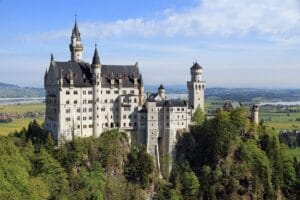
Reserve a full day for a Neuschwanstein day trip, King Ludwig II’s fairytale castle in the Bavarian Alps that inspired Disney. The independent route: a train from Munich to Füssen (about 2 hours; a Bayern-Ticket covers it), then bus 73/78 to Hohenschwangau village. Book your timed castle ticket online weeks ahead — it’s about €23.50 (roughly $26) and visits are guided at a fixed slot; walk-up tickets routinely sell out by midday in summer. Hike 30–40 minutes uphill (or take the shuttle bus/horse carriage) and cross the Marienbrücke bridge for the definitive photo across the gorge. Below sits Ludwig’s boyhood castle, honey-yellow Hohenschwangau, worth a combined ticket if time allows. Planning note: an organized round-trip coach tour from Munich (roughly €50–70 / about $55–77) removes the transfer stress and reserves your entry — worth it for a single busy day.
Day 8 — Train North to Berlin
Return to Munich and catch a direct ICE high-speed train to Berlin, the smoothest long leg of the trip — the fastest services run in about 3¾ hours, and advance Sparpreis fares start near €18–30 (roughly $20–33) if booked ahead, versus much more last-minute. Second class has free WiFi and a bistro car; reserve a seat in summer. Arrive at Berlin Hauptbahnhof, a glittering glass cathedral of a station, and settle into your neighborhood — Mitte for sights or Prenzlauer Berg for cafes. Ease in with an evening walk down Unter den Linden, the grand boulevard, to the floodlit Brandenburg Gate (always free, always open), Germany’s defining monument. Planning note: for dinner grab a Currywurst, Berlin’s beloved street snack of sliced sausage in curried ketchup (about €4 / roughly $4.35), or a doner kebab from a Kreuzberg imbiss — the city where the modern doner was popularized.
Day 9 — Museum Island & Reichstag
Book ahead for the free Reichstag dome (reserve online at the Bundestag portal weeks in advance; bring photo ID), where Norman Foster’s spiralling glass cupola crowns the German parliament with 360-degree views. Then walk to Museum Island, a UNESCO cluster of five great museums; note the famed Pergamon is closed for renovation until 2027, so head instead to the Neues Museum for the 3,300-year-old bust of Nefertiti (single ticket about €14 / roughly $15, or the 3-day Museum Pass Berlin at €32). Pause at the somber, undulating Memorial to the Murdered Jews of Europe near the gate (free, always open). Planning note: Berlin’s museums are calmest late afternoon on weekdays. For dinner explore Prenzlauer Berg around Kollwitzplatz, or sample Vietnamese food in the leafy streets — Berlin has one of Europe’s best Vietnamese scenes.
Day 10 — Wall History & Farewell
On your final day, confront Berlin’s Cold War past. Start at the Berlin Wall Memorial on Bernauer Straße (free), the most honest surviving stretch, with a preserved death strip, watchtower and open-air documentation center. Ride the U-Bahn or walk to the East Side Gallery, a 1.3-kilometre section of Wall painted by artists, home to the famous fraternal-kiss mural (free, outdoors). For deeper context, the excellent DDR Museum (about €13.50 / roughly $15) recreates daily life in East Germany, right down to a drivable Trabant simulator. If time remains before your flight, ascend the Fernsehturm TV tower at Alexanderplatz (about €25 / roughly $27) or simply relax in a Kreuzberg beer garden along the Landwehr canal. Planning note: the S-Bahn and regional trains to BER airport take about 30–45 minutes and cost roughly €4.40 (about $4.80) — far cheaper than a taxi, and you finish the trip like a Berliner.
What to book ahead
- Neuschwanstein Castle: Book online 1-2 months ahead via hohenschwangau.de. Tickets sell out same-day. Take dawn bus from Hohenschwangau village for best photos.
- Reichstag dome Berlin: Free but book online 1-2 weeks ahead. Bring passport. Best at sunset.
- ICE train tickets: Deutsche Bahn online 90+ days ahead for Sparpreis (~US$30 vs walk-up US$150). Book early.
- Munich Oktoberfest: Late September to early October. Beer tents reserve months ahead. Hotels triple in price — book 6+ months ahead.
A local planning note
Skip the Neuschwanstein Castle tourist scrum and go to Hohenschwangau Castle next door (just below Neuschwanstein) — King Ludwig’s actual home, fewer tour groups, equally interesting, and you can photograph Neuschwanstein from below without paying for the inside tour.
Best time for this trip
May-September (warmest, longest days, beer gardens open). December for Christmas markets. Avoid November (gloomy + cold without Christmas markets).
The Deutschland-Ticket trap and Romantic Road reality
Travelers see the Deutschland-Ticket (58 euros a month in 2025, 63 euros from January 2026) and assume it covers this whole trip. It does not. The ticket is valid only on regional and S-Bahn trains in second class, never on the ICE or IC services you actually want for Berlin to Munich. Buy a Sparpreis ICE ticket in advance for the long city hops, and treat the Deutschland-Ticket as a cheap add-on for local transit within each city, not for crossing the country.
The Romantic Road is the second snag. There is no single train line down it, and villages like Rothenburg ob der Tauber and Dinkelsbuhl sit off the main rail network, so this stretch wants a rental car for a day or two. Pick up the car at Nuremberg or Wurzburg, drive the road toward Fussen, then drop it and return to rail for the cities. One more honest cut: Dinkelsbuhl repeats much of what Rothenburg already gives you, so if days are tight, skip it and spend the time in Munich instead.
Frequently asked questions
Is 10 days enough for Germany?
Yes for Berlin + Munich + Romantic Road. 14 days adds the Rhine Valley wine country or Hamburg. 21 days for complete circuit including the Black Forest.
How much does a 10-day Germany trip cost?
Backpacker: US$1000-1400. Mid-range: US$1800-2800. Luxury: US$6000+ per person.
Trains or rental car in Germany?
Trains for the major cities — ICE network is excellent. Rental car only if doing the Romantic Road, Black Forest, or Bavarian villages deep-dive.
Best time to visit Germany?
May-September for beer gardens + outdoor markets. December for Christmas markets. Avoid November-February except for ski destinations.
Is Germany expensive?
Mid-range: US$110-200/day. Berlin is one of Western Europe’s most affordable capitals. Munich is pricier (similar to Paris).
Plan your Germany trip
Best time to visit Germany (real climate data)
Best months: May, June, July, August, September.
Germany’s warmest month is June (avg 26°C / 78°F), the coolest is February (low 0°C / 33°F). The wettest is July (72 mm) and the driest is April.
Source: Open-Meteo / WMO climate normals (WMO 1991–2020, or ERA5 2019–2023 where unavailable). See the full month-by-month weather →
You Might Also Love


Written by
John Morrison is the founder and lead travel writer at Packzup. Over the past decade he has explored destinations across Africa, the Americas, Asia, Europe, the Middle East, and Oceania — always self-funded, never on a press trip.
Trip prep: before you travel, plan what to wear, check the tap water, sort your mobile data, and see if it is a cash or card country, and skim local etiquette.
Planning around the date? Valentine’s Day 2027 falls on Sunday 14 February, inside a Saturday 13 to Monday 15 three-day weekend. See the 12 best Valentine’s Day getaways for 2027, with the trade-offs named.
