Last updated September 6, 2026 · Editorial policy
More: When to visit Jordan · Jordan travel guide
Buy the Jordan Pass before you fly, because it pays for your visa
This is the fact most first-time visitors miss, and it is worth real money. Jordan’s visa on arrival costs 40 JOD for a single entry. A one-day Petra ticket for a visitor staying overnight in Jordan costs 50 JOD. Bought separately that is 90 JOD before you enter a single other site. The Jordan Pass bundles both, and the cheapest tier costs 70 JOD.
There are three tiers, and the only difference between them is how many consecutive days you get at Petra:
- Jordan Wanderer, 70 JOD, one day at Petra.
- Jordan Explorer, 75 JOD, two consecutive days at Petra.
- Jordan Expert, 80 JOD, three consecutive days at Petra.
Every tier also covers entry to more than forty other sites, Jerash and Wadi Rum among them. Whichever tier you take, the pass undercuts buying the visa and the equivalent Petra ticket alone by 20 JOD, and everything else is then free at the gate.
Two conditions decide whether the visa waiver actually applies, and the official Jordan Pass site states both in the same sentence on every tier: you get the waiver only if you buy the pass before arrival in Jordan and stay a minimum of two nights, which the site glosses as three days. Miss either and you pay the visa fee normally, and the pass reverts to being a sightseeing ticket.
Three further conditions catch people out, all from the official FAQ. The pass is not available to holders of Arab nationalities, with the stated exceptions of Somalia, Djibouti, Mauritania, Libya and Iraq. It must be used within three months of purchase and expires one month after it is first scanned at an attraction. And the entry points matter: the FAQ names Queen Alia Airport and the Sheikh Hussein Bridge as issuing a visa on arrival, and the Wadi Araba crossing as doing so only for eligible Jordan Pass holders. If you are crossing from the West Bank at the King Hussein Bridge, do not assume the pass gets you a visa there; arrange entry in advance. Re-check all of this on jordanpass.jo close to your travel date, because visa rules change.
One more pricing trap. If you visit Petra without spending a night in Jordan, on a cruise excursion or a day trip in from Israel or Egypt, the official fee is 90 JOD rather than 50. The ticket office asks for your passport, which is how the two categories are told apart, so staying one night locally is the difference.
How big Petra actually is, and why one day is the floor
People arrive expecting a monument and find a city. The archaeological site covers roughly 264 square kilometres, sits at about 810 metres above sea level, and has been a UNESCO World Heritage Site since 6 December 1985. The Nabataean capital sprawls across wadis and ridgelines, and the walking is the visit.
The standard route runs like this. From the visitor centre gate you cross open ground past the djinn blocks and the Obelisk Tomb before the gorge begins. The Siq itself then winds about 1.2 kilometres between walls that stand between roughly 91 and 182 metres high, narrowing to no more than three metres in places, before opening without warning onto the Treasury. The Treasury facade is 24 metres wide and 37 metres tall, and you have still not reached the main city.
Beyond it the Street of Facades, the theatre, the Royal Tombs and the colonnaded street run on. The park authority lists its Main Trail, the visitor centre to city centre route, at 3.9 kilometres, which means a slow, honest first day that comes back the same way is close to eight kilometres of uneven ground before you add any climb.
The opening hours are the real constraint, and they change with the season. The park authority publishes the site and visitor centre as open 06:00 to 18:00 from 2 March to 1 October 2026, and 06:30 to 17:00 from 2 October 2026 to 1 March 2027. Being at the gate when it opens buys you the Siq in shade and near silence before the first coaches, and it is the single best decision you can make at Petra. Check the current dates on visitpetra.jo before you plan around them, because the changeover dates are set each year.
The Monastery climb, and whether to do it
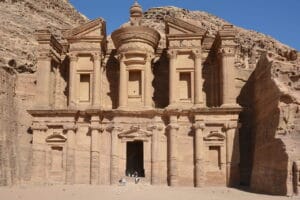
Ad Deir, the Monastery, is the largest carved facade in Petra at about 45 metres tall and 50 metres wide, considerably bigger than the Treasury. It is also up a staircase. The park authority lists the route as Al Dayr Trail 1, 2 kilometres long and graded easy to moderate, with a second, harder 1.9 kilometre approach graded moderate to difficult. Published step counts vary from about 800 to about 1,000, and no official count exists, so treat any precise number you read with suspicion. Most people take 45 to 60 minutes each way at a steady pace.
The steps are irregular, worn smooth in places and open to the sun on much of the ascent. There is no handrail for long stretches. Donkeys are offered at the bottom and worked hard on the route; if you are uneasy about animal welfare, that is a decision to make before you are being pitched at halfway up. Carry considerably more water than you think you need, because the stalls thin out as you climb.
Do it if you can walk uphill for an hour and you are not visiting in the middle of a summer afternoon. The facade is more impressive than the Treasury and the viewpoints beyond it look out over Wadi Araba. Skip it, without much loss, if your day is already short, if the heat is severe, or if you have knee trouble, because the descent is harder on joints than the climb.
The alternative high viewpoint is the signposted Al Khubtha climb from the Royal Tombs to the ledge above the Treasury, which gives you the classic view down onto the facade. It is a long staircase rather than a walk. Doing both that and the Monastery in one day is realistic only if you are through the gate at opening.
Petra by Night and Little Petra
Petra by Night runs five nights a week, not three. The park authority lists it every Sunday, Monday, Tuesday, Wednesday and Thursday, from 20:30 to 22:30, walking the Siq to the Treasury by candlelight. It costs 30 JOD per person and children under 10 go free. Older guides that name only Monday, Wednesday and Thursday are out of date, and so is the old 17 JOD price.
The ticket rule catches people at the gate. Petra by Night is not included in your daytime ticket and not included in the Jordan Pass, but you cannot buy it without one of them: the official listing requires you to already hold a daytime Petra entry ticket or a Jordan Pass. The ticket is valid only on its issue date and cannot be resold. It can be cancelled in bad weather, so confirm at the visitor centre on the day.
Manage the expectation. It is a slow, crowded walk with paper lanterns, a seated performance at the Treasury and no floodlighting of the monuments themselves. Photographers regularly find it disappointing; people who want the gorge in the dark usually do not.
Little Petra, properly Siq al-Barid, sits a short drive north of Wadi Musa and is a separate, far smaller gate. The gorge is only a few hundred metres long, but it holds Nabataean dining halls, cisterns and one of the very few surviving painted Hellenistic ceilings in the region. It takes about an hour, it is quiet even when the main site is heaving, and it works well as an afternoon after a dawn start at Petra. It also connects to the main site by the back trail to the Monastery, which the park authority lists at 7 kilometres and grades moderate, so it is a serious walk and needs a guide.
When to go, and surviving the heat
Spring and autumn are the right answer. April to early June and mid-September to November give you workable walking temperatures and low rain risk, which matters because Petra is a canyon system and heavy rain brings a genuine flash-flood risk that closes the Siq. The dam at the Siq entrance exists precisely because of that: it was rebuilt in 1963 and again in 1991 to bar the mouth of the gorge and reroute Wadi Musa, restoring what the Nabataeans did at the same point two thousand years earlier.
High summer is the hardest version of Petra. Once you leave the Siq there is almost no shade anywhere in the site, the rock radiates heat back at you all afternoon, and the Monastery staircase in July is a poor idea for most people. If you are stuck with July or August, restructure rather than shorten: be at the gate for the 06:00 opening, do the Monastery or Al Khubtha before 10:00, retreat to Wadi Musa through the middle of the day, and come back in for the last two hours when the light is better anyway.
Winter is underrated but cold and wet, and it costs you time twice over. The site opens half an hour later at 06:30 and closes at 17:00, and at 810 metres the nights drop sharply and snow is not unknown. The site is close to empty, which is the trade.
Two payment details worth knowing. The ticket office states that a valid passport must be presented and that it accepts cash in Jordanian dinars and Visa cards, so a Mastercard-only wallet is a problem at the gate. Stalls inside the site are a cash economy, so bring small notes in. Practical kit, in order of how often people get it wrong: proper closed walking shoes rather than sandals, because the surface is broken rock and sand; far more water than feels necessary; and a hat and long sleeves rather than repeated sunscreen. Children under 12 enter free in daylight hours, which softens the cost of a family visit considerably.
At a glance
| What | Cost | Covered by Jordan Pass? | Notes |
|---|---|---|---|
| Jordan visa on arrival, single entry | 40 JOD | Yes, if the pass is bought before arrival and you stay at least two nights | Waiver is void if you buy the pass after landing |
| Petra, 1 day, staying overnight in Jordan | 50 JOD | Jordan Wanderer, 70 JOD | Wanderer beats visa plus ticket bought separately by 20 JOD |
| Petra, 2 consecutive days | 55 JOD | Jordan Explorer, 75 JOD | Multi-day tickets must be used on consecutive days |
| Petra, 3 consecutive days | 60 JOD | Jordan Expert, 80 JOD | Worth it only if you are also doing the longer trails |
| Petra, day visitor with no overnight stay in Jordan | 90 JOD | No | Applies to cruise and cross-border day trips; passport checked at the ticket office |
| Petra by Night | 30 JOD | No, but a Jordan Pass or day ticket is required to buy it | Sunday to Thursday, 20:30 to 22:30; under-10s free |
| Children under 12, daylight hours | Free | Not applicable | Jordanians 1 JOD, Arab nationals 30 JOD, residents 10 JOD |
| Other sites: Jerash, Wadi Rum and 40 more | Individually ticketed | Yes, all tiers | This is where the pass moves from break-even to clearly cheaper |
Frequently asked questions
Is the Jordan Pass worth it for Petra alone?
Yes, provided you buy it before you arrive and stay at least two nights. The visa is 40 JOD and a one-day Petra ticket is 50 JOD, so 90 JOD separately against 70 JOD for the Jordan Wanderer. You save 20 JOD before visiting anything else, and Jerash, Wadi Rum and more than forty other sites are then included. The pass must be used within three months of purchase and expires one month after its first scan.
How many nights do you have to stay for the Jordan Pass to waive the visa fee?
A minimum of two nights, which the official Jordan Pass site describes as three days, and the pass must be bought before you arrive in Jordan. Both conditions apply to all three tiers. The pass is also not available to holders of Arab nationalities other than Somalia, Djibouti, Mauritania, Libya and Iraq, so check your own eligibility before you buy.
How many days do you need at Petra?
One full day from opening is the minimum and it is a hard day. The park authority’s Main Trail from the visitor centre to the city centre is 3.9 kilometres one way, so a there-and-back first day is close to eight kilometres before any climb. Two days lets you add the Monastery and the Al Khubtha viewpoint without racing, and is the better choice if the Jordan Explorer tier fits your trip.
How long is the Monastery climb at Petra?
The park authority lists the main route, Al Dayr Trail 1, at 2 kilometres and grades it easy to moderate, with a harder 1.9 kilometre alternative. Most people take 45 to 60 minutes each way. Published step counts range from about 800 to about 1,000 and there is no official figure. The steps are irregular and largely unshaded, so go early, carry plenty of water, and expect the descent to be harder on your knees than the climb.
Which nights does Petra by Night run, and is it included in the ticket?
Sunday, Monday, Tuesday, Wednesday and Thursday, from 20:30 to 22:30. It costs 30 JOD and children under 10 are free. It is not included in your daytime ticket and not included in the Jordan Pass, but you must already hold one of those two to buy it. The ticket is valid only on its issue date, and the event can be cancelled in poor weather, so confirm at the visitor centre on the day.
What time does Petra open and close?
The site and visitor centre are open 06:00 to 18:00 from 2 March to 1 October 2026, and 06:30 to 17:00 from 2 October 2026 to 1 March 2027, as published by the Petra Development and Tourism Region Authority. The changeover dates are set each year, so check visitpetra.jo before planning a dawn start around them.
You Might Also Love

Written by
John Morrison is the founder and lead travel writer at Packzup. Over the past decade he has explored destinations across Africa, the Americas, Asia, Europe, the Middle East, and Oceania — always self-funded, never on a press trip.