
Last updated August 22, 2026 · Editorial policy
Albanian food is one of Europe’s last undiscovered cuisines — a Mediterranean-Balkan fusion shaped by centuries of Ottoman rule, Greek influence from the south, and Italian flavours from across the Adriatic. The country’s food culture is built on fresh, local ingredients: lamb from mountain pastures, feta-like cheese from village herds, olive oil from the south, peppers and tomatoes from the coastal plains, and bread baked in wood-fired ovens. Eating in Albania is gloriously cheap — a full meal with wine costs what a sandwich costs in London — and the quality, especially in traditional tavernas and home-cooked guesthouse meals, is remarkably high.
More: When to visit Albania · Albania travel guide
Byrek
Flaky filo pastry filled with spinach, cheese, meat, or pumpkin, baked until golden and cut into large wedges. Byrekore (byrek shops) are found on every street corner and serve fresh byrek from early morning. A generous wedge costs 50-100 ALL. The spinach and cheese version (byrek me spinaq e djath) is the most traditional. Eat it warm from the bakery with a yogurt drink (dhalle). It is Albania’s most ubiquitous snack and the quality is remarkably consistent everywhere.
Tave Kosi
Albania’s national dish — lamb baked in a yogurt and egg custard until the top forms a golden crust and the meat falls apart beneath. The tangy yogurt sauce contrasts beautifully with the rich lamb. Found at traditional restaurants throughout the country for 400-700 ALL. Oda Restaurant in Tirana and Antigoni in Gjirokaster serve outstanding versions. The dish has ancient roots and tastes unlike anything in neighbouring cuisines. Always served with rice or bread.
Qofte
Grilled meatballs or elongated kebabs made from a mix of lamb and beef with onion, herbs, and spices. Served with a tomato and onion salad, white bread, and sometimes yogurt. Found at every restaurant and street grill for 300-500 ALL. Qofte Fergesë in Tirana is famous for its grilled meats. The charcoal grill imparts a smokiness that distinguishes them from oven-cooked versions. Order a mixed grill plate for the full experience.
Fergese
A baked dish of peppers, tomatoes, and cottage cheese (or sometimes liver) in a rich, slightly spicy sauce, served bubbling hot in an earthenware dish. It is Albanian comfort food at its best — simple ingredients elevated by slow baking. About 300-500 ALL at traditional restaurants. Tirana’s Mullixhiu restaurant serves a modern interpretation. The cheese version (fergese me djath) is more common than the liver version and more approachable for first-timers.
Trilece
A three-milk cake (tres leches) that Albania adopted from Turkey and made its own — soaked in whole milk, condensed milk, and cream, then topped with a layer of caramelised sugar. It is impossibly moist and sweet. Found in every restaurant for 150-250 ALL as dessert. Pasticeri Française in Tirana and bakeries in Berat make excellent versions. The caramel topping should be dark and slightly bitter to balance the sweet cake. A perfect end to any Albanian meal.
Raki and Meze
Albanian raki (grape or mulberry brandy) is the social drink of the country — offered to guests in every home, served before meals in every restaurant, and produced by seemingly every Albanian family. A raki session comes with meze: white cheese, olives, roasted peppers, salted fish, and bread. About 100-200 ALL per glass. The home-produced village raki is far superior to commercial versions. Never refuse a raki — it is considered a gesture of hospitality.
Peshk i Pjekur (Baked Fish)
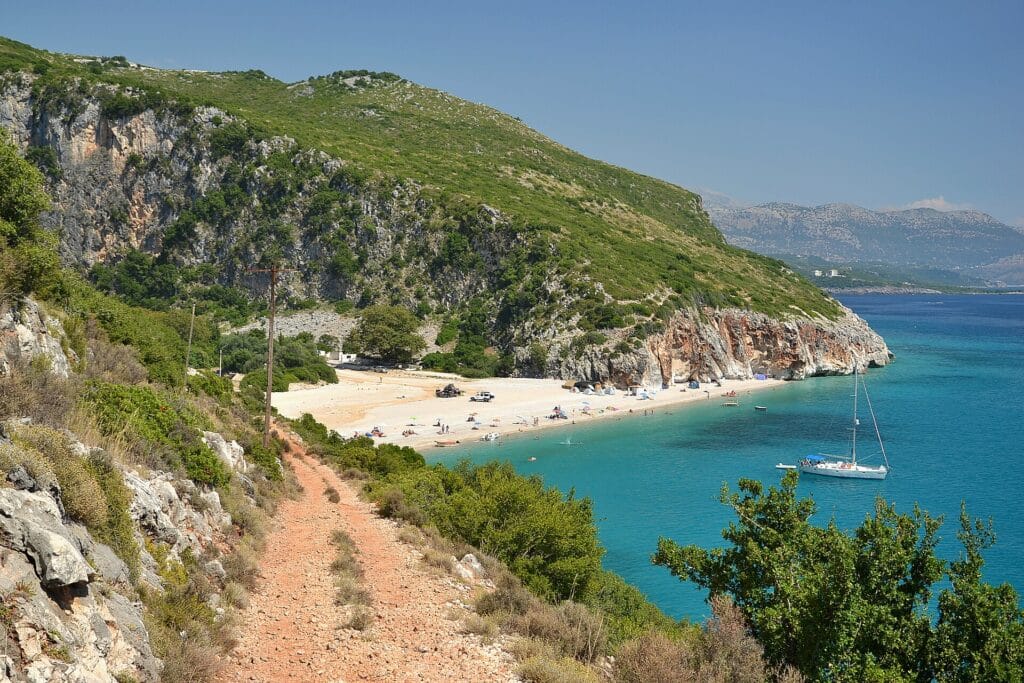
Whole fish (usually sea bass or bream) baked with tomatoes, peppers, garlic, and olive oil in an earthenware dish. The Ionian and Adriatic coasts produce exceptional fish, and waterfront restaurants in Saranda, Himara, and Vlora serve fresh-caught baked fish for 600-1,200 ALL. The fish should be fresh enough that the restaurant can tell you where it was caught that morning. Pair with a bottle of Albanian white wine from Kantina Cobo.
Baklava
Albanian baklava uses walnuts rather than the pistachios common in Turkish versions, and the syrup tends to be less sweet with a touch of lemon juice. Layers of thin filo pastry filled with crushed walnuts and soaked in sugar syrup. Found at every bakery for 50-100 ALL per piece. The versions from Elbasan and Berat are considered the finest. Buy a box of 12 from a bakery as a gift — they keep for days and are always appreciated.
Eating Tips for Albania
Albanian restaurants are extraordinarily cheap — a full meal with drinks costs 800-1,500 ALL (7-13 EUR). Service is typically included but rounding up is appreciated. Byrekore (byrek bakeries) are the best breakfast option in every town. The Albanian Riviera (Ksamil, Himara, Dhermi) has the best seafood. Raki is offered everywhere — sip slowly and eat between glasses. Albanian wine is excellent and almost unknown outside the country — try Kantina Cobo, Nurellari, and Çobo wines. Markets in Berat, Gjirokaster, and Korçe have the best local produce. Cash is preferred everywhere outside Tirana.
Frequently Asked Questions
What is the must-try food in Albania?
The absolute must-try is Byrek. Beyond that, Tave Kosi and Qofte are essential for understanding Albania’s food culture.
Is street food safe in Albania?
Yes, street food in Albania is generally safe. Look for stalls with high turnover, eat where locals eat, and choose places where food is freshly prepared.
How much should I budget for food in Albania?
Budget travelers can eat well for $15-25 per day at local restaurants. Mid-range budgets of $35-60 cover a mix of casual and sit-down meals. Fine dining starts around $60-100 per person.
You Might Also Love

Written by
John Morrison is the founder and lead travel writer at Packzup. Over the past decade he has explored destinations across Africa, the Americas, Asia, Europe, the Middle East, and Oceania — always self-funded, never on a press trip.
