
Last updated September 11, 2026 · Editorial policy
Ibiza and Mallorca sit about fifty miles apart in the same Balearic archipelago. They share a regional government, a language, near-identical weather, and that impossible glassy-turquoise water the islands are famous for. And yet they might be the two most different islands in Spain. One built a global brand on superclubs, sunset bars, and $20 cocktails; the other quietly became the most complete island in the Mediterranean, with a real capital city, a UNESCO-listed mountain range, and more beaches than you could work through in a summer.
I have done both more than once, and here is what I wish someone had told me before my first booking: most people choose based on a stereotype that is fifteen years out of date. Ibiza is not just foam parties, and Mallorca is not just package hotels. But they reward completely different trips, and picking wrong is an expensive mistake — especially in Ibiza’s case. Here is the honest breakdown, category by category.
| Category | Ibiza | Mallorca | Winner |
|---|---|---|---|
| Beaches & coves | Postcard calas, absurdly clear water | Far more variety, long sandy stretches | Tie |
| Nightlife | The best club scene on earth | Magaluf strips and Palma bars | Ibiza |
| Food & restaurants | Glamorous but pricey | Palma is a genuine food city | Mallorca |
| Mountains & scenery | Gentle pine hills, Es Vedra views | UNESCO Serra de Tramuntana | Mallorca |
| Old towns & culture | Dalt Vila | Palma, Soller, Valldemossa | Mallorca |
| Boat days & sunsets | Iconic, with Formentera next door | Good but less glamorous | Ibiza |
| Family travel | Doable but expensive | Purpose-built for it | Mallorca |
| Value for money | Priciest island in Spain | Noticeably cheaper across the board | Mallorca |
Cost comparison: what a day actually costs
Let’s get the uncomfortable part out of the way: Ibiza is the most expensive island in Spain, and in July and August it is not even subtle about it. A basic double room near the action runs $200 a night and up, a cocktail at a beach club is commonly $18 to $25, and entry to a big-name club is often $50 to $90 before you buy a single drink. A realistic bare-bones day — hostel-grade bed, supermarket lunches, one modest night out — lands around $130 to $200. Mid-range travelers should budget $250 to $450 a day, and the ceiling simply does not exist.
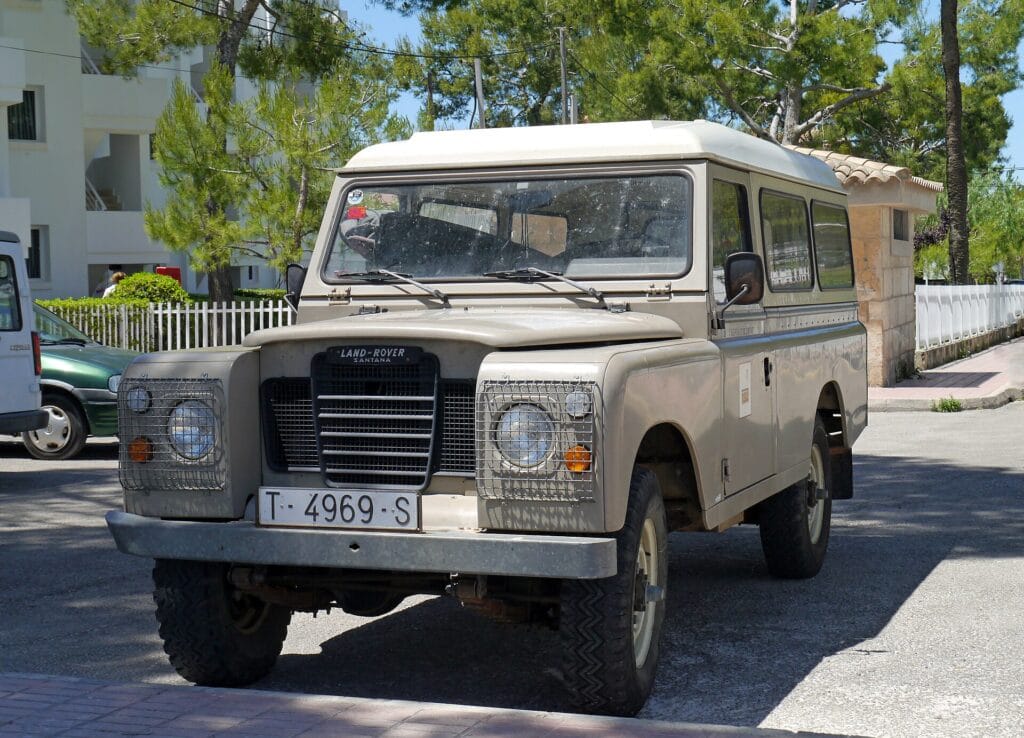
Mallorca plays by normal Spanish rules. Decent budget rooms run $50 to $80, lovely mid-range hotels $120 to $200, and a fixed-price lunch in a normal town costs $15 to $20. Budget travelers can manage on $90 to $150 a day, mid-range on $180 to $320, and even a converted stone finca in the mountains often costs less than a mediocre party hotel in Playa d’en Bossa. Shoulder season — May, late September, October — knocks roughly a third off both islands. Spain in general remains one of Western Europe’s better-value countries, as our Italy vs Spain comparison found, but within Spain, Ibiza is the exception that proves the rule.
Beaches and coves
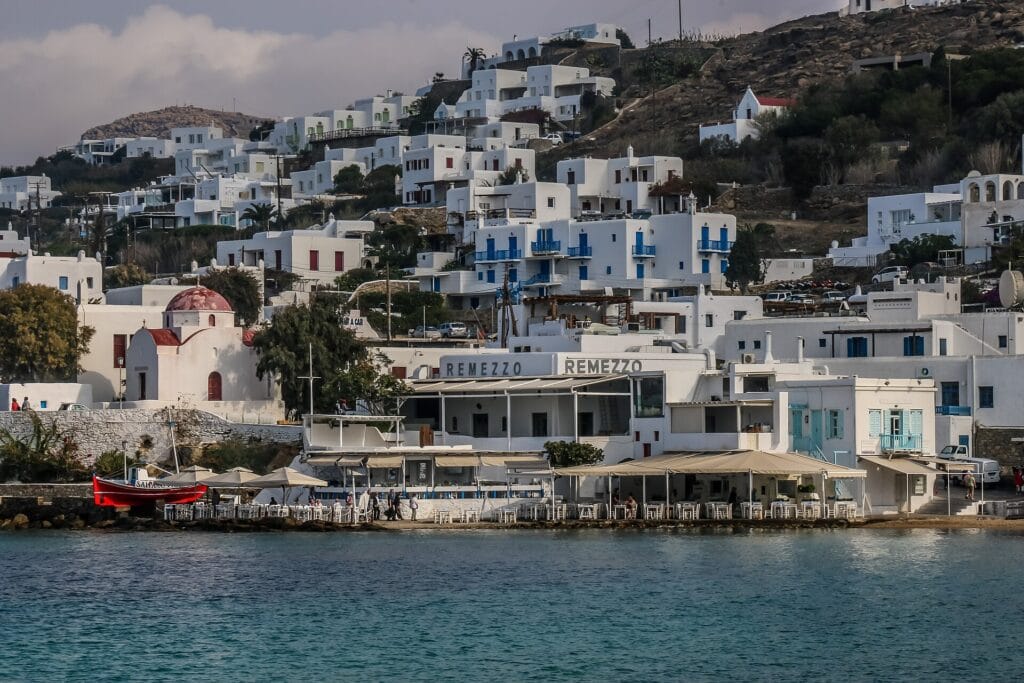
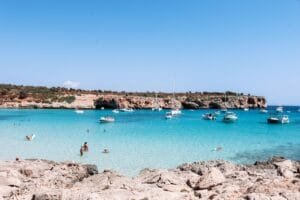
Both islands have world-class swimming, so this comes down to shape and scale. Ibiza’s specialty is the small cala: Cala Comte has some of the clearest water I have seen anywhere in the Mediterranean, Cala Salada hides below a pine forest, and Ses Salines does the see-and-be-seen thing with a genuinely gorgeous beach attached. The catch is size — these coves are small, and in July and August they are effectively full by 11 a.m. Ibiza’s trump card is Formentera, the tiny island a short ferry ride south, whose beaches are the closest thing Europe has to the Caribbean.
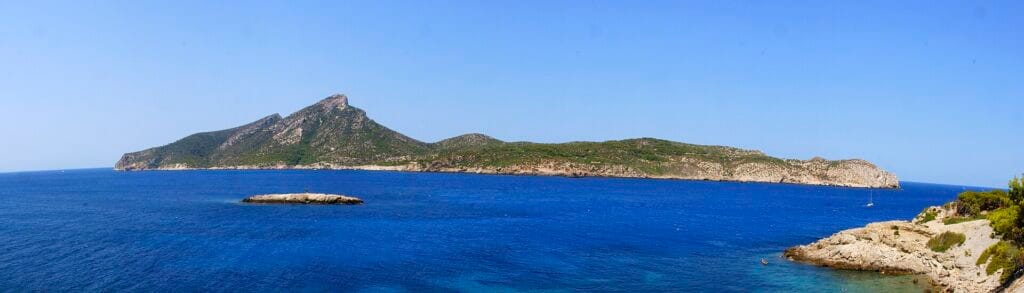
Mallorca counters with sheer variety. Es Trenc is a long, undeveloped stretch of white sand in the south, the coves around Santanyi and Cala Mondrago sit inside a protected natural park, Playa de Muro offers miles of shallow, family-friendly water, and the beaches below Cap de Formentor are backed by cliffs that barely look real. On any given August day you can still find room somewhere on Mallorca; on Ibiza you mostly cannot. Mallorca’s depth wins a two-week beach trip, while Ibiza plus Formentera wins the single perfect beach day.
Nightlife: there is no contest, but read this anyway
Ibiza’s club scene is the best on the planet, and it is not close. Pacha, Amnesia, Hi Ibiza, Ushuaia, DC-10 — from late May to early October the biggest DJs alive rotate through weekly residencies, and the opening and closing parties are pilgrimage events. It is also an industrial-scale money extraction machine: tickets, drinks, taxis, and recovery brunches add up faster than in any other party destination in Europe. Budget a genuinely silly amount for a proper club night and you will be about right.
Mallorca’s nightlife is real but local-scale. Magaluf is a younger, cheaper, rowdier strip that mostly serves British package crowds; Palma’s Santa Catalina district and old town have excellent cocktail bars and a proper Spanish going-out culture that starts late and ends later. It is a fun night out. Nobody plans a trip around it, and that is exactly the point: if the party is the trip, this comparison is already over and Ibiza has won.
Food and restaurants
Here Mallorca pulls firmly ahead. Palma is one of Spain’s most underrated food cities — market stalls and tapas counters in the old town, a serious restaurant scene in Santa Catalina, local wine from the Binissalem area, and island staples like sobrasada, pa amb oli, and the ensaimada pastry you will inevitably carry home in a hexagonal box. The mountain towns eat well too; a long lunch in Soller or Deia after a morning hike is the best version of the island.
Ibiza can absolutely feed you well, but you pay a scene tax for it. The high end is glamorous and the beachfront chiringuitos are lovely, yet the middle of the market — the honest $20 lunch that Spain does so well — is thinner on the ground and pricier when you find it. The hippy markets like Las Dalias are good for casual eating with atmosphere. Verdict: Mallorca, on both quality and value.
Mountains, hikes, and day trips
This category is why Mallorca keeps surprising people. The Serra de Tramuntana, a UNESCO World Heritage mountain range, runs the entire northwest coast: proper hiking trails, the stone villages of Deia and Valldemossa, the vintage wooden train from Palma to Soller, and the white-knuckle drive out to Cap de Formentor. In spring the island becomes one of Europe’s great road-cycling destinations. You could spend a week here and never lie on a beach.
Ibiza’s interior is gentler — pine hills, red-dirt lanes, and the quiet north around Benirras, where the Sunday sunset drumming is still a genuinely lovely thing. The Es Vedra viewpoint at golden hour earns its reputation. But it is a smaller, flatter island, and after three or four days you will have seen most of it. For hikers, cyclists, and restless day-trippers, Mallorca is simply a deeper island.
Old towns and culture
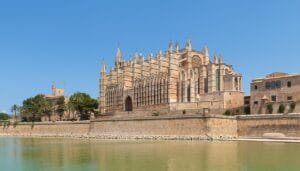
Dalt Vila, Ibiza Town’s walled UNESCO old town, is genuinely atmospheric — climb it at dusk, eat inside the walls, and you will wonder why nobody talks about this side of the island. But Palma alone out-cultures all of Ibiza: La Seu cathedral is one of the great Gothic buildings in Spain, the old town rewards aimless wandering, and because Palma is a real year-round city, it has museums, galleries, and ordinary Spanish life rather than a seasonal stage set. Add Pollenca, Alcudia’s walled quarter, and Valldemossa, and Mallorca takes this one comfortably.
Traveling with kids
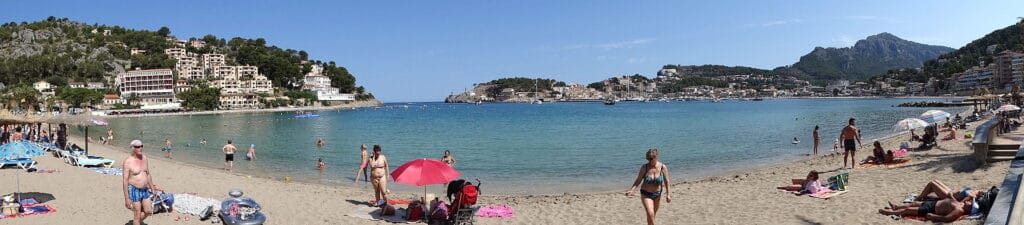
Mallorca is one of Europe’s most family-optimized islands: shallow, calm bays at Playa de Muro and Alcudia, resort infrastructure polished over decades, water parks, and short driving distances. Ibiza with children is entirely doable — Santa Eulalia and Portinatx are the family-friendly corners — but you are paying party-island prices for a destination whose peak-season energy is not aimed at you. Families should pick Mallorca and not overthink it.
Weather and when to go
The climates are near-identical: hot, dry summers with highs around 85 to 90F, warm seas from June through October, and mild winters. June and September are the sweet spots on both islands — real beach weather, warm water, and a meaningful discount on rooms. July and August bring peak heat, peak crowds, and peak prices, which stings roughly twice as hard on Ibiza.
The real difference is winter. Ibiza substantially closes from November to April — the clubs shut after the early-October closing parties, and many hotels and restaurants follow. Mallorca is a year-round island: Palma works as a proper winter city break, the almond blossom in February is quietly spectacular, and spring belongs to the cyclists. If your dates fall outside May to October, the decision has been made for you.
Getting there and around
Palma’s airport is one of the busiest in Europe, with cheap direct flights from practically everywhere on the continent, year-round. Ibiza’s airport is well served from late spring through early autumn, but frequencies thin out in winter and fares spike around big party weekends. Ferries also run to both islands from Barcelona, Valencia, and Denia if you are already touring the mainland — worth knowing if you are weighing a bigger trip like our Spain vs France matchup.
Between the islands, ferries connect Ibiza and Palma in roughly two to four hours depending on the boat, which makes a two-island trip genuinely practical. On the ground, rent a car on either island and book early for July and August. Mallorca backs the car up with a decent bus network and the Soller train; Ibiza is compact, but taxis are notoriously scarce at club hours, so plan your 4 a.m. logistics before you need them.
Ibiza or Mallorca: the honest verdict
For partiers and music people: Ibiza, and it is not a conversation. No other island on earth does what Ibiza does from May to October, and September’s closing-party season might be the best month of all.
For budget travelers: Mallorca, by a mile. You will spend a third to half less for a comparable trip and eat better while doing it.
For foodies: Mallorca. Palma is the best food city in the Balearics, and the long mountain-town lunches seal it.
For beach purists: a split decision. Ibiza with a Formentera day delivers the single most beautiful beach day; Mallorca wins the beach holiday, because you can find space and variety even in August.
For first-timers who want one safe pick: Mallorca. It is cheaper, more varied, more forgiving, and open all year. That is also my overall answer for most travelers most of the time — the same way the less hyped option quietly won our Croatia vs Portugal face-off. Choose Ibiza when the scene is the trip: the clubs, the sunset bars, the boat day, the glamour. When Ibiza is right, nothing else in the Mediterranean will do.
FAQ
Is Ibiza more expensive than Mallorca?
Can you visit both Ibiza and Mallorca in one trip?
Is Ibiza only for partying?
Which island is better for families, Ibiza or Mallorca?
Planning the trip? Go deeper with best time to visit Mallorca.
You Might Also Love

Written by
John Morrison is the founder and lead travel writer at Packzup. Over the past decade he has explored destinations across Africa, the Americas, Asia, Europe, the Middle East, and Oceania — always self-funded, never on a press trip.
