The most surreal caves in the world are Chile’s Marble Caves, New Zealand’s Waitomo Glowworm Caves, and Vietnam’s Hang Son Doong – the largest cave passage on Earth. Our #1 pick is the Marble Caves on Lake General Carrera, where 6,000 years of wave erosion carved swirling blue marble chambers you can paddle straight into. Every cave below is real, visitable, and listed with the season, access rules, and permits you actually need to plan a trip.
Caves at a Glance
| Cave | Country | Best season | Why it stands out |
|---|---|---|---|
| Marble Caves | Chile | Dec-Feb | Swirling blue marble over turquoise glacial water |
| Waitomo Glowworm Caves | New Zealand | Year-round | Ceiling of living blue-green lights |
| Hang Son Doong | Vietnam | Jan-Aug | World’s largest cave passage, with jungle inside |
| Vatnajokull Ice Caves | Iceland | Nov-Mar | Electric-blue glacier ice tunnels |
| Blue Grotto | Italy | May-Sep | Seawater that glows neon blue from below |
| Fingal’s Cave | Scotland | Apr-Sep | Cathedral of hexagonal basalt columns |
| Benagil Cave | Portugal | May-Oct | Sea cave with a natural skylight over a beach |
| Skocjan Caves | Slovenia | Apr-Oct | A river canyon 100 m underground |
| Eisriesenwelt | Austria | May-Oct | World’s largest ice cave, toured by lamplight |
| Reed Flute Cave | China | Year-round | Karst formations lit like a neon palace |
| Crystal & Fantasy Caves | Bermuda | Year-round | Glass-clear lake under soda-straw stalactites |
| Carlsbad Caverns | USA | May-Oct | Vast Big Room plus a nightly bat flight |
1. Marble Caves, Chile
Waves on Lake General Carrera have polished a peninsula of solid marble into scalloped caverns, tunnels, and the mushroom-shaped “Marble Cathedral,” all reflecting the lake’s unreal turquoise. They sit in the Aysen region of Chilean Patagonia, reached only from the tiny town of Puerto Rio Tranquilo on the Carretera Austral. Access is by 30-minute boat tour or a guided kayak trip from town – no permit needed, just decent weather. Visit December to February, when glacial melt turns the water its brightest blue. Planning note: go on a morning tour, when the lake is calmest and boats can nose deeper into the chambers.
2. Waitomo Glowworm Caves, New Zealand
Thousands of Arachnocampa luminosa glowworms – found only in New Zealand – turn the ceiling of the Glowworm Grotto into a blue-green galaxy you drift beneath in silence. The caves are in the Waikato region of the North Island, about two hours’ drive south of Auckland. Entry is by guided tour only, ending with the famous boat ride under the lights; tours run daily year-round and sell out in summer, so book ahead. Photography is not allowed in the grotto. Planning note: adventurous visitors can book black-water rafting through the adjacent Ruakuri Cave and float under glowworms in a tube.
3. Hang Son Doong, Vietnam
The largest known cave passage on Earth is big enough to hold city blocks, with its own jungle growing beneath two collapsed skylights and clouds forming inside. It lies in Phong Nha-Ke Bang National Park in Quang Binh province, central Vietnam. Access is strictly controlled: only Oxalis Adventure runs the four-day expedition, permits are capped at roughly 1,000 visitors per year, and the trip costs around US$3,000. The season runs January to August; the cave closes during flood months. Planning note: if the price or waitlist is out of reach, the same park’s Hang En and Paradise Cave deliver a similar wow for far less.
4. Vatnajokull Ice Caves, Iceland
Meltwater carves tunnels under Europe’s largest glacier each summer, and by winter they freeze into chambers of dense, bubble-free ice that glows deep blue. The most-visited caves form under the Breidamerkurjokull outlet glacier near Jokulsarlon glacier lagoon in southeast Iceland, about five hours’ drive from Reykjavik. You can only enter with a certified guide, typically on a super-jeep tour from Jokulsarlon; the season runs roughly November to March, and the caves are re-scouted every year because they change or collapse. Planning note: book an early-morning departure – flat winter light makes the blue most intense and the crowds thinnest.
5. Blue Grotto, Capri, Italy
Sunlight entering this sea cave through an underwater opening lights the water from below, so the whole grotto glows an electric, otherworldly blue. It sits on the northwest coast of the island of Capri, in Italy’s Bay of Naples. Entry is only by tiny rowboat – the mouth is about a meter high, so you lie back as the oarsman pulls you through – reached by boat from Marina Grande or via a stairway on the Anacapri side. It closes whenever seas are rough. Visit May to September and aim for late morning to early afternoon, when the light is strongest. Planning note: carry cash for the separate entry and rowboat fees.
6. Fingal’s Cave, Scotland
Perfect hexagonal basalt columns – formed by the same ancient volcanic eruptions that built the Giant’s Causeway – frame a 20-meter-high sea cave that inspired Mendelssohn’s Hebrides Overture. It is on the uninhabited island of Staffa in the Inner Hebrides, reached by boat tours from Fionnphort on Mull, from Iona, or from Oban. Tours run April to September; in calm seas you can land and walk along a natural column causeway right into the cave mouth. No permit is needed, just a ticket. Planning note: choose a landing tour rather than a cruise-by, and you will likely share the island with nesting puffins in early summer.
7. Benagil Cave, Portugal
A collapsed dome in the cliff roof forms a natural oculus that beams sunlight onto a hidden beach inside this Algarve sea cave. It sits just east of Benagil village, near Carvoeiro on Portugal’s south coast. Since 2024, swimming or paddling into the cave and landing on its beach have been banned – entry is now only aboard licensed boat tours, which depart from Benagil, Carvoeiro, Portimao, and Armacao de Pera. Best conditions run May to October. Planning note: book the first departure of the day; morning sun angles through the skylight, and the sea is usually calm enough for boats to enter fully.
8. Skocjan Caves, Slovenia
The Reka River thunders through an underground canyon roughly 100 meters deep here – a scene so vast that walking across the Cerkvenik Bridge, about 45 meters above the river, feels like entering a fantasy film. The caves are a UNESCO World Heritage site near the village of Divaca in Slovenia’s Karst region, an hour from Ljubljana. Entry is by guided tour only, a walk of about three kilometers with plenty of steps; tours run year-round, with the fullest schedule April to October. The cave holds a steady, cool temperature, so bring a layer. Planning note: visit after heavy rain, when the river is at its loudest and most dramatic.
9. Eisriesenwelt, Austria
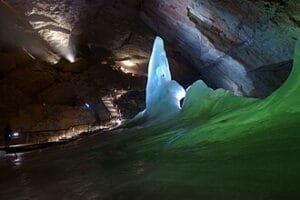
The “World of the Ice Giants” is the largest ice cave on the planet – a 42-kilometer system whose first kilometer is filled with towering frozen waterfalls and ice palaces, toured by handheld carbide lamp. It sits above the town of Werfen, about 40 minutes south of Salzburg. The cave is open only from roughly May to late October; access combines a cable car with short uphill walks, and the tour itself climbs about 700 steps. No permit is needed, but tours are guided only. Planning note: it stays near freezing inside even in August, so bring gloves and a warm jacket – most visitors underdress.
10. Reed Flute Cave, China
Dramatic multicolored lighting turns this 180-million-year-old karst cave into a glowing palace of stalactites, stone curtains, and the mirror-still “Crystal Palace of the Dragon King” chamber. It lies about five kilometers northwest of central Guilin in Guangxi, southern China, and has been an attraction for centuries – ink inscriptions inside date to the Tang dynasty. Access is easy: buy a ticket and walk the lit loop, which takes around 40 to 60 minutes; no tour or permit is required. It is open year-round. Planning note: avoid Chinese national holidays, especially Golden Week in early October, when the narrow walkways get genuinely crowded.
11. Crystal & Fantasy Caves, Bermuda
Discovered in 1907 by two boys searching for a lost cricket ball, these twin caves hide a lake so clear the floating pontoon walkway seems suspended in air, beneath ceilings dense with delicate soda-straw stalactites. They are in Hamilton Parish on Bermuda’s east end, an easy bus or taxi ride from the town of St. George. Entry is by short guided tour, running daily year-round; you can ticket one cave or both, and no permit or booking marathon is required. Planning note: buy the combo ticket – Fantasy Cave gets a fraction of Crystal Cave’s crowds and many visitors find its formations even better.
12. Carlsbad Caverns, USA
The Big Room here is one of the largest single cave chambers in North America – a stone landscape of giant stalagmites, bottomless-looking pits, and chandelier formations covering roughly eight acres. The caverns sit in the Guadalupe Mountains of southeastern New Mexico, inside Carlsbad Caverns National Park. You need a timed-entry reservation (booked online for a small fee) plus the park entrance fee; you can then self-guide, descending the 1.25-mile natural entrance switchbacks or taking the elevator. The cave stays around 56 F all year. Planning note: from late May through October, stay for the free evening bat flight program, when hundreds of thousands of Brazilian free-tailed bats spiral out of the entrance.
FAQ: Visiting the World’s Most Surreal Caves
Which cave is considered the most beautiful in the world?
There is no official ranking, but Chile’s Marble Caves are the most frequent answer thanks to their swirling blue marble and turquoise water, with Waitomo’s glowworm ceiling and Vietnam’s Hang Son Doong close behind.
Can you visit Hang Son Doong without a tour?
No. Hang Son Doong can only be visited on the official multi-day expedition run by Oxalis Adventure, with permits limited to around 1,000 people per year – independent entry is not allowed.
What is the best time of year to see ice caves?
Glacier ice caves like Iceland’s are winter-only, roughly November to March, when the ice is stable. Alpine ice caves such as Austria’s Eisriesenwelt are the opposite – they open in summer, from about May to October.
Before you book flights to any of these, check typical daily costs for each country so you know whether your cave trip is a budget adventure or a splurge.
Explore more natural wonders
- The best ice caves in the world
- The 12 best slot canyons in the world
- The 12 most beautiful natural arches in the world