
Last updated September 10, 2026 · Editorial policy
- Cost comparison: what a day actually costs
- Food: Charleston by a mile, but Savannah punches back
- Historic districts: mansions versus squares
- Beaches and day trips
- Nightlife: the to-go cup changes everything
- Vibe and crowds: polished versus lived-in
- Weather & when to go
- Getting there & around
- Charleston or Savannah: the honest verdict
- FAQ
Charleston and Savannah sit barely two hours apart on the same stretch of Lowcountry coast, and almost everyone planning a Southern trip ends up agonizing between them. On paper they look interchangeable: cobblestones, antebellum mansions, Spanish moss, shrimp and grits, ghost tours on every corner. In practice they feel surprisingly different, and picking the wrong one for your travel style means either overspending on a city that’s more polished than you needed, or feeling slightly underwhelmed by one that’s quieter than you expected.
I’ve walked both historic districts until my feet gave out and eaten embarrassingly well in each, so let me say it up front: neither is a bad choice. But they reward different travelers, the same way France and Italy do — one is grander and pricier, the other looser, moodier, and better value. Here’s the honest breakdown a friend would give you, category by category, with real ballpark costs and a verdict that actually commits.
| Category | Charleston | Savannah | Winner |
|---|---|---|---|
| Food scene | One of America’s best small food cities | Very good, less deep bench | Charleston |
| Historic architecture | Grand mansions, Rainbow Row, church steeples | Handsome townhouses, gothic edges | Charleston |
| Squares & green space | A few parks, The Battery | 22 mossy squares plus Forsyth Park | Savannah |
| Beaches & day trips | Three distinct beaches, plantations, Fort Sumter | Tybee Island, Bonaventure, Wormsloe | Charleston |
| Nightlife | Polished cocktail and rooftop bars | To-go cups, casual and rowdy | Savannah |
| Walkability | Very walkable, longer distances | Compact grid built for strolling | Savannah |
| Crowds & pace | Busy, buzzy, bachelorette-heavy | Slower, artsier, more room to breathe | Savannah |
| Value for money | Expensive for the region | Noticeably cheaper across the board | Savannah |
Cost comparison: what a day actually costs
This is where the two cities genuinely diverge. Charleston has become one of the most expensive weekend destinations in the South. A decent hotel inside the historic peninsula routinely runs $250–450 a night in spring and fall, and the famous restaurants charge accordingly. Savannah’s historic district is no bargain-bin either, but comparable rooms tend to land around $180–320, and you can still find characterful inns under $200 outside peak weekends.

As a rough per-person daily budget (sharing a room, mid-range trip): expect $250–350 a day in Charleston for a nice hotel, one good restaurant meal, a tour, and drinks. In Savannah the same style of day runs more like $190–280. Genuine budget travelers can scrape by on $120–160 a day in Savannah with a modest hotel, counter-service Southern food, and free wandering through the squares; pulling that off in Charleston is harder — figure $150–200 and more compromises on location. Tours are similar in both: ghost walks and history walks generally cost $25–40, and house-museum or plantation admissions mostly fall in the $15–35 range. If value is your deciding factor, this comparison ends the same way Greece vs Portugal does: the slightly less hyped option quietly wins your wallet.
Food: Charleston by a mile, but Savannah punches back
Charleston is, honestly, one of the best eating cities of its size in the country. The bench is absurdly deep: refined Lowcountry cooking at places like FIG and Husk, whole-hog barbecue at Rodney Scott’s, raw bars pouring local oysters all winter, and a new wave of excellent casual spots spread up the peninsula. The catch is that everyone knows it. The famous tables book out weeks ahead, and dinner for two with drinks at a top spot easily clears $150–200.
Savannah eats very well too — it just has fewer heavy hitters. The Grey is a genuine destination restaurant in a restored Greyhound bus terminal, Mrs. Wilkes Dining Room serves a legendary family-style boarding-house lunch (arrive early and bring patience), and Leopold’s has been scooping ice cream since 1919. You’ll find great fried chicken, seafood shacks, and pralines everywhere. But if you’re planning a trip around restaurants, Charleston is the answer, full stop. If you just want to eat generously and pay a bit less, Savannah won’t disappoint.
Historic districts: mansions versus squares
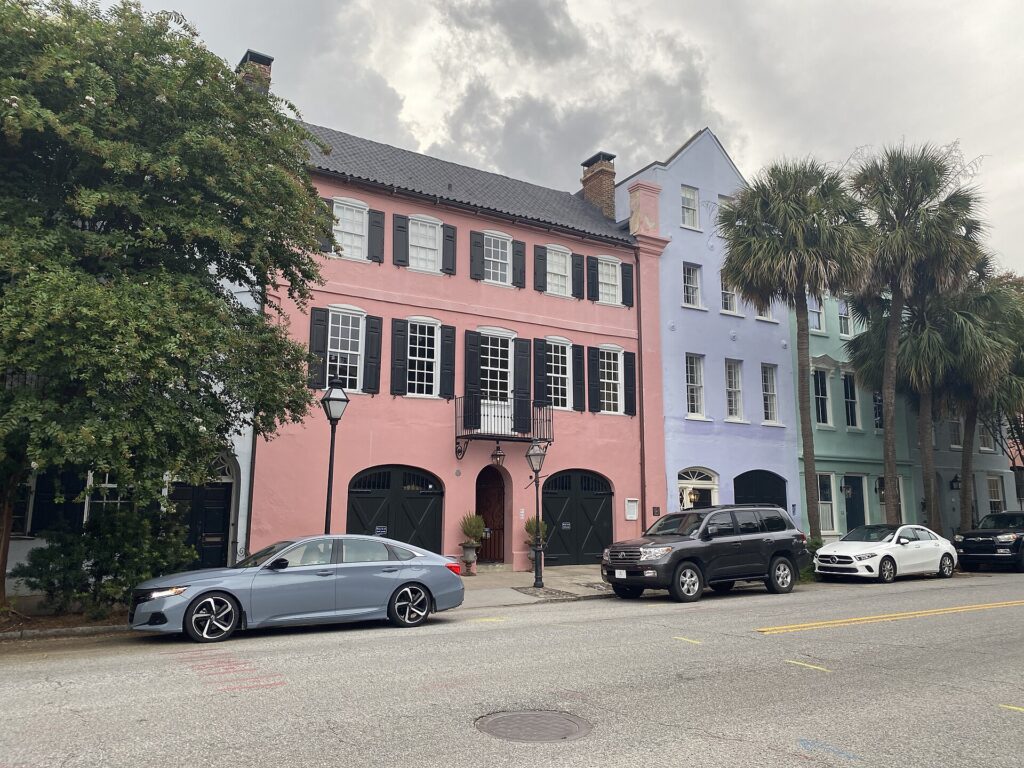
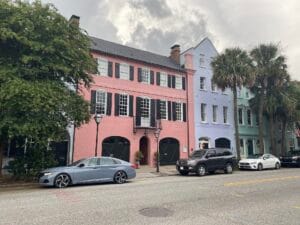
Charleston’s historic district is the grander of the two. The mansions South of Broad are jaw-dropping, Rainbow Row is exactly as pretty as the photos suggest, and the skyline of church steeples explains the “Holy City” nickname. House museums like the Nathaniel Russell House let you inside the wealth, and The Battery at golden hour is one of the great free experiences in the South. It feels curated, preserved, almost formal.
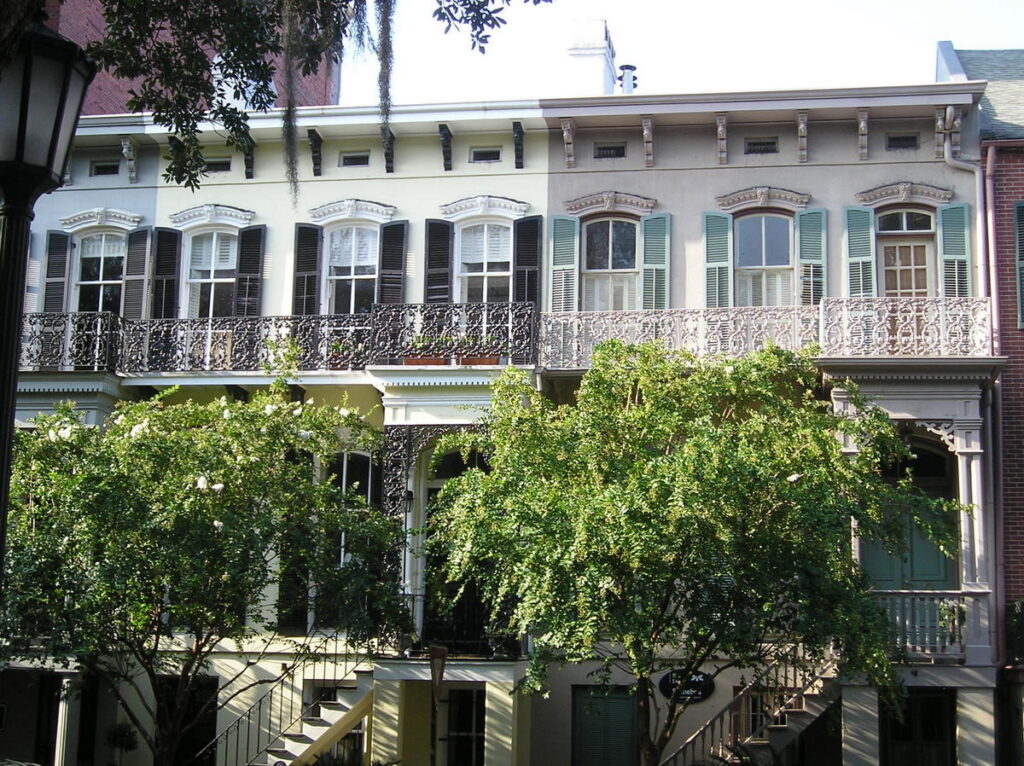
Savannah’s magic works differently. General Oglethorpe laid the city out in 1733 around a grid of public squares, and the 22 that survive are the whole point: small mossy parks every couple of blocks, each with its own monument, live oaks, and benches. Forsyth Park and its fountain anchor the southern end. The architecture is a notch less grand than Charleston’s, but the effect of walking it is arguably better — you’re strolling through a garden that happens to have a city in it. Savannah also carries a moodier, slightly gothic streak (this is the town of Bonaventure Cemetery and Midnight in the Garden of Good and Evil) that Charleston’s polish has mostly buffed away. Call it a split decision: Charleston for the buildings, Savannah for the atmosphere between them.
Beaches and day trips
Charleston clearly wins here on variety. Within 20–40 minutes you’ve got three genuinely different beaches: Folly Beach (scruffy, surfy, fun bars), Sullivan’s Island (quiet, residential, great for a long walk and a lighthouse) and Isle of Palms (wide, family-friendly, resort-adjacent). Beyond the sand, the plantation and garden estates along the Ashley River — Magnolia, Middleton Place, Boone Hall — make excellent half-days, and the boat trip out to Fort Sumter is worthwhile if Civil War history interests you at all.

Savannah has one beach: Tybee Island, about 30 minutes east. It’s likable in a faded, old-school way — a lighthouse, a pier, unpretentious seafood — but it’s a single option rather than a menu. The better Savannah side-trips are inland and atmospheric: Bonaventure Cemetery’s sculpture-filled avenues of oaks, and Wormsloe’s famous mile-long oak-lined drive. Hilton Head is about an hour away if you want a proper resort beach. If a beach day is a must-have rather than a nice-to-have, lean Charleston.
Nightlife: the to-go cup changes everything
Here’s Savannah’s ace: you can legally carry a drink in a plastic cup around most of the historic district. That one rule shapes the whole evening — you grab a to-go cup, drift between squares, wander down to the (admittedly touristy) bars on River Street, and the night stays loose and cheap. It’s a casual, come-as-you-are scene, and around St. Patrick’s Day it explodes into one of the biggest street parties in the country.
Charleston’s nightlife is more grown-up and more expensive: serious cocktail bars, rooftop bars with harbor views, wine-focused restaurants that blur into late evenings. Upper King Street gets legitimately lively on weekends, fueled by a seemingly endless supply of bachelorette parties. If your ideal night is a $16 cocktail somewhere handsome, Charleston. If it’s a $6 beer walking under live oaks at 10pm, Savannah.
Vibe and crowds: polished versus lived-in
These two get compared the way neighboring countries do — think Belgium vs the Netherlands — because from a distance they’re siblings, and up close the personalities split. Charleston is the ambitious sibling: manicured, prosperous, conscious of its own beauty. It’s also simply busier. Expect waits, tour groups, and premium pricing in high season, especially along King Street and the market area.
Savannah feels more lived-in and a little eccentric. SCAD, the art school woven through downtown, keeps the city young and creative; you’ll stumble on galleries, vintage shops, and students sketching in the squares. Outside St. Patrick’s week it rarely feels overrun, and it’s easier to find a bench, a quiet block, or a bar stool without planning ahead. Neither city is a hidden gem — both are firmly on the tourist map — but Savannah leaves you more room to breathe.
Weather & when to go
The climate is essentially identical: this is the same coastline. Spring (March–May) is the sweet spot in both cities — azaleas out, humidity tolerable, everything golden. It’s also peak pricing, and mid-March in Savannah means St. Patrick’s Day crowds, so book far ahead or steer clear of that week. Fall (October–November) is the other winner: warm days, thinner crowds after the school year starts, and the ocean still swimmable into October.
Summer is honest-to-goodness brutal — 90s with swampy humidity and afternoon thunderstorms from June through early September — though hotel deals appear and mornings are workable. August through October is hurricane season, worth watching rather than fearing. Winters are mild (highs often in the 50s and 60s), and December–February is the cheapest, quietest time in both cities; Charleston in particular does the holidays beautifully. One Charleston-specific note: the Spoleto arts festival in late May and early June fills the city, so book early or price around it.
Getting there & around
Charleston International (CHS) has the larger route map, with nonstops from most major U.S. hubs; Savannah/Hilton Head International (SAV) is smaller but well connected and famously pleasant. Both airports sit roughly 20 minutes from their historic districts, with taxis and rideshares running about $25–40. Many people fly into one city and drive the two hours down I-95 and the coastal roads to do both — genuinely the smartest play if you have five or more days.
Once you’ve arrived, neither city requires a car for the core experience. Both historic districts are best on foot, both run free downtown shuttle loops, and pedicabs and rideshares fill the gaps. Savannah’s compact square-to-square grid is the easier, flatter stroll; Charleston’s peninsula covers more ground, so you’ll walk farther between sights. Where a car earns its keep is the surroundings — Charleston’s beaches and plantations, Savannah’s Tybee and Wormsloe. Parking downtown is a paid nuisance in both, so if your hotel charges $30–45 a night for it, consider renting a car only for your day-trip days.
Charleston or Savannah: the honest verdict
Foodies: Charleston. This isn’t close. Savannah eats well; Charleston is a national-caliber food destination. Book the big restaurants before you book your flights.
Budget travelers: Savannah. Cheaper rooms, cheaper drinks, free entertainment built into the city plan, and a to-go cup culture that makes a great night out cost almost nothing.
Beach lovers: Charleston. Three different beaches within half an hour beats one likable Tybee. If sand time matters, the choice makes itself.
First-timers: Charleston, narrowly. It’s the fuller postcard — grander architecture, bigger food scene, more headline sights — and if you only ever visit one Lowcountry city, it’s the more complete single destination. But it comes with crowds and a price tag.
Couples and slow travelers: Savannah. The squares, the moss, the moody evening light, the unhurried pace — it’s the more romantic and more relaxing city, and you’ll spend a third less for the privilege.
And the real answer, if your schedule allows: do both. They’re two hours apart, they’re better for the contrast, and choosing between them permanently is like picking one coast of Croatia or Portugal and swearing off the other. Three nights in Charleston, two in Savannah, fly open-jaw, thank yourself later.
FAQ
Is Charleston or Savannah better for a first visit?
Can you do Charleston and Savannah in one trip?
Which is cheaper, Charleston or Savannah?
Which city has better beaches?
Compare: Savannah vs New Orleans — southern charm vs southern spice.
Planning the trip? Go deeper with things to do in Charleston SC and things to do in Savannah GA.
You Might Also Love



Written by
John Morrison is the founder and lead travel writer at Packzup. Over the past decade he has explored destinations across Africa, the Americas, Asia, Europe, the Middle East, and Oceania — always self-funded, never on a press trip.
