
Quick verdict: North America spans Caribbean + Mexico + USA + Canada — from Mayan ruins to NYC + national parks + Caribbean beaches. This guide covers 10+ destinations.
All countries in North America (with full guides)
USA
NYC + national parks + Hawaii + diverse regions
Mexico
Best months: Dec–Feb · 7–23°C days · dry (climate data)
Mexico City + Cancun + Oaxaca + Tulum + cenotes
Canada

Banff + Vancouver + Quebec + Niagara Falls
Costa Rica
Best months: Jan–Mar · 16–26°C days · dry (climate data)
Wildlife + zip-lining + Pacific + cloud forests
Guatemala
Best months: Jan–Mar · 13–25°C days · dry (climate data)
Tikal Mayan + Antigua + Lake Atitlan
Belize
Blue Hole + Maya ruins + Caribbean Caye
Panama
Panama Canal + Bocas + Caribbean + Pacific
Cuba
Best months: Jan–Mar · 20–29°C days · some rain (climate data)
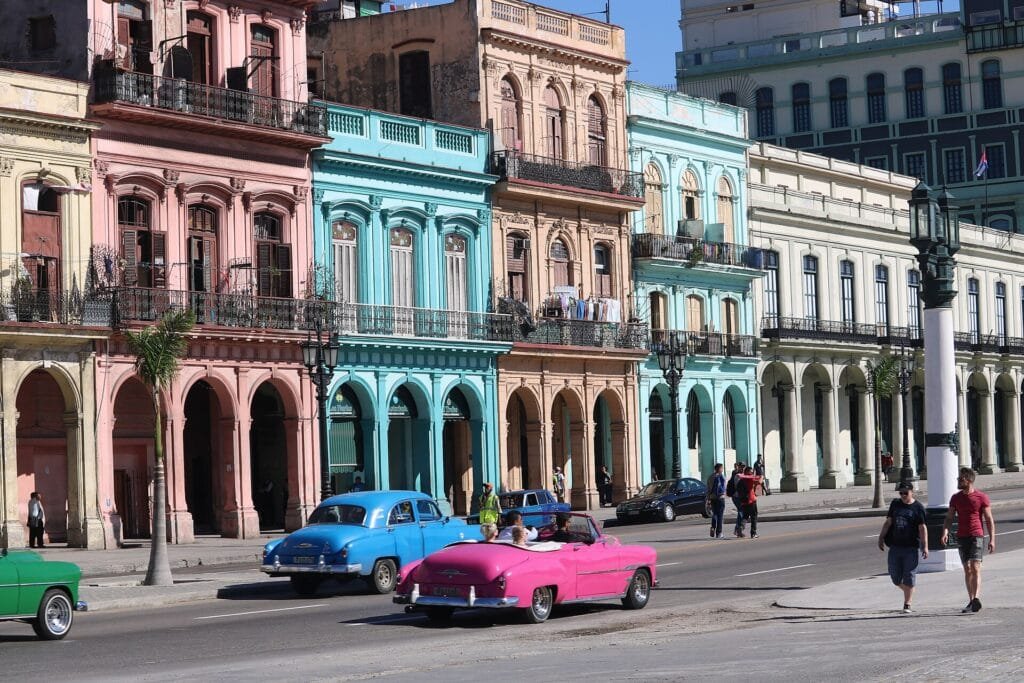
Havana + classic cars + Vinales + Trinidad
Dominican Republic
Punta Cana + all-inclusive + Caribbean
Jamaica
Best months: Dec–Feb · 20–29°C days · rainy (climate data)
Reggae + waterfalls + Negril + Bob Marley
Honduras
Roatan diving + Mayan Copan + Caribbean coast
Nicaragua
Lake Nicaragua + volcanoes + Granada + budget
Compare North America tours and tickets →
Helpful Packzup planning resources
North America travel guide
North America spans three vast countries and every kind of landscape:
- USA — iconic cities (New York, San Francisco) and the great national parks (Grand Canyon, Yellowstone, Utah).
- Canada — the Rockies (Banff), Vancouver, and cosmopolitan Toronto and Montreal.
- Mexico — ruins, colonial cities and Caribbean beaches.
When to go & tips
Summer suits Canada and the northern US and parks; winter suits Mexico and the southern US. Distances are huge — fly between regions or plan a focused road trip. Check ESTA/visa requirements for the US and eTA for Canada.
Pick one region per trip rather than trying to span the continent.
North America Travel Guide FAQ
Where should I go in North America?
US national parks and cities, the Canadian Rockies, or Mexico’s ruins and beaches — pick one region.
Do I need a visa for the USA or Canada?
Many visitors need an ESTA (US) or eTA (Canada) — check your nationality’s requirements early.
Frequently asked questions
Best North American country for first-time visit?
Cheapest North American destination?
Best North American food destination?
Best Caribbean island?
Caribbean hurricane season?
Updated 2026. Some links on Packzup are affiliate links.
Popular North America travel guides
- The Best All-Inclusive Resort Areas in Mexico
- The 10 Best Beach Vacations in the USA
- How Much Does a Trip to Mexico Cost? (2026)
- How Many Days Do You Need in Oaxaca?
- How Much Money Should You Bring to Mexico?
- Is Mexico Safe to Visit? Region-by-Region Breakdown
- Mexico on a Budget: How to Travel for $30-50/Day
- The Mexico Temporary Resident Visa: A Beginner’s Guide
Every North America destination
Complete country and city guides for North America — 19 destinations, each with best time to visit, itineraries, food, where to stay and more.
Which travel authorisation do you need for the United States, Canada and Mexico?
An ESTA for the United States, an eTA for Canada, and for Mexico either nothing, a consular visa or one of three documented exemptions. Three neighbouring countries run three unrelated systems and none of them accepts another’s paperwork, so apply and pay for each separately. Every figure here is the official position on 5 September 2026, and these rules move, so re-check each government portal named here before you book.
United States: an ESTA, and it is no longer cheap. Nationals of Visa Waiver Program countries need an approved Electronic System for Travel Authorization before they board. Section 100014 of Public Law 119-21, which amended section 217(h)(3)(B) of the Immigration and Nationality Act, raised the fee from the $21 CBP had previously required to a minimum of $40, and US Customs and Border Protection began assessing the new amount on 30 September 2025. The Federal Register notice of 19 November 2025 then applied the statutory inflation adjustment, setting the fiscal year 2026 figure at $40.27, built from components of $17, $10.27 and $13, with CBP assessing it from 1 January 2026. A refused application still costs $10.27.
That figure is re-adjusted for inflation every fiscal year. The notice states that during fiscal year 2026 and each subsequent fiscal year CBP is required to adjust the fee for inflation. No fiscal year 2027 amount appeared in a Federal Register search on 5 September 2026, and fiscal year 2027 begins on 1 October 2026, so treat $40.27 as the September 2026 price and read the fee again on esta.cbp.dhs.gov if you are applying later. CBP states that approvals are typically granted for a two-year period or until the applicant’s passport expires, whichever is sooner, and cover stays of 90 days or less. Every traveller has needed an e-passport since 1 April 2016. CBP is explicit that authorisation via ESTA does not determine whether a traveller is admissible to the United States, and that its officers determine admissibility on arrival. It advises applying as soon as you begin preparing travel plans, or before you buy the airline ticket, rather than at the airport.
Canada: an eTA, and it costs almost nothing. Immigration, Refugees and Citizenship Canada charges CAD 7 for an electronic travel authorisation, valid for up to five years or until the passport expires, whichever comes first. Most applicants get approval by email within minutes, but IRCC warns that some requests can take several days if supporting documents are asked for, so do not leave it to the airport. US citizens are exempt and instead carry proper identification such as a valid US passport. So are lawful permanent residents of the United States, who must carry official proof of status, which IRCC gives as a valid permanent resident card on Form I-551, a valid re-entry permit on Form I-327 or a foreign passport with an unexpired temporary I-551 stamp, together with a valid passport from their country of nationality.
Mexico: two separate exemption lists, and they are not the same list. Mexico either exempts your nationality or requires a consular visa, and the Instituto Nacional de Migración publishes further routes past that requirement. A valid and current visa for Canada, the United States, Japan, the United Kingdom or any Schengen Area country removes it. A document proving permanent residence removes it for that same list plus the Pacific Alliance member countries, which INM names as Chile, Colombia and Peru. An APEC Business Travel Card approved by Mexico also works, but INM restricts that route to air arrivals travelling on business. Read the visa list and the residence list separately, because the residence one is longer.
The paper form has gone for air arrivals. INM published the Forma Migratoria Múltiple Digital on 2 May 2023 and states that it will omit issuing the physical form to foreigners entering Mexico by air. You are stamped instead, and you download the digital record after entry, during the period of stay granted by the federal immigration officer at the inspection filter. INM’s own Forma Migratoria Múltiple application page puts the maximum validity at 180 calendar days for a single entry, and states that validity is counted from the immigration stamp. Photograph the stamp before you leave the hall. The number of days written on it is the number you have, and it is often fewer than the 180-day ceiling.
What changes when you arrive by land instead of flying in
The fees and the paperwork change; the passport does not. The land border is where a trip planned on air rules comes apart, and each of the three countries breaks in a different place.
An ESTA is required by land as well as by air. CBP states that eligible nationals of Visa Waiver Program countries must obtain an authorisation through ESTA before boarding a US-bound airplane or vessel or presenting themselves for admission at a United States land border port of entry, a requirement it extended to land arrivals beginning 1 October 2022 under an interim final rule. Walking over from Tijuana or driving in from Niagara Falls does not exempt you. CBP framed the change as a way for travellers to obtain an approved ESTA using CBP One or the CBP I-94 website and avoid filling out a Form I-94W at a port of entry, rather than as the abolition of that form, so do not assume the counter step disappears.
At a land port you also pay for an I-94, and air arrivals do not. The CBP notice of 19 November 2025 puts the total fee to apply for a Form I-94 at a land border port of entry at $30 for fiscal year 2026, being the $6 land border fee plus the $24 fee required by Public Law 119-21. CBP states plainly that it will not assess a fee for aliens arriving at an air or sea port of entry, because those travellers are not required to submit an application at all. Two people with identical passports pay different amounts depending only on how they crossed.
The charge is not repeated on every crossing. CBP’s 2022 announcement states that land travellers continue to pay the $6 I-94W fee provided for in 8 CFR 103.7 unless entering within the 90-day admission period. So a day trip out and back inside an existing admission is not a second payment, while a fresh admission is.
The Canadian eTA is an air rule and nothing else. IRCC states that these travellers do not need an eTA when arriving by car, bus, train or boat, including a cruise ship. Drive north from Seattle and you need nothing beyond your documents; fly into Vancouver on the same trip and the CAD 7 authorisation applies. The itinerary that catches people is the mixed one: enter Canada overland, leave to a third country, then fly back in, and that last flight puts you under the eTA rule. It also applies to transiting through a Canadian airport.
Mexico by land is a different transaction from Mexico by air. INM describes the digital form as the air-entry procedure, and offers the electronic Forma Migratoria Múltiple specifically to foreigners entering the country by land through the places designated for international transit. That version is applied for on the INM portal, grants the condition of stay of visitor without permission to carry out paid activities, and requires payment of the immigration fee through the INM services portal, which INM warns does not itself guarantee entry to Mexico. INM publishes its migration tariffs year by year and states that the 2026 tariffs took effect on 1 January 2026, but presents the amounts only as an image on its tariff page rather than as text, so read the current figure there or ask INM directly rather than budgeting from an older one. An unstamped entry is a problem you discover when you try to leave.
Why a domestic flight usually beats the train or the car across North America
Because the published transcontinental timetable runs to more than two days for a single internal hop. Amtrak schedules the California Zephyr at 51 hours 20 minutes between Chicago and Emeryville, the Bay Area terminus across the water from San Francisco, running daily and calling at 37 stations across Illinois, Iowa, Nebraska, Colorado, Utah, Nevada and California. Amtrak’s own account of the route puts it at 2,438 miles over three days and two nights. That is one leg inside one country.
So the honest framing is this. Long-distance surface travel in North America is something you do because you want the journey, not because it saves time or money. The Zephyr earns its two nights if the Rockies and the Sierra Nevada are the reason for the trip. It is a poor way to get from a meeting in Chicago to a wedding in California.
Two consequences for planning:
- Price the internal flights before you fix the route. An itinerary that looks elegant on a map can quietly spend a week of your holiday in transit.
- One-way car hire is priced differently from a return. Dropping a vehicle in a different city normally attracts a separate one-way charge set by the rental company, so ask for it as a line item rather than assuming the daily rate covers it.
Roughly: fly if you have under three weeks and more than two regions on the list, drive if the trip is one region and the ground between stops is the point, and take the train only if you can give the journey the nights it needs.
Tipping and sales tax: why the price on the label is not the price you pay
In the United States and most of Canada the advertised price excludes tax, which is added at the till. In Mexico the opposite is required by law.
The United States has no national sales tax. Rates are set by states, and by counties and cities beneath them, so the same coffee comes to different totals a few miles apart. Carry a mental margin rather than trying to learn rates.
Tipping in the United States is a wage mechanism, not a bonus. Under the Fair Labor Standards Act an employer must pay a tipped worker at least $2.13 an hour in direct cash wages and may claim a tip credit for the remainder, to a maximum credit of $5.12, against the federal minimum wage of $7.25. The US Department of Labor defines a tipped employee as one engaged in an occupation in which they customarily and regularly receive more than $30 a month in tips, and requires the employer to make up the difference if tips combined with direct wages do not equal $7.25 an hour in each workweek. Several states require the full state minimum wage before tips, so the picture is not uniform. For a visitor the point is that across much of the country the tip is part of the wage, not generosity layered on a fair one.
Canada adds federal and provincial tax separately, and the spread is wide. The Canada Revenue Agency’s own rate table gives 5 per cent GST in Alberta, the Northwest Territories, Nunavut and Yukon; harmonised rates of 13 per cent in Ontario, 15 per cent in New Brunswick, Newfoundland and Labrador and Prince Edward Island, and 14 per cent in Nova Scotia, which the CRA notes followed the province decreasing the provincial portion of the HST to 9 per cent on 1 April 2025; and 5 per cent GST plus a provincial sales tax of 7 per cent in British Columbia and Manitoba, 6 per cent in Saskatchewan and 9.975 per cent in Quebec. Edmonton and Charlottetown are ten points apart on the same purchase.
Mexico must show you the total. PROFECO states the obligation under Article 7 Bis of the Ley Federal de Protección al Consumidor as requiring the provider to display, in a notorious and visible manner, the total amount to pay for the goods, products or services it offers the consumer, and gives that amount as including taxes, commissions, interest, insurance and any other cost, charge or additional outlay. The menu price is the menu price, and any service charge should be legible on the bill rather than sprung at the end.
Value added tax therefore sits inside the displayed figure rather than being added at the till. SAT’s 2021 release on the border stimulus states that taxpayers who were active in the Registro Federal de Contribuyentes on 31 December 2020 and held the stimulus may invoice at an 8 per cent IVA rate from 1 January 2021 in the designated border regions. That relief attaches to the business, not to the shopper, so a price near the frontier is not automatically lower. The standard IVA rate is not stated here: on 5 September 2026 the Ley del Impuesto al Valor Agregado on diputados.gob.mx refused the connection and sat.gob.mx did not return a readable rate page, so confirm the current standard rate with SAT before you build it into a budget.
The two calendars: the hurricane coast and the northern winter
North America does not have one season. It has two opposing ones that overlap in autumn, and they pull a trip in different directions.
The Atlantic hurricane season runs from 1 June to 30 November and the Eastern Pacific season from 15 May to 30 November, on the National Hurricane Center’s official dates. The NHC places the peak of the Atlantic season on 10 September, with most activity occurring between mid-August and mid-October, and gives a 1991 to 2020 average of 14 named storms, 7 hurricanes and 3 major hurricanes per Atlantic season against 15, 8 and 4 in the Eastern Pacific. In the Eastern Pacific the NHC notes a peak in activity in late August but says that peak is less pronounced than the Atlantic one, with activity running between late June and early October. It also warns that formation dates in individual seasons can vary considerably from these averages. That calendar is why September rates fall on the Gulf coast, in Florida and along the Caribbean coast of Mexico.
Buy storm cover when you book, and read the named-storm clause itself. Policies commonly stop responding to a storm once it becomes a known event, and each policy defines that moment in its own wording rather than by a single industry rule. Check what triggers the exclusion, whether the policy pays for a delay as well as a cancellation, and from what date cover attaches. The summary page will not tell you any of that.
At the other end of the continent the constraint is cold, not wind speed. The National Weather Service states that if the temperature is 0F and the wind is blowing at 15 mph the wind chill is -19F, and that at that wind chill exposed skin can freeze in 30 minutes. That is an ordinary January afternoon across the Canadian prairies and the northern plains, which is why winter itineraries there are built from short outdoor exposures with warm indoor gaps rather than from walking tours.
The practical read: late April to early June, and late September into October, give the widest usable band across the continent. Both are shoulder periods, so confirm opening dates with the park service, provincial park authority or seasonal operator concerned instead of assuming a facility is running.
At a glance
| Country | What you need | Cost as of 5 September 2026 | Validity | Stay allowed | Applies to land arrivals? | Official channel |
|---|---|---|---|---|---|---|
| United States | ESTA, for Visa Waiver Program nationals | $40.27 if approved, $10.27 if refused (fiscal year 2026; re-adjusted for inflation each fiscal year) | Typically two years, or until the passport expires | 90 days or less per admission | Yes, since 1 October 2022, plus a $30 Form I-94 application fee at land ports unless entering within an admission period already held | esta.cbp.dhs.gov |
| Canada | eTA, for visa-exempt nationals flying to or transiting Canada | CAD 7 | Up to five years, or until the passport expires | Set by the officer at the port of entry | No. Car, bus, train and boat arrivals, including cruise ships, are exempt | canada.ca |
| Mexico | Visa, or a nationality, visa-holder, residence or APEC card exemption; entry recorded on the Forma Migratoria Múltiple | No online authorisation to buy before an air arrival; the electronic form for a land crossing requires payment of the immigration fee through the INM services portal, at the rate on INM’s current tariff page, whose 2026 amounts took effect on 1 January 2026 but are published only as an image | Single entry | Up to 180 calendar days, counted from the stamp | Yes, by a different route. INM describes the digital form as the air-entry procedure and offers an electronic form for designated land crossings | inm.gob.mx |
Frequently asked questions
Do I need an ESTA if I am driving into the United States from Canada?
Yes. CBP requires Visa Waiver Program travellers to hold an approved ESTA before presenting themselves for admission at a land border port of entry, a rule extended to land arrivals from 1 October 2022 under an interim final rule. You will also apply for a Form I-94 at the land port, which costs $30 in fiscal year 2026, being the $6 land border fee plus the $24 fee set by Public Law 119-21. CBP’s announcement says land travellers continue to pay that fee unless entering within the 90-day admission period, so a same-trip hop out and back is not charged twice. Neither charge applies to someone arriving on a flight, because CBP states it will not assess the fee at an air or sea port of entry.
How much is an ESTA now and why did it go up?
Section 100014 of Public Law 119-21 amended section 217(h)(3)(B) of the Immigration and Nationality Act, raising the ESTA fee from the $21 CBP had previously required to a minimum of $40, and CBP began assessing it on 30 September 2025. The notice of 19 November 2025 then applied the statutory inflation adjustment, setting the fiscal year 2026 fee at $40.27, made up of $17, $10.27 and $13, from 1 January 2026. A refused application still costs $10.27. The notice states CBP must adjust the fee for inflation in each subsequent fiscal year, and a Federal Register search on 5 September 2026 found no fiscal year 2027 figure, so check the current price before you apply. Use esta.cbp.dhs.gov; commercial sites charge a mark-up for the same form.
Do I need a Canadian eTA if I arrive by car or on a cruise ship?
No. IRCC states that these travellers do not need an eTA when arriving by car, bus, train or boat, including a cruise ship. It applies to flying to Canada and to transiting through a Canadian airport. Watch the mixed itinerary: enter Canada overland, travel on elsewhere, then fly back in, and that flight brings the CAD 7 requirement back. US citizens are exempt outright and carry proper identification such as a valid US passport, and US permanent residents are exempt if they carry official proof of status, being a valid permanent resident card on Form I-551, a valid re-entry permit on Form I-327 or a foreign passport with an unexpired temporary I-551 stamp, along with their national passport.
Does a US visa or green card let me into Mexico without a Mexican visa?
In most cases yes, but the two lists differ. INM waives the visa requirement for holders of a valid and current visa for Canada, the United States, Japan, the United Kingdom or any Schengen Area country. It also waives it for holders of a document proving permanent residence in those same places and, additionally, in the Pacific Alliance member countries Chile, Colombia and Peru. An APEC Business Travel Card approved by Mexico is a third route, limited by INM to air arrivals travelling on business. Check your own document against the INM list before you rely on it, because a residence permit and a visitor visa are treated differently.
Do I still need a Mexican tourist card?
You still need the entry record, but arriving by air you will not be handed a paper one. INM stated on 2 May 2023 that it would omit issuing the physical Forma Migratoria Múltiple to foreigners entering Mexico by air; you are stamped and can download the digital version after entry, during the period of stay granted by the federal immigration officer at the inspection filter. INM’s application page puts the maximum at 180 calendar days for a single entry, counted from the immigration stamp, and the days actually written on your stamp can be far fewer. Crossing by land is a separate procedure with an immigration fee payable through the INM services portal.
Is the price on a US shelf or menu the price I pay?
No. The United States has no national sales tax and rates are set by states and local jurisdictions, so tax is added at the till and totals vary between neighbouring towns. Tipping sits on top: federal law lets an employer pay a tipped worker a direct cash wage of $2.13 an hour and claim a tip credit of up to $5.12 against the $7.25 federal minimum, with the employer covering any shortfall each workweek. Mexico is the opposite case, where PROFECO states that Article 7 Bis of its consumer protection law requires the provider to display the total amount to pay in a notorious and visible manner, including taxes, commissions, interest, insurance and any other cost, charge or additional outlay.
When is hurricane season in North America, and should I avoid it?
The National Hurricane Center gives 1 June to 30 November for the Atlantic and 15 May to 30 November for the Eastern Pacific, with the Atlantic peak on 10 September and most Atlantic activity between mid-August and mid-October. The Eastern Pacific peak in late August is less pronounced, on the NHC’s own wording, and it warns that individual seasons vary considerably from the averages. Avoiding the season entirely removes the cheapest months on the Gulf and Caribbean coasts, so buy cover at the time of booking, read the policy’s own named-storm wording to see when cover stops attaching, keep a flexible night at each end and follow NHC advisories directly.
Is it worth crossing the United States by train instead of flying?
Only if the journey is one of the reasons for the trip. Amtrak schedules the California Zephyr at 51 hours 20 minutes between Chicago and Emeryville in the Bay Area, a route Amtrak describes as 2,438 miles over three days and two nights, calling at 37 stations across seven states. With more than two regions to cover in under three weeks, price the internal flights first and keep the train for one deliberate leg.
Related guides: Best Caribbean beaches
You Might Also Love


Before you go: see whether they speak English in North America and what to wear, check the tap water, sort your mobile data, and find out if it is a cash or card destination, and brush up on local etiquette.
