
Honest verdict · Updated 2026 · No sponsorships
Is Bali Worth Visiting? An Honest Verdict
“Yes, but only if you leave the Canggu-Seminyak strip – the Bali beyond the traffic is still genuinely special.”
The short answer: Bali is two islands wearing one name. The southern strip – Canggu, Seminyak, Kuta, and increasingly Uluwatu – is gridlocked, overbuilt, and often feels more like an Australian beach suburb with rice-field wallpaper than Indonesia. But ninety minutes east in Sidemen or up in the Munduk hills you find why Bali got famous in the first place: a living Hindu ceremony culture, absurdly good cheap food, and rice terraces under a volcano. Go for that island and treat the south as an airport with beach clubs attached.
More: When to visit Bali · Bali travel guide
Who Bali is for — and who it is not
Worth it if you are
- Culture-first travelers who base in Sidemen, Munduk, or east Bali: Balinese Hinduism is not a museum piece: arching bamboo penjor poles line every road at Galungan, some temple somewhere holds its odalan festival every week of the year, and staying in a village guesthouse means you will eventually be invited to something. No other easy tropical destination has this.
- Digital nomads and remote workers: Canggu, Pererenan, and Ubud have the deepest remote-work infrastructure in Southeast Asia: fast fiber, coworking spaces like Tropical Nomad in Canggu and Outpost in Ubud, a dedicated remote-worker visa track (rules shift often – check current requirements), and an instant social scene. Be clear-eyed that it is a bubble: you can spend a month in Canggu and speak to almost no Indonesians except staff.
- Food travelers on any budget: Nasi campur assembled from a warung glass cabinet, sate lilit off the grill, or babi guling at the Gianyar night market runs a dollar or three a plate and beats most of what the beach clubs serve at ten times the price. Eating cheap in Bali is not a compromise, it is the point.
- Surfers, beginner to expert: Batu Bolong and Kuta are forgiving learner waves; Uluwatu, Bingin, and Padang Padang are world-class reef lefts with warm water year-round and board rental everywhere. Know what you are paddling into: the famous lineups are now as crowded as the roads, and shallow reef punishes mistakes.
- Couples who want villa-with-private-pool luxury at mid-range prices: A private pool villa with staff and breakfast cooked to order on Ubud's outskirts or in the Sidemen valley often costs what a bland chain hotel room does at home. If your budget is mid-range, Bali is one of the few places where it buys honeymoon-grade lodging.
Think twice if you are
- Travelers expecting a quiet, undiscovered tropical island: South Bali is one of the most heavily touristed places on earth. The rice fields around Canggu are being poured into villa concrete block by block, and the famous spots run on queues – there is literally a line to sit on the Tegallalang rice-terrace swing.
- Beach purists: Bali's beaches are its weakest asset. Most southern sand is grey volcanic, rips at Kuta and Canggu are strong enough that drownings happen most years, and from roughly December to March monsoon currents dump plastic on the west-coast beaches. Lombok and the Gilis next door, let alone the Philippines, beat Bali on pure beach quality.
- Anyone unwilling to ride a scooter or sit in long car rides: There is no train and effectively no public transport – the subsidized Trans Metro buses have been patchy at best. Twenty kilometers in the south can take ninety minutes, and the alternative to a scooter is hiring a driver for every move. If traffic stress ruins a trip for you, this island will grind you down.
- Travelers with limited mobility: Sidewalks are broken or missing, temples mean long stairways, and almost nothing is step-free. Getting around without a scooter is genuinely hard work, and getting around with one is not an option for everyone.
The reality check
What it costs
Excellent value on the ground: a clean private room plus three warung meals can run 30-50 USD a day, and a comfortable mid-range trip with a pool villa, drivers, and restaurant dinners sits roughly around 80-150 USD a day for two. Budget separately for the visa on arrival (around 35 USD) and Bali's foreign-tourist levy (around 10 USD). Alcohol and imported goods are the exception – import taxes mean a Seminyak cocktail can cost more than a full day of local food.
Crowds
Canggu, Seminyak, central Ubud, and the Uluwatu cliff area are busy year-round and packed in July-August and from mid-December through early January, when Australian school holidays and the festive rush hit at once. Sidemen, Munduk, Amed, and west Bali stay calm even in peak season – crowding in Bali is a location problem, not a calendar problem.
Time needed
Seven days is the honest minimum because traffic makes every base change expensive in time; ten to fourteen days lets you do it properly with two or three bases – say Ubud or Sidemen plus the Bukit or Amed – instead of commuting through gridlock.
When to go
April to June and September to October: dry-season weather without the July-August price and crowd peak, and the west-coast beaches are clean. May and September are the sweet spots. November to March brings daily downpours, heavy humidity, and plastic wash-up on the western beaches – the east coast around Amed suffers less.
What actually justifies the trip
The Sidemen valley
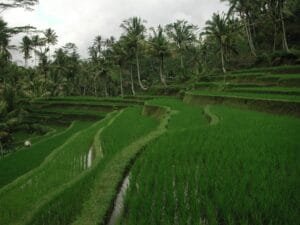
Rice terraces under Mount Agung with almost none of Tegallalang's circus – you can walk the paddies at sunrise, watch farmers actually working them, and pay guesthouse prices that have not been Instagram-inflated. This is the Bali people imagine before they land.
Stumbling into a ceremony
Around Galungan the whole island erects arching bamboo penjor poles, and any week you may hit a temple odalan with gamelan, offerings, and a procession closing the road. Nyepi, the day of silence, shuts the entire island including the airport – inconvenient, and one of the most remarkable cultural events anywhere.
Kecak fire dance at Uluwatu temple at sunset
Yes it is a ticketed tourist show on a cliff patrolled by bag-snatching macaques, and it is still worth it: dozens of chanting men, the Ramayana, and the sun dropping into the Indian Ocean behind the stage. Sunset slots sell out – arrive early or book ahead.
The USAT Liberty wreck at Tulamben and the Amed coast
A WWII shipwreck you can snorkel straight off the beach, black-sand fishing villages, and some of the cheapest quality dive and freedive instruction anywhere – the east coast is Bali with the volume turned down.
Warung eating
Babi guling (spit-roast pig) in Gianyar, bebek betutu slow-roasted duck, nasi campur picked from a glass cabinet of a dozen dishes – Balinese food is distinct even within Indonesia, and the best versions cost a dollar or three a plate.
The honest downsides
- The traffic is not a quirk, it is the defining logistical fact of the island: no trains, no real buses, and southern roads that turn a 20 km hop into a 90-minute crawl. The infamous single-lane Canggu 'shortcut' is a meme for a reason.
- Overtourism in the south is real and accelerating: beach clubs wall off the sand, construction noise is constant in Canggu and Pererenan, and parts of the island now exist mainly to be photographed. If you never leave the strip, you can go home believing Bali is ruined.
- Environment and stomach: monsoon-season plastic on the west-coast beaches, the smell of burning trash in villages, and a genuine chance of Bali Belly – drink bottled or filtered water and be choosy about street-vendor ice.
- Hassle scales with tourist density – rigged money changers off the main streets, scooter-rental damage claims, taxi cartels that block ride-hailing pickups at some beaches and temple areas – plus two risks that are actually serious: methanol poisoning from adulterated arak in cheap cocktails, and street dogs and temple monkeys that make a rabies vaccination worth discussing with a travel clinic.
Is Bali worth it? FAQ
Is Bali too touristy now?
The south is – Canggu, Seminyak, and the Kuta strip are as developed as any resort coast on earth, and central Ubud is wall-to-wall day-trippers by mid-morning. But tourism is intensely concentrated: drive to Sidemen, Munduk, Amed, or west Bali and you are in working villages where a foreigner at the warung is still slightly interesting. Whether Bali feels ruined depends almost entirely on where you sleep.
Do I need to ride a scooter?
No, but the alternatives cost time or money. Gojek and Grab motorbike taxis are cheap and everywhere in the south, though local taxi cartels block pickups in a few beach and temple areas. A private car with driver runs roughly 40-60 USD for a full day and is the sane choice for volcano or east-coast trips. If you do ride: you legally need an international driving permit with a motorcycle endorsement, police do stop foreigners, and scooter crashes are the single most common serious problem tourists have here.
Should I base in Canggu, Ubud, or somewhere else?
Canggu if you are there to work remotely, surf, and socialize – accept the traffic and construction noise as the price. Ubud for food, yoga, and day trips, but sleep outside the center in Penestanan or Sayan. If it is your second visit, or you care more about Bali than about other travelers, base in Sidemen or Amed and you will have a different and better trip. Splitting the stay across two bases beats commuting from one.
What happens if my trip overlaps Nyepi?
Nyepi is the Balinese day of silence, usually falling in March: for 24 hours the entire island stops – airport closed, roads empty, no one allowed outside, lights off, hotels in hushed mode. The night before brings the ogoh-ogoh demon parades, which are spectacular. It is a terrible day to arrive or depart and a genuinely memorable day to already be there, so check the date and book around it deliberately.
Decided? Plan it properly
Start with the full Bali travel guide, follow the Bali itinerary, pick your month with the best time to visit, budget it with real cost data, browse things to do, eat well with the food guide, check safety. Before any trip: etiquette, ATM fees and what to wear.
You Might Also Love

Weighing other trips? Is Japan worth visiting? · Is Thailand worth visiting? · Is Vietnam worth visiting? · Is Tokyo worth visiting?
