3-day itinerary
More: When to visit Marrakech · Marrakech travel guide
Marrakech in 3 days: the perfect weekend itinerary
Marrakech in 3 days requires a pace that respects the heat and chaos. This route lets you fully experience the medina without burning out, with one day in the Atlas Mountains for cool relief.
Day 1: Medina, souks, Djemaa el-Fna
Morning
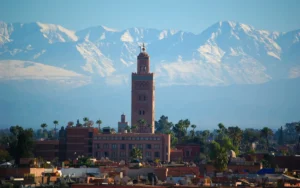
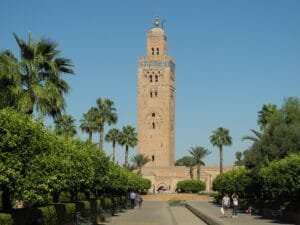
Breakfast on your riad rooftop. Then walk to Djemaa el-Fna square (pre-11am while it's calm). Visit Koutoubia Mosque (exterior only; non-Muslims can't enter).
Afternoon
Bahia Palace (100 dirhams for a non-resident adult) and the Saadian Tombs (100 dirhams), both open 9h to 17h. Both in the southern medina. Lunch at Le Jardin or Nomad rooftop.
Evening
Return to Djemaa el-Fna for the sunset transformation - food stalls, snake charmers, storytellers. Eat at a stall (30-80 dirhams per dish) or watch from the Glacier Cafe rooftop.
If you have an extra hour
Souk crawl extension - Souk Semmarine (textiles), Souk Haddadine (metalwork), Souk el-Attarine (spices).
Day 2: Atlas Mountains day-trip
Morning
Pre-arranged driver to Ourika Valley (45 min). Stop at a Berber village for traditional mint tea ceremony. Hike up to Setti Fatma waterfalls (1-2 hour return).
Afternoon
Long lunch on a riverside terrace (tagine, mint tea, fresh bread). Visit an argan oil cooperative on the drive back.
Evening
Hammam experience in the medina - Les Bains de Marrakech or Le Bain Bleu (book ahead, 400-800 dirhams). Allow 2 hours minimum.
If you have an extra hour
Alternative day-trip: Agafay Desert sunset with camel ride (45 min from Marrakech) or Ouzoud Falls (longer, 3 hours each way).
Day 3: Jardin Majorelle, Madrasa Ben Youssef, departure
Morning
Jardin Majorelle + YSL Museum (the garden is 170 dirhams, the museum is a separate ticket; both sold online only at tickets.jardinmajorelle.com, garden open from 8am with last entry at 6pm). The cobalt-blue villa and cactus garden are the iconic photo.
Afternoon
Madrasa Ben Youssef (50 dirhams for a foreign adult, restored) - the most refined Islamic architecture in Marrakech. Lunch at Cafe Clock for camel burger and storytelling.
Evening
Final dinner at a riad rooftop or at Dar Yacout (palace setting, traditional 7-course). Cooking class at La Maison Arabe if morning departure isn't urgent.
If you have an extra hour
Last-minute souvenir shopping in the souks - the second visit usually nets better prices.
Which Marrakech sights sit in the same walk, and which need a taxi
Marrakech divides into three blocks, and three days only works if you treat them as three separate outings. Each crossing between blocks costs the better part of an hour in the lanes.
The southern block is Bahia Palace, El Badi Palace and the Saadian Tombs. All three stand in the Kasbah and Mellah quarters south of Jemaa el-Fna, a few hundred metres apart, and all three are run by the same body. The Ministry of Youth, Culture and Communication sells their tickets at e-services.minculture.gov.ma, listing 9h to 17h and a non-resident adult price of 100 Dh at each, with 50 Dh for children aged 7 to 13 and 30 Dh for a Moroccan or resident adult. Entry is free for people with reduced mobility, and free for Moroccan nationals every Friday and on the first day of national and religious holidays.
The northern block is Ben Youssef Madrasa, the Almoravid Koubba, the Maison de la Photographie and Le Jardin Secret, strung along the lanes running north from Jemaa el-Fna through Souk Semmarine and rue Mouassine. The souks are not a stop on that walk, they are the walk, so a separate shopping afternoon earns you nothing.
The third block is outside the ramparts. Jardin Majorelle, the Pierre Bergé Museum of Berber Arts inside it and the Musée Yves Saint Laurent Marrakech opposite are all in Guéliz: a taxi each way and a pre-booked arrival slot, so they take a whole morning.
Closing times decide the order, not the map. The ministry monuments shut at 17h while Ben Youssef Madrasa runs to 19h and Le Jardin Secret to 19h30 from March to September. And Jemaa el-Fna is an evening event: UNESCO proclaimed its Cultural Space a Masterpiece in 2001 and inscribed it on the Representative List of the Intangible Cultural Heritage of Humanity in 2008, and the storytellers, Berber musicians and Gnaoua dancers that listing names assemble after dark.
A three-day sequence through the medina that never doubles back
Take the southern block on one morning, Guéliz on another, and the northern block in an afternoon.
Morning one, from 9h: the southern block. The ministry platform publishes no separate last-admission time, so treat 17h as the moment the doors close and keep an hour in hand. Ninety minutes at Bahia, forty-five at El Badi and thirty inside the Saadian Tombs is a realistic first pass: the tombs are a small walled necropolis reached through one narrow passage, so the visit is short even when the queue is not.
Afternoon one: north through the souks. Walk from the Kasbah back through Jemaa el-Fna into Souk Semmarine with no fixed target, and leave the lanes before the light goes. The souks shut in stages, and shuttered alleys are how people end up paying a stranger to lead them out.
Morning two: Guéliz, and never on a Wednesday. Jardin Majorelle runs 8h to 18h30, last entry 18h; the Pierre Bergé Museum of Berber Arts inside it runs 8h30 to 18h, last entry 17h30. The Musée Yves Saint Laurent Marrakech is closed on Wednesdays and so is the Villa Oasis private garden, so a Wednesday here loses two of the four things you crossed the city for. The garden opens half an hour before the Berber museum and two hours before the YSL museum, so the order that wastes nothing is garden at 8h, Berber museum from 8h30, YSL from 10h.
Afternoon two: the northern block. Ben Youssef Madrasa is open 9h to 19h, Le Jardin Secret 9h30 to 19h30 from March to September, the Maison de la Photographie 9h30 to 19h daily. All three take arrivals long after the ministry gates lock, which is why they belong after lunch.
Day three: one excursion, and only one. Keep it to a half day so that the morning or the evening still belongs to Marrakech, and put it on your departure day only if the flight is late.
What to cut from a three-day Marrakech plan
Cut El Badi Palace, the Menara Pavilion and any full-day mountain trip.
El Badi goes first, because it duplicates a ticket rather than a subject. The ministry prices it identically to Bahia, 100 Dh for a non-resident adult, on the same 9h to 17h hours, and the two stand within the same southern walk. For one admission, Bahia gives you roofed and decorated rooms while El Badi gives you an open ruin with stork nests on the walls. One warning about the source: the ministry's own El Badi ticket page currently carries Bahia Palace's history rather than El Badi's, describing a palace founded in 1886 by a grand vizier's family and covering eight hectares, so do not use that page to tell the two apart. Its price and hours are the parts to trust.
The Menara Pavilion goes second, because of where it is. The ministry lists it at 60 Dh for a non-resident adult rather than 100 Dh, and 30 Dh for a child aged 7 to 13, and it sits well west of the ramparts: a taxi round trip plus a ticket for a single pavilion, on the same 9h to 17h hours as everything else in the ministry's charge.
The third cut is the full-day Atlas or Ouzoud trip. Leaving at 07h00 and returning at 19h00 removes a day and most of the evening either side. If the mountains are why you came, plan five days. If you simply want out of the city for a few hours, the Agafay plateau is about 32 km out and models at roughly 45 minutes each way on a free-flow routing of the road network, which makes it a genuine half day.
Do not cut the second evening on Jemaa el-Fna. It is the only headline sight in Marrakech with no ticket, no closing time and no booking, so it costs the plan nothing.
What three days of Marrakech admissions and the taxe de sejour actually cost
Budget about 660 Dh a head for the admissions in this plan, and add a tourist tax charged on top of your room rate.
The 660 Dh is Bahia Palace 100 Dh, the Saadian Tombs 100 Dh, Ben Youssef Madrasa 50 DH, Le Jardin Secret 100 dirhams, the Maison de la Photographie 80 MAD, Jardin Majorelle 170 Dhs and the Pierre Bergé Museum of Berber Arts 60 Dhs. El Badi takes it to 760 Dh, and the tower at Le Jardin Secret is a further 40 dirhams. The Musée Yves Saint Laurent Marrakech does not publish its price on its own site.
Two of those tickets are worth more than they look. The Maison de la Photographie states that its 80 MAD ticket also admits you to the Musée de la Musique de Marrakech, and that it sells at the door by card or cash rather than online. Le Jardin Secret drops from 100 dirhams to 80 for anyone up to the age of 24 and to 50 for Moroccan citizens, and children under 12 go free, so a family pays far less than the headline.
The taxe de séjour is the part nobody budgets. It is set by Law 47-06 on the taxation of local authorities, whose Chapter IX states at Article 70 that the tax comes in addition to the price of the room, at Article 72 that it is due per person and per night, and at Article 73 the bands:
- Guest houses, or maisons d’hôtes, together with congress centres and luxury hotels: 15 to 30 DH per person per night
- Hotels: five-star 10 to 25 DH, four-star 5 to 10 DH, three-star 3 to 7 DH, one and two-star 2 to 5 DH
- Private clubs: 10 to 25 DH
- Holiday villages 5 to 10 DH; tourist residences 3 to 7 DH; motels, gîtes, relais and other tourist establishments 2 to 5 DH
Article 71 is the one that saves money. It exempts children under twelve outright, and it exempts unclassified hotels, pensions, camping and caravanning sites and youth hostels from the tax altogether. Article 76 makes the operator collect it and requires the invoice to show the amount of the tax separately, which is your check: if the line is not on the bill, ask for it.
Two honest gaps, both stated as of 5 September 2026. The exact figure inside each band is fixed by the commune under the procedure in Article 168, and no published Marrakech decision setting it could be reached, so treat the top of the band as your ceiling. And the only full text of Law 47-06 that could be read on an accessible official source is the version promulgated by dahir 1-07-195 in 2007; the Moroccan government hosts that would carry a later consolidated version did not answer. A riad trading as a maison d’hôtes therefore sits in the 15 to 30 DH band on the text available, which puts two people for three nights at no more than 180 DH. The itemised line on your invoice is the figure that actually applies, so read it rather than budgeting from any list, including this one.
Admission prices and opening hours in Marrakech moved during 2026. Re-check each on the ministry platform or the institution’s own site in the week you travel.
Petit taxi or on foot: what actually moves you between the three blocks
Walk everything inside the medina and pay for two taxi legs only, out to Guéliz and back. Inside the walls a taxi is slower than your own feet.
Cars cannot reach most medina lanes, so a taxi given a riad address drops you at the nearest vehicle-accessible point and the last two to five hundred metres are on foot with your bags. Ask the riad for the drop-off point rather than the street address, because that is what a driver recognises.
On fares, the official advice is clear about the risk and silent about the number. The UK Foreign, Commonwealth and Development Office tells travellers to Morocco that it is advisable to either agree a fare in advance or check the taxi is using a meter, warns that many taxis booked through ride-sharing applications may be unregulated and unlicensed, and notes that drivers of petits and grands taxis sometimes speed and do not follow other driving rules, particularly in big cities.
No Moroccan official publication setting the current Marrakech petit taxi tariff, or restating the meter obligation, could be reached as of 5 September 2026. Per-kilometre rates and night surcharges are quoted all over the internet and none trace back to a published prefectural decision, so do not plan around a figure. The rule that survives the gap: ask for the meter before you get in, and if the driver will not use it, agree the total rather than a rate. Carry small notes; drivers rarely have change for the 200 dirham note a cash machine hands you.
Can you go inside the Koutoubia Mosque?
No. The Koutoubia is a working mosque rather than a ticketed monument, and you should treat the prayer hall as closed to visitors who are not Muslim. There is no ticket, no queue and nothing to book.
The clearest confirmation of that is an absence. The Ministry of Youth, Culture and Communication sells tickets online for the Marrakech monuments in its charge, among them Bahia Palace, El Badi Palace, the Saadian Tombs, the Almoravid Koubba and the Menara Pavilion. The Koutoubia has no ticket page on that platform at all, because it is a place of worship in daily use rather than a ministry-managed attraction.
What you can do costs nothing. The mosque stands at the western edge of Jemaa el-Fna, so it needs no detour. The open ground and gardens around it are public, and the minaret is the most useful navigation aid in the city: whenever the souk lanes have lost you, walking towards it puts you back on the square without asking anyone, which also removes the opening move in the unofficial-guide routine. Go once in late afternoon and once after dark when it is lit, keep back from the doors at prayer times, and do not photograph worshippers going in.
At a glance
| Site | Non-resident adult admission | Listed hours | Where the ticket comes from | Which block |
|---|---|---|---|---|
| Bahia Palace | 100 Dh (child 7 to 13: 50 Dh; Moroccan or resident adult 30 Dh) | 9h to 17h | Ministry of Culture, e-services.minculture.gov.ma, or the gate | Southern |
| El Badi Palace | 100 Dh (child 7 to 13: 50 Dh) | 9h to 17h | Ministry of Culture platform or the gate | Southern |
| Saadian Tombs | 100 Dh (child 7 to 13: 50 Dh) | 9h to 17h | Ministry of Culture platform or the gate | Southern |
| Almoravid Koubba | 100 Dh (child 7 to 13: 50 Dh) | 9h to 17h | Ministry of Culture platform or the gate | Northern |
| Ben Youssef Madrasa | 50 DH (under 12: 10 DH; groups of 20 or more: 30 DH each) | 9h to 19h daily | At the entrance; its online ticketing was under maintenance when checked | Northern |
| Le Jardin Secret | 100 dirhams, plus 40 dirhams for the tower (80 dirhams up to age 24; under 12 free) | 9h30 to 19h30 March to September; to 18h30 February and October; to 18h November to January; to 16h30 in Ramadan; last entry 30 min before closing | lejardinsecretmarrakech.com or the door | Northern |
| Maison de la Photographie | 80 MAD, which also admits you to the Musée de la Musique (residents 50 MAD; under 15 free) | 9h30 to 19h daily | At the door only, card or cash, 46 rue Ahl Fes, Bin Lafnadek | Northern |
| Jardin Majorelle | 170 Dhs (international students 95 Dhs; Moroccan citizens and residents 75 Dhs; under 10 free) | 8h to 18h30, last entry 18h | tickets.jardinmajorelle.com, online only | Guéliz |
| Pierre Bergé Museum of Berber Arts | 60 Dhs (international students 35 Dhs; Moroccan citizens and residents 35 Dhs) | 8h30 to 18h, last entry 17h30 | tickets.jardinmajorelle.com, online only | Guéliz, inside the garden |
| Musée Yves Saint Laurent Marrakech | Not published on the museum’s own site | Closed Wednesdays; visit pages say 10h to 18h, last entry 17h30, home page says 10h to 18h30, last entry 18h | tickets.jardinmajorelle.com, online only | Guéliz |
| Villa Oasis private garden | Sold through the same online ticketing | 8h to 17h30, last entry 17h, closed Wednesdays | tickets.jardinmajorelle.com | Guéliz |
| Menara Pavilion | 60 Dh (child 7 to 13: 30 Dh) | 9h to 17h | Ministry of Culture platform or the gate | West of the ramparts |
| Koutoubia Mosque | No admission; treat the prayer hall as closed to visitors who are not Muslim | Exterior and gardens, no gate | No ticket, and no page on the ministry platform | Western edge of Jemaa el-Fna |
Frequently asked questions
Can non-Muslims go inside the Koutoubia Mosque?
No. The Koutoubia is in daily use for prayer and is not a ticketed monument, so treat the prayer hall as closed to visitors who are not Muslim. It has no page at all on the Ministry of Culture ticketing platform that sells entry to Bahia Palace, El Badi Palace, the Saadian Tombs, the Almoravid Koubba and the Menara Pavilion. The gardens around it are free at any hour, and the minaret is the landmark you navigate the medina by.
Is Ben Youssef Madrasa open after its restoration, and what does it cost?
Yes. Its official site lists 9h to 19h every day and admission of 50 DH, with 10 DH for children under 12 and 30 DH a head for groups of 20 or more. When checked on 5 September 2026 the site said its online ticketing system was undergoing maintenance and that tickets had to be bought at the entrance, so bring cash. That is a change worth checking again before you go, because it is the one northern-block ticket you cannot currently secure in advance.
Do you have to book Jardin Majorelle in advance?
Yes. The Fondation Jardin Majorelle states that tickets can only be purchased online, through tickets.jardinmajorelle.com, so there is no gate window to fall back on. The garden is 170 Dhs general, 95 Dhs for international students and 75 Dhs for Moroccan citizens and residents, with under-10s free. The Pierre Bergé Museum of Berber Arts inside it is a separate 60 Dhs and keeps different hours, 8h30 to 18h against the garden’s 8h to 18h30, and the Musée Yves Saint Laurent Marrakech is separate again.
Which day of the week should you avoid for Majorelle and the YSL museum?
Wednesday. The Musée Yves Saint Laurent Marrakech is closed every Wednesday and so is the Villa Oasis private garden, although Jardin Majorelle and the Berber museum stay open. There is a second trap: the museum’s visit pages give 10h to 18h with last entry at 17h30, its home page gives 10h to 18h30 with last entry at 18h. Two of the three official pages give the earlier time, so arrive by 17h.
How much is the tourist tax on a Marrakech riad?
It depends on how the riad is licensed, and your invoice is where you confirm it. Article 73 of Law 47-06 on the taxation of local authorities puts guest houses, or maisons d’hôtes, which is how most Marrakech riads trade, in a band of 15 to 30 DH per person per night, against 10 to 25 DH for a five-star hotel and 2 to 5 DH for a one or two-star. Article 71 exempts children under twelve, and exempts unclassified hotels, pensions, campsites and youth hostels altogether. The commune fixes the exact figure inside the band, no published Marrakech decision could be reached as of 5 September 2026, and Article 76 requires the invoice to show the tax separately, so ask for that line.
Is it worth paying for both Bahia Palace and El Badi Palace in three days?
Only if ruins interest you as much as interiors. Both are 100 Dh for a non-resident adult, both shut at 17h and both sit in the same southern walk, so paying twice costs you 100 Dh and about forty-five minutes you could have spent reaching the Saadian Tombs unhurried. Bahia is the palace with the roofed, decorated rooms; El Badi is the open ruin with stork nests. Do not try to separate them using the ministry’s own ticket pages, because the El Badi page currently carries Bahia’s history.