Last updated August 24, 2026 · Editorial policy
- The honest geography
- When to come
- Where to stay, honestly
- The medina, properly
- The food
- Day trips, worth it and not
- What will surprise you
- What will disappoint you if you let it
- Practical, briefly
- A final thought
- Seasonal questions
- Marrakech like a local: the medina, riads & the plan
- Marrakech Travel Guide FAQ
- More from Packzup
- More Travel Guides You'll Love
- Frequently Asked Questions
A man stops you in a narrow street in the medina and tells you the tanneries are this way, follow him. The tanneries are not this way. They are in Fez, four hours north. He is doing what he has done a hundred times this week, which is to attach himself to a foreigner for ten minutes, lead them deeper into the souk, and request a generous tip at the moment the foreigner realises they no longer know where they are. The honest thing about Marrakech is that this happens. The other honest thing is that, two streets later, an old man selling brass lamps will pour you a glass of mint tea, refuse payment, and explain in pidgin French that his great-grandfather was a Berber from the High Atlas. Both encounters are the city. The mistake is to let one of them define the other.
Marrakech is the busiest medina in North Africa and one of the most photographed urban environments in the world. It is also, when you learn to read it, one of the most generous travel experiences anyone can have. I want to be straight in this guide about what to expect, what to skip, where the city’s surface meets its substance, and what the new Marrakech, the boutique riad, the design hotel in the Palmeraie, the cafés on rue Yves Saint Laurent, has and has not changed about the older one.
Planning around the season?
See Marrakech in March for month-specific timing, pricing, and crowd realities.
| Best month to visit | November — 24.5°C, 3 wet days |
|---|---|
| Warmest month | July, 39.2°C average high |
| Wettest month | March, 7 wet days |
| Plugs & power | Type C,E · 220 V · 50 Hz |
| Driving side | Right |
Climate: normals (WMO 1991–2020, or ERA5 2019–2023 where unavailable) via Open-Meteo. Open data.
The honest geography
Marrakech is two cities. The walled medina at the centre — built around the eleventh century, expanded by the Almohads, broadly intact, and the new city outside the walls, called Gueliz, which grew during the French Protectorate from 1912 onwards. They look different, smell different, and operate on different clocks.
The medina is what you came for. It is a square kilometre of narrow streets, walled houses (riads) presenting blank doors to the street, twelve thousand registered shops, six famous gates, and the great central square of Jemaa el-Fna. You walk it. There are no cars. There are scooters and donkey carts and the occasional handcart. You will get lost. Getting lost is the experience.
Gueliz, ten minutes by petit-taxi from the medina, is the modernist French-colonial planned city: wide avenues, cafés on the corner, the contemporary art galleries (David Bloch, Comptoir des Mines), and the better mid-range restaurants. Stay in the medina for the visit; come to Gueliz for one or two meals.
And then outside both, on the road to Casablanca, the Palmeraie, the original palm grove, now built out with the genuine luxury hotels (La Mamounia is in the medina; the Royal Mansour is on the medina edge; Selman, Beachcomber, Amanjena are out in the Palmeraie). This is the world of swimming pools and golf courses and quiet. It is a different trip and worth being honest about that before booking.
When to come
October, November, March, and April. These are the four months Marrakech is at its best, warm dry days, cool nights, the medina bearable, the High Atlas trips comfortable.
Avoid July and August. The medina hits forty-three degrees and the riads, even the good ones, struggle to cool the indoor courtyards. The Atlas day trips become punishing.
December and January are a quieter, cooler period — cold nights down to four degrees, warm sunny days at eighteen, fewer foreign tourists, and the snow visible on the Atlas peaks from the rooftop terraces. Pack a jumper.
February has the almond blossom in the Ourika Valley, which is one of the underrated photographic windows of the year in Morocco.
Ramadan changes the rhythm of the city profoundly: most restaurants closed during the day, the medina quieter until sunset, then alive until two in the morning. Whether to come is a personal call; the experience is real but the inconveniences are real too. Dates of Ramadan shift each year; check before you book.
Where to stay, honestly
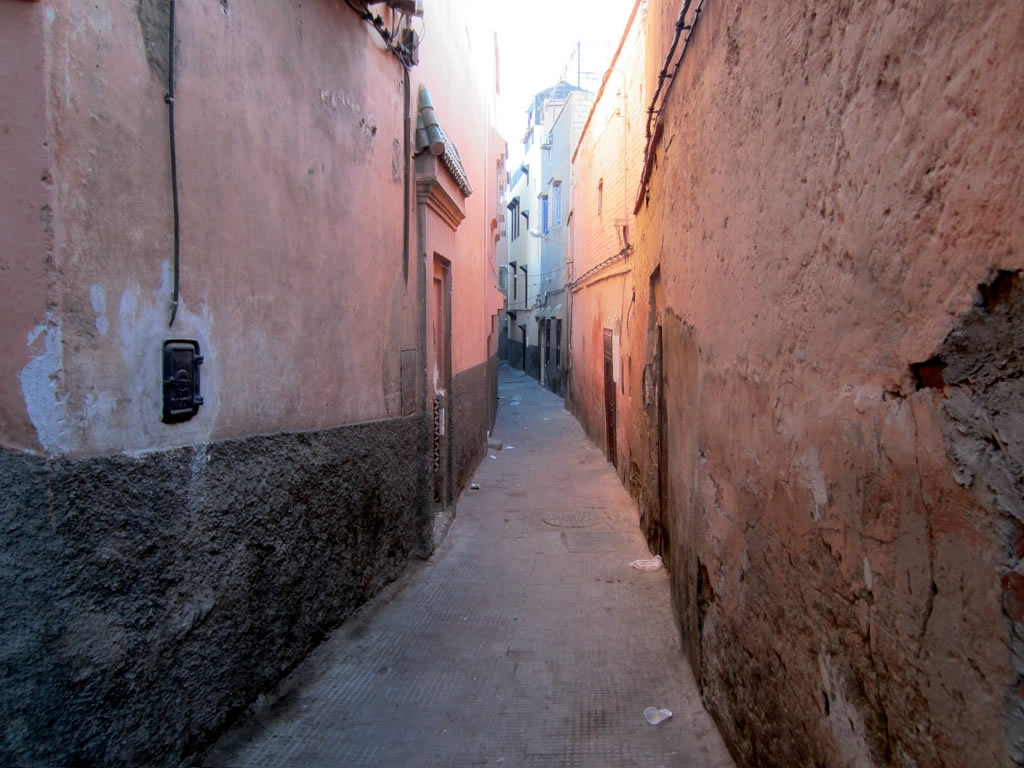
The right answer for a first-time visitor is a riad in the medina. Not a hotel outside. The whole point of Marrakech is the contrast between the small blank door on a dust-coloured street and the interior of cool tile, an interior pool, three storeys of carved wood and stucco rising around a courtyard, and a roof terrace at the top facing the Atlas. You can’t get that from outside the walls.
The whole point of Marrakech is the contrast between the small blank door on a dust-coloured street and the interior of cool tile, three storeys of carved wood and stucco rising around a courtyard.
The riads worth knowing fall into three tiers.
The genuine boutique luxury. Riad Mena, Riad Jardin Secret, El Fenn, Dar Kawa, Riad Joya, Riad de Tarabel, runs roughly €350 to €700 a night and delivers a level of design and service that rivals the best small hotels in Italy or France. El Fenn, owned by Vanessa Branson, is the famous one and still excellent. Riad Mena is the more recently fashionable choice.
The honest mid-tier — Riad Aguaviva, Riad Star, Riad BE Marrakech, Riad Karmela: runs €100 to €220 and gives you most of the riad experience for a third of the price. The roof terraces are smaller, the breakfast simpler, the hammam usually offsite, but the architecture is real.
The grand-hotel tier. La Mamounia, Royal Mansour, Selman, Amanjena, is a different category. The Royal Mansour is the maximalist Moroccan-craft fantasy commissioned by the king; the Mamounia is the historic grande dame; the Aman in the Palmeraie is the international quiet luxury. All three deliver. None of them give you the medina at night.
What to avoid: the airbnb riads run by absentee owners, where there is no one to meet you at the entrance to the medina with a wheelbarrow for your luggage (this matters more than it sounds, the narrow streets cannot take a taxi to your door, and finding the door at night with a suitcase is a real problem the boutique riads solve).
The medina, properly
The medina is best read in three layers.
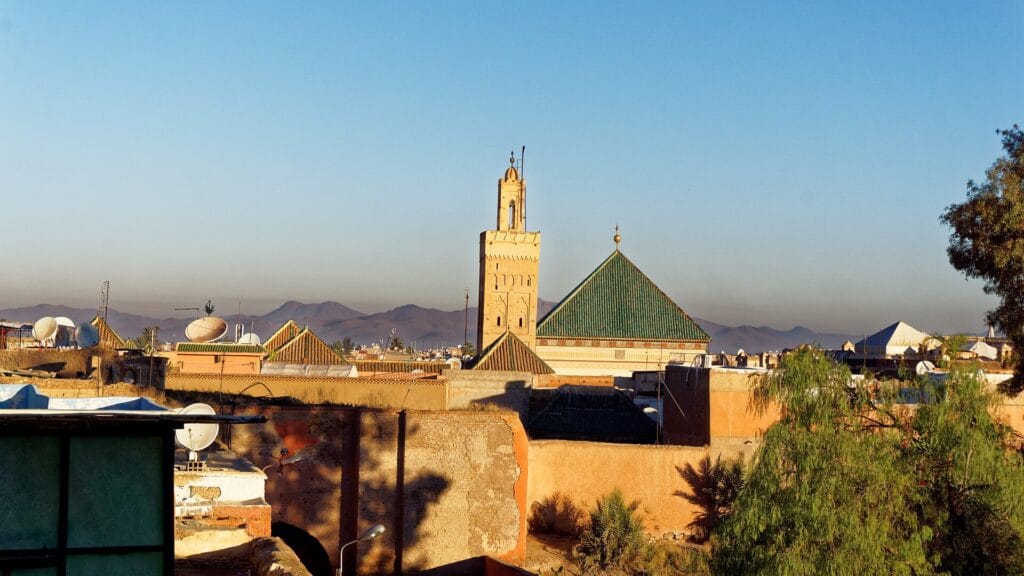
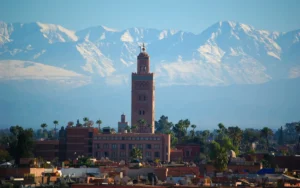
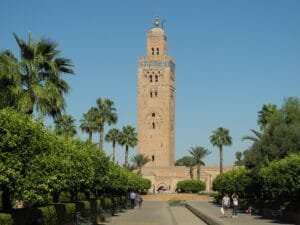
The Jemaa el-Fna square. Do it once at sunset and once at night. At sunset — around six-thirty in spring, the snake charmers and Berber musicians and food stalls assemble in a slow choreography that has been the same for a thousand years, the same families often in the same patches of the square. The smoke from the first grills starts thin and rises straight; the Atlas mountains turn pink behind the Koutoubia minaret to the west. By ten the square is at full volume: twenty grill stalls, charcoal smoke, the bray of three competing music groups, hawkers calling ‘amigo my friend, the best price’, and an entirely separate world from the daylight one. Eat at one of the famous stalls (Stall 14 for fish, Stall 31 for the spiced sausages); the prices are touristed but the food is acceptable and the experience is the point. Don’t pay for the photograph with the snake charmer, the snakes are de-fanged and the ‘tip’ is the actual price.
The souks. The famous ones. Souk Semmarine, Souk Cherratine for leather, Souk Smata for slippers, Souk des Teinturiers for the dyed wool. Go in the morning when the light through the lattice roof is at its best. Bargain firmly and politely; start at thirty percent of the asking price and meet near sixty. If you are not enjoying the bargaining, walk away, there will always be another shop.
The monuments. Bahia Palace, Ben Youssef Madrasa, Saadian Tombs, El Badi Palace, Dar Si Said. Each is worth a careful hour. The Ben Youssef Madrasa, restored and reopened, is the standout. The Marrakech Museum of African Contemporary Art (MACAAL) and Musée Yves Saint Laurent are the modern complements, both outside the medina, both worth half-days.
And the Jardin Majorelle, with the YSL museum next door. The garden is small and now heavily ticketed; go at opening or in the last hour of light. The cobalt blue is the cobalt blue you have seen in every photograph, and it is, somehow, still good in person.
The food
Moroccan food is more refined and more varied than the tagines-and-couscous summary suggests, but you have to go looking. The famous medina restaurants: Le Comptoir, La Maison Arabe, Dar Yacout. Give you a polished version with belly-dancers and a fixed menu; fine for one evening if you want the spectacle, not what to seek out for the food itself.
The food worth flying for is at three places, mostly. Nomad in the medina, with its rooftop terrace overlooking the Spice Square, doing contemporary Moroccan with a light touch (book a week ahead, ask for a roof table). Le Jardin in the same district, in a converted riad with a tiled interior courtyard, doing the proper traditional cooking. And Plus 61 in Gueliz, the contemporary fine-dining standard-bearer, run by an Australian-Moroccan chef and serving the most ambitious cooking in the city.
For everyday eating, the riad breakfasts will be the best meal of your day, every day. Bread baked that morning, msemen (a folded square pancake), khobz, eggs cooked to order, olives, jams, and the most serious mint tea ceremony anyone takes anywhere. Eat slowly.
The street food worth knowing: the harira soup stalls just inside Bab Doukkala at sunset (a hot, lentil-and-chickpea broth, ten dirhams a bowl), the snail stalls in Jemaa el-Fna (genuinely good, much better than they sound), and the orange juice carts in the central square (number 28 is the famous one).
Day trips, worth it and not
The High Atlas, yes. The Ourika Valley is the easy half-day option, ninety minutes from the city, with mountain villages and small waterfalls and Berber lunches at restaurants overhanging the river. Imlil is the proper full-day or overnight, a real mountain village at 1,800m below the slopes of Toubkal, with hiking and decent guesthouses (Kasbah du Toubkal is the famous one). The Atlas day trip is the most underrated thing most visitors miss.
Essaouira on the coast, possibly. Two and a half hours west, a small Atlantic fishing port with sixteenth-century Portuguese fortifications, much cooler air, very good grilled fish. Worth two nights if your trip allows. A one-day return trip is too much driving for too little payoff.
The Sahara, no, at least not as a two-day trip from Marrakech. The drive to Merzouga, the genuine dune town, is ten hours each way. The “Sahara day trip” tours go to a much smaller dune field at Zagora, which is not the desert you imagined. If the desert is important to you, do it from Fes or as a longer Morocco trip; do not try to do it in two days from Marrakech.
What will surprise you
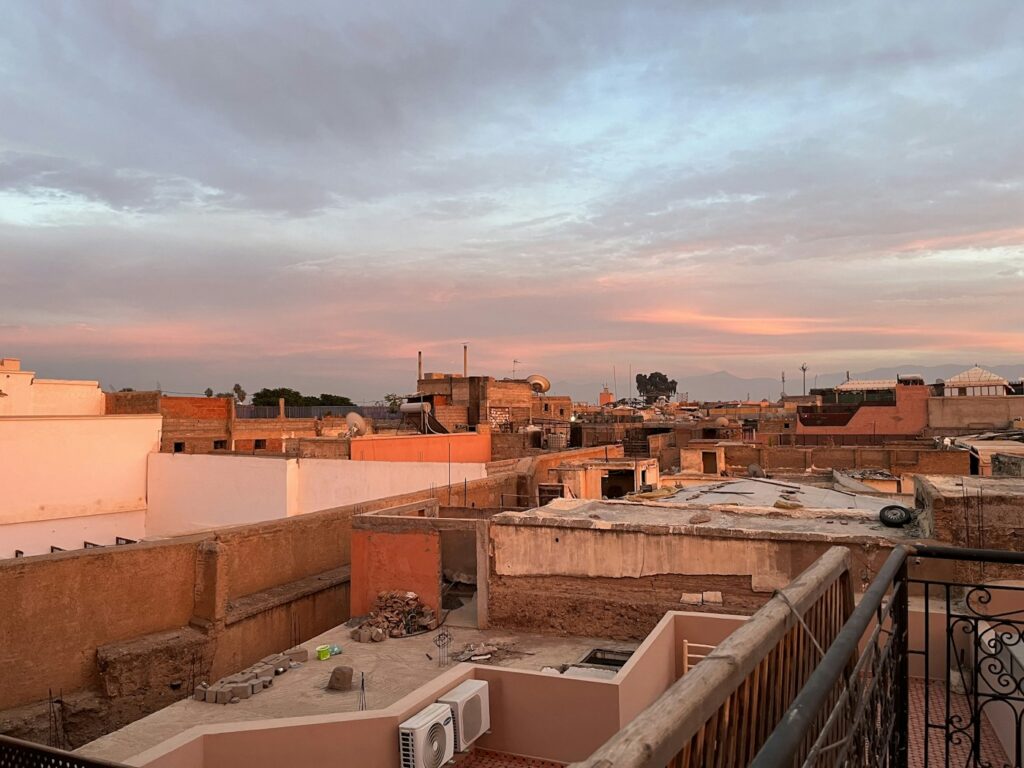
The cold of the desert nights in winter. The quality of the light on the medina walls in late afternoon, the famous “rose city” colour is real for about forty minutes a day. The depth of craft tradition, the riad you stay in has had three generations of plasterwork (tadelakt) and carved cedar in it, and the men still doing this work are findable. The number of cats, and how casually they enter the riads. The kindness, which arrives unannounced from the unlikely directions, a shopkeeper’s wife pressing dates on you, a taxi driver refusing to take the over-tip you offer. The aggression of the sales pitch in certain corners of the souk, which co-exists with the kindness and is its mirror.
What will disappoint you if you let it
The crowding at the Jardin Majorelle. The persistence of the fake-guide hustlers in the medina (firm “no, thank you” and keep walking; do not engage). The petty traffic-direction scams. The riads that sell themselves as “boutique” and are not. The cost of the famous luxury hotels, which has risen sharply since. The fact that, at certain peak hours, the medina genuinely is overcrowded.
Practical, briefly
Visa-free for most Western nationalities. The currency is the dirham, cash for souks, cards in mid-range and above restaurants. Arabic is the language; French works almost everywhere; English in tourist-facing places. Tipping is normal — five to ten dirhams for small services, ten percent in restaurants. The medina is unmappable by Google Maps in any reliable way, the riad will send a runner to meet you at the nearest gate. Petit-taxis are cheap and metered (insist on the meter). Wear a hat in summer; cover shoulders in religious places.
A final thought
The mistake most first-time visitors make in Marrakech is to come for three days and treat the city as something to extract: souk photographs, a Jemaa el-Fna evening, a tagine, a hammam. The city resists being extracted. It rewards being stayed in. Five days minimum, in a real riad, with one day in the Atlas and a long late lunch every afternoon on the terrace. You begin to recognise the calls from the muezzin at five different mosques. The medina shopkeepers begin to recognise you. The whole place softens a little. And on the last morning, in the early light, when the streets are still wet from the wash and only the cats are out, the medina becomes something quieter than the brochures know how to describe.
<!–Planning around the season?
–> <!–See Marrakech in March for month-specific timing, pricing, and crowds.
–> <!–Seasonal questions
When is the best time to visit Marrakech?
March-April and October-November. Daytime highs 22-28 C, nights cool enough to need a layer, almost no rain. July and August hit 38-42 C which makes medina walking miserable; January-February is fine but evenings drop near 5 C.
Is March a good month for Marrakech?
Yes, one of the two peak windows. Highs 22 C, lows 11 C, four rain days in the month. Atlas day trips are at their best because snow on the High Atlas is still visible from the city. Book riads four to six weeks out.
How does Ramadan affect a Marrakech trip?
Most riads stay open and most restaurants serve non-Muslim visitors during the day, but the souks slow down and many local cafes close until sunset. Iftar (sunset meal) is a remarkable experience if you can join one. Check Ramadan dates each year; they shift earlier by 11 days.
Marrakech like a local: the medina, riads & the plan
The must-dos
The labyrinthine souks and the Koutoubia, the Bahia Palace and Saadian Tombs, the cobalt-blue Majorelle Garden, and Jemaa el-Fnaa square as it erupts into food stalls and music at night.
Stay in a riad
A traditional riad (courtyard house) is the quintessential Marrakech stay — a tranquil retreat from the medina’s intensity. Treat yourself to a hammam.
Eat & bargain
Tagine, couscous, fresh mint tea, and the food stalls of Jemaa el-Fnaa. Bargain in the souks (start low, stay friendly), carry dirham cash, and hire a guide for day one (the medina is a maze).
Day trip
The Atlas Mountains (Ourika Valley), the Agafay desert, or the coast at Essaouira. Three days covers the city plus an escape.
Marrakech Travel Guide FAQ
How many days do you need in Marrakech?
Three — the medina and palaces, a hammam, and an Atlas or desert day trip.
Should I stay in a riad?
Yes — a traditional courtyard riad is the quintessential, peaceful Marrakech base.
More from Packzup
Frequently Asked Questions
Is Marrakech worth visiting?
Yes. Marrakech rewards travelers who are willing to look beyond the surface. From local food to cultural sites, there is plenty to discover for every type of traveler.
How many days should I spend in Marrakech?
Plan for at least 3-4 days to cover the main highlights. A week allows for day trips and a more relaxed pace that lets you experience the destination more deeply.
What is the best way to get to Marrakech?
Options typically include flights to the nearest international airport, followed by local transport. Check for direct flight routes from your departure city for the most convenient travel.
Do I need travel insurance for Marrakech?
Travel insurance is strongly recommended for any international trip. It covers medical emergencies, trip cancellations, and lost luggage — risks that are expensive to handle out of pocket.
More guides: Marrakech itinerary
Best time to visit Marrakech (real climate data)
Best months: March, April, November.
Marrakech’s warmest month is July (avg 39°C / 103°F), the coolest is January (low 5°C / 42°F). The wettest is March (35 mm) and the driest is July.
Source: Open-Meteo / WMO climate normals (WMO 1991–2020, or ERA5 2019–2023 where unavailable). See the full month-by-month weather →
You Might Also Love

Written by
Founder of Packzup. Independent travel writer covering offbeat destinations across six continents since 2018. Every guide is independently researched and self-funded — no press trips, never sponsored.
Before you go: see whether they speak English in Marrakech and what to wear, check the tap water, sort your mobile data, and find out if it is a cash or card destination, and brush up on local etiquette.