
Last updated August 21, 2026 · Editorial policy
- Walk the Meguro River
- Coffee pilgrimage
- Nakameguro Koukashita
- Vintage & design shopping
- Evenings
- Getting there
- Where to actually sit down once you've walked the river
- Getting to Nakameguro (and how to orient yourself)
- Time your visit for cherry blossom season (late March)
- The Starbucks Reserve Roastery: Nakameguro's design landmark
Quick answer: Nakameguro is Tokyo’s canal-side cool: cherry trees arched over the Meguro River, specialty coffee (Onibus, plus the spectacular Starbucks Reserve Roastery), vintage shops under the railway arches and small standing bars that hum after dark. Pair it with neighbouring Daikanyama for Tokyo’s best half-day walk.
Walk the Meguro River
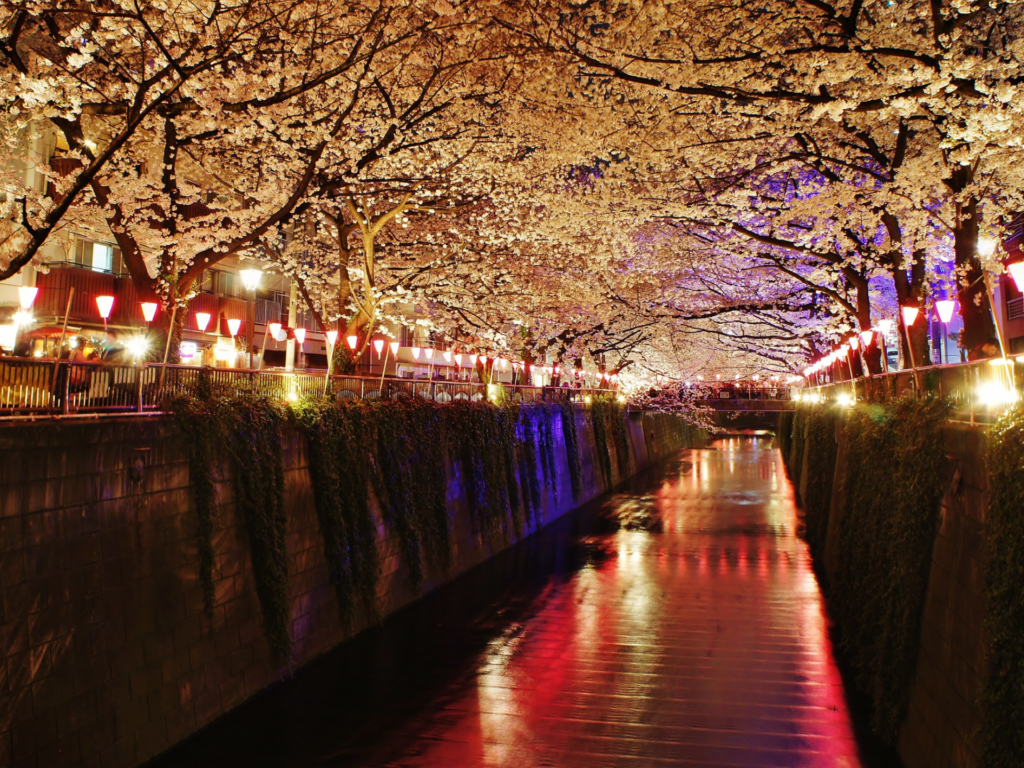
The canal is the neighbourhood’s spine: late-March cherry blossoms turn it into Tokyo’s dreamiest tunnel (lantern-lit at night), but it earns a slow stroll in any season: summer greens, autumn golds, December lights.
Coffee pilgrimage
Onibus Coffee roasts single-origins in a two-storey hut by the tracks: take the espresso upstairs and watch trains slide past. The four-storey Starbucks Reserve Roastery on the river (a Kengo Kuma building) is a tourist magnet that genuinely deserves it: go at opening.
Nakameguro Koukashita
The shops-and-izakaya strip built under the elevated rail line: a bookstore, craft sake, yakitori smoke and ramen counters in a half-kilometre of architectural ingenuity.
Vintage & design shopping
Smaller and sharper than Shimokitazawa: canal-side boutiques mix Americana, denim and homeware: browse south of the station where rents drop and finds improve.
Evenings
Standing bars and tiny counters fill from six: natural wine spots and decades-old izakaya share the same blocks. The canal at night, lanterns doubling in the water, is the closing scene.
Getting there
Nakameguro station (Hibiya line terminus + Tokyu Toyoko line) puts you on the canal in two minutes: Daikanyama is a 12-minute walk uphill, Shibuya one stop. Weekday mornings are local-quiet; sakura season is gloriously not.
Where to actually sit down once you’ve walked the river
The canal is the postcard, but the neighborhood is best once you stop walking. For coffee, Café Façon (two minutes from the station’s West Exit, open 10:00–22:00) roasts its own beans, plates serious desserts in a retro room of curved red booths, and made the Tabelog 100 cafe list for 2025. It stays open late, so it doubles as a calm evening stop after the river crowds thin.
For food and drink, the place to graze is Nakameguro Koukashita, the 700-meter strip of around 28 small businesses tucked under the elevated railway, opened in late 2016. It runs from a Tsutaya Books with its own cafe to Niwakaya Chosuke, a Kyushu udon izakaya, plus craft beer bars and a standing yakiniku counter, all a short walk from the station and sheltered if it rains.
- Café Façon: 10:00–22:00, in-house roast, 2 min from West Exit.
- Koukashita: ~28 shops under the tracks, weatherproof.
- Best time: weekday mornings are local-quiet; go off-sakura unless you want the crowds.
Getting to Nakameguro (and how to orient yourself)
Nakameguro sits on two lines, which is half its charm and half the confusion. It’s the terminus of the Tokyo Metro Hibiya Line and a stop on the Tokyu Toyoko Line, so you can roll in from opposite sides of the city without ever touching a JR platform.
- From Shibuya: two stops on the Tokyu Toyoko Line, roughly 3-4 minutes. This is the easiest approach and the one I default to.
- From Shinjuku: take the JR Yamanote Line to Ebisu, then transfer to the Hibiya Line one stop to Nakameguro. About 20 minutes door to door.
- From Tokyo Station: around 25-35 minutes; the cleanest route is the Marunouchi Line to Ginza or Kasumigaseki, then the Hibiya Line straight to the terminus.
- From the airports: plan on roughly 50 minutes from Haneda and just under two hours from Narita.
Once you exit, orientation is simple: the Meguro River runs one block from the station, and almost everything worth doing hugs its banks. Head northwest (upstream toward Ikejiri-Ohashi) for the densest cluster of cafes and boutiques. You do not need a map here; just find the water and follow it.
Time your visit for cherry blossom season (late March)
If you can only visit Nakameguro once, come during sakura season. The Meguro River is lined with roughly 800 Yoshino cherry trees whose branches meet over the water for about 4 kilometers, forming a pale-pink tunnel that is, frankly, one of the best hanami views in Tokyo.
- Peak bloom: late March into the first days of April. For 2026, full bloom was projected around March 28-29, with the annual festival weekend timed to match.
- Go at night. Pink paper lanterns (bonbori) line both banks and light up from sunset until around 8:00-9:00 PM. The blossoms reflecting in the dark water is the shot everyone comes for.
- Food stalls appear a few days before peak bloom and run through the first week of April, selling sparkling rose wine, skewers, and street snacks along the promenade.
Two logistics notes from experience: the crowds are genuinely heavy on festival weekends, so go on a weekday morning if you want photos without a sea of heads. And for an elevated vantage, the third-floor terrace of the Starbucks Reserve Roastery (see below) overlooks the river; go early, because that terrace fills fast in spring.
The Starbucks Reserve Roastery: Nakameguro’s design landmark
Even if you think you’re done with Starbucks forever, the Starbucks Reserve Roastery Tokyo is worth an hour. Opened in 2019 and designed by architect Kengo Kuma, it’s one of only a handful of Roasteries worldwide and was the largest in the world when it opened, spanning four floors around a copper cask rising about 17 meters and clad in some 2,100 hand-hammered copper cherry blossoms.
- Ground floor: the working roastery plus Princi, a Milanese bakery doing focaccia and cornetti.
- Second floor: a Teavana bar built around Japanese teas.
- Third floor: Arriviamo, a cocktail bar, opening onto an engawa-style terrace with the best river-and-sakura view in the building.
- Top floor: the Amu lounge under a ceiling of wooden origami cranes.
Hours: open daily, roughly 7:00 AM to 11:00 PM. Entry is free; walk-in drinks and pastries generally run 1,200-3,000 yen, while the reservation/VIP experiences climb far higher. It sits a short walk upstream from the station along the river, so pair it with the Meguro River walk rather than treating it as a separate trip.
You Might Also Love
More things to do in Japan



Written by
John Morrison is the founder and lead travel writer at Packzup. Over the past decade he has explored destinations across Africa, the Americas, Asia, Europe, the Middle East, and Oceania — always self-funded, never on a press trip.
