
Last updated September 16, 2026 · Editorial policy
More: When to visit Prague · Prague travel guide
Things to Do in Prague in 2026: What Is Actually Worth Your Time
Quick answer: This is an honest look at what is genuinely worth your time in Prague in 2026, including the spot most visitors never reach. It also covers the transit and money moves that save the most hassle.
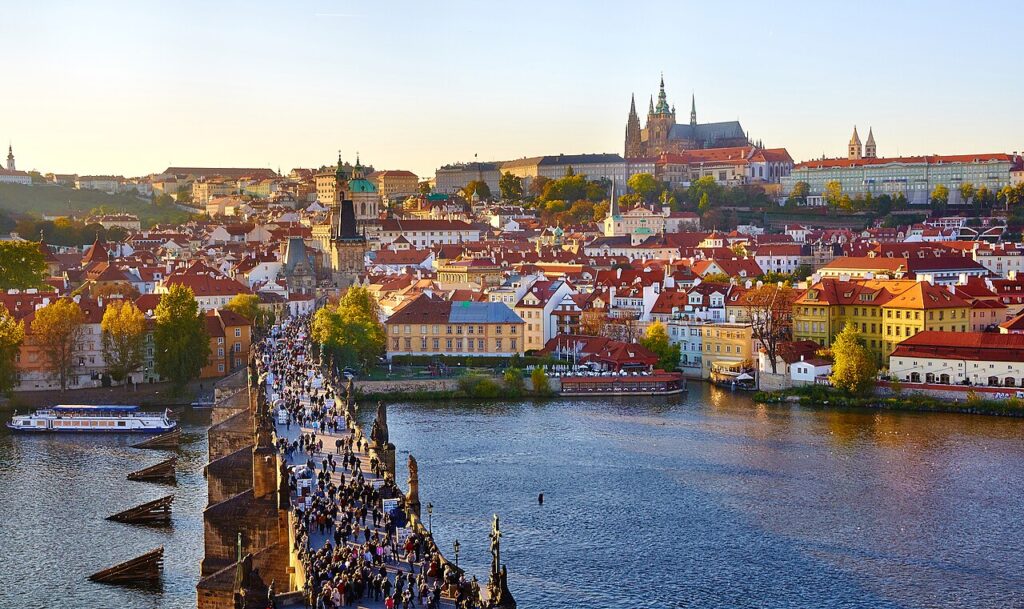
Here is the honest version. The hourly Astronomical Clock show, which runs on the hour through the day and evening, is the most oversold few minutes in the city: you wait shoulder-to-shoulder for the Walk of the Apostles, and the figures are small and brief. Spend your money on the Old Town Hall Tower above it instead. The climb is included with the tower ticket (the elevator costs extra), it is fully wheelchair accessible, and from the top you look down on the spires of Tyn Church and across to the castle rather than craning up at a clock face.
The pick most people walk past is Vysehrad, the older fortress about 2km south of Old Town on a cliff above the Vltava. The grounds are free and open 24/7, the national cemetery holds Dvorak and Smetana, and the Romanesque rotunda there is the oldest surviving building in Prague. Bring this back to the river walls for some of the longest open views in the city, minus the castle queues.
- Smart move: reach Charles Bridge by about 7:30am on a weekday and you get it nearly empty for 20 to 30 minutes; by 9am it is packed.

Prague survived the twentieth century largely intact
- That is the underlying reason it looks like this. The city escaped the heavy bombing that flattened most central European capitals, so the medieval street plan, the Gothic churches, the Baroque palaces and the Art Nouveau facades all stand together. The historic centre is UNESCO-listed.
- Four historic towns make up the core. Stare Mesto, the Old Town, with the square and the astronomical clock; Josefov, the Jewish Quarter, with six surviving synagogues and the old cemetery; Mala Strana, the Baroque Lesser Town below the castle; and Hradcany around the castle itself. Nove Mesto, the fourteenth-century New Town, holds Wenceslas Square.
- Prague Castle is the largest ancient castle complex in the world by area, and it is a walled district rather than a single building – St Vitus Cathedral, palaces, gardens and the Golden Lane are all inside it.
- The astronomical clock is genuinely remarkable and the show is not. The mechanism dates to 1410, making it the oldest astronomical clock still operating, and the dial tells sidereal time, the zodiac and old Bohemian time. The hourly parade of figures lasts under a minute and draws a crowd out of all proportion to it.
- Vysehrad is the alternative. The other fortress, upriver and far quieter, has a national cemetery, ramparts and a view back over the whole city with almost none of the crowd.
Seasons, crowds and how to behave
- Spring and autumn are the best months – April to June and September to October – with mild weather and the gardens open.
- Summer is very crowded. July and August fill the Charles Bridge and the Old Town Square to the point where walking is slow. Early morning genuinely solves this: the bridge is close to empty at dawn and impassable by mid-morning.
- Winter is cold, dark and atmospheric, with Christmas markets in the main squares and the castle at its most dramatic under snow. It is also the cheapest season by a wide margin.
- Beer is cheaper than water and taken seriously. Czech per-capita beer consumption is the highest in the world, and the tank-fresh unpasteurised pilsner in a good pub is a different drink from the exported bottle.
- Watch the money traps. Exchange booths in the tourist centre and taxis hailed on the street are the two classic ways visitors lose money here. Use bank ATMs, decline dynamic currency conversion, and book cars by app.
How to choose what you actually do
- Three days: one for the Old Town and Josefov, one for the castle and Mala Strana, one for Vysehrad, the riverside and a neighbourhood like Vinohrady or Zizkov.
- Cross the river on foot early. Charles Bridge at dawn and the walk up to the castle before the tour groups arrive is the single best few hours in the city.
- Kutna Hora is the day trip – a UNESCO silver-mining town with a vast Gothic cathedral and the ossuary at Sedlec, about an hour away by train.
More guides: Prague airport to city center · Day trips from Prague · Prague vs Budapest
You Might Also Love

Written by
John Morrison is the founder and lead travel writer at Packzup. Over the past decade he has explored destinations across Africa, the Americas, Asia, Europe, the Middle East, and Oceania — always self-funded, never on a press trip.
