Quick answer: Three days in Cartagena covers the walled Old City, a Rosario Islands beach day, and the forts and Getsemaní nightlife.
Colombia’s Caribbean jewel mixes colonial colour, beaches and nightlife. Here’s a 3-day plan.
The itinerary, day by day
Day 1 — The walled Old City
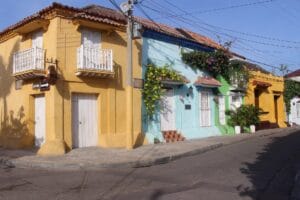
Wander the Ciudad Amurallada’s plazas and churches, walk the city walls at sunset, and explore Getsemaní’s street art and buzzing nightlife.
Day 2 — Islands & beaches
Take a boat to the Rosario Islands or Playa Blanca for clear water, snorkeling and a beach lunch.
Day 3 — Forts & views
Visit the Castillo San Felipe fortress and La Popa monastery for views, relax in Bocagrande, and finish with a cooking class or salsa night.
Where to stay & when to go
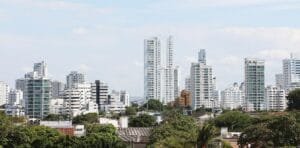
Stay inside the walled city or in Getsemaní for atmosphere; Bocagrande for high-rise beach hotels. The dry season (December–April) is best. Carry cash and use registered taxis or apps.
Cartagena in 3 days: a day-by-day itinerary
Three days suits Cartagena’s walled city and its Caribbean islands:
Day 1 — Walled City
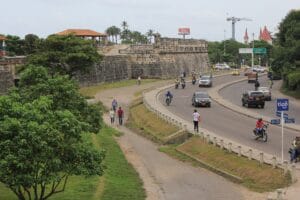
Wander the colourful Old Town and ramparts, the Clock Tower, Plaza Santo Domingo, and sunset drinks at Cafe del Mar on the walls.
Day 2 — Getsemani & fortress
The street art and nightlife of Getsemani, and the hilltop Castillo San Felipe fortress.
Day 3 — Islands
A boat to the Rosario Islands or Playa Blanca for turquoise water and white sand.
Tip: explore the Old Town in the cooler early morning and evening, and negotiate island boat trips the day before.
Cartagena In 3 Days FAQ
Is 3 days enough for Cartagena?
Yes — the walled city and Getsemani in two days, plus an island beach day.
What are the Rosario Islands?
A coral archipelago off Cartagena with clear water and beaches — a popular day trip.
Related travel guides
Which hours of a Cartagena day are usable, and which are not
Put every outdoor stretch before about 10:30 or after about 16:00, and give the middle of the day to something seated, shaded or indoors. That one rule shapes a three-day plan here more than the order of the sights does.
The district’s own environmental authority sets out why. The Observatorio Ambiental de Cartagena de Indias, run by the Establecimiento Público Ambiental (EPA Cartagena), describes the city’s climate regime as tropical semiárido, built from records at the Aeropuerto Internacional Rafael Núñez weather station, the station the Centro de Investigaciones Oceanográficas e Hidrográficas (CIOH) keeps at the Escuela Naval Almirante Padilla, and IDEAM data.
The consequence is the part visitors get wrong. A dry month in Cartagena is dry, not cool. Your dates change how much rain falls and how rough the sea is; they do not buy you a comfortable midday in any month.
Two published times then anchor everything. Fortificaciones Cartagena de Indias opens Castillo de San Felipe de Barajas at 07:00, seven days a week. Parques Nacionales gives boat departures for the Rosario Islands as 08:00 to 10:00. Both are morning commitments, so they cannot share a day.
The workable shape: give the first day to the walled city, which needs no booking and no boat, then order the fort day and the island day by the sea forecast rather than by a fixed plan. Checked 5 September 2026.
How do you spend the walled-city day without crossing it twice in the heat?
Walk the old city in one direction only, and spend the hot middle of the day indoors near the middle of the route. Backtracking is what turns a pleasant morning into an exhausting one.
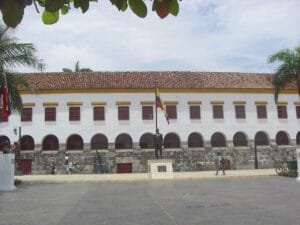
The indoor hour has an obvious candidate. The Museo del Oro Zenú is run by the Banco de la República at Calle 33 # 3-123, on the Plaza de Bolívar in the Centro. The bank’s own page for the museum records a collection of 902 archaeological objects, of which 747 are metal, 105 ceramic, 11 bone, 34 shell and 5 ceramic fragments. It was inaugurated on 27 March 1982 and fully renovated in 2006.
One caution, and it is the kind of thing that wrecks a tight day. The Banco de la República’s museum page does not publish opening days, opening hours or an admission price, so confirm all three on the bank’s own site or by telephone before you build a morning around it. Do not take an opening time from a listing site.
Then the routing. Start at first light while the stone is still cool and the plazas are being swept, work through the quarters in a single loop rather than a figure of eight, and keep the rampart walk for after 16:00, because the walls carry almost no shade and the sea breeze arrives late. Finish in Getsemaní in the evening. In that order you never cross the walled city twice in full sun.
What Castillo de San Felipe de Barajas costs in 2026 and when to arrive
The full adult ticket is 38,000 Colombian pesos, and a Colombian national showing a cédula pays 33,000. Fortificaciones Cartagena de Indias publishes the list as Tarifa Plena 38,000, Tarifa para nacionales 33,000, Tarifa Reducida 16,000, Tarifa Programa Educativo ¡Vive tu Patrimonio! 32,000 and Tarifa Instituciones Educativas oficiales de Colombia 2,000, under Resolución No. 005 of 9 January 2026.
Read the labels carefully, because the discount is not a foreigner surcharge in reverse. The reduced Colombian rate is a document rate: the operator states that you “debe presentar la cédula de ciudadanía Colombiana para acceder a los descuentos otorgados”. Everyone without that document pays the tarifa plena, foreign visitor or not.
The fort is open Monday to Sunday, 07:00 to 18:00. Arriving at opening is not a comfort preference; it is the difference between climbing an exposed ramp in shade and climbing it in full sun. The tunnels are the only part of the site that stays cool, so leave them until last.
Budget for a guide separately if you want one. The operator states plainly that “no se incluye el servicio de guianza y audio guía”, and that guides are hired at the ticket window. Decide before you reach the counter rather than in the queue.
Free entry is published for children under 6, Colombians aged 62 and over, visitors with a disability together with one companion, military reservists and beneficiaries under Ley 1699, and for Colombians on the last Sunday of the month, excluding January and December.
The convent on the hill of La Popa sits on the same side of the city, which is the only reason to pair the two. It is a drive rather than a walk, and it is not one of the sites Fortificaciones Cartagena de Indias prices: that body publishes tariffs for the Castillo, the Murallas de Cartagena and the Fortificaciones de Bocachica. La Popa’s admission is therefore set and collected separately, so ask the price at the gate.
What you must pay and check before a Rosario Islands boat will take you
Two charges sit outside the boat ticket, and neither is set by the boat operator.
The first is the national park entrance right. The islands lie inside Parque Nacional Natural Los Corales del Rosario y de San Bernardo, declared on 6 June 1977 and covering 123,393.67 hectares, with the Rosario sector beginning about 23 km south of Cartagena. Parques Nacionales publishes an entrance right of 11,000 pesos for the San Bernardo sector on the park’s own page. It publishes no Rosario-sector figure in the same place, and entrance rights are set by resolution and updated annually, so confirm the current amount before you travel by writing to ecoturismo.coralesdelrosario@parquesnacionales.gov.co. Treat any figure quoted at the pier as something to check rather than accept. You can pay in person at the muelle turístico La Bodeguita, Avenida Blas de Lezo, opposite the Parque de La Marina, or online through the park’s own payment link at linkdepago.parquesnacionales.gov.co.
The second charge is an accident and assistance insurance, and the official record is not tidy. Parques Nacionales announced in its newsroom on 7 January 2026, and again on 14 June 2026, that under Resolución 273 de 2024 this insurance is compulsory for everyone entering the park from 1 March 2026, naming Positiva Compañía de Seguros with Magenta Seguros, and Aseguradora Zurich with AVIA, as the approved providers. The park’s own visitor page still uses softer wording, telling visitors it “recomendamos adquirir la póliza contra accidentes”. Where the two disagree, buy it: the newsroom statement is the later and stricter position, and arriving without it risks being turned away at the pier.
Parques Nacionales does not publish the premium. It states only that the insurance “es un servicio prestado por las aseguradoras avaladas y su costo no corresponde al valor de ingreso”, meaning you pay the insurer rather than the park and the amount is not part of the entrance right. Ask for the current price at the Bodeguita ticket point or from the approved insurer, and treat it as a third line on the day alongside the boat and the entrance right.
Then the timing. Parques Nacionales gives departures as 08:00 to 10:00 and states that the return is set “según lo establecido por capitanías de puerto y condiciones del mar”. Neither you nor your operator chooses it, so book nothing for that evening. The park also asks visitors to contact it before paying, to check carrying capacity and confirm places, which makes a sold-out day a real outcome in high season.
The park’s published visitor rules are worth reading as practical advice rather than boilerplate: wear the life jacket, check the boat is not carrying more people than it should, do not touch the coral, leave single-use plastics behind, and carry identity documents and valid medical cover.
Getting between the three days: Transcaribe fares and taxis
Transcaribe, the district’s mass transit system, charges a flat 3,900 pesos a trip regardless of distance. Transcaribe states that the fare was fixed by Decreto 017 of 15 January 2026 issued by the Alcaldía de Cartagena and applies from 23 January 2026, replacing the previous 3,400 pesos. An older figure you find quoted is last year’s.
The network runs trunk routes coded T100E, T101, T102 and T103, pretroncal routes X101 to X106, feeder routes in the A101 to A117 series and complementary routes C001, C017 and C018. The useful part for a short visit is the trunk corridor and the feeders reaching the beach strips.
Taxis are a different matter, and this page will not quote you a fare. Cartagena’s taxi tariffs are set by district decree on a cost study by the transit department, the DATT, and the Alcaldía’s own site was not reachable to confirm the current figures, so no minimum fare or night surcharge is stated here. Ask to see the tariff card in the vehicle and agree the fare before you get in, and check the current decree with the DATT or the Alcaldía Mayor de Cartagena if you want the published numbers.
Inside the walls none of this matters. The walled city and Getsemaní are one continuous walk, which is the strongest practical argument for sleeping in either.
Which three days of the year should you pick?
Choose your dates for rain and sea state, not for temperature, because temperature is the thing that barely moves in a tropical semi-arid climate at sea level.
For rain, the reference is IDEAM, the national hydrology and meteorology institute, which publishes monthly climate normals for Cartagena from the Rafael Núñez airport station. The district’s environmental observatory draws on those same records, so the two agree. No monthly figures are quoted here because the IDEAM host refused every automated request, so read the numbers from IDEAM directly rather than from a summary.
For the sea, the relevant authority is the maritime one. The park states that your return time from the Rosario Islands is set by the capitanías de puerto, the port captaincies of DIMAR, together with the state of the sea. That is a decision taken above your operator’s head on the morning itself.
Sea state is what actually reshapes a three-day plan. Rain here tends to arrive as a heavy hour rather than a lost day, and the walled city is walkable straight after it. A rough sea shortens or cancels the island day outright.
So build in a swap. Fix the walled-city day first, look at the marine forecast the evening before, and take the boat on whichever of the remaining days looks calmer. The fort is open daily from 07:00 to 18:00 and needs no reservation, which makes it the flexible half of the pair.
Is a three-day walking itinerary in Cartagena safe?
The UK Foreign, Commonwealth and Development Office does not advise against travel to Cartagena. Its Colombia travel advice, updated 3 September 2026 and checked here on 5 September 2026, advises against all but essential travel to a list of specific areas. The only entry on that list in this department is “the southern part of Bolívar Department”, which is well away from the city. Cartagena appears in no regional restriction.
What the FCDO flags for the city is ordinary crime: “Pickpocketing, mugging and armed robbery are a problem, especially in major cities, including Bogotá, Medellín, Cali and the Caribbean coast.”
It is specific about drug-assisted robbery, which is worth reading before a night out: “Criminals can administer drugs through food, drinks, cigarettes, aerosols and even paper flyers. Victims become disoriented quickly and are vulnerable to robbery, sexual assault, rape and other crimes.” On dating apps: “Criminals use dating applications and websites to identify and lure foreign nationals who are travelling alone and looking to meet local people.”
On transport it advises you to “use licensed telephone or internet-based taxi services whenever possible or book through your hotel”, notes that “well-known taxi companies can be booked via Uber and Cabify”, and states that authorised taxis are yellow with white licence plates and plate numbers on the doors and roof. It also warns that express kidnappers often pose as taxi drivers and select targets from around ATMs, often at night. That fits this plan, because the only stretches you would drive after dark run between the walled city, Getsemaní and the beach strips. Re-check the FCDO page before you travel, since it is revised without notice.
At a glance
| Fixed cost on a three-day plan | Published price (COP) | Set by, and where it is published |
|---|---|---|
| Castillo de San Felipe de Barajas, Tarifa Plena | 38,000 | Resolución No. 005 of 9 Jan 2026, Fortificaciones Cartagena de Indias |
| Castillo de San Felipe de Barajas, Tarifa para nacionales (cédula required) | 33,000 | Same resolution |
| Castillo de San Felipe de Barajas, Tarifa Reducida | 16,000 | Same resolution |
| Castillo de San Felipe de Barajas, guide or audio guide | Not included in any ticket | Fortificaciones Cartagena de Indias; hired at the ticket window |
| Museo del Oro Zenú, Calle 33 # 3-123, Plaza de Bolívar | Not published on the museum’s own page | Banco de la República; confirm admission and hours with the bank |
| Transcaribe, one trip, any distance | 3,900 | Decreto 017 of 15 Jan 2026, applied from 23 Jan 2026 |
| PNN Corales del Rosario, entrance right, San Bernardo sector | 11,000 | Parques Nacionales; no Rosario-sector figure published there, confirm with the park |
| Compulsory park accident and assistance insurance | Not published by the park; paid to the approved insurer | Resolución 273 de 2024; Parques Nacionales states it is compulsory from 1 Mar 2026 |
| Taxi | Not stated here | District decree on a DATT cost study; ask to see the tariff card and agree the fare first |
Frequently asked questions
What time do the Rosario Islands boats leave, and can I choose when to come back?
Parques Nacionales gives departures as 08:00 to 10:00 and states that the return time is set by the port captaincies and the state of the sea. You do not choose it and neither does your operator, so keep that evening free.
Is there anything to pay for the Rosario Islands beyond the boat ticket?
Yes, two things. A national park entrance right, set by resolution and updated annually, which you can pay at the muelle turístico La Bodeguita or through the park’s online payment link; and an accident and assistance insurance which Parques Nacionales says is compulsory from 1 March 2026 under Resolución 273 de 2024, sold by approved insurers and charged separately from the entrance value. The park publishes 11,000 pesos for the San Bernardo sector but no Rosario-sector figure and no insurance premium, so confirm both at ecoturismo.coralesdelrosario@parquesnacionales.gov.co before you travel.
How much is Castillo de San Felipe de Barajas in 2026?
The Tarifa Plena is 38,000 Colombian pesos and the Tarifa para nacionales is 33,000, which requires a Colombian cédula, under Resolución No. 005 of 9 January 2026 from Fortificaciones Cartagena de Indias. It opens 07:00 to 18:00 daily and needs no reservation. No ticket includes a guide or an audio guide; both are hired at the ticket window.
Is three days enough for Cartagena?
Three days covers the walled city, the fort and hill, and one boat day at a pace that respects the heat. It does not cover two separate sea days, so choose between the Rosario Islands and a longer run down to Barú.
Is there a museum inside the walled city worth the hot hour?
The Museo del Oro Zenú, run by the Banco de la República at Calle 33 # 3-123 on the Plaza de Bolívar, holds 902 archaeological objects, 747 of them metalwork. The bank does not publish the museum’s opening days, hours or admission on that page, so confirm all three with the bank before you plan a day around it.
Buses or taxis for three days?
Inside the walls, neither. For anything further, Transcaribe charges a flat 3,900 pesos a trip under Decreto 017 of 2026, applied from 23 January 2026. Taxi tariffs are set by district decree on a DATT cost study; ask to see the tariff card in the vehicle and agree the fare before you set off. After dark the FCDO advises a booked or app-based car rather than a street flag-down.