Quick answer: Three days in Athens covers the Acropolis and ancient sites, the Plaka and Monastiraki, and a sunset day trip — here’s the plan.
Athens’ ancient core is compact and walkable. This 3-day plan balances the must-see ruins with the city’s lively neighbourhoods.
More: When to visit Athens · Athens travel guide
The itinerary, day by day
Day 1 — The Acropolis & Plaka
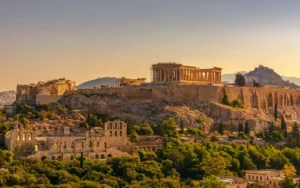
Visit the Acropolis and Parthenon early to beat crowds and heat, then the Acropolis Museum. Wander the Plaka and tiny Anafiotika, and have dinner under the lit-up Acropolis.
Day 2 — Ancient Athens & Monastiraki
Explore the Ancient Agora and Roman Agora, browse Monastiraki’s flea market, catch the changing of the guard at Syntagma, and stroll the National Garden.
Day 3 — Views & a day trip
Climb Lycabettus Hill for the best views, see the National Archaeological Museum and the Panathenaic Stadium, then head to Cape Sounion for sunset at the Temple of Poseidon.
Where to stay & when to go
Stay in Plaka or Monastiraki to walk everywhere, or Koukaki near the Acropolis Museum. Visit in spring or autumn to avoid the summer heat, then pair Athens with the islands.
Athens in 3 days: a day-by-day itinerary
Three days is perfect for Athens’ ancient core plus an escape to the coast:
Day 1 — The Acropolis
The Parthenon and Acropolis at opening, the superb Acropolis Museum, then dinner in Plaka under the lit-up rock.
Day 2 — Ancient & modern
The Ancient Agora, the changing of the guard at Syntagma, the National Archaeological Museum, and lively Monastiraki.
Day 3 — Day trip
The Temple of Poseidon at Cape Sounion for sunset, or a fast ferry to a Saronic island (Hydra, Aegina).
Tip: buy the combined archaeological-sites ticket and start early — Athens gets very hot and crowded by midday.
How should three days in Athens be sequenced on foot?
Shape the three days as three walking zones rather than a checklist of monuments. Day one belongs to the Acropolis rock and the slopes directly below it, day two to the Agora and Kerameikos axis running west of it, and day three to the National Archaeological Museum with a hill at either end. The pedestrianised spine of Dionysiou Areopagitou and Apostolou Pavlou links the first two zones outright, roughly 1.5 km of car-free paving curving from the Arch of Hadrian around the south slope to Thissio, so neither of those days needs transport.
The reasoning shifts with the kind of traveller. Anyone landing late on the first evening should swap days one and two, because the Agora and Kerameikos absorb visitors far better than a single rock reached through two gates. Travellers with young children or limited stamina should treat the south slope as the destination rather than the approach, since the Theatre of Dionysus and the Odeon of Herodes Atticus sit on much gentler ground than the climb to the Propylaea. Photographers often get more out of reversing the standard order and putting Filopappou Hill, at 147 m, on the first evening for a side-on view of the Parthenon before ever standing on it.
Repeat visitors can compress the classical core into two days and give the third to the hills alone, chaining Filopappou, the Pnyx at 97 m and the Areopagus outcrop at 115 m into one loop that barely crosses a road.
Fitting the walking day around Greek meal hours
Build each day around the Athenian eating clock, not around a monument list. Locals sit down to lunch nearer 14:00 than noon and rarely start dinner before about 21:00, so tavernas in Makrigianni, Koukaki and Psyrri are quiet in the early afternoon and full by three, and an early evening table puts a visitor in an empty room. That single fact sets where the long walk falls: mid-morning and again from late afternoon, with the meal in between.
On the rock itself, enter by the main west gate below the Propylaea and leave by the south-east Dionysus Eleuthereus gate. That exit drops walkers straight onto Dionysiou Areopagitou about five minutes from the Acropolis Museum, whereas doubling back to the west gate means climbing the same slope twice. Around 90 minutes above and two hours in the museum fills the morning and lands neatly on the 14:00 lunch. From Monastiraki the following day, Hadrian’s Library, the Ancient Agora and Kerameikos fall in one straight westward line of roughly 15 minutes of walking end to end, with Psyrri immediately north of Monastiraki for the evening and no transport needed at any point.
The northern day works the same way. Victoria on Line 1 stands about seven minutes on foot from the National Archaeological Museum and Omonia, on Lines 1 and 2, about ten, and two to three hours inside is a realistic allowance. Finishing east in Kolonaki lines the evening up with the Lykavittos funicular, which climbs from Aristippou Street through a 210 m tunnel to the 277 m summit in a few minutes, so the view from the top and a 21:00 table are not in competition.
Heat, crowds and the cost of backtracking
The decision that shapes a summer visit is what hour the Acropolis is climbed. July highs average around 32 C and August around 31 C, heatwaves push past 40 C, and there is almost no shade on the summit, so the rock belongs in the first entry slot of the day rather than the middle of it. The hills work the other way round: Filopappou at 147 m, the Pnyx at 97 m and the Areopagus at 115 m are all better late, when the light is side-on and the rock has emptied.
Crowding is uneven across the zones as well as across the day. The Acropolis concentrates visitors on a single fixed route, while the Ancient Agora and Kerameikos spread the same numbers over open ground, which is why the second walking zone stays comfortable at hours when the first does not. Dining follows the same gradient. The lanes immediately outside the Acropolis exits turn over the most visitors and price accordingly, and five to ten minutes further into Koukaki, Pangrati or Psyrri changes both the menu and the bill.
Backtracking costs more time than any queue. Plaka, Monastiraki and Psyrri run into one another on foot, so putting one on day one and another on day three means crossing the same ground twice. Syntagma behaves the same way, sitting between Plaka and Kolonaki, and belongs on whichever day already passes through rather than being given a slot of its own.
| Anchor point | Reaching it on foot | Best slot in the day |
|---|---|---|
| Acropolis Museum | About 5 min from the south-east gate along the promenade | Straight after the rock |
| Areopagus rock (115 m) | A few minutes below the west gate | Late afternoon |
| Ancient Agora | About 12 min via the Thissio promenade | Mid-morning |
| Kerameikos | About 15 min further west along the same spine | Late afternoon |
| Filopappou Hill (147 m) | About 12 min up from the south slope | Sunset |
| Lykavittos (277 m) | Funicular from Aristippou Street, Kolonaki | Sunset onwards |
Athens In 3 Days FAQ
Is 3 days enough for Athens?
Yes — enough for the Acropolis, the major museums and a coastal or island day trip.
What is the must-see in Athens?
The Acropolis and Parthenon, paired with the modern Acropolis Museum below it.