
Colombia travel guide
Colombia travel guide: Cartagena, Medellín, and the wider country
Colombia is South America's most-improved destination of the past decade, Cartagena's Caribbean colonial walled city, Medellín's eternal-spring transformation story, plus coffee country, Tayrona's beaches, and Bogotá. Currency depreciation makes exceptional value.
Destinations we cover in Colombia
Country overview
Colombia spans Caribbean coast, Andean highlands, Amazon basin, and Pacific coast. Most Western travelers get 90 days visa-free. Onward ticket sometimes requested at immigration. Bogotá altitude (2,640m) requires acclimatization.
- Language
- Spanish (Colombian Spanish is considered among the clearest in Latin America). English common in tourism but limited elsewhere.
- Currency
- Colombian Peso (COP). Cash useful; cards accepted in tourist areas.
- Best time to visit
- December-March for Caribbean coast dry season. Medellín year-round 18-24C ('city of eternal spring'). Andean regions and Amazon vary by elevation and season.
- Trip highlights
- Cartagena walled city + Caribbean coast, Medellín transformation story + Comuna 13 + paragliding, Tayrona National Park, coffee country (Salento).
Colombia travel guide
Colombia has emerged as a South American highlight — colonial cities, Caribbean coast, coffee country and eternal-spring weather.
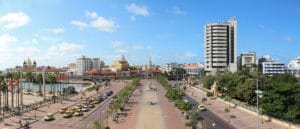
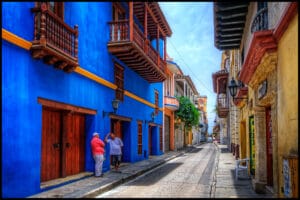
- Cartagena — the walled Caribbean old town.
- Medellin — the transformed "City of Eternal Spring."
- Bogota — the high-altitude capital, museums and street art.
- The Coffee Triangle — green valleys and farm stays.
When to go & tips
Colombia is good year-round; December-March and July-August are driest. Safety has improved hugely, but keep city street-smarts — "no dar papaya" (don't make yourself a target). Carry pesos and use Uber/DiDi at night.
Two weeks covers the cities, the coast and the coffee region.
How should a first trip to Colombia be structured?
Three regions, three to four days each, joined by domestic flights in a single direction is the structure that makes two weeks in Colombia feel unhurried. Bogota and the highlands come first because arriving there deals with the altitude early: the capital sits at about 2,640 m, and most visitors feel nothing worse than a slow first day, which is easier to absorb at the start than mid-trip. Two full days cover the historic centre and a day trip; a third adds a highland town.
Medellin and the coffee region make the middle third. Flying Bogota to Pereira or Armenia takes about 55 minutes to one hour; Salento is then about an hour by taxi from either Pereira or Armenia airport, or up to two hours by public bus with a change in the city, and the wax palms of the Cocora Valley are a 20-to-30-minute jeep ride from Salento's square. Three nights there, then six to eight hours by bus to Medellin for another three nights. Medellin's international airport sits at Rionegro, roughly 40 to 60 minutes from El Poblado off-peak and longer at rush hour, which matters when timing the onward flight.
Cartagena and the Caribbean coast close the trip because heat is a better ending than a beginning, and because Medellin to Cartagena is about one hour 10 by air. Four nights allows a Rosario Islands day and an optional Santa Marta extension four to six hours east by bus. Flying home from Cartagena, or back to Bogota in about one hour 30, keeps the route from ever doubling back.
Getting around Colombia: why flights beat the bus between regions
For any hop between Bogota, Medellin and the coast, fly; the mountains punish road travel between regions far more than the map suggests. Bogota to Medellin is roughly 420 km yet takes nine to eleven and a half hours by bus against about one hour in the air. Medellin to Cartagena is around 13 hours on an overnight coach versus about one hour 10 by plane. Bogota to Cartagena is about one hour 30 by air and has no road option that makes sense on a two-week visit.
Buses still earn their place within a region. Cartagena to Santa Marta is four to six hours along the coast with a stop in Barranquilla, and no airport shortcut saves real time. Salento to Medellin is six to eight hours through coffee country and scenic enough to justify a daytime departure. Inside the coffee region the Willys jeeps that leave from village squares are the local transport, and the 20-to-30-minute run to Cocora is the standard first ride.
Two airport details catch people out. Medellin's main international airport is in Rionegro, 40 to 90 minutes from the city depending on traffic, while a smaller in-city airport serves some regional routes, so check which one a ticket names. And the onward-ticket check at immigration noted above means the return or exit booking should be reachable offline, not buried in an email that needs a signal to open.
When to go, and what a trip realistically costs
Colombia has two dry windows, roughly December to March and July to August, but they behave differently by region, so a two-week route rarely gets uniform weather. The Caribbean coast around Cartagena and Santa Marta is driest from December to March and has a single wet season, roughly May to November, where the interior has two. The Andes, including Bogota and the coffee region, see a clearer dry spell in July and August, while the Amazon is wettest around March. A January trip therefore favours the coast and a July trip favours the highlands, with the coast still workable between showers. October is the wettest month across much of the country, and the coffee region gets some rain in every month, which is why it stays green.
The daily tiers listed on this page cover a bed and meals; the figures here add intercity transport and activities averaged over a two-week trip. A hostel-and-bus traveler who takes two domestic flights, one guided tour and a Cocora day lands at about $35 to $50 a day. A traveler in private rooms with three flights, restaurant dinners and paid tours lands at about $80 to $130 a day. Cartagena is the most expensive major stop, so weighting the budget toward the coast days is more accurate than a flat average. Domestic flights booked a few weeks out are often cheaper than the equivalent overnight bus once a night of accommodation is counted, which tilts the mid-range budget toward flying on every long leg.
| Leg | Flight | Bus |
|---|---|---|
| Bogota to Cartagena | About 1 hour 30 | Not practical on a short trip |
| Bogota to Medellin | About 1 hour | About 9-11.5 hours |
| Medellin to Cartagena | About 1 hour 10 | About 13 hours, mostly overnight |
| Bogota to Pereira (for Salento) | About 55 min-1 hour, then about 1 hour by taxi | About 8-11 hours with a change |
| Salento to Medellin | No direct flight | About 6-8 hours |
| Cartagena to Santa Marta | No sensible flight | About 4-6 hours |
Colombia Travel Guide FAQ
What's the best itinerary for Colombia?
Cartagena, Medellin, Bogota and the Coffee Triangle — about two weeks.
Is Colombia safe to visit?
Much improved and welcoming; stay in good areas, use ride-hailing at night, and keep street-smarts.
Compare Colombia with other destinations
Still deciding where to go? See how Colombia stacks up head-to-head:
Related guides: Cheapest places to travel in Latin America · Colombia vs Costa Rica
Best time to visit Colombia (real climate data)
Best months: January, July, August.
Colombia’s warmest month is August (avg 27°C / 80°F), the coolest is January (low 15°C / 60°F). The wettest is October (267 mm) and the driest is January.
Source: Open-Meteo ERA5 climate normals (2019–2023). See the full month-by-month weather →
You Might Also Love


Before you go: see whether they speak English in Colombia and what to wear, check the tap water, sort your mobile data, and find out if it is a cash or card destination, and brush up on local etiquette.
