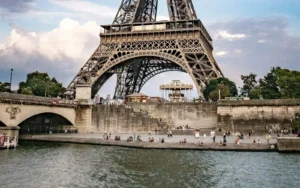
Quick answer: 4–5 days is ideal for Paris — the major museums and monuments, the neighbourhoods, and a day trip to Versailles.
Paris rewards a longer stay. Here’s how much time to give it.
More: When to visit Paris · Paris travel guide
How many days, by trip type
2–3 days
The icons — the Eiffel Tower, the Louvre, Notre-Dame area and Montmartre.
4–5 days (ideal)
Add the Musée d’Orsay, the Marais, more neighbourhoods and a Versailles day trip.
6+ days
Day trips (Giverny, Champagne) and time to live like a Parisian.
The ideal length
Four to five days lets you see the headline sights without rushing and still wander. Book major museums and the Eiffel Tower ahead.
How many days do you need in Paris?
Four to five days is the sweet spot for a first trip to Paris — enough for the icons plus time to linger in cafes and neighborhoods. Three days is a tight highlights-only minimum; a week lets you add day trips and a slower pace.
Suggested plan
- Day 1: Eiffel Tower, Champ de Mars, Seine walk, Trocadéro at sunset.
- Day 2: Louvre, Tuileries, then Île de la Cité (Notre-Dame exterior, Sainte-Chapelle).
- Day 3: Montmartre and Sacré-Cœur, then Marais and a café evening.
- Day 4: Musée d’Orsay, Latin Quarter, Luxembourg Gardens.
- Day 5: Day trip to Versailles (or Giverny).
Paris rewards an unhurried pace — build in café time. Pair with a day trip to Versailles for a fuller visit.
How many days by traveller type, and what moves the answer
Four full days is the right answer for a first trip to Paris, and five nights is what it takes to produce four full days once arrival and departure are subtracted.
The arrival day is the variable. Flights into Orly now connect by Metro line 14, extended to the airport in June 2024, which reaches Chatelet-Les Halles in about 25 minutes, so a morning landing there still yields most of a day. A late arrival or a slow transfer produces an evening and nothing else.
By traveller type:
- First-timer – five nights, four full days. That covers the major museums, two or three neighbourhoods walked properly, and one day outside the city.
- Couples on a short break – three full days. Tight, but workable where the plan is two museums rather than five.
- Art-led travellers – six nights and up. One large collection can absorb a full day, and stacking two into one day buys fatigue rather than coverage.
- Families – five or six nights, with the pace set by the youngest walker. A Disneyland day runs about 40 minutes each way on the RER A from Chatelet, before the park day itself.
- Repeat visitors – three nights, planned one arrondissement per day rather than one landmark per day.
Two days is a stopover rather than a trip, and it only works where the museum choices were made before landing.
What each additional day in Paris buys
An extra day in Paris does not add landmarks so much as remove the need to rush the ones already listed.
- Day one – the central river corridor on foot. Islands, quays and the streets on either side, with nothing that needs booking.
- Day two – the first big museum, taken as a half-day rather than a full one, paired with an afternoon in a single neighbourhood.
- Day three – Montmartre and the northern slopes, or the Marais. This is the day that stops the trip reading as a list of monuments.
- Day four – the day out. Versailles is the default, but Vernon for Giverny is about 46 to 56 minutes from Saint-Lazare, and Chartres a little over an hour from Montparnasse, both far quieter.
- Day five – the second museum, or a return to whichever quarter worked best. Going back to one place is what separates a trip from a checklist.
- Day six and beyond – Reims sits about 46 minutes from Gare de l’Est on the fastest TGV, which puts the champagne country inside day-trip range.
The real gain from day four onward is scheduling slack. Three-day trips break when one queue runs long, because there is nowhere to move the displaced plan. A five-night trip absorbs the same delay and loses nothing.
First-timer mistakes and what to skip
The most common planning error is buying a weekly Navigo pass on the wrong day, since it always runs from Monday at 00:00 to Sunday at 23:59 regardless of when it is bought.
- Mistimed transport passes. A Wednesday-to-Sunday trip gets five days of use out of the seven paid for, and the pass cannot be bought at all after the Thursday of the week it covers. Day tickets suit a trip that does not begin on a Monday.
- Two large museums in one day. Each of the major collections is a half-day at minimum, and the second one gets walked through rather than looked at.
- Using the Metro for short hops. Central Paris is compact and core stations sit only a few hundred metres apart, so a two-stop ride often takes longer than the walk once stairs and interchanges are counted.
- Scheduling the day trip last. A cancelled train on the final full day deletes the excursion outright. Placed mid-trip, it can be moved.
- Booking on price alone at the city edge. Twenty minutes each way, twice a day, across four days, costs more than a full day of the trip.
On a trip shorter than four days, drop the outlying palaces and the observation decks whose queues cost more time than the view returns. High ground in the north of the city gives a comparable panorama without a ticket.
| Full days on the ground | What it realistically covers | Best suited to |
|---|---|---|
| 2 | One major museum and the central river corridor | Stopover, choices made in advance |
| 3 | Two museums plus one neighbourhood on foot | Short breaks and repeat visitors |
| 4 | The above plus a day trip out of the city | Most first-timers |
| 5 | Adds a second neighbourhood and slack in the schedule | Families and slower trips |
| 6 or more | Adds a second excursion and return visits | Art-led and long stays |
How Many Days In Paris FAQ
Is 3 days enough for Paris?
For the icons, yes; four to five is better to enjoy the city without rushing.
How many days for Paris and Versailles?
Five — four for the city plus a Versailles day trip.
Related travel guides
Which day you arrive decides which museums you lose
Paris closes in two halves, and the split catches short trips. The Louvre shuts on Tuesdays. The Musée d’Orsay shuts on Mondays. The Orangerie, home to Monet’s Water Lilies rooms, shuts on Tuesdays with the Louvre. Versailles closes the Palace and the Trianon estate on Mondays, leaving only the gardens. A Monday-to-Wednesday break loses the Orsay and Versailles on the Monday and the Louvre and Orangerie on the Tuesday, so the Wednesday is the only one of the three days with everything open.
| Site | Weekly closing day | Late opening |
|---|---|---|
| Louvre | Tuesday | Wednesday and Friday to 9pm |
| Musée d’Orsay | Monday | Thursday to 9.45pm |
| Musée de l’Orangerie | Tuesday | Friday to 9pm in exhibition periods |
| Palace of Versailles | Monday, gardens still open | None |
| Centre Pompidou | Closed for rebuild to 2030 | None |
The Pompidou removes another option outright: it closed in 2025 for a rebuild running to 2030, with its programme moved out to partner venues.
Late openings buy some of that back. The Louvre runs to 9pm on Wednesdays and Fridays, the Orsay to 9.45pm on Thursdays at a cheaper night rate, the Orangerie to 9pm on Fridays in exhibition periods. Two evening sessions inside three days is close to an extra half day.
A Paris Museum Pass runs as 48, 96 or 144 consecutive hours from first entry, not as days you pick. One started at 3pm on Monday expires at 3pm on Wednesday, and the Tuesday in the middle removes both the Louvre and the Orangerie from it.
Notre-Dame is free, and the booking rules have moved
The cathedral’s ground floor is free to everyone, with no ticket to buy and no authorised reseller, so any site charging for entry is selling what the diocese gives away. The official site offers a free timed slot, but it is optional and only shortens the queue. Book it on the cathedral’s own site, which is the only place authorised to issue one.
Doors run about 7.50am to 7pm Monday to Friday, to 10pm on Thursdays, and 8.15am to 7.30pm at weekends, last entry half an hour before closing. This is a working cathedral, so times move around services and ceremonies and are worth confirming on the day.
The towers are a separate visit run by the Centre des Monuments Nationaux. Entry is €16, covered by the Paris Museum Pass, and sold online only with nothing at the door. Booking a slot is compulsory even for pass holders and for everyone else entitled to free entry. The climb is 424 steps, and last admission is an hour before closing, so treat it as its own slot rather than something squeezed in. Hours run 9am to 11pm from 1 April to 30 September and 9am to 5.30pm from 1 October to 31 March.
Two other rules moved. From 14 January 2026 the Louvre charges €32 for visitors who are neither citizens nor residents of the European Economic Area, against €22 for those who are. It recommends a timed slot even for free entrants, and publishes a running list of which rooms are open, worth checking if you are going for one specific work.
The Orsay began renovating its public areas on 10 March 2026, with work running to summer 2028. Collections stay open and unchanged, but entrances are rerouted, Paris Museum Pass holders must now book a time slot on the Paris Museum Pass website rather than the museum’s own, and you are asked to arrive at least 15 minutes early. Its online rate is €16 against €14 at the door: the extra €2 buys the slot.
Versailles: half day or full day
Half-day Versailles is the State Apartments and a walk in the gardens. The full day adds the Trianon estate and Marie-Antoinette’s hamlet, and the decider is the clock, not your stamina: the Trianon does not open until midday for most of the year, and at 10am only in July and August. A morning visit cannot include it.
The Palace runs 9am to 6.30pm from April to October and 9am to 5.30pm from November to March. The park and gardens open every day, from 7am between 1 April and 31 October and from 8am the rest of the year, and are free except on fountain-show and musical-garden days.
The estate names Tuesdays and weekends as its busiest days and advises arriving at 9am on those. That collides with the museum calendar, because Tuesday is exactly when the Louvre and Orangerie push their visitors out of central Paris. If your dates allow, take Versailles on a Wednesday or Thursday and keep Tuesday for the Orsay.
RER C to Versailles Château Rive Gauche leaves about a 10-minute walk to the Palace, against 18 minutes from Versailles Chantiers and 17 from Versailles Rive Droite.
What the flat fare means for a short stay
The region now sells one metro, train and RER ticket at a single price for the whole of Île-de-France rather than by zone. As of January 2026 that ticket is €2.55, valid everywhere in the region except the airports. Buses and trams have their own €2.05 ticket, and the two are not interchangeable.
The effect is that the long outings got cheap. A Versailles return on singles comes to about €5.10, and the same flat fare covers the RER out to Marne-la-Vallée.
Passes win only above a threshold you can work out beforehand:
- Navigo one-day pass, €12.30. Also excludes the airports, and needs about five metro or RER journeys in a day to beat singles.
- Navigo weekly, €32.40 for all zones at 2026 rates. Roughly thirteen journeys, or two and a half day passes, on top of the Monday-to-Sunday timing problem.
- Airports. A separate Paris Region to Airports ticket costs €14 a trip.
Most visitors make three or four rides a day, so on a trip of three or four days plain singles win.