
Last updated September 11, 2026 · Editorial policy
Key West and Miami sit at opposite ends of one of the most scenic drives in America, about four hours apart on the Overseas Highway, and I get asked about this matchup more than almost any other Florida question. On paper it looks like a simple choice between a big city and a small island town. In practice, they are so different that picking the wrong one can genuinely wreck a trip. Miami is a loud, glamorous, Latin-flavored metropolis with some of the best urban beaches in the country. Key West is a scruffy, sun-bleached island of porches, roosters, and bar stools, where the main event of the day is watching the sun go down.
I have paid for both trips out of my own pocket several times, in high season and low, and the honest answer is that they solve completely different problems. One is a destination you do; the other is a destination you surrender to. Most guides hedge on this pair. I will not. Here is the full breakdown, category by category, with real winners and realistic costs.
| Category | Key West | Miami | Winner |
|---|---|---|---|
| Beaches | Small, rocky, mostly man-made | Wide, white, genuinely world-class | Miami |
| Water activities | Reef snorkeling, sailing, Dry Tortugas | Decent but not the point | Key West |
| Food scene | Great seafood, limited depth | One of the best food cities in the US | Miami |
| Nightlife | Barefoot bar crawls, live music | Superclubs, rooftops, Latin dance floors | Miami |
| Walkability | Entire Old Town on foot or bike | Sprawling, car-dependent | Key West |
| Atmosphere | Quirky, friendly, zero pretension | Energetic, glamorous, image-conscious | Key West |
| Day trips | Dry Tortugas, and that is about it | Everglades, the Keys, Key Biscayne | Miami |
| Value for money | Painfully expensive lodging | Pricey but options at every level | Miami |
Cost comparison
Let me kill a myth early: Key West is not the cheap, laid-back alternative to flashy Miami. It is one of the most expensive small towns in America. It is a four-by-two-mile island with a fixed number of beds and a year-round stream of visitors, and the lodging prices reflect that. In high season, roughly December through April, finding a decent guesthouse room under $250 a night is a genuine achievement, and the charming Old Town inns you see in photos often run $350 to $500. There are no true budget hostels to speak of, and camping options are miles up the Keys.

Realistic daily budgets per person in Key West: a disciplined budget traveler sharing a room can scrape by on $180 to $250 a day. Mid-range, with a nice guesthouse, a snorkel trip, and good dinners, you are looking at $300 to $450. A splurge trip clears $600 without trying. The consolation prizes: you need zero transport budget once you arrive, happy hours are a competitive sport, and the best activity in town, the Mallory Square sunset, is free.
Miami is expensive in a different shape. Rooms span a much wider range: hostels in South Beach run roughly $40 to $80 a night, solid mid-range hotels $150 to $300, and the famous Art Deco and luxury properties far beyond that. The traps are the add-ons: resort fees of $25 to $45 a night, hotel parking that can hit $30 to $50, and beach club cocktails in the $18 to $25 range. But Cuban lunch counters, free beaches, and cheap neighborhoods to stay in mean a budget traveler can do Miami on $120 to $180 a day, with mid-range trips around $250 to $400. On pure flexibility, Miami wins the money category, which is not something I expected to write the first time I priced both.
Beaches: the result nobody expects
Here is the dirty secret the postcards will not tell you: Key West does not really have great beaches. It is a coral rock island, and its beaches are small, mostly man-made, and prone to seaweed. Smathers Beach is long but narrow, with imported sand. Fort Zachary Taylor Historic State Park has the nicest setting and the clearest water, but the entry is rocky enough that water shoes are a sincere recommendation, not a suggestion. If your dream vacation is lying on soft sand for six hours, Key West will quietly disappoint you.

Miami, meanwhile, has the real thing: miles of wide, white, properly maintained sand. South Beach earns the hype, the mid-beach stretches are calmer, and Bill Baggs Cape Florida State Park on Key Biscayne is one of my favorite urban-adjacent beaches anywhere in the US.
But flip the question from lying beside the water to getting in it, and Key West wins decisively. It sits next to the only living coral barrier reef in the continental US, so snorkeling and diving trips leave the harbor every morning. Add sunset sails, backcountry kayaking through mangroves, flats fishing, and the spectacular day trip to Dry Tortugas National Park about 70 miles west, and Key West is the water-sports capital of this matchup. It is the classic island-versus-mainland trade-off, the same tension we wrestled with in our Greece vs Portugal comparison: the island gives you the water, the mainland gives you the sand and everything else.
Food and drink
Miami is simply one of the best eating cities in the United States, and it is not close in this category. The Cuban food alone justifies the trip: ventanita windows serving cortaditos and pastelitos, Versailles in Little Havana doing its institution thing, and croquetas available on practically every block. Then you layer on Haitian, Peruvian, Colombian, Venezuelan, and Argentine kitchens, the stone crab ritual from October to May, and a high-end scene in Wynwood, the Design District, and Coconut Grove that keeps national critics busy. You could eat a different cuisine every night for two weeks and never repeat.

Key West punches far above its weight for a town of about 25,000 people, but it is a different sport. The hits are casual and specific: conch fritters, peel-and-eat shrimp, whatever hogfish or snapper came off the boat that day, a proper Cuban mix sandwich, and the never-ending key lime pie rivalry, which I encourage you to adjudicate personally across at least three bakeries. The misses are real too. Parts of Duval Street serve forgettable tourist food at ambitious prices, and the depth simply is not there for a week of ambitious eating. Verdict: Miami for range and quality, Key West for eating fried seafood with your feet in the sand, which is its own kind of excellence.
Nightlife: velvet rope versus barstool
These two are not even the same species after dark. Miami nightlife is a production: superclubs where the party genuinely runs until sunrise, rooftop bars with skyline views, salsa and reggaeton floors, dress codes, cover charges, and bottle-service math that can quietly double your trip budget. It runs on Latin time, with dinner at ten and dancing at one, the closest thing the US has to the big-city energy we described in our Argentina vs Brazil matchup. When Miami nightlife is good, it is unforgettable. It is also expensive, image-conscious, and occasionally exhausting.

Key West nightlife is a bar crawl in flip-flops. Duval Street stacks live-music bars shoulder to shoulder, Sloppy Joe’s leans into its Hemingway lore, and the Green Parrot remains one of the great scruffy locals’ bars in America. Nobody checks your outfit, cover charges are rare, and the whole show winds down earlier, partly because everyone was drinking at a sunset celebration by 6 p.m. If your ideal night involves a table at a club, choose Miami. If it involves talking to a stranger with a parrot, choose Key West.
Things to do and day trips
Miami wins on sheer volume. Wynwood Walls for street art, Little Havana for an afternoon of coffee and cigars, the Art Deco district for architecture nerds, Vizcaya Museum and Gardens, the Pérez Art Museum, serious shopping, and boat tours of celebrity-lined islands. Then the day trips: Everglades National Park is under an hour away for airboats and alligators, Key Biscayne is twenty minutes, and, in the ultimate flex, the Florida Keys themselves are a day trip if you start early.
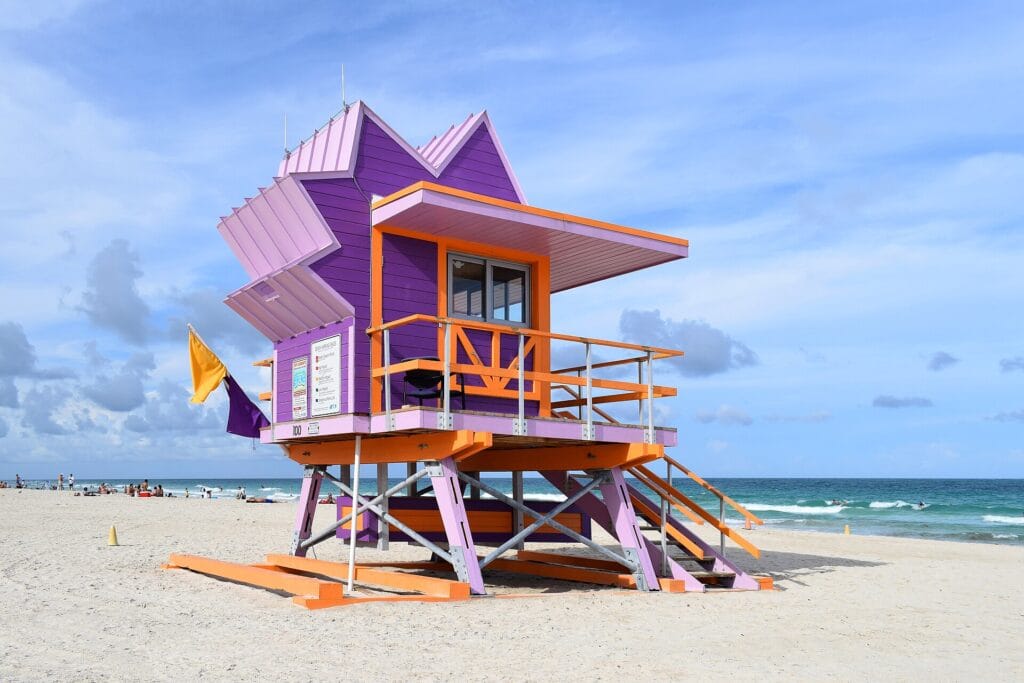
Key West’s sightseeing list is short and charming: the Hemingway Home and its six-toed cats, the Southernmost Point buoy queue, the Truman Little White House, the lighthouse, and the excellent little museums of wrecking and treasure-hunting lore. The one bucket-list day trip, the ferry to Dry Tortugas and Fort Jefferson, books out well ahead, so reserve before you travel. You will exhaust the formal sights in two days, and that is the point. Key West is not a checklist destination; it is a permission slip to stop sightseeing.
Atmosphere and walkability
This is where Key West runs away with it. The entire Old Town is walkable, and a rented bicycle makes the whole island yours. There is no reason to have a car, and every reason not to, since parking is scarce and hotels charge for it. The texture of the place is the attraction: gingerbread Victorian houses, chickens crossing the road with total impunity, porch conversations with strangers, a long-standing live-and-let-live culture that has made the island a beloved LGBTQ destination for decades. Nobody is looking at your outfit. Nobody is in a hurry.

Miami is a real city with real city friction. It sprawls, the traffic is legitimately bad, and its best neighborhoods are far enough apart that you will spend meaningful time and money on rideshares. South Beach is walkable within itself, and there is undeniable electricity to the place: the beautiful crowds, the architecture, the Spanish in the air, the sense that something is happening tonight. But it is a city that performs, and it expects you to perform a little too. It is the same charm-versus-firepower fight we ran into with Croatia vs Portugal, and your answer there probably predicts your answer here.
Weather and when to go
The two share a subtropical climate, so the broad calendar is identical: December through April is dry, sunny, and glorious, with temperatures in the 70s and 80s, and it is also peak pricing everywhere. Summer brings serious heat, soupy humidity, and afternoon thunderstorms, and hurricane season officially runs June through November, with the highest historical risk in late summer and early fall. Travel insurance is worth it for either destination in that window; for low-lying Key West, where a single road is the way out, I would call it essential.
The differences are in the details. Key West is a touch warmer and breezier in winter and rarely sees the cold snaps that occasionally graze Miami. Miami in March means spring break, which transforms South Beach in ways you will either love or flee. Key West’s calendar quirk is Fantasy Fest in late October, a week of costumed mayhem when room rates spike and the island is emphatically adults-only in spirit. My sweet spots for both: late April into May, and the first three weeks of November, when the weather is kind, the crowds have thinned, and prices exhale.
Getting there and around
Miami is easy: MIA is one of the biggest hubs in the hemisphere, and Fort Lauderdale’s airport, about 40 minutes north, frequently undercuts it on fares. Once you land, decide honestly how you will move: a rental car brings parking fees and traffic, so many visitors do fine with rideshares, the free Metromover downtown, and the occasional trolley.
Key West has its own small airport with nonstops from a surprising number of eastern cities, but fares often sting because small island runway economics are what they are. Most travelers fly into Miami and drive the Overseas Highway, three and a half to four and a half hours of bridges and turquoise water that is a legitimate attraction in itself; do it in daylight. There is also the Key West Express ferry from Fort Myers, around three and a half to four hours across open water. Once on the island, walk, bike, or grab a scooter, and skip the rental car entirely if Key West is your only stop.
Key West or Miami: the honest verdict
Budget travelers: Miami. Hostels, free world-class beaches, and $12 Cuban lunch counters give it a real budget floor. Key West’s lodging costs simply do not allow a genuinely cheap trip.
Foodies: Miami, and it is a landslide. Key West does excellent casual seafood, but Miami is a top-five American food city.
Beach lovers: split decision. If the dream is sand, towels, and people-watching, Miami wins outright. If the dream is snorkeling a living reef, sailing at sunset, and being on the water more than beside it, Key West wins just as clearly.
Nightlife: choose your fighter. Clubs, rooftops, and dancing until dawn is Miami. Live music, dive bars, and no dress code is Key West.
Couples and slow travelers: Key West. It is the more romantic, more human-scaled, more memorable place to do very little, beautifully.
First-timers: do both, weighted toward Miami. Fly into Miami, take three or four days for the beaches and food, then drive down for two nights in Key West. This is one of the rare matchups where the combination is genuinely better than either alone, and if you are a chronic destination-agonizer, the kind of reader our Italy vs Spain comparison was written for, the road trip is your loophole: you do not actually have to choose.
FAQ
Is Key West worth the drive from Miami?
Can you do Key West as a day trip from Miami?
Which is cheaper, Key West or Miami?
Does Key West or Miami have better beaches?
Planning the trip? Go deeper with best time to visit Key West Florida and things to do in Miami.
You Might Also Love
More side-by-side comparisons





Written by
John Morrison is the founder and lead travel writer at Packzup. Over the past decade he has explored destinations across Africa, the Americas, Asia, Europe, the Middle East, and Oceania — always self-funded, never on a press trip.
