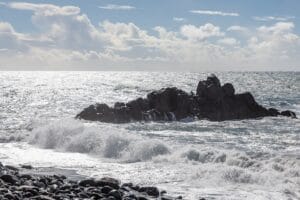
Madeira is an Atlantic island that does not play by the rules of typical beach destinations — it has almost no beaches at all. Instead, it offers the most dramatic hiking in Europe, year-round subtropical temperatures, wine that has been produced since the 15th century, and a volcanic landscape of plunging sea cliffs, laurel forests, and levada irrigation channels that double as 2,500 kilometres of walking trails. The island punches absurdly above its weight for food (espetada beef skewers, scabbardfish with banana, bolo do caco bread), and Funchal’s old town is a compact gem of street art, market stalls, and Madeira wine lodges. It is Portugal’s best-kept secret from its own mainland.
- Hike a Levada Walk
- Watch Sunrise from Pico do Arieiro
- Ride the Monte Toboggan Run
- Explore the Funchal Mercado dos Lavradores
- Stand on the Cabo Girao Glass Skywalk
- Swim in Porto Moniz Natural Volcanic Pools
- Go Whale and Dolphin Watching
- Tour Blandy’s Wine Lodge
- Hike Through the Laurissilva Forest
- Visit the Botanical Garden and Monte Palace
- Eat Espetada and Bolo do Caco
- Drive the Mountain Roads to Curral das Freiras
1. Hike a Levada Walk
Madeira’s network of levadas — centuries-old irrigation channels carved into mountainsides — creates the most unique walking trail system in Europe. The channels follow gentle gradients through laurel forests, along cliff edges, through tunnels, and past waterfalls. The Levada das 25 Fontes (25 Fountains) is the most popular — a 10-kilometre return walk to a waterfall amphitheatre for 5 EUR entry. The Levada do Caldeirão Verde trail passes through tunnels into a fern-draped canyon. Bring a headlamp for the tunnel sections and waterproof layers for the mist.
2. Watch Sunrise from Pico do Arieiro
Madeira’s third-highest peak at 1,818 metres is accessible by car, and watching the sun rise above a sea of clouds from the summit is one of the island’s most powerful experiences. The mountain ridgeline trail to Pico Ruivo (the highest peak at 1,862 metres) is a challenging 7-kilometre trek along exposed ridges with jaw-dropping views on both sides. Start the sunrise drive from Funchal at 4:30 AM. The road is steep and winding but well-paved. Temperatures at the top can be 15 degrees cooler than the coast.
3. Ride the Monte Toboggan Run
Wicker toboggans piloted by two drivers in white uniforms and straw hats careen down 2 kilometres of steep, slippery streets from Monte village to Funchal’s Livramento quarter. The tradition dates to the 1850s and the ride takes about 10 minutes reaching speeds up to 48 km/h on the waxed cobblestones. Tickets are 30 EUR per person for two passengers. Take the cable car up to Monte first (16 EUR return) for aerial views of Funchal. The Botanical Garden at the top is worth a stop.
4. Explore the Funchal Mercado dos Lavradores
Funchal’s two-storey art deco market is a riot of colour and aroma — tropical fruits you have never seen (monstera deliciosa, tamarillo, passion fruit), flower stalls overflowing with bird of paradise and protea, and a fish market in the basement where black scabbardfish and tuna are displayed on marble slabs. Free to enter. Sample the exotic fruits but agree on a price first — the vendors are enthusiastic sellers. Saturday morning is the busiest and most atmospheric.
5. Stand on the Cabo Girao Glass Skywalk
At 580 metres, Cabo Girao is one of the highest sea cliffs in Europe, and the glass-floored skywalk extends out over the edge, letting you look straight down to the ocean and the tiny faja (farming terraces) below. Entry is free. The cable car descending to the faja below costs 5 EUR return and takes you to a tiny beach and banana plantations at the cliff base. The view from the skywalk on a clear day stretches along the entire south coast. Go in the morning before clouds build.
6. Swim in Porto Moniz Natural Volcanic Pools
On Madeira’s northwest coast, natural lava rock pools have been sculpted by the Atlantic into swimming pools filled by the tide — crystal-clear seawater surrounded by black volcanic rock with waves crashing just beyond the walls. The main complex charges 3 EUR entry with changing facilities. The adjoining natural pools are free. Combine with a drive along the north coast road, which winds past waterfalls cascading directly onto the road. Summer weekends are busy; go on a weekday morning.
7. Go Whale and Dolphin Watching
Madeira’s deep offshore waters are a migration highway for sperm whales, fin whales, and over 20 species of dolphins and cetaceans. Boat tours from Funchal marina spot dolphins on nearly every trip and whales on most (April-October is best for sperm whales). Tours cost 35-65 EUR for three hours. Lookouts onshore use binoculars to radio positions to the boats. Sustainable operators limit approach distance. The sight of a sperm whale diving with its tail raised against the mountainous coastline is extraordinary.
8. Tour Blandy’s Wine Lodge
Madeira wine — the fortified wine that has been produced on the island since the 15th century — ages in warm attic conditions rather than cool cellars, giving it a unique caramelised flavour that can last centuries. Blandy’s Wine Lodge in Funchal offers guided tours through the barrel ageing rooms and a tasting of five wines for 25 EUR. The 10-year Malmsey and 20-year Bual are exceptional. Bottles start at 15 EUR at the lodge shop — a fraction of international prices.
9. Hike Through the Laurissilva Forest
Madeira’s laurel forest is a UNESCO World Heritage Site — the largest surviving fragment of a forest type that once covered southern Europe 15 million years ago. The Levada do Furado and Vereda dos Balcoes trails pass through this ancient, moss-draped, mist-shrouded forest. The atmosphere is primeval and the biodiversity includes species found nowhere else on earth. The forest is most atmospheric in light rain or mist. The Fanal area has ancient, twisted til trees that look like something from a fairy tale.
10. Visit the Botanical Garden and Monte Palace
Monte Palace Tropical Garden above Funchal cascades down a hillside with 100,000 plant species from around the world, azulejo tile collections, Japanese gardens, and African sculpture. Entry is 15 EUR. The adjacent Funchal Botanical Garden (6 EUR) offers terraced gardens with views over the city and harbour. Both are accessible by cable car from the city centre. The gardens are at their most dramatic in spring (March-May) when azaleas and camellias are in full bloom.
11. Eat Espetada and Bolo do Caco
Madeira’s signature meal is espetada — chunks of beef seasoned with garlic, bay leaf, and coarse salt, skewered on a laurel wood stick and grilled over open coals. It is served hanging from a hook above the table so the juices drip onto bolo do caco (garlic bread made from sweet potato flour). Restaurante do Forte in Funchal and Santo Antonio in Curral das Freiras serve excellent versions for 14-20 EUR. Always order milho frito (fried cornmeal cubes) as a side.
12. Drive the Mountain Roads to Curral das Freiras
The Nun’s Valley village sits in a volcanic crater surrounded by towering peaks accessible only by a winding road through tunnels and hairpin bends. The viewpoint at Eira do Serrado above the valley offers one of Madeira’s most dramatic panoramas — the village 600 metres below in a natural amphitheatre. The drive from Funchal takes 30 minutes. The village specialises in chestnut-based dishes and liqueurs. The chestnuts festival in November fills the valley with smoke from roasting braziers.
Practical Tips for Madeira
Check our full Madeira travel guide for detailed tips on transport, safety, money, and the best time to visit. For food recommendations beyond this list, see our Madeira food guide.
Frequently Asked Questions
What are the top things to do in Madeira?
The must-do experiences include Hike a Levada Walk, Watch Sunrise from Pico do Arieiro, and Stand on the Cabo Girao Glass Skywalk. Madeira also offers incredible food, vibrant culture, and unforgettable landscapes.
How many days do you need in Madeira?
We recommend at least 4 to 5 days to cover the highlights, though a week or more lets you explore at a relaxed pace and reach more remote areas.
Is Madeira safe for tourists?
Madeira is generally safe for tourists who take normal precautions. Stay aware of your surroundings in crowded areas and keep valuables secure.