
5 days in Kyoto
More: When to visit Kyoto · Kyoto travel guide
5 Days in Kyoto: Beyond the Tourist Trail
Five days lets Kyoto unfold properly, temples at quiet hours, geisha district at dusk, deeper neighborhoods like Demachiyanagi + Fushimi, and time for kaiseki dinner. Here's the route.
Day 1: Eastern Kyoto (Higashiyama)
Morning
Pre-7am Fushimi Inari Shrine: climb to upper torii sections before crowds arrive. Return to Kyoto by 10am.
Afternoon
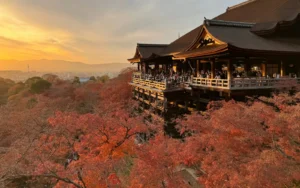
Kiyomizu-dera Temple + Sannenzaka + Ninenzaka cobbled streets. Stop for matcha + traditional sweets.
Evening
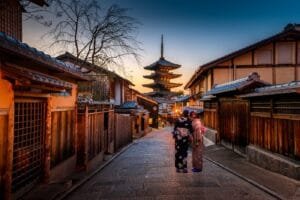
Dusk walk through Gion + Pontocho. Dinner along the Kamogawa river. Kawayuka summer terraces (May-Sep) famous.
Day 2: Western Kyoto (Arashiyama)
Morning
Arashiyama bamboo grove at sunrise. Tenryu-ji Temple gardens (Zen). Hike or rent bicycle through Sagano countryside.
Afternoon
Iwatayama Monkey Park (Kyoto's panorama). Lunch at a Sagano village restaurant. Visit the Adashino Nenbutsu-ji's stone Buddhas.
Evening
Return to central Kyoto. Dinner at Pontocho (lantern-lit alley) or Gion-area kappo restaurant.
Day 3: Northern Kyoto (Kinkaku-ji + Ryoan-ji)
Morning
Kinkaku-ji Golden Pavilion at opening. Walk or bus to Ryoan-ji's famous Zen rock garden.
Afternoon
Ninna-ji Temple + Daitoku-ji's sub-temples (often empty). Tea ceremony at Daitoku-ji's Koto-in or in Gion.
Evening
Dinner at Honke Tagoto soba (Kyoto's oldest, est. 1853) or modern Italian at Salon de Mucha.
Day 4: Day trip to Nara
Morning
45-min train to Nara. Walk through Nara Park (free deer + sika cookies). Todai-ji Temple's Great Buddha.
Afternoon
Lunch at a traditional inn (kakinoha-zushi specialty). Walk to Kasuga Taisha shrine through the lantern-lined approach.
Evening
Return to Kyoto by 6pm. Kaiseki dinner at Hyotei (3 Michelin stars, 400 years old) or Kikunoi. Reserve 2-3 weeks ahead.
Day 5: Philosopher's Path + departure
Morning
Walk Philosopher's Path (1.5km canal-side, cherry trees April or autumn maples November). Ginkaku-ji at the north end.
Afternoon
Nanzen-ji Temple + sub-temple gardens. Late lunch at Tofu Yudofu (Buddhist temple cuisine) at Nanzen-ji.
Evening
Departure or extend with another night. Final dinner at Nishiki Market food alley snacking + sake at Saka Shop Yoramu.
5 days in Kyoto: a day-by-day itinerary
Kyoto rewards a slow pace among its 1,600 temples. A balanced five days:
Day 1 — Higashiyama
Kiyomizu-dera, the lantern-lit lanes of Sannenzaka, and historic Gion at dusk (watch for geiko).
Day 2 — Arashiyama
The bamboo grove early, Tenryu-ji temple, the monkey park, and a riverside lunch.
Day 3 — Fushimi & market
The thousand vermilion torii of Fushimi Inari at sunrise, then graze through Nishiki Market.
Day 4 — Golden Kyoto
Kinkaku-ji (the Golden Pavilion), the Zen rock garden at Ryoan-ji, and Nijo Castle.
Day 5 — Day trip
Nara for bowing deer and the Great Buddha, or Uji for matcha and Byodo-in.
Tip: start temple visits at opening to beat crowds and heat.
5 Days In Kyoto FAQ
Is 5 days enough for Kyoto?
Yes — comfortably covers the major temple districts plus a day trip to Nara or Uji.
What is the must-see in Kyoto?
Fushimi Inari's torii gates, Kinkaku-ji, Arashiyama's bamboo and the Higashiyama district.
The reservation-only Kyoto that only a longer trip opens up
Days four and five are the only ones with room for the places you cannot simply walk into, and there are five of them. Four are run by the Imperial Household Agency and one is a temple that books you in by the pair.
From the Agency's own visitor information page: Katsura Imperial Villa costs 1,000 yen for visitors aged 18 and over, is free for ages 12 to 17, and sets a minimum age of 12. Shugakuin Imperial Villa and Kyoto Sento Imperial Palace are free but admit only visitors aged 18 or over. All three require an advance application, run as guided tours, and close on Mondays, on the Tuesday when a public holiday falls on the Monday, and from 28 December to 4 January. Kyoto Imperial Palace is the one you can add on the day: free, no prior registration, English guided tours at 10:00 and 14:00 lasting about 50 minutes.
The age rules matter more than the prices. Two of the four exclude anyone under 18, so a family with a teenager is choosing between Katsura and the Imperial Palace, not between all four. Katsura is also free for a holder of a disability certificate and one attendant.
Saiho-ji, the moss temple, is the fifth and the most restrictive. Its booking portal states that a reservation must be made at least one day in advance, that a single booking covers a maximum of two people, that groups of three or more need separate bookings, and that parties of more than five are asked to refrain. The visit runs about 60 minutes: sutra copying in the main hall first, garden afterwards. Neither the temple's site nor its booking portal states a fee in text, so confirm it when you reserve.
Slot each one by quadrant, not by mood. Katsura sits out to the south-west, so it belongs with an Arashiyama day rather than with anything in the eastern hills. Shugakuin is in the northern foothills and pairs with the top of the Philosopher's Path and Ginkaku-ji. Sento is central and pairs with Nijo Castle. Get it wrong and a booked morning becomes a lost day, because you can neither move the slot nor arrive late.
Which trips out of Kyoto earn a whole day, and which are half days
Over five days you can afford one full day out and one half day and still keep three and a half days in the city. Two full days out leaves three, which is where the three-day plan started.
Nara is the full-day one, and the operator you pick decides how much of it you spend walking. JR runs to JR Nara, which is a walk west of Nara Park, and is the option a Japan Rail Pass covers. Kintetsu runs to Kintetsu Nara, which sits beside Kofuku-ji at the park edge, and its fastest trains are limited expresses that need a limited express ticket on top of the ordinary fare. Price both on the operators' own fare searches on the day, because the cheaper ticket and the shorter walk are not the same ticket. Todai-ji's Great Buddha Hall opens 7:30 to 17:30 from April to October and 8:00 to 17:00 from November to March, at 800 yen for adults and 400 yen for ages 6 to 12, or 1,200 and 600 for the joint pass with the museum.
Uji is the honest half day, and it has a hard cut-off. Byodo-in's garden runs 8:45 to 17:30 with last entry at 17:15 and the Hoshokan museum 9:00 to 17:00 with last entry at 16:45, at 700 yen for adults, 400 yen for junior and senior high school students and 300 yen for primary school children. The constraint is the Phoenix Hall interior: 9:30 to 16:10, one group every 20 minutes, a maximum of 50 people, a further 300 yen, and tickets sold on the day at the reception inside the garden rather than online. Turn up after three in the afternoon in high season and you will see the hall only from outside.
Kurama and Kibune are the half day the standard day-trip lists leave out, and they are the one trip here with a fare published plainly on the operator's own page. The Eizan Electric Railway runs from Demachiyanagi, on the Keihan Main Line, to Kurama and Kibuneguchi for 470 yen adult and 240 yen child; its Ee Kippu one-day ticket for the whole Eizan network is 1,200 yen for age 12 and over and 600 yen for ages 6 to 11. A Japan Rail Pass is not accepted on Eizan at all. Kurama-dera charges a 500 yen mountain entry fee, set at that level on 1 April 2023, and its cable car takes 200 yen one way for adults and 100 yen for elementary school children and younger. Walk the ridge path from Kurama down to Kibune and you come out at the other station rather than doubling back.
Amanohashidate is the one that eats a day and then some. The Hashidate limited express leaves Kyoto Station and runs over the JR San'in Main Line before continuing on the Kyoto Tango Railway Miyazu Line, so the second half of the route is not JR track and a JR pass will not carry you the whole way. The Kyoto Tango Railway operator sells its own Sea of Kyoto Amanohashidate and Ine Free Pass at 3,550 yen adult and 1,780 yen child for one day, or 4,550 and 2,280 for two, covering its local and rapid trains and non-reserved limited express seats plus the Amanohashidate to Ine buses, the sightseeing boats and the Kasamatsu Park cable car and chairlift. It does not cover JR lines. Confirm the through fare and the reservation requirement with both operators before you set out.
Which day of the week each part of a five-day plan belongs on
Put the day trip on Monday. In a five-day Kyoto week Monday is the day the city closes the things you booked, and every other constraint worth planning around is either a fixed weekday rule or a weekend-only opening.
Monday. All four Imperial Household Agency sites, Kyoto Imperial Palace included, close on Mondays, or on the Tuesday when a public holiday lands on the Monday, and again from 28 December to 4 January. A Monday spent applying for a villa slot is a Monday wasted, so send it out of town to Nara, Uji or Amanohashidate.
Tuesday, if Nijo Castle is on the list. Nijo Castle admits only between 8:45 and 16:00 and clears the site at 17:00, at 800 yen for the castle grounds or 1,300 yen including Ninomaru-goten Palace. The castle's own site closes Ninomaru-goten every Tuesday during January, July, August and December, so in those four months a Tuesday visit buys the 800 yen ticket and not the 1,300 yen one. Honmaru-goten Palace closes the third Monday of each month and the day after.
Saturday, Sunday and public holidays. Tenryu-ji states that its Dharma Hall, the one with the cloud dragon painted on its ceiling, opens on Saturdays, Sundays and holidays only outside its designated spring and autumn periods, at a separate 500 yen. If the dragon is on your list, it is a weekend item.
Operation days, which are not the same as weekends. Kyoto City's Sightseeing Limited Express buses, routes EX100 and EX101, do not run every day. The Transportation Bureau's own page refers to an operation day and weights the service to the morning, with the Kyoto Station to Gojozaka run leaving every seven to eight minutes in the morning on a day it operates. It does not publish the operating days on that page, so check the Bureau's calendar rather than assuming a weekend.
Fixed dates worth checking. Tenryu-ji lists building closures for the afternoon of 1 April, from 12:30, and for 29 and 30 October in 2026, with the Dharma Hall shut on 28, 29 and 30 October and on 2 January 2027. Ginkaku-ji switches to winter hours, 9:00 to 16:30, from 1 December to 28 February, and raised its offering on 1 April 2026 to 1,000 yen for high school age and above and 500 yen for primary and middle school children.
The two that have no schedule at all. Fushimi Inari Taisha publishes no closing time, no admission fee and no route timings on its own site, and the Sagano bamboo path is a public lane with no gate. On a five-day trip they are what you use at 07:00 and at 18:00, and the summit loop above Fushimi Inari is the sort of half morning a three-day plan never finds room for.
Five days of fares: there is no five-day Kyoto pass
Kyoto City sells nothing longer than a single day, so a five-day trip is priced from separate products rather than one ticket. The Transportation Bureau's range is the Subway and Bus 1-Day Pass at 1,100 yen adult and 550 yen child, and a subway-only version at 800 and 400. The 700 yen City Bus day pass that older itineraries still quote stopped being sold on 30 September 2023 and stopped being accepted on 31 March 2024.
Because a flat-fare City Bus ride is 230 yen for adults and 120 for children, the 1,100 yen pass needs a fifth ride in one calendar day to pay. Across five days you will normally clear that on one or two days, not five.
The regional passes are where a five-day trip gets interesting, and where the fine print bites:
- JR-West Kansai Area Pass covers Osaka, Kyoto, Kobe, Nara, Himeji, Wakayama and Otsu on special rapid, rapid and local services, with reserved seats on the Kansai-Airport Express HARUKA up to two times, and excludes the Shinkansen. It costs 2,800 yen for one day, 4,800 for two, 5,800 for three and 7,000 for four, children at half, and stops at four days, so a five-day trip buys the four-day version and pays cash on the fifth. Like the WIDE pass it requires a passport issued by a foreign government and Temporary Visitor entry status.
- JR-West Kansai WIDE Area Pass is five consecutive days at 12,000 yen adult and 6,000 yen for ages 6 to 11, valid to 24:00 on the last day, and it is the only one of these that includes reserved seats on the Sanyo Shinkansen between Shin-Osaka and Okayama. It also needs a foreign passport and Temporary Visitor status, and only pays if you are heading well beyond Kyoto. It does not list the Kyoto Tango Railway among its covered operators, so it will not solve Amanohashidate on its own.
- Kintetsu Rail Pass 5day is 4,900 yen adult and 2,450 yen child for five consecutive days from first use, on all Kintetsu lines plus the Iga Tetsudo line, across Osaka, Nara, Kyoto, Nagoya and Mie. Kintetsu is blunt about the catch: KINTETSU RAIL PASS alone does not allow you to board Limited Express trains. To board a Limited Express train, please additionally purchase a Limited Express ticket. On the Kyoto to Nara run that means buying a second ticket for the fast train.
- Kansai Railway Pass Lite, sold by Surutto Kansai at 5,200 yen for two days and 6,500 for three, is the one to think hardest about, and it is time-limited. Its own page puts the sales period at 25 March to 30 September 2026, with the pass valid three months from purchase but requiring activation by 30 September 2026, so it is no help for a trip later in the year. It also states that it does not cover JR, the Kyoto City Subway, the Keihan Keishin and Ishiyama-sakamoto lines, the Randen or buses. Inside Kyoto that leaves very little.
For a Kyoto-based five days the arithmetic usually lands in the same place: an IC card for everything, one or two Subway and Bus 1-Day Passes on the bus-heavy days, and point-to-point tickets for the trips out. Regional passes start paying only when you leave the prefecture more than once.
Budget the bed tax separately. Since 1 March 2026 Kyoto has charged an accommodation tax of 200 to 10,000 yen per person per night in five bands, read from the room-only charge with meals and consumption tax excluded, and set by the night you stay rather than the day you booked. Four nights at 25,000 yen a head is 1,000 yen a night, so 4,000 yen per person on top of the room, collected at the property.
Fares and pass prices in Kansai change with the timetable revisions and with each sales period. Every figure here was checked on the operator's own page on 5 September 2026, and each should be re-checked there before you buy.
At a glance
| Trip from Kyoto | Operator and line | Fare published on the operator's own page | What you pay at the other end | Realistic unit |
|---|---|---|---|---|
| Fushimi Inari | JR Nara Line to JR Inari | Not published as a fixed figure; price it on JR-West's fare search | Nothing. The shrine publishes neither a fee nor a closing time | One hour to the first gates, a morning for the summit loop |
| Uji and Byodo-in | JR Nara Line | Not published as a fixed figure; price it on JR-West's fare search | Byodo-in garden and museum 700 yen adult, 400 junior and senior high, 300 primary; Phoenix Hall interior a further 300 yen, 9:30 to 16:10 only | Half day, arriving well before the 16:10 Phoenix Hall cut-off |
| Nara via JR | JR Nara Line to JR Nara | Not published as a fixed figure; Japan Rail Pass valid | Todai-ji Great Buddha Hall 800 yen adult, 400 for ages 6 to 12; joint pass with the museum 1,200 and 600 | Full day; JR Nara is a walk from the park |
| Nara via Kintetsu | Kintetsu Kyoto Line to Kintetsu Nara | Not published as a fixed figure; a Limited Express ticket is charged on top of the fare | Same Todai-ji prices | Full day; Kintetsu Nara is at the park edge |
| Kurama and Kibune | Eizan Electric Railway from Demachiyanagi | 470 yen adult, 240 yen child; Ee Kippu one-day 1,200 yen (age 12 and over) and 600 yen (ages 6 to 11); no Japan Rail Pass | Kurama-dera mountain entry 500 yen; cable car 200 yen one way adult, 100 yen elementary and younger | Half to full day including the ridge walk |
| Amanohashidate | JR Hashidate limited express, JR San'in Main Line then Kyoto Tango Railway Miyazu Line | No single through fare published by either operator; Kyoto Tango Railway's own pass is 3,550 yen adult and 1,780 yen child for one day, 4,550 and 2,280 for two | That pass covers the Ine buses, the sightseeing boats and the Kasamatsu cable car and chairlift, but no JR line | A long full day |
Frequently asked questions
Is there a five-day Kyoto transport pass?
No. The Kyoto City Transportation Bureau sells single-day tickets only: the Subway and Bus 1-Day Pass at 1,100 yen adult and 550 yen child, and a subway-only version at 800 and 400. There is no two-day or five-day municipal option. The five-day products that do exist are regional rather than city ones: the Kintetsu Rail Pass 5day at 4,900 yen adult and 2,450 yen child, which does not let you board a Limited Express without buying a separate Limited Express ticket, and the JR-West Kansai WIDE Area Pass at 12,000 yen adult and 6,000 yen child, which is restricted to foreign passport holders entering on Temporary Visitor status.
Do I have to book Katsura Imperial Villa before I travel?
Yes. The Imperial Household Agency requires an advance application for Katsura Imperial Villa, Shugakuin Imperial Villa and Kyoto Sento Imperial Palace. Katsura costs 1,000 yen for visitors aged 18 and over, is free for ages 12 to 17 and has a minimum age of 12; Shugakuin and Sento are free but admit only over-18s. All close on Mondays, on the Tuesday after a Monday public holiday, and from 28 December to 4 January. Kyoto Imperial Palace is the only one of the four with no prior registration, and it runs English guided tours at 10:00 and 14:00 lasting about 50 minutes.
Can you visit Amanohashidate as a day trip from Kyoto?
Yes, but it is the longest day on the list and it involves two operators. The Hashidate limited express leaves Kyoto Station on the JR San'in Main Line and finishes on the Kyoto Tango Railway Miyazu Line, so a JR pass does not cover the whole route, and the JR-West Kansai WIDE Area Pass does not list the Kyoto Tango Railway among its operators. The Kyoto Tango Railway sells its own Sea of Kyoto Amanohashidate and Ine Free Pass at 3,550 yen adult and 1,780 yen child for one day, or 4,550 and 2,280 for two, which also covers the Ine buses, the sightseeing boats and the Kasamatsu Park cable car and chairlift, but no JR line. Check the through fare and whether your train needs a seat reservation before you set out.
Which day of the week should the day trip fall on?
Monday. All four Imperial Household Agency sites in Kyoto close on Mondays, or on the Tuesday when a public holiday falls on the Monday, which makes Monday the cheapest day to be out of the city. Keep a weekend free for Tenryu-ji's Dharma Hall, which the temple opens on Saturdays, Sundays and holidays only outside its designated spring and autumn periods. And if you want Nijo Castle's Ninomaru-goten Palace, avoid Tuesdays in January, July, August and December, when the castle's own site closes it. The Sightseeing Limited Express buses run on designated operation days rather than daily, and the Transportation Bureau does not publish those days on its service page, so check its calendar rather than assuming a weekend.
Is the Kansai Railway Pass Lite worth buying for a Kyoto trip?
Rarely, if Kyoto is your base, and only inside its sales window. Surutto Kansai prices it at 5,200 yen for two days and 6,500 for three, sells it from 25 March to 30 September 2026 and requires activation by 30 September 2026, so it is no use for a trip later in the year. Its own page also states that it does not cover JR, the Kyoto City Subway, the Keihan Keishin and Ishiyama-sakamoto lines, the Randen or buses. Inside Kyoto that rules out the subway, the city buses and the JR Nara and Sagano lines, which is most of how you move around. It earns its price on Osaka and Kobe private railways, not here.
How late can you get inside the Phoenix Hall at Byodo-in?
The last interior group goes in at 16:10, and that is the figure that decides an Uji half day. Byodo-in admits one group every 20 minutes to a maximum of 50 people, charges a further 300 yen on top of the 700 yen garden and museum ticket, and sells those interior tickets on the day at the reception inside the garden rather than online. The garden itself runs 8:45 to 17:30 with last entry at 17:15 and the Hoshokan museum 9:00 to 17:00 with last entry at 16:45, so arriving late still buys you the grounds and the museum, just not the hall.
You Might Also Love
Trip prep: before you travel, plan what to wear, check the tap water, sort your mobile data, and see if it is a cash or card country, and skim local etiquette.
