Things to do
More: When to visit Kyoto · Kyoto travel guide
The 12 things to do in Kyoto
Kyoto is Japan's spiritual and cultural capital - 17 UNESCO World Heritage sites in one city, plus the country's most concentrated traditional crafts, food, and gardens. These 12 things define a 3-5 day Kyoto trip.
Fushimi Inari Shrine at sunrise
10,000 vermillion torii gates ascending the sacred Mount Inari. The lower gates are touristy; the upper sections (above the Yotsutsuji intersection) become almost solitary.
- Why do it
- Visually unlike anywhere else in Japan. The full hike (2.5 hours round trip) takes you above the city for excellent views.
- How long
- 2-4 hours
- What it costs
- Free (open 24/7)
- When to go
- Pre-7am for crowd-free torii tunnels and morning light. Most tour buses arrive 10am-3pm.
Kinkaku-ji (Golden Pavilion)
Three-story pavilion covered in gold leaf, reflected in a mirror pond. One of Kyoto's most photographed sites.
- Why do it
- Quintessential Japanese garden aesthetic. The reflection makes the photo; this is the postcard view of Kyoto.
- How long
- 1 hour
- What it costs
- 500 yen (~$3.50)
- When to go
- Pre-10am or last 30 min before close (5pm). Winter snow days are mythical.
Arashiyama Bamboo Grove + Tenryu-ji
Atmospheric bamboo forest path leading to Tenryu-ji Zen temple with its 14th-century Sogenchi garden. The Monkey Park (Iwatayama) is a steep but rewarding extension.
- Why do it
- The bamboo grove is the icon; Tenryu-ji's garden is the substance.
- How long
- Half day
- What it costs
- Tenryu-ji 500 yen; Monkey Park 600 yen
- When to go
- Pre-8am for crowd-free bamboo grove photos. Late afternoon for cooler light.
Gion district walk at dusk
Kyoto's most famous geisha district. Wooden machiya townhouses, ochaya teahouses, lantern-lit alleys. Walk from Yasaka Shrine down to Pontocho.
- Why do it
- Best for sense of atmospheric historical Kyoto. Highest chance of seeing a real geisha or maiko (always at dusk, walking to evening appointments).
- How long
- 2 hours
- What it costs
- Free
- When to go
- 5-7pm, especially Hanami-koji street. Don't photograph geisha without permission - it's increasingly fined.
Kiyomizu-dera Temple
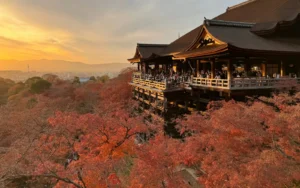
Wooden stage temple perched on a hillside above Kyoto. Built in 778, the current structure is from 1633. Sannenzaka and Ninenzaka approach streets are themselves historic.
- Why do it
- The dramatic wooden architecture and panoramic Kyoto view. Especially striking during cherry blossom (early April) and autumn foliage (mid-November).
Nishiki Market
Five-block covered market called 'Kyoto's kitchen' - 100+ stalls selling Kyoto specialties (yuba tofu skin, Kyoto pickles, Kyo-yaki ceramics, fresh seafood).
- Why do it
- Best food market in Japan after Tsukiji. Less overwhelming than Tokyo's options and uniquely Kyoto-flavored.
- How long
- 1.5-2 hours
- What it costs
- Free to walk; snacks 100-500 yen each
- When to go
- Late morning to early afternoon for full activity. Closed Wednesdays for some stalls.
Kaiseki dinner at a real ryotei
Multi-course traditional Japanese dinner. Each dish presented sequentially with attention to seasonal ingredients and visual composition. Hyotei (400 years old), Kikunoi, and Wakuden are the iconic spots.
- Why do it
- Kyoto invented this cuisine. Best in Kyoto means best in the world.
- How long
- 2-3 hours
- What it costs
- 20,000-40,000 yen (~$140-280) per person
- When to go
- Reserve weeks ahead through your hotel concierge.
Philosopher's Path walk
1.5km canal-side stone path lined with cherry trees, connecting Ginkaku-ji (Silver Pavilion) at one end to Nanzen-ji at the other.
- Why do it
- The walk is genuinely peaceful (named after a 20th-century philosopher who used it daily). Best in cherry blossom or autumn.
- How long
- 1.5-3 hours including temple stops
- What it costs
- Free; temple entries 500 yen each
- When to go
- Morning. Cherry blossom (late March-early April) is iconic; autumn (November) is equally beautiful with fewer crowds.
Tea ceremony
Formal Japanese tea ceremony. Camellia Tea Ceremony, En Tea Ceremony, and various ryokan options offer authentic experiences in English.
- Why do it
- Kyoto is where this art form was refined. A 45-minute introduction is enough to understand the ritual.
- How long
- 45 min - 2 hours depending on format
- What it costs
- 2,000-6,000 yen (~$14-42)
- When to go
- Reserve ahead. Camellia has multiple daily sessions.
Ginkaku-ji (Silver Pavilion) + Zen rock garden
Restrained counterpoint to the Golden Pavilion - never actually silvered, but features one of Japan's most refined dry-stone Zen gardens.
- Why do it
- Where Japanese aesthetic restraint is most concentrated. The 'silver sand' garden (kogetsudai) is the architectural centerpiece.
- How long
- 1 hour
- What it costs
- 500 yen (~$3.50)
- When to go
- Pre-10am. Combine with the Philosopher's Path walk.
Day trip to Nara
45 minutes by train. Japan's first permanent capital (710), with the Great Buddha at Todai-ji and 1,200 free-roaming sacred deer in Nara Park.
- Why do it
- The temple architecture is older and more concentrated than anything in Kyoto. The deer make it kid-magic.
- How long
- Full day
- What it costs
- Train round-trip ~1,400 yen; Todai-ji 600 yen
- When to go
- Pre-9am train. Wear long pants - the deer can be nippy.
Pontocho dinner
Narrow lantern-lit alley along the Kamogawa river, lined with restaurants from cheap yakitori to high-end kaiseki. Outdoor riverside terraces (kawayuka) in summer.
- Why do it
- Most atmospheric dinner street in Kyoto. The river-side seating in summer (May-September) is iconic.
- How long
- 2-3 hours
- What it costs
- 3,000-15,000 yen depending on restaurant
- When to go
- Dinner from 6pm. Reserve ahead for kawayuka terraces in summer.
Loved the temples? Best Buddhist Temples in Asia
More guides: Kyoto vs Osaka