
Last updated September 12, 2026 · Editorial policy
I get asked this one more than almost any other Italy question, and I understand why. The Amalfi Coast and Cinque Terre look nearly identical in photos: pastel villages stacked on cliffs, turquoise water, laundry strung between shutters, a boat bobbing somewhere in the frame. Most travelers have time and money for exactly one of them, and the fear of picking the wrong cliff-village coastline is real. I’ve done both more than once, in different seasons, and the honest news is that they are far more different than Instagram suggests.
The short version: the Amalfi Coast is bigger, more glamorous, more expensive, and more of a production to get around. Cinque Terre is smaller, simpler, cheaper, and built for people who want to hike between villages and eat pesto with sea views rather than dress up for dinner. Neither is a secret anymore, and both get genuinely uncomfortable in August. Here’s the full breakdown so you can pick the right one for the trip you’re actually planning.
| Category | Amalfi Coast | Cinque Terre | Winner |
|---|---|---|---|
| Scenery | Grand, cinematic, vertical drama | Intimate, colorful, postcard-compact | Amalfi Coast |
| Beaches | Proper beach towns, ferries, lidos | One real sandy beach, mostly rocks | Amalfi Coast |
| Hiking | Path of the Gods plus scattered trails | Village-to-village trail network | Cinque Terre |
| Food & wine | Seafood, lemons, Campania depth | Pesto, anchovies, crisp Ligurian whites | Amalfi Coast |
| Towns & atmosphere | Glamour with tour-bus traffic | Fishing-village charm, tiny scale | Cinque Terre |
| Crowds | Bad in summer, but more room to escape | Midday crush in very small villages | Amalfi Coast |
| Getting around | Buses and ferries on a jammed road | A local train every few minutes | Cinque Terre |
| Value for money | Premium prices for almost everything | Expensive but noticeably gentler | Cinque Terre |
Cost comparison
Let’s kill the suspense: the Amalfi Coast is one of the most expensive places in Italy, and Positano specifically will make Rome look cheap. In summer, a decent double in Positano commonly runs $350–600 a night, and even Praiano or Maiori — the “budget” ends of the coast — rarely dip below $150 in season. A realistic mid-range day on the Amalfi Coast, per person with shared lodging, lands around $250–400 once you add a lido chair, a seafood lunch, ferry hops, and dinner. Determined budget travelers staying in Salerno or Atrani and self-catering can scrape by on $130–180 a day, but it takes discipline.
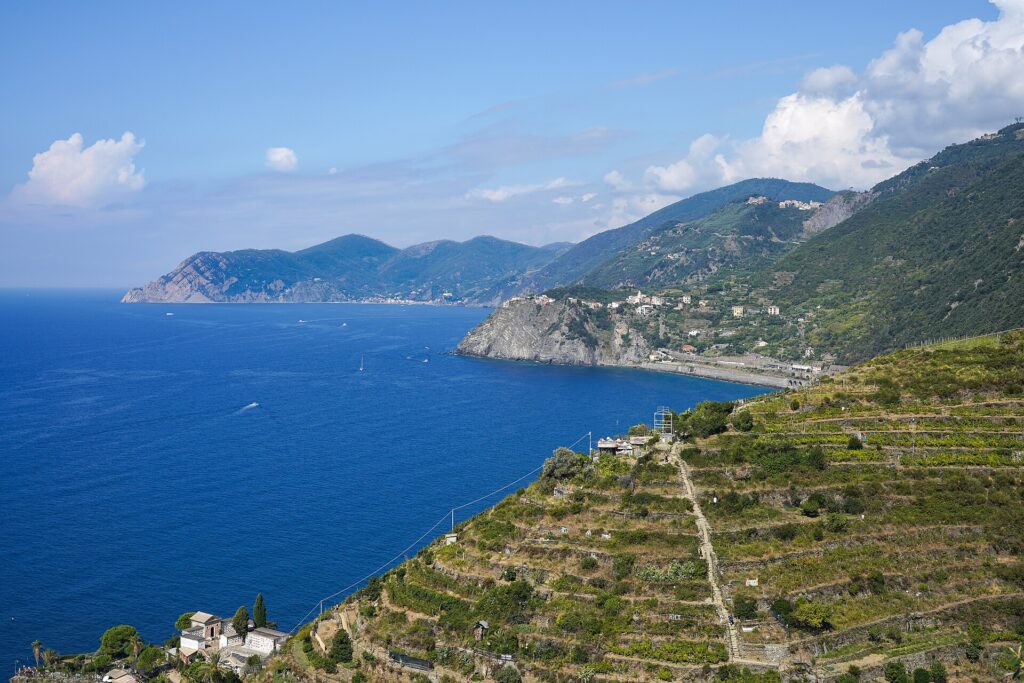
Cinque Terre is not cheap either — nowhere this photogenic in Italy is — but the ceiling is much lower. Simple guesthouse rooms and apartments in the five villages generally run $120–250 in summer, and staying in La Spezia (ten minutes away by train) can cut that in half. A comfortable mid-range day is more like $180–280 per person, and a genuine budget day of $110–160 is achievable without suffering: trail pass, train hops, focaccia lunch, trofie al pesto for dinner. If cost is the deciding factor and you’re flexible on the country entirely, our Croatia vs Portugal comparison covers two coastlines that deliver similar drama for meaningfully less money.
Scenery and the towns themselves
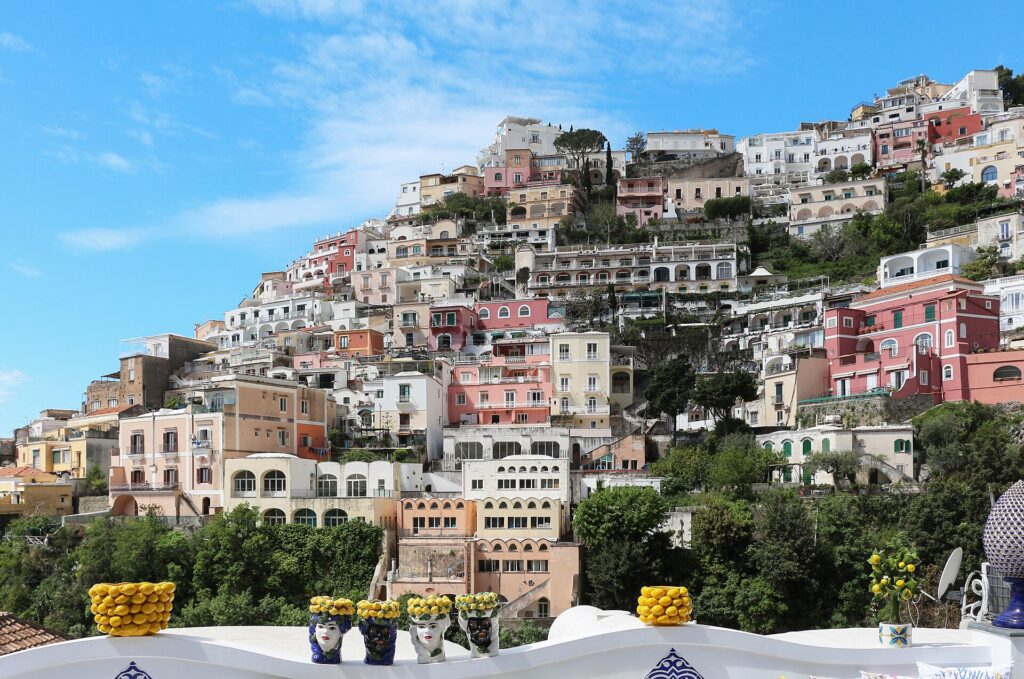
This is where the two coastlines genuinely diverge. The Amalfi Coast is operatic. The cliffs are taller, the villages are bigger and more ornate, and towns like Ravello sit hundreds of meters above the sea with gardens and villa terraces that feel engineered for a film set. Positano cascading down its ravine at golden hour is one of the great sights in Europe, full stop. There’s also more variety: Amalfi town has a genuine cathedral and maritime history, Ravello has a highbrow music-festival elegance, and Atrani and Minori still feel like places where Italians actually live.
Cinque Terre plays a different game. The five villages — Monterosso, Vernazza, Corniglia, Manarola, and Riomaggiore — are tiny, and their beauty is about compactness: a huddle of ochre and pink houses wrapped around a miniature harbor, vineyard terraces stitched into the hills above. Vernazza’s harbor and Manarola viewed from the trail at dusk are as beautiful as anything on the Amalfi Coast, just at a fraction of the scale. You can walk end-to-end through any village in ten minutes. If you want grandeur, Amalfi wins. If you want the fishing-village postcard you’ve been picturing, Cinque Terre is closer to it.
Beaches
Neither coastline is a beach destination in the Caribbean sense — this is dramatic, rocky, deep-water Mediterranean coast — but the Amalfi Coast is clearly better if swimming and lounging matter to you. Positano’s main beach and the smaller Fornillo are pebbly but properly set up with lidos, Maiori has the longest stretch of beach on the coast, and Atrani has a compact, more local strip. Add the ferry network and you can also reach beach spots along the coast or day-trip to Capri’s swimming coves. You’ll pay for chairs and umbrellas almost everywhere, and the free sections fill by mid-morning in July and August.
Cinque Terre has exactly one conventional beach: the sandy-and-shingle stretch at Monterosso, which is lovely and gets absolutely packed in summer. Everywhere else, swimming means ladders off rocks, tiny pebble coves, or leaping off the breakwater with local teenagers — which, honestly, is half the charm. If your dream trip is beach-first with Mediterranean islands in the mix, you might be better served comparing Greece vs Portugal instead, because neither of these Italian coastlines is truly built around sand.
Hiking
Cinque Terre wins this category, and it isn’t close. The villages are linked by a network of trails through terraced vineyards and olive groves, with the coastal Sentiero Azzurro as the headline act — you can genuinely structure your whole visit as a village-to-village walk, stopping for focaccia and swims along the way. Trail sections do close periodically for landslide repairs (this coast is geologically busy), so check current conditions when you arrive, and expect to buy a trail card in season for the most popular coastal stretches. The higher inland trails are free, harder, and dramatically quieter.
The Amalfi Coast has one world-class walk — the Path of the Gods, running high above the coast toward Positano — plus a web of old mule paths and staircases connecting towns to hamlets above. The Path of the Gods deserves its reputation, but hiking on the Amalfi Coast is a day activity you plan, not the connective tissue of the trip. You’ll ride a bus back rather than strolling into the next village for dinner. Hikers who want boots on trail every single day should choose Cinque Terre without hesitation.
Food and wine
Both coastlines eat extremely well, but they’re totally different cuisines and it’s worth knowing what you’re signing up for. The Amalfi Coast is Campania: spaghetti with clams, grilled whole fish, mozzarella that ruins you for supermarket cheese forever, lemons the size of your fist turned into everything from pasta to limoncello, and Naples-grade pizza a ferry ride away. The high end is higher too — this coast has serious fine dining if you want a blowout meal. Expect to pay for it: seafood pasta in Positano commonly runs $22–35.
Cinque Terre is Liguria, which means this is the homeland of pesto — trofie al pesto here is a different food from anything you’ve had abroad — plus anchovies from Monterosso served fresh, fried, or marinated, farinata chickpea pancakes, and some of Italy’s best focaccia eaten standing up on a harbor wall. The local white wines grown on those terraces are crisp, saline, and made in tiny quantities. It’s simpler food at simpler prices, and it’s wonderful, but Campania’s bench is deeper. If food is the main reason you travel to Europe at all, our France vs Italy comparison digs into that decision at the country level.
Crowds and day-trippers
Here’s the honest part nobody’s tourism board wants written down: both places are heavily overtouristed in peak season, and you should plan around it rather than pretend otherwise. Cinque Terre’s problem is acute because the villages are so small. When cruise excursions and day-trippers from Florence funnel in between about 10am and 5pm in summer, Vernazza’s single main street becomes a slow-moving queue. The fix is simple and it works: sleep in the villages, do your walking and swimming before 10 and after 5, and you’ll get the magic hours almost to yourself.
The Amalfi Coast’s crowds express themselves differently — as traffic. The single coastal road backs up for hours in summer, tour buses inch past each other at pinch points, and a “quick” bus ride from Sorrento to Positano can take double the scheduled time. But the coast is much bigger, so escape valves exist: Ravello stays calmer than Positano, Minori and Maiori calmer still, and ferries skip the road entirely. On balance I’d rather manage Amalfi’s crowds than Cinque Terre’s midday crush, which is why it takes the table row — but shoulder season transforms both.
Day trips and the bigger trip around it
The Amalfi Coast is the better base for a longer southern-Italy trip. Capri is a short ferry hop, Pompeii and Vesuvius are day-trip distance, Naples is one of Europe’s great underrated food cities, and Paestum’s Greek temples sit just down the coast. You could anchor ten days here without repeating yourself. Cinque Terre’s neighborhood is quieter but still good: Portovenere (arguably as beautiful as the five villages themselves) is a short boat or bus ride away, and Pisa, Lucca, and even Florence are realistic train day-trips. The difference is that Cinque Terre slots neatly into a classic Rome–Florence–Venice itinerary as a two-to-three-night interlude, while the Amalfi Coast pulls your whole trip south. If you’re still assembling the country list itself, Italy vs Spain is the comparison to read before this one.
Weather & when to go
Both coastlines run on the same Mediterranean calendar. May, June, and September are the sweet spots: warm sea, long days, functioning trails, and crowds a notch below the July–August peak. High summer is hot — expect highs around 85–90°F (29–32°C) — which matters more in Cinque Terre because hiking exposed cliffside trails at 2pm in August is genuinely punishing. April and October are gambles that often pay off: quieter, cheaper, mostly sunny, but with real rain risk, and autumn storms occasionally close Cinque Terre trails outright.
Winter is where they differ. Much of the Amalfi Coast effectively hibernates from November through March — many hotels and restaurants in Positano simply close — while Cinque Terre stays marginally more alive because the villages are real year-round communities with train service, though plenty of businesses still shutter. My honest recommendation for either: late May or the second half of September. You give up nothing that matters and gain back most of your sanity.
Getting there & around
This category decides more trips than people admit. Cinque Terre is logistically easy: fly into Pisa or Genoa (or arrive by train from Florence or Milan), connect to La Spezia, and from there a local train reaches all five villages, running frequently in season with hops of just a few minutes between stops. Cars are worse than useless — parking is scarce to nonexistent and village centers are closed to traffic — so you simply don’t bring one. Seasonal ferries link four of the five villages (Corniglia sits too high) and make a gorgeous alternative to the train.
The Amalfi Coast is a commitment. There’s no train on the coast itself: you fly into Naples, then take a train toward Sorrento or Salerno, then finish by SITA bus, ferry, or private transfer along the famous — and famously jammed — coastal road. The buses are cheap and scenic but packed in summer, with luggage an outright hassle; ferries between the main towns are the civilized option from roughly April to October. Renting a car is something I’d talk almost everyone out of: the driving is white-knuckle, and parking runs brutally expensive where it exists at all. Budget half a travel day to get in and half a day to get out, and you’ll be planning realistically.
Amalfi Coast or Cinque Terre: the honest verdict
Budget travelers: Cinque Terre. Lower room rates, cheaper food, one train ticket instead of a chain of transfers, and the best activities — hiking and swimming — are nearly free. Base in La Spezia and it gets cheaper still.
Foodies: Amalfi Coast. Cinque Terre’s pesto and anchovies are memorable, but Campania’s overall depth — the seafood, the mozzarella, the lemons, Naples across the bay — wins the eating trip.
Beach-first travelers: Amalfi Coast. Real beach infrastructure, more swimming spots, ferries to more coastline, and Capri’s coves in reach. Cinque Terre’s single sandy beach can’t compete.
First-timers to Italy: Cinque Terre — with a caveat. It slots into the classic first-trip triangle of Rome, Florence, and Venice with minimal logistics, and two nights there is the perfect coastal exhale. But if your first trip is built around southern Italy, or it’s a honeymoon where glamour is the point, flip the answer: the Amalfi Coast is the more spectacular stage and worth its hassle.
If I could only ever return to one, I’d pick the Amalfi Coast for the sheer drama — but I’d tell most people planning a standard two-week Italy trip to choose Cinque Terre, and I’d mean it both times.
FAQ
Can you visit both the Amalfi Coast and Cinque Terre in one trip?
Which is cheaper, the Amalfi Coast or Cinque Terre?
Is the Amalfi Coast or Cinque Terre better for couples and honeymoons?
How many days do you need in each?
Planning the trip? Go deeper with our Amalfi Coast Weather BY Month guide.
You Might Also Love

Written by
John Morrison is the founder and lead travel writer at Packzup. Over the past decade he has explored destinations across Africa, the Americas, Asia, Europe, the Middle East, and Oceania — always self-funded, never on a press trip.