Last updated August 27, 2026 · Editorial policy
Iceland vs New Zealand: traveler quick facts
Quick facts: Iceland runs about $180-300/day mid-range (Pricey) vs New Zealand at about $180-300/day (Pricey). Daily costs are broadly similar.
| Traveler factor | Iceland | New Zealand |
|---|---|---|
| Daily cost (mid-range) | $180-300 (Pricey) | $180-300 (Pricey) |
| Tourist tax | ISK 800 per unit per night (hotels/guesthouses); ISK 400 per unit per night (campsites/mob | NZD 100 per person (International Visitor Conservation and Tourism Levy, IVL), one-time |
| Tipping | Not customary | Not customary |
| Plug & voltage | C, F | 230V | I | 230V |
| Adapter needed from US | Yes | Yes |
Compiled from Packzup's Travel Cost Index, Tourist Tax Index, Tipping Index and Power Plug Index — updated 2026. Costs are per person, mid-range, excluding flights.
- Iceland vs New Zealand at a glance
- Scenery
- Trip length
- Cost
- Adventure
- Who should choose which
- The verdict: which one your calendar can actually handle
- Iceland vs New Zealand FAQ
- Getting there: a 6-hour hop vs the long haul
- When to go: opposite hemispheres, opposite seasons
- Entry requirements and the fees nobody mentions
Quick answer: Choose Iceland for a compact, otherworldly week; choose New Zealand for vast, varied adventure over weeks. Both are nature-lover dream road trips.
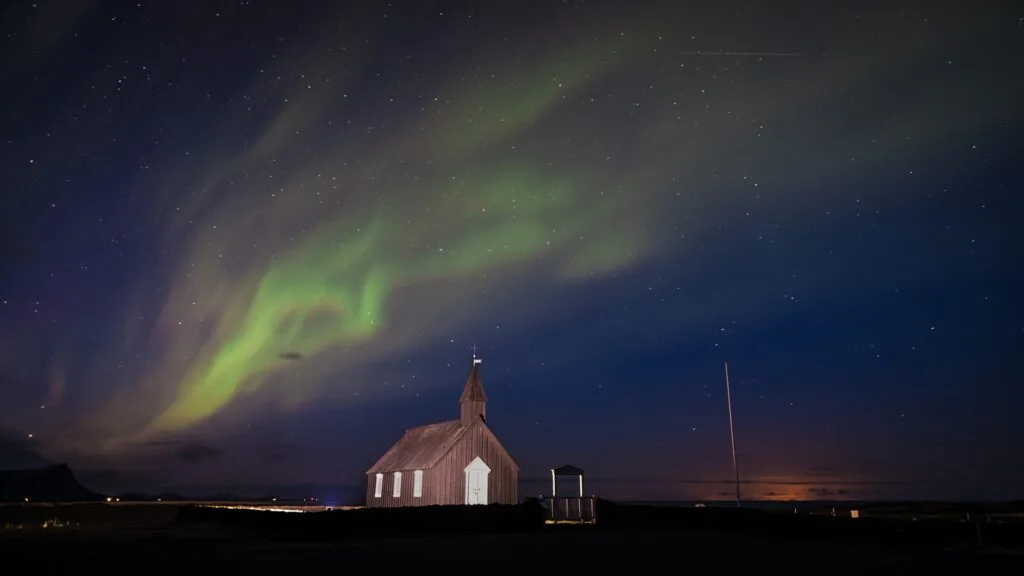
Iceland vs New Zealand at a glance
| Iceland | New Zealand | |
|---|---|---|
| Best for | Compact epic nature, auroras, geothermal | Diverse adventure, fjords, two islands |
| Vibe | Stark, volcanic, small | Lush + alpine; adventure capital |
| Daily budget (mid-range) | $150–250 | $120–200 |
| Best time | Jun–Aug (mild) or Sep–Mar (auroras) | Dec–Mar (summer) |
| Don’t miss | Ring Road, Blue Lagoon, glaciers | Milford Sound, Queenstown, Hobbiton |
| The catch | Pricey; fast-changing weather | Far; needs 2–3 weeks for both islands |
Scenery
Iceland: waterfalls, glaciers, geysers, black beaches and the Northern Lights — all on one Ring Road. New Zealand: fjords, mountains, beaches, glowworm caves and rainforest across two big islands.
Trip length
Iceland packs its wonders into a tight 7-10 day loop; New Zealand needs 2-3 weeks to do justice to both islands.
Cost
Both are expensive. Iceland is pricier day-to-day (food, tours); New Zealand’s costs spread over a longer, bigger trip.
Adventure
New Zealand is the adventure-sports capital (bungee, skydiving, hiking); Iceland leans toward geology, glaciers and hot springs.
Who should choose which
A short, intense, otherworldly road trip: Iceland. A longer, varied, adventure-packed journey: New Zealand.

The verdict: which one your calendar can actually handle
The deciding factor is how much time you have and how far you’ll fly. Choose Iceland if you have a week and want minimal travel pain, and choose New Zealand if you have two to three weeks and don’t mind a brutal flight. Iceland’s Ring Road is 1,322 km and loops the whole country in 7 to 10 days, and it’s only a 5-to-7-hour nonstop from New York or Chicago. New Zealand is two long islands (the North runs 829 km, the South 840 km) that genuinely need a fortnight, and the flight is around 13 hours nonstop from the West Coast on Air New Zealand out of LA or San Francisco.
The experiences split cleanly too. Iceland’s signature sight, the Northern Lights, is seasonal: you need the dark months from roughly September to April, so a summer visit means missing them entirely. New Zealand has no such window. The Te Anau glowworm caves and Milford Sound, about 90 minutes apart in Fiordland, run year-round. Short, otherworldly, and close is Iceland. Long, varied, and far is New Zealand.
Iceland vs New Zealand FAQ
Which needs more time?
New Zealand (2-3 weeks); Iceland works in a week.
Which is better for Northern Lights?
Iceland — NZ is in the south (aurora australis is harder to catch).
Which is more expensive?
Both are pricey; Iceland is steeper day-to-day.
Getting there: a 6-hour hop vs the long haul
The single biggest practical difference between these two trips is how far you have to fly. Iceland sits in the middle of the North Atlantic, which makes it one of the most accessible “remote” destinations on earth. Icelandair and PLAY run direct flights into Keflavik (KEF) from a long list of US East Coast hubs, and the New York (JFK) to Reykjavik leg is only about 5 hours 45 minutes in the air. From the East Coast, you can leave after dinner and be soaking in geothermal water by lunch the next day. Iceland even built its tourism brand on free multi-day stopovers between North America and Europe.
New Zealand is the opposite. There is no shortcut across the Pacific. Air New Zealand‘s Los Angeles to Auckland (AKL) run is roughly 12 hours 50 minutes southbound, and if you’re starting from the US East Coast you’re realistically looking at 17-20+ hours of total travel once you add the domestic connection to LAX or San Francisco. You also cross the International Date Line, so you lose a calendar day on the way out and get it back coming home.
- Iceland: ~6 hr nonstop from NYC; easy to bolt onto a Europe trip
- New Zealand: ~13 hr nonstop from LAX; a genuine long-haul commitment that argues for staying two weeks or more
When to go: opposite hemispheres, opposite seasons
Because New Zealand is in the Southern Hemisphere, its seasons are flipped from Iceland’s, and the two countries reward completely different parts of the calendar. Pick the wrong month and you’ll either freeze in the dark or pay peak prices for crowds.
Iceland is really two destinations depending on when you arrive. For the Northern Lights, you need darkness, which means roughly September through April; the longest, darkest nights fall between November and January, while September and March often deliver the strongest displays thanks to the equinox geomagnetic boost. The trade-off is short daylight and icy roads. If you want to actually drive the Ring Road comfortably and hike, come in summer (June-August), when you get near-24-hour daylight but essentially no aurora.
New Zealand‘s summer runs December to February, with daytime temperatures from the high 50s into the 80s F and daylight stretching past 9:30 pm. That’s prime hiking and road-trip weather, but late December through early January is the busiest and most expensive window, with locals on holiday too.
- Want aurora? Iceland, roughly Sept-Apr (peak displays around the equinoxes)
- Want long warm hiking days? Iceland summer or NZ Dec-Feb
- Want to dodge crowds: shoulder months like NZ’s March or Iceland’s May
Entry requirements and the fees nobody mentions
For US travelers, the paperwork and entry costs are surprisingly different, and they’re easy to overlook when you’re budgeting. Neither country requires a traditional visa for a short tourist stay, but New Zealand quietly charges you twice before you even land.
Iceland is part of the Schengen Area, so US passport holders enter visa-free for up to 90 days within any 180-day period. There’s no entry levy to pay in advance. Your main on-the-ground add-on is a small lodging tax, set at 800 ISK per room, per night (around $6 USD) for hotels and guesthouses as of 2025, and 400 ISK for campsites and motorhome spots. Note that an EU-wide pre-travel authorization (ETIAS) is in the pipeline, so check before you fly.
New Zealand requires US citizens to hold an NZeTA (Electronic Travel Authority) before boarding, valid for stays under 3 months. It costs NZD $17 via the official app or NZD $23 online. On top of that, almost every visitor must pay the International Visitor Conservation and Tourism Levy (IVL) of NZD $100, collected at the same time as the NZeTA.
- Iceland: visa-free 90 days, no entry fee, ~$6/night lodging tax
- New Zealand: NZeTA ($17-23) plus the $100 IVL before arrival
Planning the trip? Go deeper with and our New Zealand Travel guide.
You Might Also Love




Written by
John Morrison is the founder and lead travel writer at Packzup. Over the past decade he has explored destinations across Africa, the Americas, Asia, Europe, the Middle East, and Oceania — always self-funded, never on a press trip.