
Last updated September 4, 2026 · Editorial policy
Quick answer: Sri Lanka is a route, not a resort: the classic loop sleeps in Galle Fort (colonial charm), a south-coast beach town (Weligama–Mirissa), the hill country (Ella or a tea-estate bungalow) and the cultural triangle (Sigiriya): with Colombo only as a flight-night.
Where to stay in Sri Lanka: best areas
| Area | Best for | The vibe |
|---|---|---|
| Colombo | Gateway & city | Urban hub |
| Kandy | Culture & hills | Temple, scenic |
| Galle | Coast & the fort | Historic, beachy |
| Ella | Tea country & views | Hill-station, hiking |
Galle Fort: the romantic anchor
Dutch ramparts, lighthouse sunsets and boutique heritage hotels inside the walls (US$60–200). Two nights bookends the south perfectly.
The south coast: pick your beach
Weligama for surf lessons and budget socials: Mirissa for whale season and nightlife-lite: Tangalle for empty-sand splurges: Hiriketiya’s jungle cove for the wave-and-smoothie crowd. Guesthouses US$25–60: villas upward.
Hill country: Ella or an estate
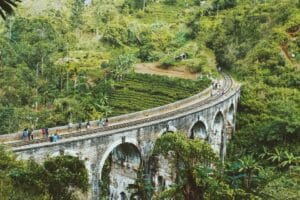
Ella is the backpacker-pretty base for Nine Arch Bridge and Little Adam’s Peak: tea-estate bungalows around Hatton/Nuwara Eliya deliver the planter’s-life splurge. Take the famous train between Kandy and Ella regardless of where you sleep.
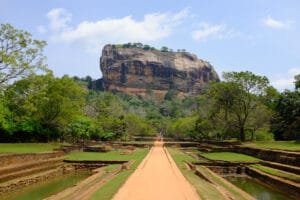
Sigiriya & the cultural triangle
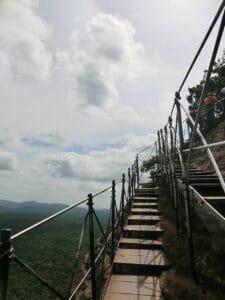
Sleep among paddies under the rock fortress: eco-lodges and family guesthouses make dawn climbs (Sigiriya or the cheaper, view-of-Sigiriya Pidurangala) effortless. One or two nights.
Quick picks by traveler type
Two weeks classic: Sigiriya → Kandy → Ella → south coast → Galle. Honeymoon: Galle Fort + Tangalle. Surf trip: Weligama/Hiriketiya (Dec–Apr) or Arugam Bay (May–Sep, east coast). Skip: more than one Colombo night.
The east coast base most southern itineraries skip (May to September only)
Almost every Sri Lanka guide funnels you to Galle and the south coast, which is right for December through April. But if you are traveling between May and September, the southwest monsoon blows the south out and the action moves to the east coast, and that is where you should base. Arugam Bay is the obvious pick: guesthouses start around USD 13–21 a night, the Main Point right-hand break draws surfers from June to August, and the village stays loose and walkable. For calmer water and snorkeling instead of surf, base in Trincomalee or neighboring Nilaveli, where rooms also start near USD 14–21 and Pigeon Island is a short boat ride offshore.
The trade-off is brutal seasonality, so do not get this backwards. Roughly 70% of Arugam Bay’s hotels and restaurants shut from November through March when the northeast monsoon makes the bay flat and blown-out; show up in December expecting surf and you will find shuttered cafes. In that window the waves and the crowds are back on the south coast around Weligama and Mirissa. Match your base to the calendar: east coast May–September, south coast November–April. Trying to do both in one trip means a long cross-island drive and a lot of rain on the wrong side.
FAQ
Which coast and when?
Driver or trains?
Is Colombo worth staying?
How many nights total?
Best time to visit Sri Lanka (real climate data)
Best months: July, August, December.
Sri Lanka’s warmest month is February (avg 31°C / 88°F), the coolest is January (low 23°C / 73°F). The wettest is October (359 mm) and the driest is February.
Source: Open-Meteo / WMO climate normals (WMO 1991–2020, or ERA5 2019–2023 where unavailable). See the full month-by-month weather →
You Might Also Love

Written by
John Morrison is the founder and lead travel writer at Packzup. Over the past decade he has explored destinations across Africa, the Americas, Asia, Europe, the Middle East, and Oceania — always self-funded, never on a press trip.
