
Last updated August 21, 2026 · Editorial policy
Quick answer: Yanaka is the Tokyo that survived: low wooden houses, eighty-odd temples, cats sunning on stone walls and the beloved Yanaka Ginza shopping street: the shitamachi (old downtown) at its gentlest. Come on foot, leave the itinerary loose.
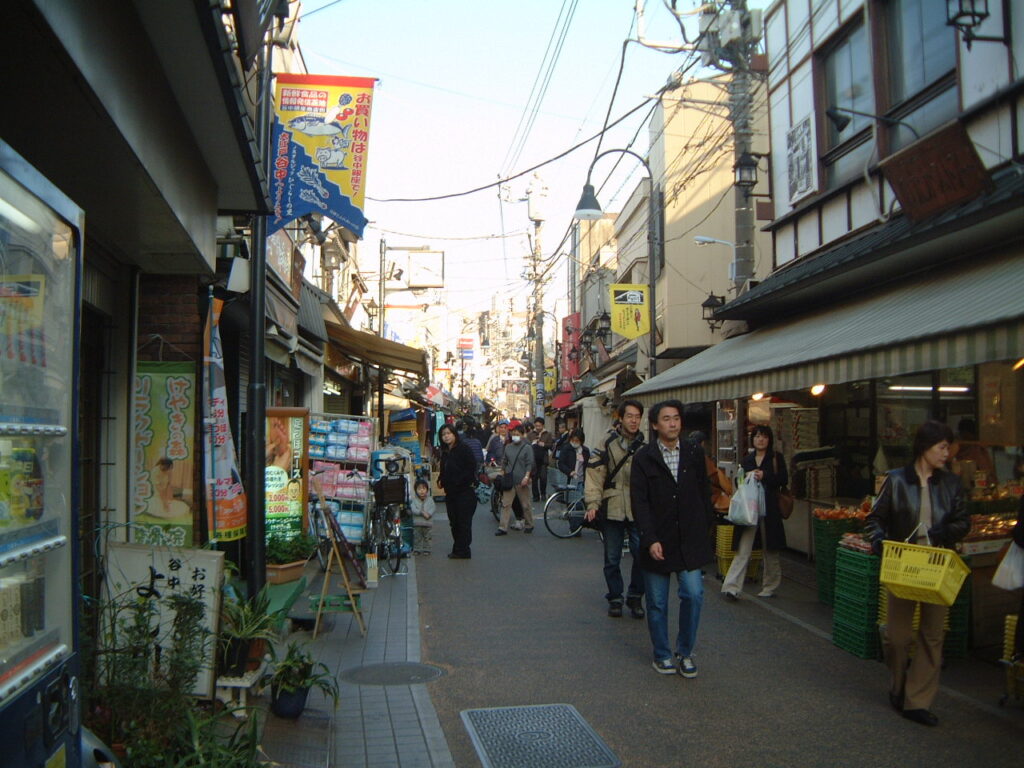
Yanaka Ginza
The retro shopping street of every Japanese film set: croquette stands, tea merchants, cat-themed everything and the “sunset stairs” (Yuyake Dandan) framing it from above: golden hour earns the name.
Temple-and-lane wandering
Eighty temples thread the quarter: incense, mossy gates and graveyards softened by cherry trees. Yanaka Cemetery’s lanes (resting place of shoguns and literati) are a peaceful sakura secret each spring.
Old houses, new art
Machiya townhouses host galleries and studios: SCAI The Bathhouse shows contemporary art inside a 200-year-old public bath: the neighbourhood’s past-meets-present in one room.
Nezu Shrine
Ten minutes west: vermilion torii tunnels (a quieter Fushimi Inari echo) and April’s azalea festival cascading down the hillside: one of Tokyo’s loveliest small shrines.
Snack-walking
Senbei grilled to order, taiyaki, sake tastings in standing bars and kissaten coffee under paper lanterns: Yanaka’s eating is grazing, ideally trailing a melting soft-serve past a temple gate.
Getting there
Nippori station (JR Yamanote) drops you at the sunset stairs; Sendagi (Chiyoda line) at the quarter’s heart: pair with Ueno’s museums (15 minutes’ walk) for a full old-Tokyo day. Mornings are quietest; cats keep their own schedule.
The three stops worth timing your visit around
Yanaka’s charm is in slow, specific stops, and a few have rules worth knowing before you go. Kayaba Coffee (6-1-29 Yanaka), the converted 1930s wooden cafe near the cemetery, opens at 8am and now takes reservations only, with no waiting line allowed outside to keep it quiet. Go right at opening or book ahead. For dessert, Himitsudo serves towering kakigori shaved ice with around 132 rotating seasonal syrups, but it is closed Mondays and runs roughly 10:00 to 18:00, and the queue is real, so arrive before lunch.
For a drink, Yanaka Beer Hall sits inside the Ueno Sakuragi Atari complex, three 1938 wooden houses, pouring its own house Yanaka Beer alongside August Beer taps. The same lane hides Vaner, a Norwegian bakery, if you want bread to take away.
- Kayaba Coffee: opens 8am, reservation only.
- Himitsudo: closed Mondays, ~10:00–18:00, ~132 syrups.
- Kanekichien: 80-year-old tea merchant that will actually teach you to brew properly.
Morning is the move here. By early afternoon the day-trippers from Ueno arrive and the lanes lose their quiet.
Yanaka Cemetery, the last shogun, and the pagoda that burned
The 25-acre Yanaka Cemetery (Yanaka Reien) is the green, contemplative heart of the neighborhood, and it is far more interesting than the word “cemetery” suggests. It opened in 1874 on land carved out of Tennoji Temple, which was founded back in 1274 and still sits at the cemetery’s edge. Locals treat the grounds as a park: come in late March to early April and the central path, Sakura-dori, runs under roughly 170 cherry trees in full bloom, one of Tokyo’s quietest hanami spots.
Two things are worth hunting down here:
- Tokugawa Yoshinobu’s grave — the 15th and last shogun of Japan, who handed power back to the emperor in 1867. Unusually, he was buried Shinto-style by his own wish, so his tomb is a round earthen mound rather than a Buddhist marker. The walled Tokugawa enclosure beside it is closed, peeked at through double-barred gates.
- The five-story pagoda ruins — Tennoji’s famous wooden pagoda, the model for Koda Rohan’s 1891 novel The Five-Storied Pagoda, burned to the ground in a notorious arson on July 6, 1957. Only the stone foundation outline survives.
The grounds are open and free; keep an eye out for the neighborhood’s resident cats among the stones.
Kayaba Coffee and the lost art of the kissaten
If you do one sit-down stop in Yanaka, make it Kayaba Coffee, on the corner where the cemetery side of the district meets the lanes down toward Nezu. The wooden building dates to 1916, and the Kayaba family ran a kissaten (a classic Japanese coffeehouse) here from 1938 until the original owner died in 2006. It sat shuttered until a local non-profit, working with the SCAI the Bathhouse gallery up the street, restored and reopened it in 2009. The result is rare: a genuine pre-war kissaten still serving, not a recreation.
What to order:
- The tamago (egg) sandwich — a thick, fluffy folded omelette pressed between firm white bread, cut into fingers and served with a small salad. Around 500 yen (roughly $3.50) and the thing people line up for.
- The “Russian” — the house signature, coffee mixed with chocolate syrup and milk, a holdover from the original menu, about 500 yen ($3.50).
Hours run roughly 8:00 to 18:00, closed Mondays (with later evening hours some days), so it doubles as an early-morning or late-afternoon anchor. Expect a short wait at peak times; the upstairs tatami room is the seat to angle for.
Getting there, and the staircase you arrive on
Yanaka rewards arriving on foot from the right direction. The smart move is to come in from JR Nippori Station (on the Yamanote, Keihin-Tohoku, and Joban lines), take the West Exit, and walk about 5 minutes. That route delivers you to the top of Yuyake Dandan — literally “Sunset Stairs” — a short flight of steps that drops straight into the Yanaka Ginza shopping street. Standing at the top looking down over the low rooftops, especially in the late-afternoon light, is the single most photographed view in the district, and it sets the tone before you’ve spent a yen.
Your options:
- From Nippori (JR): ~5-min walk, arrives at the Sunset Stairs. Best for the view.
- From Sendagi (Tokyo Metro Chiyoda Line), Exit 2: ~3-min walk on a flat approach to the shopping street’s far end — easier if you want to skip the steps or have luggage/strollers.
- From Narita Airport: the Keisei Skyliner reaches Nippori in about 36 minutes, so Yanaka makes an easy first or last stop on a trip.
Most of Yanaka is genuinely walkable in a half-day loop, and the terrain is flat once you’re off the stairs.
You Might Also Love
More things to do in Japan




Written by
John Morrison is the founder and lead travel writer at Packzup. Over the past decade he has explored destinations across Africa, the Americas, Asia, Europe, the Middle East, and Oceania — always self-funded, never on a press trip.
