
Last updated September 6, 2026 · Editorial policy
- Where to stay in Cartagena: best areas
- The Walled City (Centro): the splurge that earns it
- Getsemaní: the character quarter
- Bocagrande & the beach towers
- Quick picks by traveler type
- Picking Your Street, Not Just Your District
- FAQ
- The 19 percent IVA exemption on hotel rooms: what you actually have to show in 2026
- Is there a tourist tax or city stamp on a Cartagena hotel bill?
- How to check a Cartagena property is legally registered before you pay a deposit
- Where is the clear water, and what does reaching it cost?
- What it costs to get out of each neighbourhood
- Manga, cruise days, and why the old city fills up
- What official safety guidance means for choosing a base
- At a glance
- Frequently asked questions
Quick answer: Sleep inside the Walled City for the full colonial-romance experience: or in Getsemaní right outside the walls for boutique character, street art and better prices. Bocagrande’s towers suit beach-and-AC tastes: most travelers do not need them.
Where to stay in Cartagena: best areas
| Area | Best for | The vibe |
|---|---|---|
| Old Town (Walled City) | First-timers | Historic, romantic |
| Getsemaní | Nightlife & hip | Bohemian, lively |
| Bocagrande | Beaches & high-rises | Resort, modern |
| Manga | Local & value | Residential |
The Walled City (Centro): the splurge that earns it
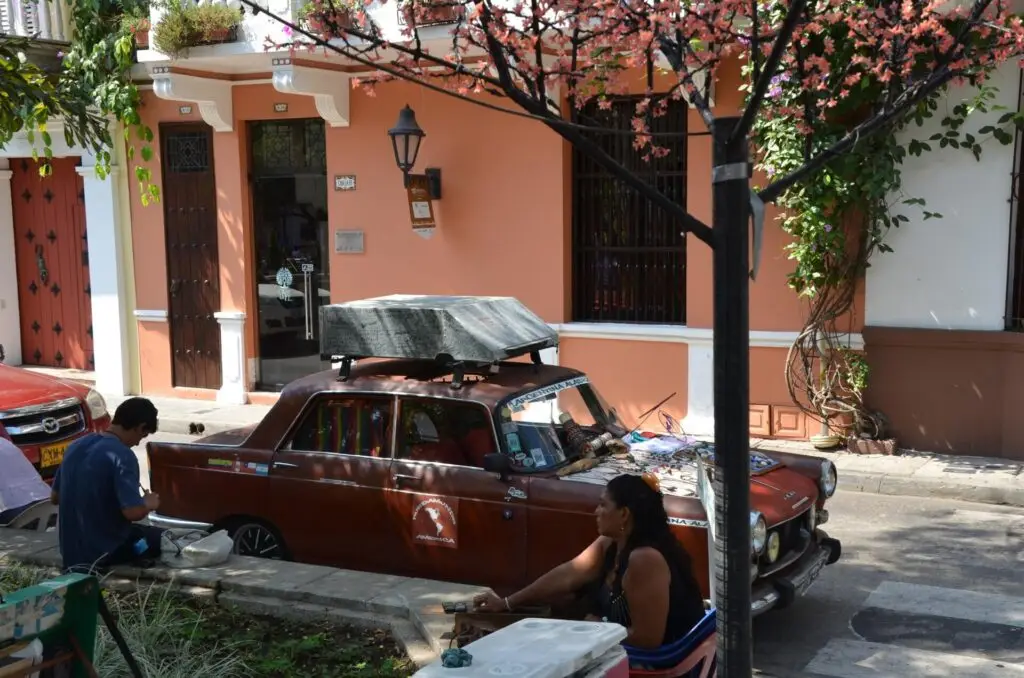
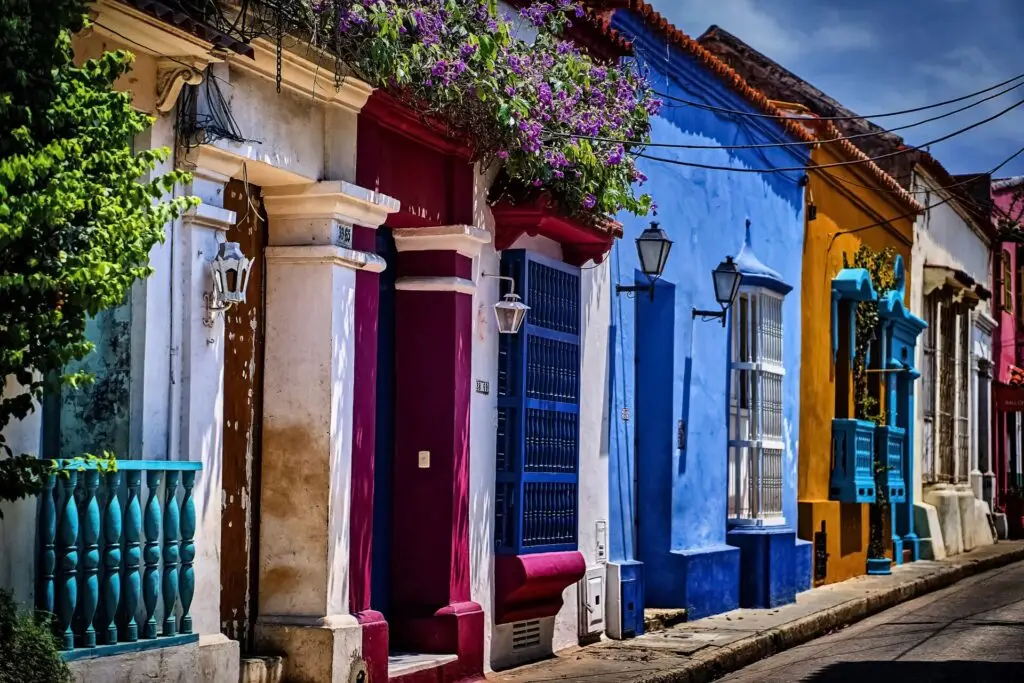
Balconied mansions turned boutique hotels (US$150–400), evening breezes on the ramparts and bougainvillea everywhere: nowhere in the Americas does colonial atmosphere better. Light sleepers: courtyard rooms over street-facing.
Getsemaní: the character quarter
Once-gritty, now the creative heart: hostels-to-boutiques (US$40–150), Plaza Trinidad evenings, murals and the city’s best casual eating: a five-minute walk through the clocktower to the walls. The value-romance sweet spot.
Bocagrande & the beach towers
Miami-style high-rises on a busy city beach: modern rooms, malls and AC at chain prices. Fine for conferences and beach-prioritized families: the magic, though, lives in the old town: and the REAL beaches are the Rosario Islands by boat.
Quick picks by traveler type
Honeymoon: Walled City. Most travelers: Getsemaní. Families: Bocagrande or walled-city apartments. Beach-first: one Rosario Islands night (Isla Grande eco-stays) attached to either.
Picking Your Street, Not Just Your District
The district names only get you halfway; in Cartagena the right street inside a district matters more. First-timers who want the colonial look without the tour-group crush should skip the busiest El Centro plazas and book in San Diego, the quieter sub-quarter of the Walled City. It keeps the balconied-mansion boutiques (roughly US$150 and up) but trades sidewalk vendors for sleepier bar-and-cafe corners, while staying a few minutes’ walk from the cathedral and the walls.
Nightlife travelers belong in Getsemani, but be precise about where. A room facing Plaza de la Trinidad or on Callejon Ancho means vallenato and champeta sound systems until very late; book a street back toward the walls, such as Carrera 11, and you get the same five-minute walk to the action with a chance of sleep. Budget rooms here still run from around US$40.
The area to be skeptical of is Bocagrande as a beach base. Its high-rises are convenient and family-friendly, but the city beach has dark, coarse sand and water clouded by sediment. For actual Caribbean water, treat any city stay as a launch pad and take the roughly 45-to-60-minute boat to the Rosario Islands instead.
FAQ
Is Getsemaní safe?
When to visit?
Are city beaches good?
How many nights?
The 19 percent IVA exemption on hotel rooms: what you actually have to show in 2026
A qualifying foreign visitor’s hotel room in Colombia is invoiced at a rate of zero, not at 19 percent. Article 481, literal d) of the Estatuto Tributario makes tourism services provided to residents abroad and used inside Colombia exempt with a right to refund, where they come from operating agencies or hotels inscribed in the Registro Nacional de Turismo under Ley 300 de 1996. Three conditions carry it, and the third one has changed since the rule was written.
You must be a resident abroad. Decreto 297 de 2016 defines that as “los extranjeros y … los nacionales que ingresen al territorio nacional sin el ánimo de establecerse en Colombia”. A Colombian living abroad is inside that definition. A foreigner who has settled in Colombia is outside it. The test is intention on entry, not nationality.
The property must be in the Registro Nacional de Turismo. An unregistered room cannot lawfully be zero-rated, whatever the host says.
The document list in the decree is out of date, and DIAN has said so. Decreto 297 de 2016 asks a foreign resident abroad to prove their status “mediante la presentación del pasaporte original; la tarjeta Andina o la tarjeta de Mercosur”, then to evidence migratory status with a valid Permiso de Ingreso y Permanencia stamp PIP-3, PIP-5, PIP-6 or PIP-10, or a valid Visa Temporal TP-7, TP-11 or TP-12. Those are alternatives, not a bundle you must produce all of.
None of those codes still exists. DIAN Concepto 003522 int 413 de 2025, dated 25 March 2025, traces the repeals: the TP-7, TP-11 and TP-12 visas came from Resolución 5512 de 2015, which Resolución 6045 de 2017 expressly repealed, and that in turn was repealed by Resolución 5477 de 2022, the current visa regime, which classifies visas as V for visitante, M for migrante and R for residente. The PIP-3, PIP-5, PIP-6 and PIP-10 permits came from Resolución 1220 de 2016 of Migración Colombia, repealed by Resolución 3167 de 2019.
DIAN does not publish a code-for-code map from the old stamps to the new V, M and R categories. What it publishes instead is a test. Later norms count “bien sea por un proceso de modificación, adición o sustitución normativa”, provided they “den lugar a validar que el ingreso al país del residente en el exterior es sin el ánimo de establecerse”. In other words the question is no longer which code is in your passport; it is whether your documents show you came in as a visitor.
So what do you hand over at a desk in 2026? DIAN’s answer is the original passport, together with documents showing your entry was not for the purpose of settling: “los extranjeros que ingresen a Colombia a través de Biomig deberán acreditar su condición de no residentes a través de la presentación del pasaporte original, junto con los documentos que demuestren que su ingreso al país no tiene como propósito establecerse en él”.
There is a trap here that catches people at check-in. Biomig, the iris-recognition channel defined in article 2 of Resolución 3167 de 2019, lets you in and out “sin sellar el pasaporte”. If you use it, you will have no entry stamp at all. DIAN’s answer for exactly that case is the Certificado de Movimientos Migratorios, which under article 2 of Resolución 2061 de 2020 certifies your entries to and exits from the country. Request it from Migración Colombia and keep it with the passport.
The burden then sits on the property, not on you. Decreto 297 de 2016 states that “el prestador del servicio será responsable de obtener y conservar la copia de los documentos”, and without those copies the exemption does not apply. DIAN Concepto 010454 int 1182 de 2025, dated 4 August 2025, adds that for hotel services the exemption “rige independientemente de que el responsable del pago sea el huésped no residente en Colombia o la agencia de viajes”.
Practically: ask the hotel to apply the exemption at check-in rather than arguing about it at checkout, hand over the passport itself rather than a photograph so the property can take its copies, and have your immigration record to hand, a stamp if you were stamped and the Certificado de Movimientos Migratorios if you came through Biomig. If a 19 percent line still appears on the folio, ask for it to be re-invoiced before you pay. Rules and resolution numbers move, so re-check with DIAN or the hotel before you travel. Checked 5 September 2026.
Is there a tourist tax or city stamp on a Cartagena hotel bill?
No. There is no per-night visitor levy added to a hotel bill in Cartagena. The tourism levy that does exist is a charge on the business.
Ley 1101 de 2006 creates the contribución parafiscal para la promoción del turismo, set at 2.5 per mil of operating income and liquidated quarterly, payable by the tourism providers listed in the law, hotels included. Article 1 describes it as a contribution “que en ningún caso será trasladada al usuario”, so the statute itself bars the provider from passing it on to the guest. Article 3, which defines who pays, was modified by article 37 of Ley 2068 de 2020.
Be careful how you use that. It is a rule addressed to the provider about its own tax, not a licence to walk out on a bill. If you see a line described as a tourism contribution, ask what it is and ask for the folio to be corrected before you pay. If the property will not explain it, the escalation route is a complaint to the Superintendencia de Industria y Comercio, which can investigate and sanction registered providers. Refusing to pay at the desk is not the same thing as being right, and a disputed line is easier to fix in writing than at midnight.
What you may legitimately be offered at check-in is an optional insurance product sold on your behalf to an insurer. That is a product, not a tax. Ask what it covers and what it costs in pesos before agreeing.
How to check a Cartagena property is legally registered before you pay a deposit
Look the property up in the Registro Nacional de Turismo before you send money. The Ministerio de Comercio, Industria y Turismo describes the RNT as the mechanism for identifying and regulating tourism service providers, and under Decreto 1836 de 2021 registration is compulsory for seventeen categories of provider, including hotels, hostels, glamping and viviendas turísticas, which is the category most short-let apartments fall into.
Registration lasts a year and must be renewed “entre el 1° de enero y el 31 de marzo”. Providers do it through the electronic platform run by the chambers of commerce, at rnt.confecamaras.co, so you can ask for a number and check it yourself.
This matters twice over. The IVA exemption only runs through RNT-registered providers, so an informal apartment let cannot lawfully zero-rate your room. And the ministry states that operating without registration exposes the provider to administrative investigation and sanction by the Superintendencia de Industria y Comercio, plus “la clausura del establecimiento por parte del alcalde distrital o municipal”. An unregistered let is not just cheaper paperwork; it is a place that can be shut while you are staying in it.
A property that cannot give you an RNT number is telling you how the rest of the stay will be handled.
Where is the clear water, and what does reaching it cost?
The water in the photographs is not in front of any Cartagena hotel. It is roughly 23 km south of the city, in and around Parque Nacional Natural Los Corales del Rosario y de San Bernardo, which Parques Nacionales gives as the distance from the city to the Rosario sector. No neighbourhood choice shortens that.
Reaching it is a boat day with published rules. Parques Nacionales gives departures as 08:00 to 10:00, and states that the return is set “según lo establecido por capitanías de puerto y condiciones del mar”, so you do not choose it and neither does your operator. There is an entrance right set by resolution and updated annually; the park’s page publishes 11,000 pesos for the San Bernardo sector and no figure for the Rosario sector, so confirm the current amount at ecoturismo.coralesdelrosario@parquesnacionales.gov.co. Payment is taken at the muelle turístico La Bodeguita on Avenida Blas de Lezo, opposite the Parque de La Marina, or through the park’s own online payment link.
Since 1 March 2026 there is also an accident and assistance insurance, compulsory under Resolución 273 de 2024 according to Parques Nacionales newsroom items of 7 January and 14 June 2026, sold by approved insurers and charged separately, because its cost “no corresponde al valor de ingreso”. The park’s own visitor page still uses the softer wording “recomendamos adquirir la póliza”. Where two official pages disagree, buy it.
So do not choose your neighbourhood for its beach. Choose it for what is within walking distance of the door, and treat good water as a day that starts before 10:00 from wherever you sleep.
One address is genuinely beach-led rather than city-beach: La Boquilla, the fishing corregimiento on the strip north of the airport, between the open sea and the Ciénaga de la Virgen lagoon. Beach certification has been publicised there, but the Alcaldía Mayor de Cartagena’s site could not be reached to confirm the current status and Blue Flag International’s site map is offline, so no certification claim is made here. If it matters to your booking, check with the Alcaldía or with Blue Flag Colombia, run by ACODAL Seccional Centro, the programme’s national operator listed by Blue Flag International.
What it costs to get out of each neighbourhood
One published figure decides most of it. Transcaribe, the district’s mass transit system, charges a flat 3,900 pesos per trip regardless of distance, fixed by Decreto 017 of 15 January 2026 and applied from 23 January 2026, up from 3,400. Trunk routes are coded T100E and T101 to T103, pretroncal routes X101 to X106, and feeders run in the A101 to A117 series.
Taxi fares are set by district decree on a cost study by the transit department, the DATT, and this page does not quote them, because the Alcaldía’s site returned an error to every attempt to read the current decree. Ask to see the tariff card in the vehicle and agree the fare before you get in, or check the current figures with the DATT.
The arithmetic still works without the numbers. A base that needs two car journeys a day for four nights buys eight fares you would not pay from a walkable address, and evening returns are the expensive ones. That is the real difference between a room inside the walls and a cheaper room somewhere else.
The short version: inside the walls and in Getsemaní you pay for the room and walk. Anywhere else you pay less for the room and buy the difference back in fares.
Manga, cruise days, and why the old city fills up
Manga is an island in the bay reached by bridge, and the thing that shapes it is the port rather than the architecture. The Sociedad Portuaria Regional de Cartagena states that its cruise terminal sits “only 3.2 kilometers from the Historic Center”, can serve up to five cruise ships simultaneously and more than 10,000 passengers per day, works with 34 cruise lines and receives 97 percent of the passengers arriving by sea to Colombia.
Hold those numbers when you look at Manga rates and wonder why they are lower. On a heavy ship day more than ten thousand people can come ashore a short drive from the walls, and the old city absorbs them. Plazas that are calm at 08:00 are not calm at 11:00.
Manga buys you space, republican-era streets and prices below the walls. It costs you the evening walk home: getting back from Getsemaní after dinner means a car. It suits a longer stay or a family wanting a kitchen, not two or three nights built around the old city at night.
If your dates are flexible, the cheapest way to use this is to walk the walled city early on any day and keep the middle of the day for somewhere seated and shaded, whichever neighbourhood you sleep in.
What official safety guidance means for choosing a base
The UK Foreign, Commonwealth and Development Office does not advise against travel to Cartagena. Its Colombia advice, updated 3 September 2026 and checked here on 5 September 2026, advises against all but essential travel to a list of named areas. The only entry on that list in this department is “the southern part of Bolívar Department”. The city appears in no regional restriction.
The risks it describes bear directly on where you sleep. On street crime: “Pickpocketing, mugging and armed robbery are a problem, especially in major cities, including Bogotá, Medellín, Cali and the Caribbean coast.” On express kidnapping: “Short-term opportunistic abductions known as ‘express kidnappings’ are common in Colombia. Criminals, often posing as taxi drivers, may track and select a target victim, often from around ATMs and often at night.” On drug-assisted robbery: “Criminals can administer drugs through food, drinks, cigarettes, aerosols and even paper flyers.”
On transport it is specific. “Use licensed telephone or internet-based taxi services whenever possible or book through your hotel”, and “well-known taxi companies can be booked via Uber and Cabify”. It adds that authorised taxis are yellow with white licence plates and plate numbers on the doors and roof.
Read alongside the fares, that is an argument for a base you can walk home to. The walled city and Getsemaní are where you never need a car after 22:00. Everywhere else, budget a booked car rather than a street flag-down and treat it as part of the nightly cost. Re-check the FCDO page before you travel, since it is revised without notice.
At a glance
| Area | Who it suits | Reaching the walled city | Published cost of moving | The honest trade-off |
|---|---|---|---|---|
| Centro Histórico, inside the walls | Short first visits, walking home after dark | You are in it | Nothing, on foot | Highest rates in the city; tour groups outside the door by mid-morning |
| Getsemaní | Solo travellers, longer stays, eating out nightly | On foot, continuous with the walls | Nothing, on foot | Loud near the main plaza; a residential quarter first |
| Bocagrande | Pool-and-balcony stays, high-rise apartments | Taxi or Transcaribe | Transcaribe 3,900 COP a trip; taxi by district tariff card | A city beach; the clear water is 23 km south, inside a national park |
| Manga | Longer stays, kitchens, lower rates | Bridge, then a car; cruise terminal 3.2 km from the historic centre | Transcaribe 3,900 COP a trip; taxi by district tariff card | Port-side island; capacity for five ships and 10,000 passengers a day lands nearby |
| La Boquilla | Beach-led stays, mangrove and lagoon trips | North of the airport, taxi or Transcaribe feeder | Transcaribe 3,900 COP a trip; taxi by district tariff card | Every old-city evening is a paid journey; check current beach certification with the Alcaldía or ACODAL Seccional Centro |
Frequently asked questions
Do foreign tourists really pay no IVA on hotels in Colombia?
A resident abroad staying in a hotel registered in the Registro Nacional de Turismo is invoiced at a zero rate under Article 481(d) of the Estatuto Tributario. You present the original passport together with documents showing you entered Colombia without the intention of settling, and Decreto 297 de 2016 makes the hotel responsible for obtaining and keeping copies. No documents, no exemption.
The rule lists PIP-3 and TP-7 stamps. Do those still exist?
No. DIAN Concepto 003522 de 2025 confirms the repeals: TP-7, TP-11 and TP-12 came from Resolución 5512 de 2015, repealed by Resolución 6045 de 2017 and then by Resolución 5477 de 2022, which replaced them with the V, M and R visa classes; PIP-3, PIP-5, PIP-6 and PIP-10 came from Resolución 1220 de 2016 and were repealed by Resolución 3167 de 2019. DIAN publishes no code-for-code map, only the test that your documents must show you entered without the intention of settling. Ask the hotel to apply the exemption and keep your passport and immigration record to hand.
I came in through Biomig and got no passport stamp. Can I still claim the exemption?
Yes. Biomig, the iris-recognition channel under Resolución 3167 de 2019, admits you ‘sin sellar el pasaporte’, so there is no stamp to show. DIAN’s answer is the Certificado de Movimientos Migratorios, defined in article 2 of Resolución 2061 de 2020, which certifies your entries and exits. Request it from Migración Colombia and present it with the original passport.
Does the IVA exemption apply to Colombians living abroad?
Yes. Decreto 297 de 2016 defines residents abroad as foreigners and nationals who enter Colombian territory without the intention of settling in the country. A Colombian resident abroad proves it with documentation issued by the authorities of their country of residence.
Is there a tourist tax or city stamp added to a Cartagena hotel bill?
No per-night visitor levy exists. The national tourism levy under Ley 1101 de 2006 is 2.5 per mil of the provider’s operating income, liquidated quarterly, and article 1 says it may in no case be passed on to the user. That is a rule about the provider’s own tax, so if such a line appears ask for the folio to be corrected before you pay rather than treating it as grounds to refuse the bill; complaints go to the Superintendencia de Industria y Comercio.
How do I check a hotel or apartment is legally registered?
Ask for its Registro Nacional de Turismo number and check it at rnt.confecamaras.co. Under Decreto 1836 de 2021, registration is compulsory for seventeen categories including hotels, hostels, glamping and viviendas turísticas, lasts one year and is renewed between 1 January and 31 March. Operating without it exposes the provider to sanction by the Superintendencia de Industria y Comercio and to closure by the district or municipal mayor.
Is it worth paying more to sleep inside the walls?
It is if your evenings are in the old city. Inside the walls and in Getsemaní you walk home. From Bocagrande, Manga or La Boquilla a night return is a car journey, and the FCDO advises a booked or app-based car rather than a street flag-down, noting that express kidnappers often pose as taxi drivers.
You Might Also Love




Written by
John Morrison is the founder and lead travel writer at Packzup. Over the past decade he has explored destinations across Africa, the Americas, Asia, Europe, the Middle East, and Oceania — always self-funded, never on a press trip.
