
Last updated September 5, 2026 · Editorial policy
- Where to stay in Hokkaido: best areas
- Sapporo: the all-season hub
- Niseko: powder royalty
- Furano & Biei: flowers and gentler snow
- Hakodate & Noboribetsu: the add-ons
- Quick picks by traveler type
- Picking Your Base by Traveler Type: Sapporo Wards and Niseko Villages
- FAQ
- How far apart Hokkaido's bases really are
- Which Hokkaido base suits which season
- What Hokkaido's accommodation taxes add from 1 April 2026
- Is the Hokkaido Rail Pass worth it, or should you hire a car?
- Sapporo Snow Festival 2027 dates and what they do to your booking
- Winter driving in Hokkaido: the honest position
- What goes wrong if you base yourself in the wrong place in Hokkaido
- At a glance
- Frequently asked questions
Quick answer: Base in Sapporo for city comfort and rail links, Niseko or Furano for snow season, Furano–Biei for summer flower fields, and add a Hakodate or Noboribetsu onsen night: Hokkaido is a road-trip island: two or three bases beat one.
Where to stay in Hokkaido: best areas
| Area | Best for | The vibe |
|---|---|---|
| Sapporo | A city base | Lively, dining |
| Niseko | Ski & powder | Resort, international |
| Furano / Biei | Flowers & quiet | Rural, scenic |
| Hakodate | Views & seafood | Port town |
Sapporo: the all-season hub
Big-city hotels at honest prices (¥9,000–20,000), the beer-and-ramen night scene of Susukino, and trains/buses radiating everywhere. Winter’s Snow Festival HQ: book February far ahead.
Niseko: powder royalty
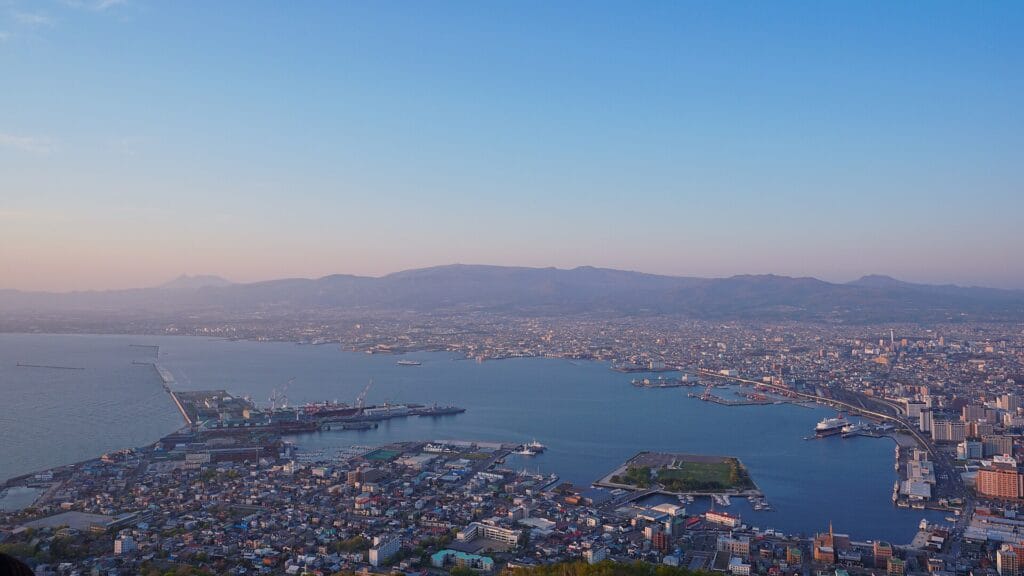
The famous lift-served powder with international ski-town comforts: chalets, izakayas and English-friendly schools. December–February rates soar: book by September: Annupuri and Hanazono edges sleep quieter than Hirafu’s centre.
Furano & Biei: flowers and gentler snow
July’s lavender carpets and patchwork hills: pensions and farm stays with onsen nearby: in winter, an uncrowded, cheaper ski alternative with serious quality.
Hakodate & Noboribetsu: the add-ons
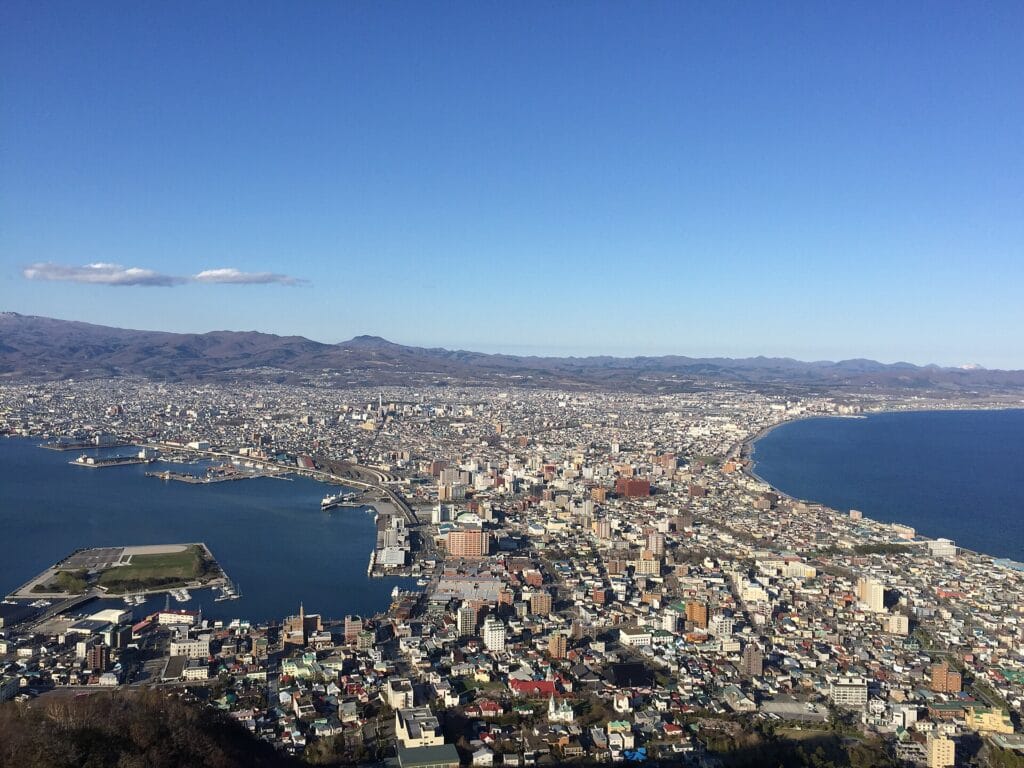
Hakodate: harbour morning market and the famous night view: one night on a southern loop. Noboribetsu: Hell Valley steam and Hokkaido’s grandest onsen ryokan: the soak-and-feast night every itinerary deserves.
Quick picks by traveler type
Ski trip: Niseko (or Furano for value). Summer road trip: Sapporo + Furano/Biei + an onsen night. Food pilgrimage: Sapporo + Hakodate. Families: Furano’s pensions: space, breakfasts, bears optional.
Picking Your Base by Traveler Type: Sapporo Wards and Niseko Villages
Most of your decision happens inside Sapporo, where the right ward depends on who you are, not which hotel has the best photos. The four bases below are all on the Namboku subway line, so they are only a couple of minutes apart by train even when their character is not.
- First-timers: base around Sapporo Station or Odori. You are walkable to the underground shopping concourse, Odori Park events, and the train out to the airport, with mid-range rooms running roughly 9,000 to 20,000 yen a night.
- Nightlife: Susukino, the largest entertainment district in Japan outside Tokyo’s Kabukicho, puts the bars, ramen alley, and izakaya at your door. Expect noise until the small hours.
- Families and quiet sleepers: Nakajima-Koen, one subway stop south of Susukino beside a large park, stays calm while keeping you minutes from the center.
- Budget skiers: sleep in Kutchan town or quieter Annupuri rather than central Hirafu, where slope-side apartments start well above 30,000 yen in peak January.
The area I would skip is a room buried deep in Susukino if you are not there for the nightlife. The savings are thin and the 3am crowds are not.
FAQ
Do I need a car in Hokkaido?
When is ski season?
Ryokan or hotel?
How many nights?
How far apart Hokkaido’s bases really are
Hokkaido is the reason the single-base plan fails, and one figure from JR Hokkaido makes the case: Sapporo to Kushiro is 348.5 rail kilometres, which the railway itself compares to the 366 km between Tokyo and Nagoya. Nobody day-trips Tokyo to Nagoya, and nobody should day-trip Sapporo to Kushiro either.
JR Hokkaido’s own distance page gives Sapporo to Asahikawa as 136.8 km and about 1 hour 25 minutes, Sapporo to Hakodate as 318.7 km and about 3 hours 40 minutes, Sapporo to Kushiro as 348.5 km and about 4 hours 10 minutes, and Sapporo to Wakkanai as 396.2 km and about 5 hours 10 minutes. Its published model itinerary puts the Limited Express Okhotsk from Abashiri back to Sapporo at 5 hours 20 minutes.
Two places people assume are close are not. Furano has a direct train from Sapporo only in season. JR Hokkaido’s own model course uses the Furano Lavender Express, about 2 hours from Sapporo with reserved seats, and footnotes it as a seasonal train. When it is not running, the same company routes you Sapporo to Asahikawa on Limited Express Lilac or Kamui in 1 hour 25 minutes, then local trains Asahikawa to Biei in 40 minutes and Biei to Furano in 40 minutes. That is the same destination at roughly double the time with two changes, so check whether the Lavender Express runs on your dates before you treat Furano as a day trip. Niseko is not on a limited express line at all. Kutchan Town, which contains the Hirafu side of the ski area, states about 150 minutes from Sapporo by JR via Otaru and Yoichi, about 90 minutes from Otaru on a local train, and about 130 minutes from Sapporo by car on Routes 230 and 276.
Treat anything beyond about three hours as a base change, not an excursion. Sapporo works as a hub for Otaru, Noboribetsu and Furano. It does not work as a hub for Hakodate, Abashiri, Kushiro or Wakkanai.
Which Hokkaido base suits which season
Season decides the base far more than budget does, because several of these places are effectively single-season.
Sapporo is the only genuinely all-season base. New Chitose Airport to Sapporo Station is 37 minutes on the Rapid Airport service, which is why it also works as a first and last night even when the trip is really about somewhere else.
Niseko and Kutchan are a December to March proposition for most visitors, with summer rafting and cycling as a quieter second season. Note the administrative split: the ski area spans Kutchan Town and Niseko Town, which tax accommodation differently.
Furano and Biei peak in July for lavender and again in deep winter for a smaller, calmer ski scene. Outside the season of the direct Furano Lavender Express you arrive on local trains through Asahikawa and Biei, so a missed connection at Asahikawa costs an hour or more.
Hakodate is the year-round base for the south and the natural stop if you arrive from Honshu by Shinkansen, which terminates at Shin-Hakodate-Hokuto. At 3 hours 40 minutes from Sapporo it earns two nights, not one.
Kushiro and the Akan area suit late winter for cranes and frozen lakes, and summer for Kushiro Shitsugen and Akan-Mashu National Park. It is the base most often underestimated, because everything inside it is another hour apart by road. Rishiri and Rebun are summer islands reached by ferry from Wakkanai, itself 5 hours 10 minutes from Sapporo by rail, so build them into a northern loop or leave them out.
What Hokkaido’s accommodation taxes add from 1 April 2026
A prefecture-wide accommodation tax started in Hokkaido on 1 April 2026, and in several tourist towns a municipal tax sits alongside it. Figures are as of 5 September 2026 and should be re-checked before booking.
The Hokkaido prefectural tax, published by the prefecture’s tax division, is charged per person per night on the room rate: JPY 100 under JPY 20,000, JPY 200 from JPY 20,000 to under JPY 50,000, and JPY 500 at JPY 50,000 and above. Exemptions are narrow and aimed at group travel rather than at ordinary visitors: school events below university level, and events run by childcare facilities, on production of a certificate from the organising institution. There is no general exemption for children, so a child in an ordinary family booking is taxed like an adult.
The question that decides your budget is whether the prefectural tax sits on top of the municipal one or inside it, and Hokkaido does it both ways.
In Sapporo and Hakodate it is on top. Sapporo City charges JPY 200 per person per night, rising to JPY 500 where the accommodation charge is JPY 50,000 or more, from 1 April 2026, and its own page prints the combined totals as JPY 300, JPY 400 and JPY 1,000 across the three bands. Hakodate City uses four bands rather than three, at JPY 100, 200, 500 and 2,000, adding the JPY 2,000 step above JPY 100,000, for combined totals of JPY 200, 400, 1,000 and 2,500. Hakodate also publishes the transitional rule, and it is the reverse of what people assume: a stay that spans the night of 31 March into 1 April 2026 is not taxed, while a booking made before 1 April 2026 for a night on or after that date is taxed.
Kutchan is the outlier and the expensive one. It charges 3 per cent of the accommodation charge from 1 April 2026, raised from 2 per cent, with the prefectural tax deducted from within that 3 per cent so the guest pays 3 per cent in total. On a JPY 60,000 January night in Hirafu that is JPY 1,800, not JPY 500.
Niseko Town runs its own tax and is mid-change, with three different regimes inside one year. Its press release of 27 March 2026, issued after the Minister for Internal Affairs and Communications consented to the change, sets them out. Until 31 March 2026 the town charged alone on five fixed bands, JPY 100, 200, 500, 1,000 and 2,000. From 1 April to 31 October 2026 the same bands carry the prefectural tax on top, giving totals of JPY 200, 300, 700, 1,500 and 2,500. From 1 November 2026 Niseko Town moves to 3 per cent of the accommodation charge with the prefectural tax taken from inside that 3 per cent, which is the Kutchan arrangement, and the town gives unifying the Niseko area with Kutchan as one of its reasons. So a January 2027 stay in Niseko Town and one in Kutchan cost the same in tax, but an October 2026 stay does not.
Is the Hokkaido Rail Pass worth it, or should you hire a car?
The pass wins on long trunk runs and loses everywhere else, and Hokkaido has a lot of everywhere else.
JR Hokkaido prices the Hokkaido Rail Pass at JPY 22,000 for 5 consecutive days, JPY 28,000 for 7 days and JPY 37,000 for 10 days bought before arrival, each JPY 1,000 more at a station in Japan, and about half price for children aged 6 to 11. It covers all JR Hokkaido lines plus some JR buses and includes reserved ordinary-car seats on limited expresses, which matters because those trains are all-reserved. Read the exclusions rather than the headline: it does not cover the Hokkaido Shinkansen, and it does not cover the South Hokkaido Railway, streetcars or subways, so the tram in Hakodate and the subway in Sapporo are still cash. Two area passes exist, each valid 4 days: Sapporo to Noboribetsu at JPY 10,000 before arrival or JPY 11,000 at a station, and Sapporo to Furano at JPY 11,000 or JPY 12,000. On JR Hokkaido’s own four-day Sapporo, Furano, Biei, Asahiyama and Otaru itinerary the normal tickets come to JPY 29,270 against JPY 11,000 for the Sapporo-Furano pass, which is the clearest worked example the railway publishes.
Buy the pass if your route is a spine: Sapporo to Hakodate, Asahikawa, Kushiro, Abashiri or Wakkanai. Hire a car if your route is a cluster, because Akan-Mashu, Shiretoko, Biei, the Furano lavender farms and the Rishiri-Rebun-Sarobetsu approaches are off the rail network or served by a handful of local trains a day.
The map is also going to thin further, and the section that matters to a Niseko trip is already decided in principle. The Hakodate Line between Oshamambe and Otaru, the line that serves Kutchan and Niseko, is to be replaced by buses when the Hokkaido Shinkansen reaches Sapporo and JR Hokkaido gives the line up. The Hokkaido government’s council on conventional lines parallel to the Shinkansen confirmed the bus direction at its 13th Shiribeshi block meeting on 27 March 2022, and the papers for its 18th Shiribeshi block meeting on 7 April 2026 record Oshamambe Town noting that the bus-conversion direction is settled but the Shinkansen opening date is not, so talks with bus operators are still to come. The railway’s builder told the same council in August 2024 that the end of the 2030 financial year was no longer achievable for the Sapporo extension. In plain terms: the trains still run, nobody has published a closing date, and the change will not happen quietly. Check pref.hokkaido.lg.jp before assuming a local line will run in a future season. Most visitors end up with rail for the long hops and a car or local bus around each base.
Sapporo Snow Festival 2027 dates and what they do to your booking
The 77th Sapporo Snow Festival runs from 4 to 11 February 2027 at all three sites, Odori Park, Susukino and Tsudome, according to the festival’s own organising committee at snowfes.com. The same site says 2027 detail will be published in stages, so treat the dates as fixed and the programme as still filling in, and re-check before you buy a non-refundable room.
The consequence for where you stay is straightforward. Central Sapporo rooms in that window are the scarcest and dearest of the Hokkaido year, and the same week overlaps peak ski demand in Niseko. If the festival is the reason for the trip, book central Sapporo early. If it is not, move your Sapporo nights outside 4 to 11 February 2027 and you will pay materially less for the same room.
If you are late to book, stay along a subway line rather than in the Odori and Susukino blocks. The sites are walkable from several subway stations and the saving on a room two or three stops out is usually larger than the taxi you will not need.
Winter driving in Hokkaido: the honest position
Winter driving in Hokkaido is routine for residents and genuinely demanding for visitors, and the risk is not the falling snow. It is the ground blizzard, where wind lifts settled snow and visibility drops to nothing on a clear day, and the polished ice that forms at urban junctions.
Three points decide whether hiring a car is sensible. First, roads close without much warning in the north and east, and a closure can strand you for hours; the Hokkaido Regional Development Bureau publishes live road information, and checking it on the morning you drive is the single most useful habit. Second, hire cars are supplied on studless winter tyres during each company’s winter season, but the window is set by the company rather than a fixed national date, so confirm in writing that your pick-up falls inside it, especially in early November and April. Third, check the current requirements for driving on a foreign licence with the National Police Agency before booking, because accepted documents differ by issuing country and there is no fixing it on arrival.
If that sounds like more risk than you want, base yourself where trains and shuttles already go: Sapporo, Hakodate, Asahikawa, and the Niseko area, served by seasonal ski buses from New Chitose Airport and Sapporo from mid-November to early April.
What goes wrong if you base yourself in the wrong place in Hokkaido
Four failures repeat, and each has a fix at the booking stage.
Treating Sapporo as a base for the whole island. A Sapporo-only trip that reaches for Abashiri or Wakkanai spends ten to eleven hours on trains for a few hours on the ground.
Booking Niseko without checking which town you are in. Kutchan Town and Niseko Town tax differently, and the shuttles between the Hirafu, Hanazono, Niseko Village and Annupuri bases run to their own timetables. Confirm which side you are on and how you reach the lift you intend to use.
Underestimating the last leg. The Furano Line and the Hakodate Line west of Otaru are local lines with limited services, so an evening landing will not get you to Furano or Kutchan the same night in comfort. Put the arrival night in Sapporo or near the airport and move in daylight.
Assuming a summer base works in winter. Rishiri and Rebun ferries, many Akan and Shiretoko roads and most of the flower-season infrastructure around Biei are seasonal. Check the operating season for the specific thing you are travelling for, not just the town.
At a glance
| From Sapporo to | Rail distance | Rail time | Base change or day trip |
|---|---|---|---|
| Asahikawa | 136.8 km | About 1 hr 25 min | Day trip possible |
| Furano, seasonal direct | Not published | 2 hr by Furano Lavender Express | Day trip while that train runs |
| Furano, via Asahikawa and Biei | Not published | 1 hr 25 min plus 40 min plus 40 min | Better as a base out of season |
| Kutchan for Niseko, change at Otaru | Not published | About 150 min per Kutchan Town | Base change |
| Hakodate | 318.7 km | About 3 hr 40 min | Base change, two nights |
| Kushiro | 348.5 km | About 4 hr 10 min | Base change |
| Abashiri | Not published | About 5 hr 20 min, Ltd Exp Okhotsk | Base change |
| Wakkanai | 396.2 km | About 5 hr 10 min | Base change, northern loop only |
Distances and times from JR Hokkaido and Kutchan Town, as of 5 September 2026.
| Where you stay | Municipal accommodation tax | Hokkaido prefectural tax | Effect on a JPY 30,000 room |
|---|---|---|---|
| Sapporo | JPY 200, or JPY 500 from JPY 50,000 | JPY 100 / 200 / 500 | JPY 400 per person per night |
| Hakodate | JPY 100 / 200 / 500 / 2,000 | JPY 100 / 200 / 500 | JPY 400 per person per night |
| Kutchan, including Hirafu | 3 per cent of the charge | Deducted from within the 3 per cent | JPY 900 per person per night |
| Niseko Town, to 31 October 2026 | JPY 100 / 200 / 500 / 1,000 / 2,000 on five bands | Added on top | JPY 700 per person per night |
| Niseko Town, from 1 November 2026 | 3 per cent of the charge | Deducted from within the 3 per cent | JPY 900 per person per night |
| Elsewhere, no municipal tax | None | JPY 100 / 200 / 500 | JPY 200 per person per night |
Tax rates as of 5 September 2026, from the Hokkaido prefectural tax division, Sapporo City, Hakodate City, Kutchan Town and Niseko Town’s press release of 27 March 2026. Re-check before booking.
Frequently asked questions
Can I stay in Sapporo and day-trip the whole of Hokkaido?
No. Sapporo works as a hub for Asahikawa at about 1 hour 25 minutes and for Furano at about two hours while the seasonal Furano Lavender Express runs, or about 2 hours 45 minutes plus two changes via Asahikawa and Biei when it does not. Hakodate is about 3 hours 40 minutes each way, Kushiro about 4 hours 10 minutes and Wakkanai about 5 hours 10 minutes, so those need a base of their own.
How much accommodation tax will I pay in Hokkaido?
From 1 April 2026 the prefecture charges JPY 100, JPY 200 or JPY 500 per person per night depending on whether the room rate is under JPY 20,000, under JPY 50,000 or JPY 50,000 and above. Whether the municipality adds to that or absorbs it differs by town. In Sapporo and Hakodate the prefectural tax is charged on top of the city tax, so a JPY 30,000 room costs JPY 400 a head. In Kutchan the town charges a flat 3 per cent and the prefectural tax comes out of it, so the same room costs JPY 900 a head and no more.
When is the Sapporo Snow Festival in 2027?
The 77th Sapporo Snow Festival runs from 4 to 11 February 2027 across the Odori Park, Susukino and Tsudome sites, per the festival’s organising committee. Central Sapporo rooms that week are the most expensive of the year, so shift your Sapporo nights outside it if the festival is not why you are going.
Is the Hokkaido Rail Pass worth buying?
It is worth it if your trip is a spine of long limited-express runs between Sapporo, Hakodate, Asahikawa, Kushiro, Abashiri and Wakkanai. At JPY 22,000 for 5 days, JPY 28,000 for 7 and JPY 37,000 for 10 bought before arrival, a couple of those legs covers it. It is poor value if you are circling one region such as Akan-Mashu, Shiretoko or Biei.
Will the train to Kutchan and Niseko stop running?
Eventually, on current policy, but no date is published. The Hokkaido government’s council on lines parallel to the Shinkansen confirmed on 27 March 2022 that local transport between Oshamambe and Otaru will be secured by bus rather than rail once JR Hokkaido gives the line up, and its April 2026 papers record that the direction is settled while the Shinkansen opening date is not. Trains run normally in the meantime.
Do I need a car to stay in Niseko?
Not usually. Kutchan is reachable by JR from Sapporo in about 150 minutes via Otaru, by highway bus in about 150 minutes, and by seasonal ski bus from New Chitose Airport and Sapporo between mid-November and early April. A car helps if you plan to move between the Hirafu, Hanazono, Niseko Village and Annupuri bases outside shuttle hours.
Is it safe to drive in Hokkaido in winter?
It is done routinely by residents, but the hazards that catch visitors are ground blizzards on clear days, polished ice at junctions, and road closures in the north and east. Check the Hokkaido Regional Development Bureau road information on the morning you drive, and confirm your hire car falls inside the studless-tyre window.
You Might Also Love



Written by
John Morrison is the founder and lead travel writer at Packzup. Over the past decade he has explored destinations across Africa, the Americas, Asia, Europe, the Middle East, and Oceania — always self-funded, never on a press trip.
