
Greece travel guide
Greece travel guide: Athens, the islands, and the route between
Greece delivers Europe's deepest classical heritage paired with the Mediterranean's most photogenic island geography. Athens is the cradle; Santorini, Mykonos, Crete, and 200+ inhabited islands extend the trip into something singular.
Destinations we cover in Greece
Country overview
Greece is mediterranean climate with hot dry summers and mild wet winters. EES biometric registration at the border since April 2026; ETIAS not yet in force. Ferry network connects most major islands; domestic flights via Athens are the time-saver.
- Language
- Greek (with its own alphabet). English widely spoken in tourism, especially Athens and the major islands.
- Currency
- Euro (EUR). All cards accepted; small bills useful for tavernas and ferry tickets.
- Best time to visit
- April-June and September-October are the sweet spots. July-August is hot and tourist-crushed (especially Santorini); winter is mild but most islands shut down.
- Trip highlights
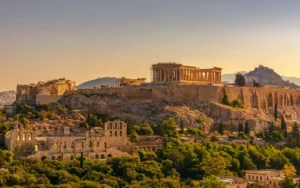
- Athens' Acropolis + Plaka taverna evenings, Greek island hopping (Mykonos, Santorini, Crete, Naxos), classical antiquity at Delphi + Olympia + Meteora.
Greece travel guide: regions, islands & when to go
Greece is Athens, mainland antiquity, and a constellation of islands. The essentials:
- Athens: the Acropolis and ancient sites — 2-3 days before the islands.
- The Cyclades: the iconic blue-and-white isles — Santorini and Mykonos (famous, pricey), Naxos, Paros and Milos (better value).
- The Ionian: greener, Italian-flavored islands like Corfu and Kefalonia.
- Crete: the largest island — beaches, mountains, Minoan ruins and great food.
- Mainland: Delphi, Meteora's clifftop monasteries, the Peloponnese.
When & how
May-June and September are ideal (warm, swimmable, fewer crowds than July-August). Island-hop by ferry from Piraeus; book ahead in peak summer. Budget mid-range around $120-200/day. See the cost index.
How should a first trip to Greece be structured?
A first trip to Greece works best as Athens plus one island group, not Athens plus every island group. Ten to fourteen days is enough for the capital and a single region done properly; trying to add a second region usually means a wasted day in a port or an airport.
Give Athens two or three days for the Acropolis, the museums and a neighbourhood or two, then pick one of the following blocks:
- Cyclades (Santorini, Naxos, Mykonos and their neighbours): five to seven days, moving by ferry between two or three islands rather than trying to see five.
- Crete: five to seven days on its own. It is a large island, and Chania to Heraklion is about 140 km and two to two and a half hours by road, so treat the west and the east as separate bases.
- Mainland circuit: Nafplio in the Peloponnese is around two hours from Athens by bus, and Meteora is reachable by coach in roughly four and a half to five and a half hours, either on the daily direct express service or on KTEL buses with a change at Trikala, because the rail link into Kalambaka has been closed since the 2023 floods and is not expected to reopen before late 2026 at the earliest.
To avoid backtracking, arrive in Athens, travel outward by ferry through your chosen islands, and fly back to Athens from the last island for your departure. Santorini and Heraklion both have flights to Athens of roughly 45 to 55 minutes, which turns what would be a full ferry day into a morning.
Getting around Greece: how long do the main journeys actually take?
Ferries and short domestic flights do most of the work in Greece, and the realistic journey times matter more than the map distances. From Athens airport, Metro Line 3 reaches Syntagma in the centre in about 40 minutes, and the main ferry port is Piraeus on the other side of the city.
Typical times from Piraeus and between islands:
- Piraeus to Santorini: around five to five and a half hours on a high-speed catamaran, or roughly six to eight hours or more on a conventional Blue Star ship, depending on how many islands it calls at. The slower ships carry cars, have open decks and cope better in rough water.
- Piraeus to Heraklion, Crete: the overnight ferries leave around 21:00 and arrive around 06:00 to 07:00, so the crossing doubles as a night of accommodation.
- Santorini to Naxos: about one hour ten minutes on a fast boat, or two to two and a half hours on a conventional ferry.
- Athens to Thessaloniki by Hellenic Train: about five hours, with only a few departures a day.
One thing to plan around: the Meltemi, a strong northerly wind that peaks in July and August across the Cyclades. When it blows hard, smaller and high-speed vessels are cancelled first, so an island-to-island connection on a departure day is a gamble. Booking the larger conventional ship, or leaving a buffer night before a flight home, is the sensible response.
When to go, season by season, and what Greece really costs per day
Greece splits cleanly into two pricing seasons, and the government's climate resilience fee is the clearest marker of where the line falls: April to October is high season, November to March is low season. The fee is charged per room per night, not per person, and in high season it runs from around EUR 2 for one- and two-star hotels up to about EUR 15 for five-star properties, with short-term rentals at about EUR 8. In low season the same charges drop sharply, to around EUR 0.50 for the cheapest hotel bands and about EUR 2 for rentals.
Season by season:
- July and August bring the most heat, the highest room prices and the Meltemi winds in the Aegean.
- April and October are quieter and cheaper, but sea temperatures are cooler and some island tavernas and ferry routes run reduced schedules at the edges of the season.
- November to March is city and mainland time: Athens, Thessaloniki and Meteora work well, while most small-island services thin out.
A realistic two-tier daily budget per person, excluding flights to Greece:
- Shoestring, around EUR 40-60: a hostel bed or a basic room in a shared booking, bakery and souvlaki meals, conventional ferries booked ahead and free-to-walk sites.
- Comfortable, around EUR 130-200: a mid-range hotel with a view, two sit-down meals, one paid site or boat trip a day, and the occasional high-speed ferry or domestic flight to save time.
Greece Travel Guide FAQ
What is the best Greek island to visit?
Santorini and Mykonos for icons; Naxos, Paros and Milos for value and authenticity.
When is the best time to visit Greece?
May-June and September — warm and swimmable without the peak-summer crowds.
Compare Greece with other destinations
Still deciding where to go? See how Greece stacks up head-to-head:
Torn between destinations? See our honest comparisons: Croatia vs Greece, Greece vs Thailand, Greece vs Spain, Greece vs Portugal, Croatia vs Greece, Greece vs Italy, Greece vs Turkey.
Sources: European Commission – Entry/Exit System (EES) · European Union – official ETIAS information. Entry rules change; confirm with the official source before booking. Last checked 25 August 2026.
Popular guides: Greece vs Spain
More guides: What to pack for Greece
Best time to visit Greece (real climate data)
Best months: April, May, June, September, October, November.
Greece’s warmest month is July (avg 34°C / 92°F), the coolest is January (low 5°C / 42°F). The wettest is December (110 mm) and the driest is July.
Source: Open-Meteo ERA5 climate normals (2019–2023). See the full month-by-month weather →
You Might Also Love



Before you go: see whether they speak English in Greece and what to wear, check the tap water, sort your mobile data, and find out if it is a cash or card destination, and brush up on local etiquette.
Still deciding? Read the honest take: Is Santorini worth visiting? — who it suits, who should skip it, and what it really costs.
