
Honest verdict · Updated 2026 · No sponsorships
Is Sri Lanka Worth Visiting? An Honest Verdict
“Yes – Sri Lanka packs beaches, safaris, tea country, and ancient ruins into one small island at backpacker prices; just pick your coast by season.”
The short answer: Sri Lanka is one of the best-value destinations anywhere right now: leopard safaris, the Kandy-to-Ella train, tea-country walks, and blue whales all sit within a few hours of each other, and the 2022 economic crisis that made headlines is over as a practical concern for visitors. The catch is logistics – roads average 30-40 km/h, foreigner entrance fees sting against everything else being cheap, and getting the monsoon wrong puts you on a rain-lashed beach while the opposite coast is sunny. Go with ten-plus days, pick your coast by month, and it over-delivers.
More: When to visit Sri Lanka · Sri Lanka travel guide
Who Sri Lanka is for — and who it is not
Worth it if you are
- Budget travelers who want variety, not just a beach: Nowhere else gives you leopards, blue whales, 2,000-year-old ruined cities, surf, and highland tea estates on a $30-50/day budget within a single two-week loop.
- Train and scenery romantics: The Kandy-Ella line through tea country is genuinely one of the world's great rail journeys and a ticket costs a few dollars – the rare famous thing that is underpriced rather than overpriced.
- Wildlife watchers without an African-safari budget: Yala Block 1 claims one of the world's highest leopard densities, the dry-season elephant Gathering (roughly July-September) shifts between Minneriya and neighboring Kaudulla with reservoir levels, and Mirissa runs blue whale trips November-April – all at a fraction of East African prices.
- Surfers: Weligama's beach break is beginner central and Hiriketiya suits improvers (roughly November-April), while Arugam Bay's point breaks work the opposite season (roughly May-September) – so a cheap, working surf coast exists almost year-round.
- Couples and slow travelers: Galle Fort's ramparts at dusk, planter's-bungalow stays around Haputale and Hatton, and seven-hour train rides reward people who linger – and since the roads punish anyone in a hurry anyway, slow is the correct speed here.
Think twice if you are
- Travelers with under a week who want to see it all: The island looks small but roads average 30-40 km/h outside the southern expressway; trying to do beach, hills, and cultural triangle in 6 days means spending most of it in transit.
- Luxury seekers expecting Maldives-level polish everywhere: There are superb boutique hotels around Galle and the tea country, but service, infrastructure, and consistency run a tier below Bali or Thailand at the same price point, and five-star options thin out fast outside the southwest.
- Nightlife and party travelers: Outside Mirissa in season and Arugam Bay in summer, evenings are quiet; heavy alcohol taxes mean a beer can cost as much as a rice and curry, and sales stop entirely on monthly Poya (full moon) holidays.
- People irritated by hustle: Tuk-tuk overcharging, gem-shop detours in Kandy, and commission games around tourist hubs are constant low-grade friction – harmless but tiring if you cannot shrug it off.
The reality check
What it costs
Genuinely cheap on the ground – backpackers manage $30-50/day and midrange couples live well on $80-150/day combined – but foreigner entrance fees are the exception: Sigiriya runs around $35, Polonnaruwa and Anuradhapura about $25-30 each, and a Yala safari with jeep hire and park fees typically lands at $50-100 per person. Two ways to soften it: climb Pidurangala next door for a couple of dollars to get the classic view of Sigiriya itself, and pick one ancient city rather than both.
Crowds
December to March the south and west coasts, Ella, and the hill-country train fill up hard – reserved seats go on sale 30 days out and high-season dates can sell out the day bookings open, and Sigiriya is a queue by sunrise. Yala jeeps cluster badly around leopard sightings year-round; Wilpattu sees a fraction of the traffic. The east coast is busy only around July-August, and Polonnaruwa and Anuradhapura rarely feel crowded at all.
Time needed
Ten days is the honest minimum for one coherent loop (airport – cultural triangle – Kandy – train – Ella – safari – south coast); two to three weeks is the ideal. Note the airport is near Negombo, about 35 km north of Colombo, and most itineraries rightly skip Colombo altogether. With only a week, cut the cultural triangle or the beach and do half the island properly instead of all of it badly.
When to go
Two monsoon systems hit opposite coasts, so there is no single best time: December-March is dry for the south, west, and hill country (the classic loop), while May-September is the window for Trincomalee and Arugam Bay in the east. The cultural triangle sits in the dry zone and works most of the year. April brings inter-monsoon rain plus the Avurudu New Year in mid-April, when locals travel and prices jump; October-November is the rainiest, least predictable stretch island-wide.
What actually justifies the trip
The Kandy to Ella train
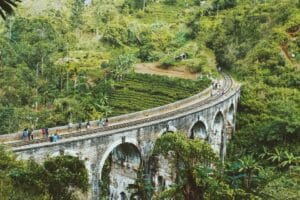
About seven hours through tea terraces, tunnels, and cloud forest for pocket change; the Nanu Oya to Ella stretch is the best of it. Ride second or third class – the first-class air-con carriage has sealed windows, which defeats the whole point of hanging out the open doors.
Safari – but choose your park
Yala has the leopards and the jeep scrum; Udawalawe delivers near-guaranteed elephants with far fewer vehicles; the dry-season elephant Gathering moves between Minneriya and Kaudulla with reservoir levels, so ask which park the herds are in that week. Wilpattu in the northwest is the quiet connoisseur's choice.
Tea country beyond the Ella selfie spots
Ella has the Nine Arch Bridge and Little Adam's Peak, but Haputale feels like the real thing – reach Lipton's Seat early, because cloud usually swallows the view by mid-morning – and faded colonial Nuwara Eliya, with its racecourse and mock-Tudor post office, is agreeably odd.
Sigiriya and the cultural triangle
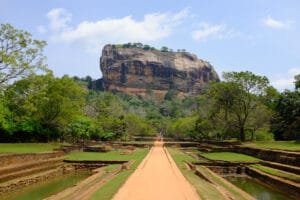
A 5th-century royal complex on top of a nearly 200-meter rock column, with Polonnaruwa's ruined medieval capital, vast Anuradhapura, and the painted Dambulla cave temples all within an hour or two – a density of ancient sites most countries would build an entire tourism industry on.
The south coast and its food
Blue whales out of Mirissa (November-April), the horseshoe bay at Hiriketiya, Dutch-era Galle Fort – and everywhere the food: proper rice and curry with eight or ten dishes, kottu roti hammered on a griddle at night, egg hoppers with sambol for breakfast.
The honest downsides
- Getting around is slow and tiring: Ella to the south-coast beaches is four to five hours for roughly 140 km, buses are driven aggressively, and outside the Colombo-Galle expressway there is no fast option – the trains are lovely but slower still.
- Dual pricing stings at the headline sites: a couple hitting Sigiriya, one ancient city, and a Yala safari can spend more on tickets in three days than on a week of guesthouses, and it grates precisely because everything else is so cheap.
- Tourist-hub hustle is constant: inflated tuk-tuk fares, 'the temple is closed' redirections, gem-shop commissions in Kandy. None of it is threatening; all of it is wearing.
- The two most famous experiences are victims of their fame: Yala leopard sightings draw dozens of jeeps in high season, and the train's reserved seats can sell out the day the 30-day booking window opens, leaving latecomers standing for hours.
Is Sri Lanka worth it? FAQ
Is Sri Lanka safe to visit after the 2022 crisis?
Yes. The fuel queues, blackouts, and protests of 2022 ended long ago, tourism has grown strongly since 2023, and politics stayed stable through the 2024 change of government. The realistic risks are ordinary ones: rip currents at unguarded beaches, aggressive bus driving, dengue (use repellent year-round), and petty theft. Solo women mostly report trouble-free trips, but persistent low-level hassle – staring, comments – is common in some beach towns; guesthouse owners are good allies for local advice.
Should I hire a car and driver, or use trains and buses?
A car with driver typically runs $50-80 a day including fuel and the driver's lodging, and for two or more people over ten days it is money well spent on an island this slow. Mixing works well: take the hill-country train for the scenery, the expressway bus for Colombo-Galle, and use PickMe (Sri Lanka's ride-hailing app) in cities to skip tuk-tuk haggling. Self-driving a rented tuk-tuk is popular but requires a Sri Lankan recognition permit arranged in advance.
How many days do I actually need?
Ten days minimum for a satisfying loop; two weeks is the sweet spot; three weeks lets you add the east coast or the Jaffna peninsula in the north. The classic mistake is treating it like a small island – distances look short on the map but roads average 30-40 km/h, so plan one direction of travel rather than crisscrossing.
Is the famous train ride worth the hype?
Yes, with caveats. The scenery between Nanu Oya and Ella is genuinely spectacular and the ticket costs almost nothing, but reserved seats go on sale 30 days ahead and high-season dates can vanish within hours. Unreserved second class works fine if you board at an origin station like Kandy or Nanu Oya and arrive early; riding just the Nanu Oya-Ella leg (around three to four hours) gets you the best views with far less endurance required.
Decided? Plan it properly
Start with the full Sri Lanka travel guide, follow the Sri Lanka itinerary, pick your month with the best time to visit, budget it with real cost data, browse things to do, eat well with the food guide, check safety. Before any trip: etiquette, ATM fees and what to wear.
You Might Also Love
Weighing other trips? Is Barcelona worth visiting? · Is India worth visiting? · Is Bangkok worth visiting? · Is Rome worth visiting?
