Skip to content
Samarkand travel guide

Things to Do in Samarkand: 12 Experiences You Can’t Miss

7 min read1,349 wordsUpdated May 2026
Samarkand travel guide

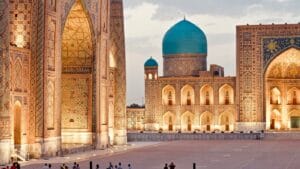
Samarkand is the kind of city that makes you believe in time travel. For 2,500 years this Silk Road crossroads has dazzled visitors — Alexander the Great reportedly said it was more beautiful than he had imagined — and the turquoise-tiled mosques, madrasas, and mausoleums built by Timur (Tamerlane) in the 14th century remain among the most spectacular architecture on earth. The Registan Square alone, with three colossal madrasas facing each other across a vast plaza, would justify a trip to Central Asia. Beyond the monuments, Samarkand is a living city where the bazaar hums with spice sellers, bread bakers stamp enormous naan in tandoor ovens, and plov rice is served from communal cauldrons. It is exotic, affordable, and almost entirely undiscovered by Western tourism.

1. Stand in Awe at the Registan Square

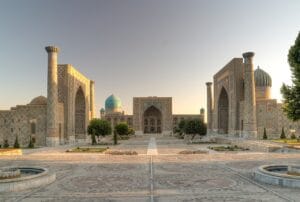
Three monumental madrasas — Ulugh Beg (1420), Sher-Dor (1636), and Tilya-Kori (1660) — face each other across a plaza that is arguably the most stunning public space in the Islamic world. The tilework is staggering in its detail and colour — cobalt blue, turquoise, gold, and white in geometric and floral patterns that shimmer in the sunlight. Entry is 40,000 UZS. Visit at sunrise before tour groups arrive and return for the evening light show (20,000 UZS extra). A guide is recommended for 100,000-200,000 UZS to explain the Timurid history.

2. Walk the Shah-i-Zinda Necropolis

This avenue of tombs and mausoleums climbing a hillside is the most intensely decorated site in Central Asia — each building covered in dazzling majolica tilework in blues, greens, and turquoise that looks freshly glazed despite being 600 years old. The 44 steps up the entrance are believed to be holy — legend says those who count the same number ascending and descending will enter paradise. Entry is 30,000 UZS. Morning light illuminates the eastern facades best. Allow 90 minutes to absorb the detail.

3. Visit the Bibi-Khanym Mosque

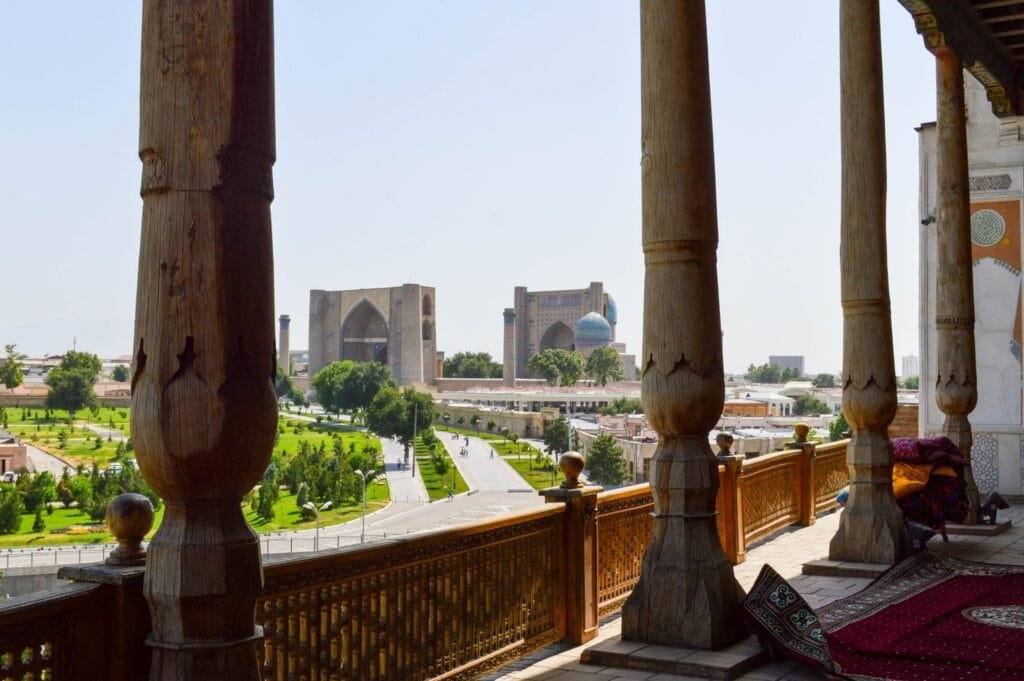
Timur built this mosque in 1404 as the largest in the Islamic world — so ambitious that it began crumbling during construction. The partially restored facade and the massive courtyard with a Quran stand carved from a single block of marble hint at its original scale. Entry is 30,000 UZS. The bazaar directly behind the mosque — Siab Bazaar — is the best place in the city to buy dried fruit, spices, and Samarkand’s famous bread. The two landmarks complement each other perfectly.

4. Eat Plov at the Central Plov Centre

Samarkand’s plov (pilaf) is the country’s most celebrated version — long-grain rice cooked in an enormous kazan (cauldron) with lamb, carrots, chickpeas, onions, and cumin. The Central Plov Centre near Siab Bazaar prepares vats of plov for hundreds of people every morning — it is served from 6 AM and typically runs out by noon. A large plate costs 20,000-30,000 UZS. The theatre of watching the oshpaz (plov master) stir the massive kazans over wood fires is half the experience.

5. Explore the Ulugh Beg Observatory

Timur’s grandson Ulugh Beg was one of the great astronomers of the medieval world, and his 15th-century observatory — with a three-storey underground sextant carved into rock — calculated the length of the stellar year to within 58 seconds of modern measurements. The remaining sextant arc and the museum above it explain the achievements. Entry is 25,000 UZS. The hilltop site also offers views over the city. It is a short taxi ride from the centre — combine with the Afrosiyab Museum nearby.

6. Visit a Silk Paper Workshop

Samarkand was one of the first cities outside China to produce paper (in the 8th century), and the Meros Paper workshop has revived the traditional technique of making silk paper from mulberry bark, using a water wheel, stone mill, and hand-pressing methods unchanged for centuries. The workshop tour includes demonstrations and hands-on participation. About 30,000-50,000 UZS for a full tour. Sheets of handmade silk paper make elegant souvenirs from 10,000 UZS. The workshop is in the Konigil village outskirts.

7. Browse the Siab Bazaar

Samarkand’s main bazaar behind the Bibi-Khanym Mosque is a sensory overload of spice mountains, dried fruit pyramids, fresh bread stacked in towers, and suzani embroidery. The bread section is remarkable — Samarkand’s non (flatbread) is stamped with elaborate patterns and baked in tandoor ovens before your eyes. Buy a pomegranate juice for 5,000 UZS and wander. The dried fruit and nuts — apricots, walnuts, almonds, raisins — are superb and absurdly cheap. Go in the morning when it is busiest.

8. Tour the Gur-e-Amir Mausoleum

Timur’s final resting place is a ribbed blue dome atop an octagonal building with some of the finest onyx and gold-leaf tilework in the city. The jade tombstone marking his grave is the world’s largest piece of jade. The interior was restored by Soviet archaeologists who notoriously opened Timur’s tomb in 1941 — legend has it that the curse inscribed on it brought about Operation Barbarossa two days later. Entry is 30,000 UZS. The dome lit up at night is one of Samarkand’s most evocative sights.

9. Drink Tea in a Traditional Chaikhana

The chaikhana (teahouse) is the social heart of Uzbek life — men gather on raised wooden platforms (tapchans) covered with carpets, drinking green tea from painted piala bowls and eating fresh non bread. Chaikhana-style restaurants near the Registan serve tea for 5,000 UZS with sugar cubes and dried fruit. The Platan Chaikhana and Samarkand Bukhara are atmospheric spots. The ritual of pouring tea back and forth three times before serving (loycha) is a tradition of hospitality.

10. Day Trip to the Ruins of Afrosiyab

The ancient city that preceded Samarkand covers a vast archaeological mound on the city’s northeastern edge, with excavated remains spanning 2,500 years. The Afrosiyab Museum houses the extraordinary 7th-century wall frescoes discovered in a palace room — vibrant paintings of ambassadors, hunting scenes, and mythical animals that are Central Asia’s most important ancient artworks. Museum entry is 25,000 UZS. The mound itself is free to walk. Combine with the Ulugh Beg Observatory, which is adjacent.

11. Watch a Carpet Being Woven

Samarkand has been a centre of silk carpet production for centuries, and workshops like Hudjum and the Samarkand Carpet Workshop allow visitors to watch weavers working on traditional designs using silk threads dyed with natural pigments. A single carpet can take months to complete. The workshops explain the symbolism of the patterns and the dyeing techniques. Carpets start from 200 USD for small pieces. Even if not buying, watching the speed and precision of the weavers is mesmerising.

12. Visit a Local Hammam

Samarkand’s traditional hammams (bathhouses) have been gathering places for centuries. The restored hammams near the old town offer steam rooms, scrubs, and massage in tiled chambers with domed ceilings. A full hammam experience with scrub costs 50,000-100,000 UZS. The atmosphere — steam, hot stone, cold water plunge — is rejuvenating after days of walking dusty streets and climbing minarets. Go in the late afternoon when the heat feels best. Most hammams have separate hours or sections for men and women.

Practical Tips for Samarkand

Check our full Samarkand travel guide for detailed tips on transport, safety, money, and the best time to visit. For food recommendations beyond this list, see our Samarkand food guide.

Frequently Asked Questions

What are the top things to do in Samarkand?

The must-do experiences include Stand in Awe at the Registan Square, Walk the Shah-i-Zinda Necropolis, and Explore the Ulugh Beg Observatory. Samarkand also offers incredible food, vibrant culture, and unforgettable landscapes.

How many days do you need in Samarkand?

We recommend at least 3 to 5 days to cover the highlights, though a week lets you explore at a relaxed pace and add day trips.

Is Samarkand safe for tourists?

Samarkand is generally safe for tourists who take normal precautions. Stay aware of your surroundings in crowded areas and keep valuables secure.

Honest travel guides, monthly. First-hand. No spam.
Browse every page | Travel library | Compare destinations | XML sitemap