
January is the month Greece stops being a holiday and becomes a country. The islands are shut, the ferries are skeletal and the sea is 15°C – but Athens sits around 13°C in the sun, the Acropolis has no queue, the state museums are free on the first Sunday, and you can eat in the best tavernas in the city on the same evening you decide to.
What is actually open
This is the whole question for a Greek January, and the honest answer is: the mainland, and very little else.
- Athens runs completely normally. Museums, restaurants, markets, nightlife, the lot – with a fraction of the visitors.
- Thessaloniki, Nafplio, Ioannina, Meteora and Delphi all work, and the mainland is green rather than the burnt gold of August.
- The big islands keep functioning – Crete, Rhodes and Corfu have year-round populations, working towns and daily flights.
- The small Cyclades largely do not. On Santorini and Mykonos a large share of hotels, restaurants and shops close from roughly November to Easter. Some stay open; most do not.
The ferry timetable is the constraint that decides everything else. Winter schedules are dramatically reduced – some routes drop to two or three sailings a week – and they are cancelled outright in bad weather. Island-hopping is not a January activity.
Free entry on the first Sunday
From 1 November to 31 March, entry to state-run archaeological sites, monuments and museums is free on the first Sunday of each month. In 2027 the January date is Sunday 3 January.
Two things to know. It applies to Ministry of Culture sites – the Acropolis, the Ancient Agora, Delphi, Knossos, Mycenae – but not to the Acropolis Museum, the Benaki or other private and municipal museums, which set their own rules. And you still collect a free ticket at the entrance rather than walking straight in.
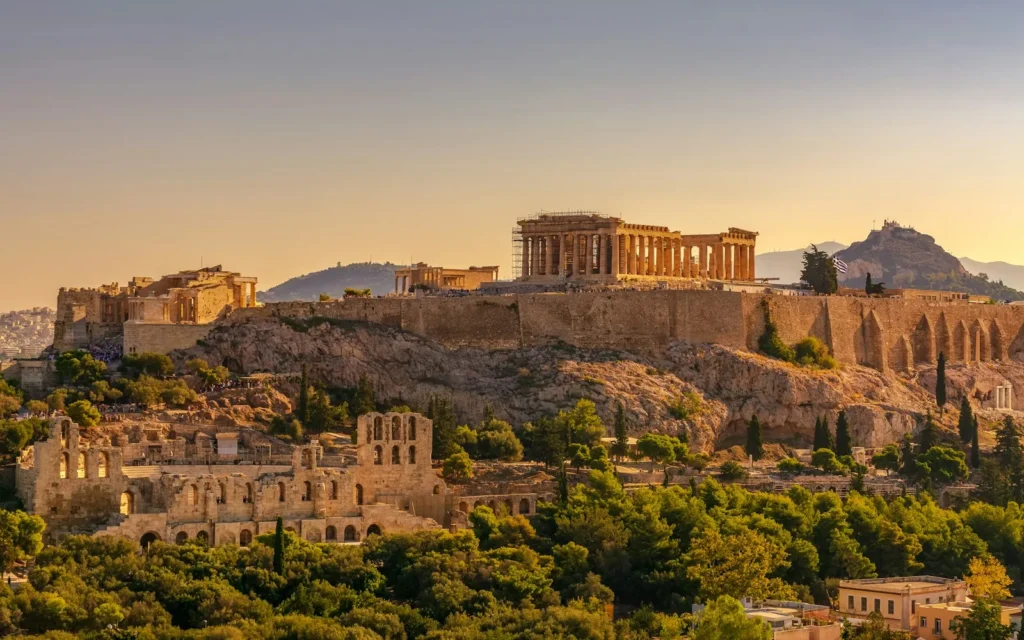
Winter opening hours at the ancient sites
Continue planning your Greece trip
Greek archaeological sites run a summer and a winter timetable, and January is firmly winter: shorter days, earlier last admission, and in some cases reduced site access. The Acropolis in particular closes several hours earlier than it does in July.
Check the current hours for each site rather than assuming, and plan the big ones for late morning – in January the light is at its best and the site is emptiest between about 09:00 and 11:00.
Weather: milder than most of Europe, wetter than you think
- Athens – highs near 13°C, lows near 7°C, with roughly 50 mm of rain across nine days. Cold mornings, warm afternoons in the sun, and the clearest views of the year across the city.
- Thessaloniki and the north – genuinely cold, occasionally below freezing, with snow inland.
- Crete and the south – the mildest part of the country, high teens on a good day, and the earliest wildflowers.
- The mountains – Parnassos, Kalavryta and Vasilitsa are in ski season. Greece has real skiing and almost no foreign visitors doing it.
The sea sits at about 15–16°C. Nobody is swimming.
Epiphany, 6 January: the blessing of the waters
Theophania on Wednesday 6 January 2027 is a public holiday and produces the best free spectacle of the Greek winter. A priest throws a cross into the water – the sea at Piraeus and in every coastal town, a river or a reservoir inland – and young men dive in to retrieve it. It is genuinely cold, genuinely competitive, and completely unstaged.
Piraeus, Thessaloniki’s waterfront and any island harbour will have one, usually mid-morning after the church service. It is free, it takes twenty minutes, and it is worth building the day around.
Prices
January is the cheapest month of the Greek year. Athens hotel rates are at their floor, flights are low, and the restaurants that need booking in September do not in January. The exceptions are the New Year period up to about the 7th, and the ski resorts at weekends.
For what a day actually costs, see how much a trip to Greece costs.
What to wear
Layers and a waterproof. Athens in January can give you 17°C and sun or 10°C and rain in the same week, and Greek buildings are often less well heated than northern European ones. Shoes with grip matter on the marble of the Acropolis, which is lethally slippery when wet. Churches and monasteries – Meteora especially – enforce covered shoulders and knees, and Meteora requires a long skirt for women, lent at the door.
The January 2027 calendar
- Friday 1 January – Protochronia, New Year’s Day and a public holiday; the day for vasilopita, the cake with a coin baked into it.
- Sunday 3 January – free entry at state archaeological sites and museums (first Sunday, November to March).
- Wednesday 6 January – Theophania, a public holiday; the blessing of the waters in every coastal town.
- From about 8 January – the quietest and cheapest stretch of the Greek year.
- All month – winter opening hours at archaeological sites; reduced island ferries; ski season on Parnassos.
Read alongside
- Greece in February – carnival season, and the last of the low season.
- Greece in March – Clean Monday, Independence Day and the first warmth.
- Best time to visit Greece – all twelve months compared.
- How much a trip to Greece costs – low-season daily numbers.
- Athens travel guide – the city that carries a Greek winter.
- Greece travel guide – regions, islands and how to combine them.
- What to pack for Greece – the winter list.
Frequently asked
Is January a good time to visit Greece?
For Athens and the mainland, yes – it is the cheapest month, the ancient sites have no queues and the city runs normally. For the islands, no: most of the small Cyclades are closed, ferries are skeletal and the sea is 15°C.
Are the Greek islands open in January?
The big ones with year-round populations – Crete, Rhodes, Corfu – are. On Santorini and Mykonos most hotels and restaurants close from about November until Easter, and winter ferry schedules drop to a few sailings a week and are cancelled in bad weather.
How cold is Greece in January?
Athens averages about 13°C by day and 7°C at night, with roughly 50 mm of rain across nine days. Thessaloniki and the north are colder with snow inland; Crete is the mildest part of the country.
Are museums free in Greece in January?
On the first Sunday – 3 January in 2027 – entry to state archaeological sites and museums is free, under the scheme that runs 1 November to 31 March. It does not cover the Acropolis Museum or other private and municipal museums, and you still collect a free ticket at the gate.
What happens on 6 January in Greece?
Theophania, the Epiphany: a public holiday on which a priest throws a cross into the water and swimmers dive to retrieve it, in every coastal town and at Piraeus. It happens mid-morning, it is free, and it is the best spectacle of the Greek winter.
Can you swim in Greece in January?
The sea is around 15–16°C, so only if you actively want to. January is a sites-and-cities month.
Is there skiing in Greece?
Yes – Parnassos above Delphi, Kalavryta in the Peloponnese and Vasilitsa in the north all run through the winter, and they are almost entirely domestic.
Is January the cheapest month in Greece?
Yes, after the first week. Athens hotel rates and flights are at their annual floor from about 8 January until the end of February.
You Might Also Love



Written by
John Morrison is the founder and lead travel writer at Packzup. Over the past decade he has explored destinations across Africa, the Americas, Asia, Europe, the Middle East, and Oceania — always self-funded, never on a press trip.
